


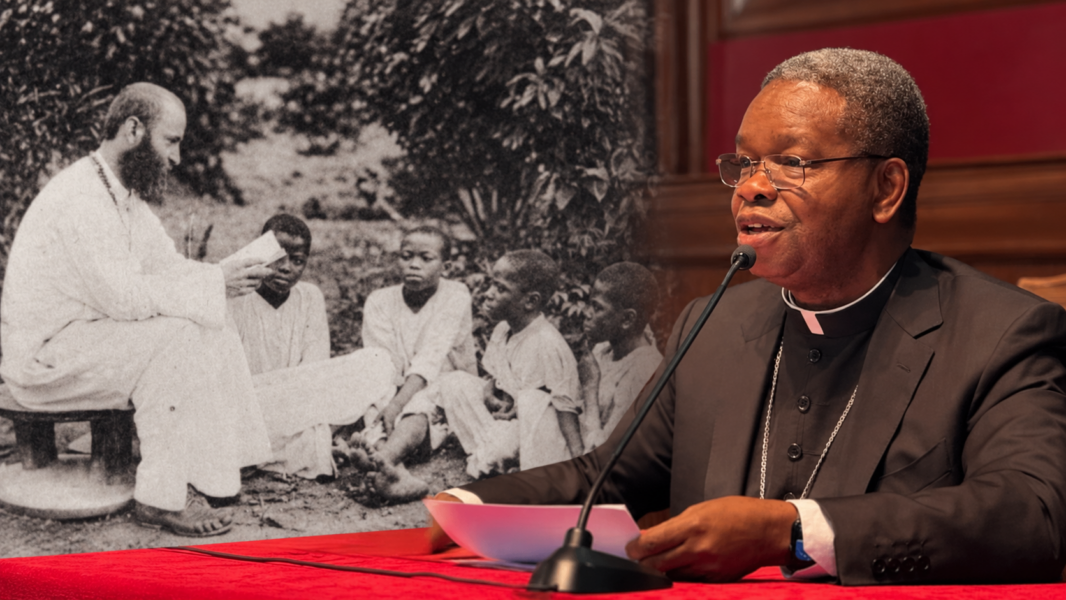
In Rome, Archbishop Fortunatus Nwachukwu, secretary of the Section for First Evangelization and New Particular Churches of the Dicastery for Evangelization, lamented that Catholics from former mission lands are labeled as “conservative” for remaining faithful to the teachings received from Western missionaries, while from the West itself they are urged to adopt “new and untested values.”
The Nigerian prelate issued this warning before bishops ordained during the past year who are participating in Rome in the formation courses organized by the Dicasteries for Evangelization and for Bishops. During the day, held at the Pontifical Urbaniana University, Nwachukwu presented the project called “Church of the Sheaves,” with which the Dicastery for Evangelization seeks to describe the new stage of Churches that received the Gospel from missionaries and are now called to contribute to the evangelization of the universal Church.
From mission lands to evangelizers
Nwachukwu explained that the clergy and religious of these territories have progressively assumed “from the hands of Western missionaries the responsibility of evangelization” and that they are now beginning to contribute their own fruits to the universal Church as well.
To explain this transformation, he turned to the final verse of Psalm 126: those who go out weeping, carrying the seed, return with joy, bearing their sheaves.
In the men who went out to sow, the archbishop identified the missionaries who left their countries, families, and surroundings to bring the Gospel to unknown lands. Many, he recalled, departed knowing they would probably never return, and some died only months after arriving at their destination.
“They sacrificed everything, including their lives,” Nwachukwu noted. Those missionaries, he added, carried with them “the seeds of the Gospel,” and their sacrifice produced fruits that are now ripe.
The image of the sheaves thus serves to represent the Churches born of that evangelization. “We are now in the time of the harvest,” the archbishop explained, noting that it falls to the Dicastery to continue watering what the missionaries planted and to help bring those fruits to the universal Church.
“Many in the West want them to abandon the teachings they received”
Nwachukwu, who described himself as “part of the sheaves,” then offered words of gratitude to the Churches that sent those missionaries, whom he called “heroes of our faith.”
The archbishop recalled that they sacrificed the best years of their youth and even their lives to transmit values that, he noted, were also foundational to present-day Europe.
From that recognition, he raised a critique of certain tensions currently arising between the Churches of former mission territories and Western sectors.
“Unfortunately, at times, when some people from our local Churches insist today on remaining faithful to those teachings of the missionaries, they are labeled as conservative,” he stated.
Nwachukwu added that “many in the West want them to abandon the teachings received from Western missionaries in order to embrace new and untested values,” promoted, he maintained, by people who cannot be compared with those missionaries “in conviction and fraternal solidarity.”
“We cannot abandon our heritage or neglect the past, because the future has its roots there,” he concluded on this matter.
The secretary of the Dicastery therefore urged the Western Churches to honor the memory of those who brought the Gospel to these lands by also welcoming the fruits born of their sacrifices.
The “Church of the Sheaves”
The project presented by Nwachukwu is being developed by the Dicastery for Evangelization together with the Centre for World Catholicism at DePaul University in the United States, the Pontifical Urbaniana University, and an international network of university professors, mainly theologians.
He explained that if the former mission lands now constitute the “Church of the Sheaves,” the Western communities that sent the missionaries have also been proposed to be called the “Church of the Seeds.”
The goal is to prepare those fruits “for their welcome into the family of the universal Church and into the local Churches of the West.” Nwachukwu also announced that the first world conference dedicated to the project will be held next month at the Urbaniana University.
You Heung Sik: synodality can remain “blah, blah, blah”
During the same day, Cardinal Lazzaro You Heung Sik, prefect of the Dicastery for the Clergy, spoke on priestly formation in the current context.
Recalling his early years as coadjutor bishop of Daejeon in South Korea, he explained that in the face of unknown, painful, or delicate situations, he established three priorities: “to be, not to do”; to prioritize relationships with collaborators, priests, and other bishops over activities; and to keep his gaze fixed on “the one Master: the Crucified and Risen One.”
The cardinal warned that without this rootedness in the Gospel, “everything else, even the wonderful program of a synodal and missionary Church, runs the risk of remaining ‘blah, blah, blah’”: words, programs, and activities incapable of changing the hearts and lives of communities.
You Heung Sik also addressed the application of synodality to priestly formation. He recalled that the Final Document of the Synod called for forming candidates “in a synodal style,” including a significant presence of women, greater insertion into the daily life of communities, collaboration with the various members of the Church, ecclesial discernment, and the missio ad gentes.
In this context, he noted that Study Group 4, created during the pontificate of Francis to review the Ratio fundamentalis institutionis sacerdotalis from a synodal and missionary perspective, chose not to rewrite the document but to prepare a preliminary text on “the relational identity of ordained ministers in a synodal missionary Church,” accompanied by examples of already existing practices, including the participation of women on formation teams.
The prefect linked this process to the recent apostolic letter of Leo XIV A Fidelity that Generates the Future, in which the Pope has insisted on fraternity among ordained ministers and on overcoming a model of priestly leadership that concentrates all pastoral life and all community responsibilities on the presbyter.