


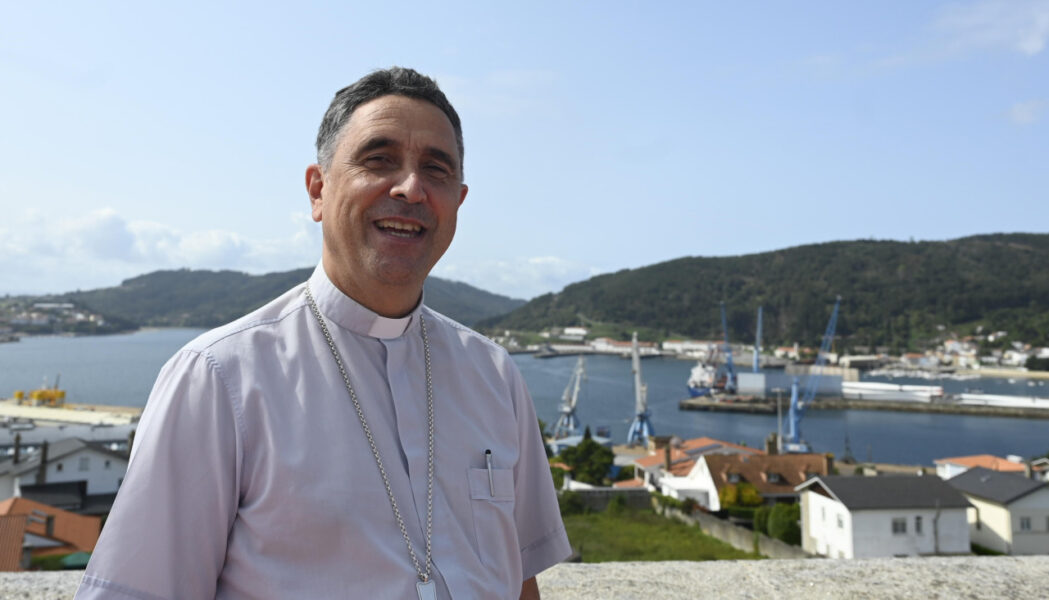
The bishop of Mondoñedo-Ferrol and president of the Episcopal Subcommittee for Migration and Human Mobility of the Spanish Episcopal Conference (CEE), Fernando García Cadiñanos, has stated that “migrants are not a threat” when addressing the situation in Ceuta one month after the incursion of last July 30. The prelate maintains that reception must be combined with the right of States to “manage their borders and control flows for real integration.”
In an interview given to Vida Nueva, García Cadiñanos defends the Church’s response to what happened and also acknowledges the situation faced by the residents of the autonomous city, whose society he describes as “very tense.” In response to the opposition between the needs of the people of Ceuta and those of the immigrants, he affirms that “the debate has been framed as: either you are with the migrants, or you are with the people of Ceuta, and that is not true.”
“Migrants are not a threat”
When asked specifically whether immigrants represent a threat to Spain, García Cadiñanos rejects the idea and points to those places in the country where “integration is a fact” and immigrants contribute to the “economic, social, human, and religious development” of communities.
The head of Migration for the CEE believes, however, that during the incursion in Ceuta those who crossed the border were instrumentalized. “Migrants have been used and continue to be used by dark interests. This is very sad and regrettable,” he states.
He also remembers those who lost their lives trying to reach Spanish territory. “We will not be truly human if we do not feel the pain and consider as our brothers and sisters that undetermined number of people who have died crossing the border, following siren songs that someone has launched and who is ultimately responsible for their deaths.”
García Cadiñanos believes that around immigration a “war between the poor” is being fostered that ultimately diverts attention from what he calls “the real causes of the problem.”
The right of States to control their borders
The bishop acknowledges that the right to emigrate does not exclude the authority of States to control their borders. In explaining the Church’s position, he lists three principles he considers necessary to address the migration phenomenon: “the right not to migrate, the right to migrate, and the right of States to manage their borders and control flows for real integration.”
“Thus, the particular good and the common good are combined,” García Cadiñanos notes, for whom immigration is a complex reality that requires the intervention of different actors and cannot be addressed from a single perspective.
The prelate also calls for “legal and safe pathways to facilitate migration” and introduces at this point a criticism of the “capitalist economic system,” which he attributes with generating “exclusion and social fracture.”
The people of Ceuta and the debate on the order of charity
García Cadiñanos also dedicates part of his statements to the population of Ceuta. Although he presents the city as an “integrated and integrating” society, he acknowledges that after the incursion it is “very tense” and asks that its inhabitants not have to face alone a situation that overwhelms them.
“We must help them so they do not feel alone and believe it is a problem they have to solve in isolation,” he states. The bishop also calls for “discarding all violence and all hostility” and seeking paths of “dialogue and legality,” with the intervention of the State and the international community.
His words come just days after priest Jesús Francisco Molina, parochial vicar of the Sanctuary of Santa María de África in Ceuta, raised the issue from the order of charity in light of the insufficiency of available resources in the city.
Molina then recalled that the Church was already attending to people in need before the incursion and maintained that the arrival of thousands of immigrants could not mean neglecting those who already depended on that assistance. “It is charity that demands that hierarchy. One attends first to one’s neighbor, who is the nearest, the one beside, the person from Ceuta, before the one who is not,” he stated.
García Cadiñanos does not refer to Molina or respond directly to his statements. He does reject framing attention to immigrants and the defense of the people of Ceuta as opposing alternatives: “The claim of their fundamental rights cannot be an alternative to fraternity.”
“The debate has been framed as: either you are with the migrants, or you are with the people of Ceuta, and that is not true. Together we must get out of this dilemma that can cause many negative consequences,” he adds.
Also the vicar of Ceuta, Francisco Fernández Alcedo, referred this week to the tension the city is experiencing and called for preventing the situation from leading to confrontations between the different religious communities. “The Church is the guarantor of that coexistence and is the guarantor that this will not escalate into another confrontation,” he stated.
The Church’s response after the incursion
When taking stock of the ecclesial action over the past month, García Cadiñanos affirms that the parishes and Cáritas have remained close to both the inhabitants of Ceuta and the immigrants, “accompanying, helping, praying, giving hope and horizon.”
According to him, the Church’s reception centers are “overwhelmed” and a campaign to collect donations has been carried out to meet the needs arising after the mass entry from Morocco.
For the president of the Episcopal Subcommittee for Migration, the Church’s response consists of “being close to the victims, repudiating all violence, defending the dignity of every person” and applying the principles of social doctrine in a situation that, he acknowledges, “has many facets” and goes beyond “the purely humanitarian.”