


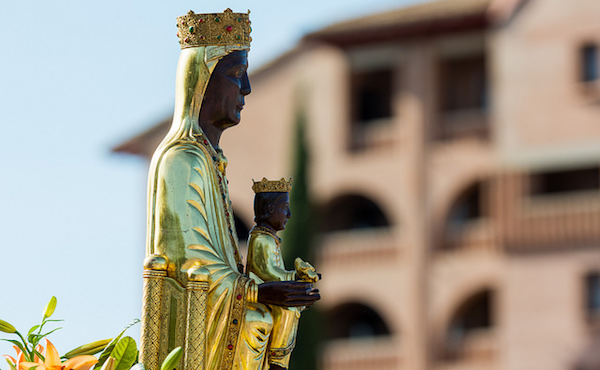
There is a Romanesque carving in Upper Aragon over which a bishop is willing to resign, invoking Eleazar and the martyrs of 2 Maccabees, and a prelature ready to publish 1962 deeds with registry inscription from Benabarre. The object of the dispute measures a little over half a meter. The distance being contested, from the hermitage to the altarpiece of the new church, fits within the same enclosed precinct, because that is what the 1966 agreement stipulated, which both parties cite. What is being litigated, in the language of plunder and mafia intrigues, is whether Our Lady of the Angels of Torreciudad should be in one building or the one next door.
One reads the statement of Bishop Pérez Pueyo and understands the emotion: the Mother is coming home, the people touched her, kissed her, dressed her, hid her from the reds at the risk of their lives. One reads the clarifications of the Prelature and understands the exasperation: ownership was never disputed, the beneficial ownership was ceded in perpetuity, the image has presided since 1975 over a public and free altarpiece through which ten million pilgrims have passed. What one does not understand is at what moment the Church stopped knowing what an image is.
Because the difference between a carving and the Eucharist is exactly the opposite of what both statements presuppose. The Host appears to be bread and is not. The carving appears to be the Virgin and is not. Nicaea II settled this twelve centuries ago with a formula that any seminarian knows how to recite and that no one here seems to remember: the honor paid to the image passes to the prototype. The wood is indifferent. It is the Mother of God who is venerated, not the walnut (or the poplar, or whatever remains under the restorations of 1964 and 1970, which the bishop of that time also authorized). When a diocese says it cannot «deprive this people of their Mother» because of a move of dozens of meters, and when a prelature defends a notarial clause that requires that «the image» receive worship in its church, both are doing the same theology, which is that of the talisman. The Real Presence, that one does require the object: if the ciborium is taken, Christ is taken. If the carving is taken, a carving is taken.
Popular devotion knows this better than its pastors. The Virgin of the Head that ascends every April to the hill of Andújar is from 1944; the original was burned in ’37. No one has suspended the pilgrimage for lack of authenticity. Half of Spain prays before replicas of images that the red terror reduced to ashes, and faith has not noticed the difference, because faith never went by carbon-14. Lourdes has no relic. Fatima has a commissioned image from 1920. Devotion is passed on like the fire from one candle to another, and the old candle is not thereby slighted.
So, if one were Opus Dei (God forbid, they will say in Barbastro), one would do the obvious: commission an exact replica, place it on the altarpiece of Torreciudad and return the original to the hermitage with a notarial deed stating that the bishop may do with it what he wishes. Cost: a clause from 1966. Benefit: public proof of what this matter is about. If the bishop accepts, the Virgin is in her millennial home, the pilgrims walk down to kiss her and no one has resigned. If the bishop rejects it, one will have to ask him why he cares what wood is on each altar, and the answer will no longer be devotional.
And conversely. If the diocese believed what it preaches about the sign and the signified, it could itself commission the replica for the hermitage and stop talking about plunder. It will not, because the word «original» does in its statement the work that in others the word «heritage» does: turning piety into a title of ownership. Pérez Pueyo has renounced in writing the management of the church, the accounts, the companies, any compensation. He has asked the Pope that Torreciudad be an international sanctuary dependent on Rome, which is amusing if one recalls that Opus proposed just the opposite, a diocesan sanctuary, that is, under him. Each party wants to hand over the sanctuary to whom the other cannot stand. And in the middle, the only good that neither cedes is an object which, according to the doctrine both teach, is nothing more than a sign.
On Saturday the carving will go to the hermitage for a day, for the pilgrimage of the Virgins of Ribagorza and Sobrarbe, and will return. The bishop has said he will never sign a formula in which the Virgin lives in someone else’s house and visits her children. That formula is the one that premieres on September 5 with his blessing. We will have to see who has authorized it, and whether Commissioner Arellano, who arrived as plenipotentiary at the diocese’s request, is already the mediator the diocese regrets.
In the meantime, the catechesis. A people taught that their Mother is in one specific piece of wood and not in another identical one is a people that has been taught to confuse the sacrament with the memory. And a prelature that fortifies with deeds the exact place of that wood confuses worship with the clause. Both are right legally and both are wrong in the same thing. The carving is worth what the faith of its people is worth. What is not worth is what they are making it pay for it.