


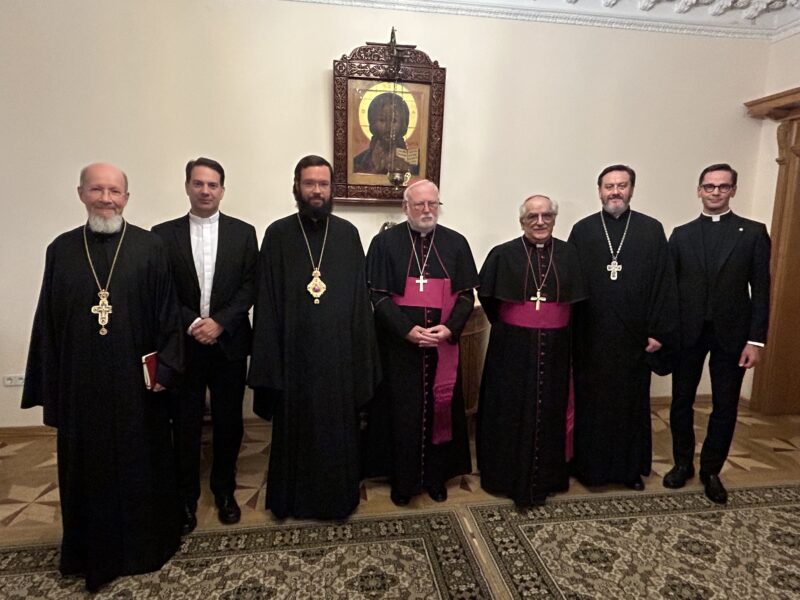
The Russian Orthodox Church has directly raised with the Vatican the situation of the Ukrainian Orthodox Church and what it describes as its “persecution” by the authorities in Kyiv. The matter was addressed on Tuesday afternoon in Moscow during the meeting between Metropolitan Anthony of Volokolamsk, head of external relations for the Moscow Patriarchate, and Archbishop Paul Richard Gallagher, Secretary for Relations with States and International Organizations of the Holy See.
The official communiqué from the Department of External Church Relations of the Moscow Patriarchate states that “the high-ranking Vatican representative received information about the persecution of the Ukrainian Orthodox Church by the Ukrainian state authorities.” The Vatican Secretariat of State confirmed the meeting, although it limited itself to noting that both delegations had discussed “topics of common interest,” without specifically mentioning this issue.
Read also: The Vatican sets Gallagher’s agenda in Moscow: Lavrov, the Patriarchate and a Putin adviser
The Patriarchate brings the Ukrainian religious conflict to the Vatican
Anthony received Gallagher on behalf of Patriarch Kirill of Moscow and All Russia. The Vatican side also included the Apostolic Nuncio to the Russian Federation, Archbishop Giovanni d’Aniello.
The Orthodox delegation also included Archpriest Nikolai Balashov, adviser to Patriarch Kirill, and Archpriest Igor Vyzhanov, deputy head of the Department of External Church Relations.
According to information from the Moscow Patriarchate, the participants examined “a number of urgent issues relating to the current situation in the world.” Among them, the Russian side specifically highlights the situation of the Ukrainian Orthodox Church.
The choice of this issue comes at a particularly delicate moment for this community. The Ukrainian authorities consider that it maintains canonical and organizational ties with the Russian Orthodox Church, while the Ukrainian Orthodox Church maintains that it took steps to become independent from Moscow after the Russian invasion of 2022.
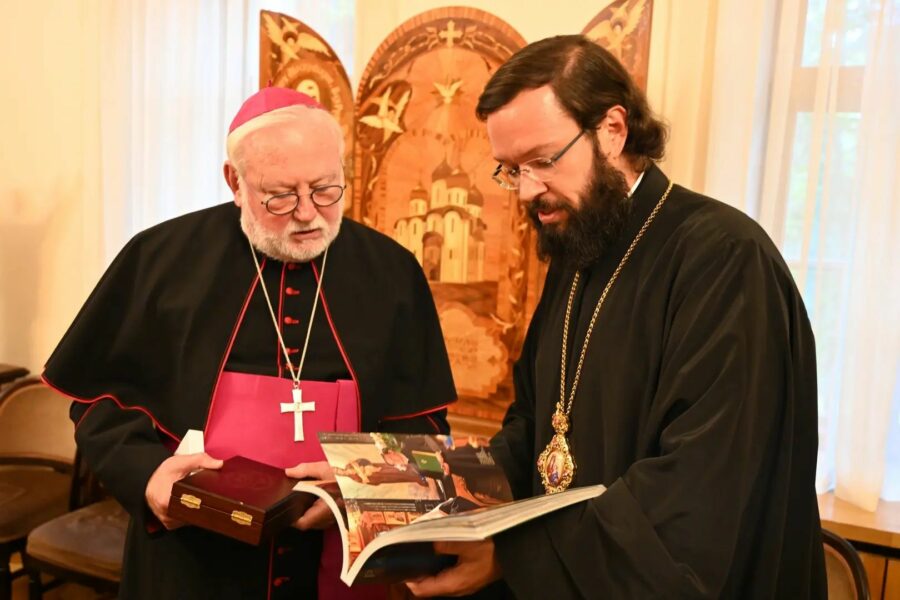
The meeting concluded with an exchange of gifts between the delegations.
Ukraine continues to enforce the law on ties with Moscow
The complaint conveyed to Gallagher coincides with new actions by the Ukrainian authorities against various structures of the Ukrainian Orthodox Church.
In 2024, Ukraine passed the law “On the Protection of the Constitutional Order in the Sphere of Religious Organizations’ Activities.” The law prohibits the activity of the Russian Orthodox Church on Ukrainian territory and establishes procedures for determining whether religious organizations established in Ukraine are affiliated with it.
In August 2025, Ukraine’s State Service for Ethnic Policy and Freedom of Conscience (DESS) declared that the Kyiv Metropolis of the Ukrainian Orthodox Church was affiliated with the Russian Orthodox Church. The decision came after the agency demanded the elimination of the ties it had identified and Metropolitan Onufriy rejected the demands made by the authorities.
The dispute has continued throughout 2026. In May, the Ukrainian state agency again confirmed the findings of its examination regarding the existence of a canonical-ecclesiastical link between the Ukrainian Orthodox Church and the Moscow Patriarchate.
In July, the authorities also determined that the Pochaiv Dormition Lavra, one of the country’s main Orthodox monasteries, shows signs of affiliation with the Russian Orthodox Church.
New actions this week
The measures continue while Gallagher is in Moscow.
On Monday, August 24, just one day before his meeting with Anthony, the Ukrainian state agency announced that it had found three signs of affiliation between the administration of the Zaporizhzhia diocese of the Ukrainian Orthodox Church and the Russian Orthodox Church.
Among the arguments used is that the diocese is part of the Ukrainian Orthodox Church and is integrated into the Kyiv Metropolis, which Ukrainian authorities have declared affiliated with a foreign religious organization whose activity is prohibited in the country.
Also this week, a similar procedure has begun regarding the Boryspil diocese, belonging to the same Church. The DESS announced that the examination began on August 24 and aims to determine whether there are signs of affiliation with a prohibited foreign religious organization.
These actions are part of the progressive implementation of legislation passed by Kyiv and provide immediate context for the issue raised by the Moscow Patriarchate with the Holy See representative.
The dispute over independence from Moscow
The relationship between the Ukrainian Orthodox Church and the Moscow Patriarchate is one of the central points of the controversy.
In May 2022, just months after the start of the full-scale invasion, the Ukrainian Orthodox Church amended its statutes and declared its “full autonomy and independence.” It also publicly expressed its disagreement with Patriarch Kirill’s position on the war.
The Ukrainian authorities maintain, however, that these changes did not completely sever canonical ties with the Russian Orthodox Church.
The State Service for Ethnic Policy and Freedom of Conscience maintains that its investigations have confirmed the existence of this relationship. In May of this year, it again confirmed its conclusion regarding the canonical-ecclesiastical link, following a legal dispute over the procedure followed in examining the statutes.
The Ukrainian Orthodox Church rejects this interpretation and maintains that it operates independently of Moscow.
Onufriy lost his Ukrainian citizenship
The tension directly affected the primate of this Church, Metropolitan Onufriy (Orest Berezovsky).
In July 2025, President Volodymyr Zelensky revoked his Ukrainian citizenship after Ukraine’s Security Service claimed that he had voluntarily obtained Russian citizenship in 2002 without notifying the country’s authorities.
The security service also claimed that Onufriy maintained ties with the Moscow Patriarchate. The metropolitan had previously stated that he had held a Russian passport but did not consider himself a citizen of Russia.
The position of the Moscow Patriarchate is substantially different from that held by Kyiv: it considers the actions of the Ukrainian authorities against the Ukrainian Orthodox Church to be religious persecution and presented the matter to Gallagher precisely in those terms.
Gallagher, between the Patriarchate and the Russian Government
The meeting with Anthony took place after the more than one-hour meeting that Gallagher held this Tuesday with Russian Foreign Minister Sergey Lavrov.
During that conversation, the Vatican representative called for an end to the war. “To be clear: this war must end,” he later declared, while maintaining that “the conflict cannot be resolved by military means” and calling for the creation of conditions for a political and diplomatic process.
Gallagher also called for respect for international and humanitarian law and advocated progress on issues such as prisoners of war, civilians, minors, and family reunification.
The visit continues on Wednesday with the scheduled meeting between Gallagher and Yuri Ushakov, Vladimir Putin’s foreign policy adviser. On Thursday, the Holy See representative will dedicate the day to the Catholic community in Russia, with meetings with priests, religious, and bishops and a Mass at the Cathedral of the Immaculate Conception of the Blessed Virgin Mary in Moscow.