


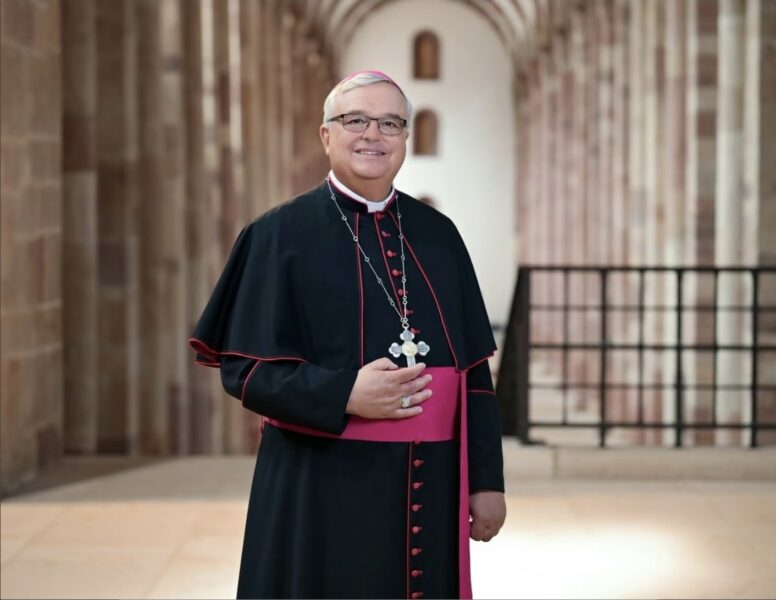
Pope Leo XIV has accepted this Wednesday, August 19, the resignation for health reasons of Karl-Heinz Wiesemann, bishop of Speyer (Germany), aged 66 and one of the German prelates who supported several of the reforms promoted by the Synodal Way. Wiesemann, who had led the diocese since March 2008, leaves the post with immediate effect, nine years before reaching the ordinary age for episcopal resignation.
The Holy See announced it in its bulletin without specifying the causes. The diocese of Speyer, however, has confirmed that Wiesemann had asked the Pope to be relieved for health reasons. The bishop explained that he had come to understand that he no longer had the strength to see “the entire path through to the full implementation of the upcoming structural reforms” of the diocese.
A resignation after years of health problems
Wiesemann’s departure comes after several years marked by health problems. The bishop had already had to step away temporarily from his responsibilities in 2021 for approximately seven months, a period that included hospital treatment.
He later spoke publicly about the depression he had suffered and the circumstances that had contributed to his illness. Last May he again addressed his experience during the Katholikentag held in Würzburg, at an event specifically dedicated to depression and mental health.
Wiesemann then explained the intense pressures accumulated during his episcopal ministry. Among them he placed the financial and structural difficulties facing the German Church and, in particular, the crisis caused by sexual abuse within the Church.
The prelate has now acknowledged that the demands linked to his episcopal responsibility have ultimately taken a toll on his physical and psychological health.
Bishop of Speyer since 2008
Born on August 1, 1960, in Herford, North Rhine-Westphalia, Wiesemann was ordained a priest in 1985. Saint John Paul II appointed him auxiliary bishop of Paderborn in 2002, and he received episcopal consecration that same year.
Benedict XVI named him bishop of Speyer on December 19, 2007, as successor to Anton Schlembach. He took possession of the diocese on March 2, 2008, and has remained at its head for more than 18 years.
Speyer, located in southwestern Germany, has around 423,000 Catholics and comprises territories in Rhineland-Palatinate and the Saarland.
His support for the reforms of the German Synodal Way
In recent years, Wiesemann positioned himself among the bishops favorable to several of the reform proposals put forward by the German Synodal Way, particularly on issues related to sexual morality and homosexuality.
The prelate expressly supported a “re-evaluation of homosexuality in Church teaching” and voted in favor of introducing blessings for same-sex couples. Wiesemann later stated that he had defended these positions “out of conviction.”
After the failure, in September 2022, of one of the Synodal Way documents on sexual morality for not reaching the necessary two-thirds majority among the bishops, Wiesemann publicly expressed his disappointment. The text proposed substantially modifying the Church’s approach to various issues of sexuality and homosexuality.
A year later, the bishop transferred these positions to his own diocese. In November 2023 he sent a letter to the pastoral agents of Speyer in which he opened the door to blessings for homosexual couples and for divorced and remarried persons, assuring that those who imparted them would not have to fear sanctions.
Read also: German bishop asks his priests to bless homosexual couples
In the letter, Wiesemann reiterated that he had campaigned during the Synodal Way for a revision of the teaching on homosexuality and added: “I stand by it.”
He received “Fiducia supplicans” as “a great encouragement”
When the Dicastery for the Doctrine of the Faith published the declaration Fiducia supplicans in December 2023, Wiesemann welcomed the document and described it as “a great encouragement.”
The bishop considered that the declaration supported the pastoral direction Speyer had already undertaken. Fiducia supplicans, however, established specific conditions for these blessings: they were to be carried out outside any marriage ritual and without morally legitimizing the couple’s situation.
The issue has continued to generate tensions between Rome and various sectors of the German Church. Pope Leo XIV has expressed during his pontificate reservations about the formalization of blessings for homosexual couples beyond the framework established by the Vatican document.
Read also: The powerful German lay lobby challenges Pope Leo XIV and defends homosexual blessings
A pastoral approach oriented toward “sexual and gender diversity”
Under Wiesemann’s episcopate, Speyer also developed a so-called “queer-sensitive” pastoral ministry, specifically directed at LGBT persons.
Diocesan initiatives have included training on sexual and gender diversity and measures aimed at incorporating the demands of people who identify as transgender into ecclesial life.
Within the implementation of the conclusions of the Synodal Way, issues such as the modification of the name and sex recorded in the baptismal registers of transgender persons, as well as certain provisions for intersex persons, have been addressed.
Wiesemann had also shown himself to be in favor of other reforms advocated by the progressive sector of the German Church. Among them are the possibility of ordaining married men to the priesthood and opening the diaconate to women.
His resignation now leaves vacant a diocese that faces important structural reforms. According to canonical procedure, the cathedral chapter must elect a diocesan administrator to govern Speyer until Pope Leo XIV appoints Wiesemann’s successor.