


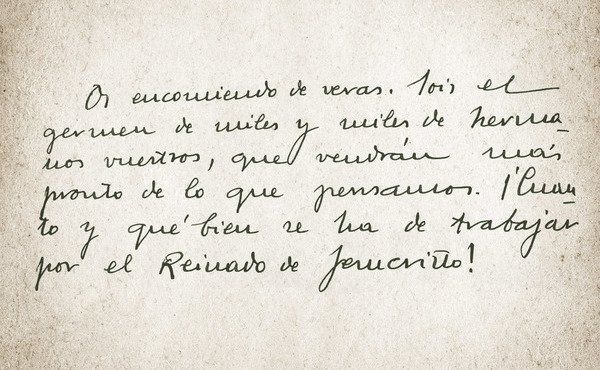
This newspaper published, on July 5, the analysis of an internal meditation by St. Josemaría Escrivá, and a few days later the response arrived. It was not signed by the Prelature of Opus Dei, which is the custodian of the author’s charism; nor by a Roman dicastery, which is the custodian of his cult; nor by a theologian, who could debate the reading. It was signed by the secretary of the board of directors of a limited company. Scriptor, S.A., presents itself in its demand as “the company holding the intellectual property rights over the works of St. Josemaría Escrivá de Balaguer,” reproaches us for reproducing “The Good Shepherd” “without authorization or any title,” warns that “it is not the first time,” and demands withdrawal and future abstention. It is worth pausing to consider what that letter means, because it says more than it asks: the saint belongs to the Church; his voice has a commercial registrar.
First, the transparency owed to the reader. This newspaper had added to the analysis, as a documentary appendix, the full text of the 1961 meditation. Upon receiving the demand, we reduced the appendix to the limits of the quotation that the law protects for analysis and information. The article remains intact, because the demand says nothing about the article: in its lines not a single fact, a single quotation, a single conclusion of what was published is disputed. What is challenged is the reproduction, not the reading. And there is something more, which we acknowledge without irony or almost: whoever claims exclusive rights over “the work ‘The Good Shepherd’ of the aforementioned author” is certifying that the work belongs to the aforementioned author. The authenticity of the internal volume from which the meditation comes —While He Spoke to Us on the Way, Rome, 2000—, which the Work had never denied, is now formally claimed by the company that administers the saint’s rights. Our most uncomfortable pending verification has been resolved by a law firm on Ortega y Gasset Street.
Second: what Scriptor is. What is documented, without an extra comma. In 2011, the Prelature of Opus Dei and Scriptor, S.A. jointly sued the website opuslibros.org —the Prelature for the “internal documents,” Scriptor for the founder’s writings—, and the Work’s own communiqué then recognized Scriptor as the rights holder and collaborator of the St. Josemaría Historical Institute in the critical edition of his work. The Commercial Court No. 10 of Madrid issued precautionary measures on October 11, 2011, and later a judgment, and opuslibros withdrew works in compliance. Note the legal basis that supported that action, because it is the key to everything: article 14.1 of the Intellectual Property Law, the author’s right to “decide whether his work is to be disclosed and in what form.” It was not litigated for royalties: the volumes of meditations were never sold, have no market, generate not a single euro. It was litigated for non-disclosure. Intellectual property, in this use, does not protect exploitation: it protects a secret. It is the commercial extension, with court and costs, of the rule that the 1961 meditation itself enunciated with a proverb: dirty laundry is washed at home. And the pattern goes back further: the academic history of Ediciones Rialp, the publisher of The Way, documents that even its brand was the personal property of Álvaro del Portillo, who only legally transferred it to the company in 1987. In this world, not even the name of the founder’s publishing house belonged to the publishing house.
Third, the question that lawsuit left open and that this demand reopens. In the course of those proceedings, opuslibros documented —adversarial source, and as such it is noted— that Escrivá died without making a will. The fact has its salt in an institution where numeraries and associates are asked to make wills in favor of the Work: the only one who did not make a will was the founder. And it has, above all, its legal consequence: upon the author’s death, Spanish law attributes the exercise of the right of disclosure to the person he has designated in his will or, failing that, to his heirs, for a period that, for authors who died before 1987, retains the eighty years of the old law: until 2055, in the case at hand. The question, then, formulates itself and we will not answer it here but where it is answered, which is the Commercial Registry: by what chain of titles does a limited company exercise the most personal of the rights of an intestate saint, that of deciding which of his words the world may read and which not? We note, in passing, two things. That the same text claimed from this house remains accessible today on opuslibros, and we are not aware of the reason. And that the Spanish legislator foresaw exactly this case: article 40 of the same law allows the judge to intervene when the rights holders exercise non-disclosure of a deceased author under conditions that violate the constitutional right of access to culture, at the request of cultural institutions “or of any other person who has a legitimate interest.” It has been said.
Fourth, and this is the thesis: this is not a registry anecdote, it is the second floor of the building we have been describing. In “Santa coacción” we showed that the mechanism of governing consciences does not live in the Work’s statutes but in its “spirit,” and that is why it is unreformable: for four years Rome has been “studying” statutes where there is nothing to strike out, because the essential is in volumes of meditations. Now we know that the patrimonial architecture is exactly symmetrical: neither is the founder’s voice the canonical person’s. The spirit lives outside the norm; the property lives outside the Prelature. Rome can study statutes and even suppress entire canonical persons, but it cannot lift the veil of a limited company in Madrid. When this newspaper touched the spirit, the Church did not respond: a board of directors responded.
And to know how that game ends when Rome decides to play it seriously, no hypothesis is needed: there is a laboratory, and it is called Sodalicio. According to El País’s investigation, the Sodalitium empire —estimated by the press at about one billion dollars— began in 2000 with nine private luxury cemeteries managed as “missions” exempt from taxes under the Peruvian Concordat, with the canonical endorsement of two jurists who are now cardinals, Luis Martínez Sistach and Gianfranco Ghirlanda; the same Ghirlanda who a quarter of a century later traveled to Aparecida to communicate the suppression. The cemeteries of Parque del Recuerdo do not hang from the Sodalitium but from a civil association, which in 2020 contributed them to a trust administered by a securitization company; and when El Comercio asked, the house’s defense was textbook, literal: they are “two distinct legal persons,” the Sodalitium neither directs nor owns them. Read slowly: the entity canonically suppressed by Rome invokes the corporate veil to explain that its assets are not its own. Lawyer José Ugaz —the former anti-corruption prosecutor, who represents six uncompensated victims; not to be confused with the journalist of the same surname— maintains in a letter to the Holy See that the patrimony has been dispersed through private companies, front men and offshore vehicles; an allegation by a party, and as such we present it. Meanwhile, the apostolic commissioner attempts to liquidate assets to compensate the victims, in a process whose controversies this newspaper has been documenting, and repeatedly runs into the same wall: canonical suppression reaches the canonical person; the cash is elsewhere.
Civil law has, for decades, a tool against this game. It is called piercing the corporate veil, when someone uses a company as a screen —to hide assets, to evade debts, to be able to say “that is not mine” while controlling it—, the judge is authorized to look behind the screen and treat things as what they are. It was developed by the Spanish Supreme Court in the 1980s and Peruvian courts know and apply it. Canon law, on the other hand, has nothing similar: it can create and suppress its own legal persons, but before a limited company in Madrid or a trust in Lima its arm does not reach. However, that does not leave the Church defenseless. Nothing prevents it from doing what any defrauded party does: going to the civil courts of the country and asking there what the canon does not give it. And in the Peruvian case it would go with reinforced title, because the 1980 Agreement between the Holy See and the Republic recognizes civil effects to canonical entities: an association that by concordat is canonical and depends on the Church cannot later present itself, before that same Church, as a third party without connection. If its patrimony was emptied toward civil associations, trusts and interposed companies, that emptying is challenged where frauds are challenged, which is the State court, with simulation, rescissory action or piercing the corporate veil. The apostolic commissioner who repeatedly runs into the corporate wall, therefore, has a door.
The name remains, which seems chosen by an ironist. Scriptor, in Latin, is the one who writes. The one who wrote preached in 1961 that dirty laundry is washed at home, and died in 1975 without willing a single line. Half a century later, the company that bears his profession as its corporate name decides, demand in hand, who may read him. The sheep were called, according to what he himself recounted before a sheepfold in Castile, with words that held a certain something of affection. Readers are written to from a law firm.