


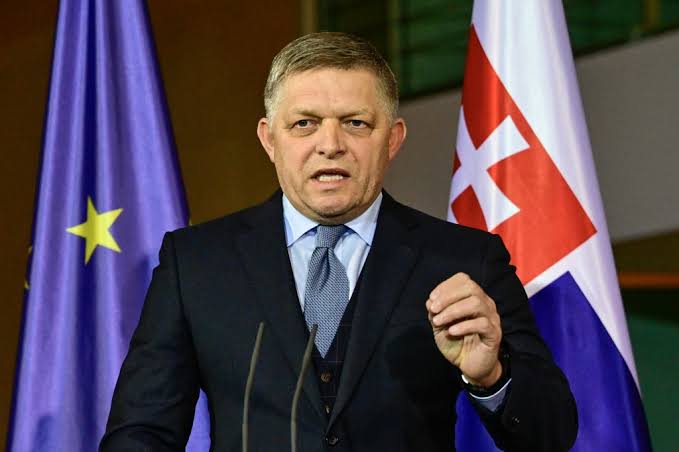
The Government of Slovakia has reiterated that it will not recognize «marriages» between persons of the same sex celebrated in other countries of the European Union, considering that this legal figure does not exist in its constitutional order, which defines marriage exclusively as the union between a man and a woman. The decision represents an open challenge to the interpretation of the Court of Justice of the European Union (CJEU), which holds that Member States must recognize the legal effects of these unions when they have been validly celebrated in another EU country.
During an appearance held in June following a visit to the Special Registry Office of the Ministry of the Interior, the Slovak Prime Minister, Robert Fico, insisted that the country’s authorities cannot register a «marriage» between persons of the same sex because it would mean recognizing an institution that the Slovak Constitution does not contemplate.
«I must protect the Constitution of the Slovak Republic,» Fico stated. «The civil registry cannot register a marriage contrary to the constitutional definition of marriage as the union between a man and a woman. One cannot request the registration of something that does not exist in our legal system,» he added.
The head of government explained that he has agreed on this interpretation with the Minister of the Interior, Matúš Šutaj Eštok, and assured that he is willing to wage a «legal battle» with European institutions to defend national legislation.
The case that triggered the conflict
The controversy arose after two Slovak diplomats, who entered into a «marriage» in Austria in 2020, requested that this union be registered in Slovakia’s Special Civil Registry. The couple, who are raising a child, demanded that the State recognize their bond with the effects provided for by European law.
However, the administration allowed the legal deadline to pass without issuing a resolution, which led the Attorney General to file a formal complaint demanding that a decision be adopted.
The CJEU requires recognition of certain legal effects
The origin of the conflict lies in a ruling issued by the Court of Justice of the European Union in November 2025 (case C-713/23). Although the court recognized that family law remains a competence of the Member States, it held that they must exercise that competence in a manner compatible with Union law.
For this reason, the CJEU concluded that States must recognize certain legal effects of «marriages» between persons of the same sex legally celebrated in another EU country when this is necessary to guarantee the right to free movement of European citizens.
The ruling originated from a dispute brought before the Polish courts, after two citizens of that country requested recognition of a «marriage» celebrated in Germany. Following the European ruling, the Supreme Administrative Court of Poland ordered the registration of that union in accordance with the interpretation of Community law.
The Slovak Constitution reaffirms the nature of marriage
The Bratislava Government maintains that this interpretation by the CJEU conflicts with one of the fundamental principles of its legal system. Months earlier, in September 2025, Parliament approved a constitutional reform that expressly reinforced the definition of marriage as the exclusive union between a man and a woman, reaffirming this principle as one of the pillars of the country’s family legislation.
The reform also incorporated new guarantees aimed at protecting national competences in matters related to family and the constitutional identity of the State. Among other measures, it prohibited adoption by same-sex couples and surrogacy, and established that essential issues such as marriage and family form part of Slovakia’s constitutional sovereignty.
On this basis, the Executive maintains that European Union law cannot be interpreted in a way that obliges the country to recognize as marriage a reality that its own Constitution does not contemplate.
A legal battle over the definition of marriage
Unlike what happened in Poland, where the CJEU ruling was ultimately applied by national courts, Robert Fico’s Government has made it clear that it will defend the primacy of the Slovak Constitution.
For Bratislava, the conflict is not limited to a jurisdictional disagreement with European institutions, but affects the very legal definition of marriage. The Executive maintains that recognizing these unions would blur an institution that the Slovak constitutional order reserves exclusively for the union between a man and a woman.