


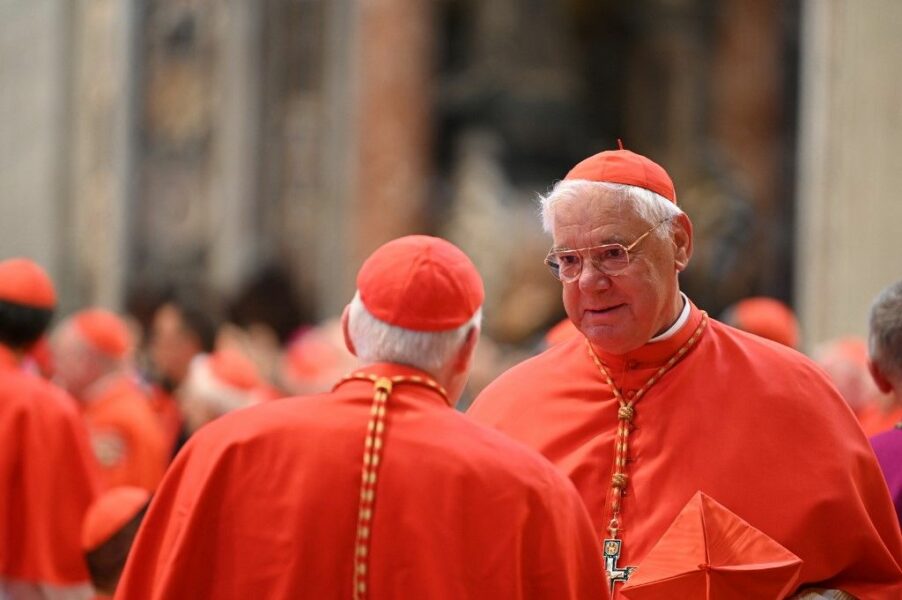
Cardinal Gerhard Ludwig Müller considers that the recovery of consistories by Leo XIV has been a positive step, but believes that the new working method inspired by the synodal methodology prevents the College of Cardinals from addressing in depth some of the main problems of the Church.
In an interview given to The Catholic Herald, the prefect emeritus of the Dicastery for the Doctrine of the Faith laments that the meetings held this year have largely replaced the traditional plenary debate with working tables with previously prepared questions. «It was more of a brainstorm than a thoughtful conversation», he summarizes.
Although he acknowledges that there is a «good harmony between the Pope and the cardinals», Müller insists that the College of Cardinals «is not an assembly of individuals», but a true college called to assist the Successor of Peter in the governance of the Church. For this reason, he maintains that «I would prefer plenary discussion, because we are not simply groups or individuals gathered together. We are constituted as a college».
«The real problems could hardly be debated»
The cardinal explains that a large part of the consistory was devoted to reflection on the encyclical of Leo XIV, peace, artificial intelligence and human dignity. However, he considers that the method used made it difficult to address other issues that directly affect the life of the Church.
Among them, he expressly mentions the situation of the Priestly Fraternity of Saint Pius X (FSSPX). Müller states that he took advantage of his intervention to request a collegial response to the profession of faith sent by the Fraternity to the Pope and the College of Cardinals, although he acknowledges that the issue barely sparked debate among the participants.
The proposal was not improvised. In another interview given during the days prior to the episcopal consecrations in Écône, the cardinal had asked Rome to respond doctrinally to the document sent by the Fraternity and even proposed studying a structure inspired by the former Ecclesia Dei Commission to welcome the priests and faithful who might leave the FSSPX in the event of a definitive break.
Following the consecrations on July 1, Müller maintains that «this ordination of a bishop without communion with the Pope is in itself a schismatic act». The cardinal thus maintains the line he has been defending in his latest public interventions, in which he has also insisted on distinguishing the conflict with the Priestly Fraternity of Saint Pius X from the debate on the traditional liturgy.
«The decisive question is the truth»
If the firmness shown by Rome toward the FSSPX deserves his support, Müller considers that the Holy See should act with the same clarity regarding the doctrinal drift of the German Synodal Way.
«Diplomatic solutions are good up to a certain point. The decisive question is the truth», the cardinal affirms, convinced that many of the current tensions in the Church cannot be resolved through pastoral compromises when the integrity of doctrine is at stake.
In this context, he warns that some approaches promoted from Germany unduly resort to the concept of development of dogma to justify changes that, in his view, alter the content of the Catholic faith. «They are abusing the concept of development of dogma. The development of dogma does not consist in changing the substance», he maintains.
For the prefect emeritus, doctrinal development involves a deepening in the understanding of the Revelation transmitted by the Church, but never a modification of the received truths. For this reason, he rejects that this principle can be invoked to transform essential aspects of the sacramental constitution of the Church or of the ministerial priesthood.
This same concern appears in other of his recent public interventions. When criticizing, in an article published by Kath.net, the proposal of the German Synodal Way to allow lay preaching during Holy Mass, he recalled that «precisely those who so gladly invoke Vatican II are the first to contradict it», because they separate the liturgy of the Word from the eucharistic liturgy and blur the ministerial priesthood.
He now expands this criticism and directs harsh words against the leaders of the Central Committee of German Catholics (ZdK), whom he accuses of wanting to build «another Church» inspired by woke ideology and feminism, more concerned —he says— with transforming the ecclesial structure than with proclaiming the Gospel.
A call to recover the role of the College of Cardinals
Beyond the specific issues addressed during the interview, Müller raises a reflection on the role that the College of Cardinals should play in the life of the Church. In his view, the meetings of the cardinals should not be limited to the exchange of impressions on current affairs, but should become a true space for discernment on the issues that affect the faith and unity of the Church. In this context, he insists that «it is not our goal to be accepted or praised by the modern press. If they praise us, it means we are on the wrong path», an affirmation with which he summarizes his conviction that doctrinal clarity must prevail over any criterion of opportunity or convenience.
For Müller, issues such as the situation of the FSSPX, the drift of the German Synodal Way or the correct understanding of the development of dogma demonstrate the need to recover consistories in which the College of Cardinals can deliberate with greater depth. Only in this way, he maintains, will the cardinals be able to fully exercise their mission of assisting the Roman Pontiff in discerning the great doctrinal and pastoral challenges facing the Church today.