


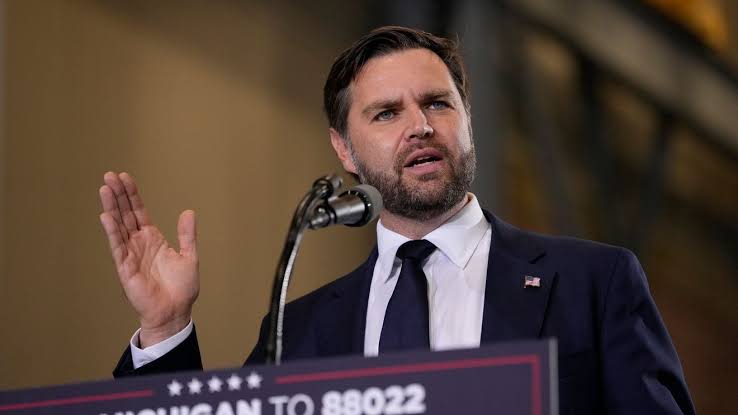
Three hours on Joe Rogan’s podcast, unscripted and without an opponent, provide the most complete inventory to date of what the most powerful Catholic in the United States believes: a Christian political economy, a demonology, and a theory of religion in public schools.
The Vice President of the United States was asked how to fix a country where young people turn socialist because they cannot buy a house, and he answered with Rerum novarum. Not with a passing allusion: with the encyclical itself, recommended live to the world’s largest audience as “one of the best things a Christian leader has ever written,” summarized in its thesis—a middle way between six-year-olds in factories and socialism—and laid out as a program. That is what episode 2526 of The Joe Rogan Experience, released on Wednesday, contains: nearly three hours without a script, without an opponent, and with no agenda beyond selling a book, and therefore the most reliable available inventory of what JD Vance believes. He believes the Church’s social doctrine is the appropriate instrument of government for artificial intelligence. And he believes in demons.
The pretext was Communion: Finding My Way Back to Faith, the memoirs of his conversion to Catholicism that Harper published on June 16, a month after a book whose tour began the day after the UFC event in the White House South Lawn—seven fights, seven knockouts, Trump’s birthday, the Vances’ twelfth wedding anniversary, Usha thirty-nine weeks pregnant with their fourth child—where the conversation begins and stays for twenty minutes. It is the second time Vance has sat with Rogan; the first was on October 31, 2024, while he was still a candidate. The difference is that now he is negotiating with Iran.
Political economy occupies the final hour and is the most articulated part of the interview. Vance begins with a concession that surprises Rogan: yes, the system is rigged. An engineer earning more than 75 percent of her generation explained over dinner that she no longer aspires to what her parents had; in Oceanside, the California neighborhood where the children of Camp Pendleton troops grew up, no house costs less than a million dollars and even Marine officers cannot afford one. From there comes the warning he directs more at his own side than at anyone else: “If we do not return to a more Christian understanding of the economy, socialism is the alternative.” Republican revulsion at socialism strikes him as justified yet sterile as long as it does not ask how we arrived here, and his answer is a third way “that has existed in virtually all Christian economic thought for two thousand years”: extreme inequality creates real problems, but without private property—and without a state to protect it—there is no way out. It is, in his words, “my Christian answer.” It is also, in his words, the occasion to promote the book, which leads to the best gag of the afternoon: Rogan informs him that another Communion exists, Whitley Strieber’s, and it is about alien abductions.
With AI, the framework holds and is refined. The analogy he uses—one given to him by the CEO of a tech company—is not mass unemployment but the Industrial Revolution: there was plenty of work, but inequality spiraled out of control, and from the robber barons came fascism and communism. The operative question, then, is not how many jobs are destroyed: it is “how do you ensure that ordinary people retain some control” and do not wake up in a world where they cannot buy a house while someone else owns thirty-five mansions. Two remedies: participation—real seats at the negotiating table, with unions redesigned for the twenty-first century according to his friend Oren Cass’s model, more flexible and less tutored by the legislator—and antitrust, because a hyper-monopolist who dominates the sector and then captures government and the nonprofit sector leaves people out of the deal, like the steel trusts Teddy Roosevelt described as more powerful than the state. He admits he is accused of being too pro-labor for a Republican and replies that the alternative may be communism. And he places the historical diagnosis where this newspaper is interested: if the United States and Britain weathered the Industrial Revolution better than any other Western country, it was, first, because of strong religious institutions; second, because of institutions of worker participation. “Right now we have very weak religious institutions.” He says it in passing, without drawing consequences, and continues with the unions.
A note from the archives is in order here. The encyclical Vance recommends—without quite naming it—is from May 15, 1891. On May 15, 2026, on its 135th anniversary, Leo XIV signed Magnifica humanitas, “on the safeguarding of the human person in the age of artificial intelligence,” published on May 25. Its paragraph 5 holds that the engines of innovation are no longer states but private actors, often transnational, “endowed with resources and capacity for action superior to those of many governments,” and that technological power today presents “an unprecedented face, predominantly private,” harder to govern and to orient toward the common good: exactly the hyper-monopolist thesis, two months earlier and with a signature. Vance told NBC on May 26 that he had read “scattered pieces” and that what he had read “sounds very profound, the kind of thing one would expect from a leader of the Church.” In July he recommends the 1891 text. Of the May text, not a word in three hours.
The war question arrives by an unexpected route. Rogan reads him the complaint a non-commissioned officer filed in February with Mikey Weinstein’s Military Religious Freedom Foundation—first reported by journalist Jonathan Larsen—according to which his commander opened a combat-readiness briefing, smiling, to announce that Trump had been “anointed by Jesus to light the signal in Iran” and trigger Armageddon, with citations from Revelation. Vance hits the brakes: “If I’m in that meeting, I hit the brakes.” He then distinguishes providence from presumption, which is correct and not trivial—everything falls within God’s plan, even the terrible, but that does not imply anything about this war—takes shelter in Lincoln—“you hope to be on God’s side; you do not assume God has taken your side”—and states: “There are just wars, there are necessary wars, but war is always something one tries to avoid. I think that is a fundamental Christian principle.” He adds that he distrusts the account because the press distorts and that he wants to confirm it before criticizing anyone, but that such language is not encouraged from the government.
The problem with the statement is the calendar. In April, with the Epic Fury offensive underway since February 28, Vance invoked the just-war doctrine to respond to objections from Leo XIV, and auxiliary bishop James Massa of Brooklyn, chairman of the Doctrine Committee of the U.S. Conference of Catholic Bishops, issued a reminder of the Church’s teaching without naming him. In May, Magnifica humanitas declared that same doctrine obsolete, too often used to justify any war, and Vance applauded: “the just-war doctrine needs updating […] that is exactly what the Pope is trying to do, and I am glad he has done it.” In July he returns to the full statement, as a fundamental Christian principle, without mentioning the revision he celebrated. Updating is not abolishing, and the contradiction is not formal; but the vice president had already said, regarding papal interventions on Iran, that in some cases it would be better for the Vatican to stick to moral questions and what happens inside the Catholic Church, and leave the president of the United States to dictate American policy. One begins to understand which magisterium he finds usable.
The only sustained theological development in the interview, however, is not war: it is demonology, and that is what the headlines carry. Rogan reminds him that in March, before Benny Johnson, he said UFOs are not aliens but demons. Vance confirms it and reasons: he is not a hyper-rationalist, he believes supernatural things happen, and if what the case literature describes is a humanoid but non-human being, of practically infinite power, that takes people and experiments on them, “you can call it an alien if you want, but there is plenty of historical precedent for calling it a demon.” Rogan counters with the Travis Walton case from 1975, where the beings heal the abductee and speak to him telepathically, and Vance concedes without blinking: “that sounds like an angel.” The discussion escalates to whether a civilization a million years more advanced would be distinguishable from the supernatural—“to my dog there is no real difference between God and me: I turn on the light, I make food appear”—and ends in a concession no headline has captured: asked whether he admits that an angel, a demon, and an extraterrestrial are distinct things, he answers yes, he concedes it, that his argument was about perception and not about metaphysics. He acknowledges he has not looked at the files for lack of time, not lack of access—“I have unlimited access to information”—promises to devote a couple of weeks to it and sneak in with a camera; when Rogan warns him that then they will not show him anything, he replies: “I’m not good at lying.”
Religion in the public square occupies more than half an hour and is the passage where he defines himself most clearly. Rogan attacks the Texas mandate to display the Decalogue in all public classrooms—2025 law, recently upheld by a federal appeals court and headed to the Supreme Court—with the argument of Democratic congressman James Talarico, a Protestant seminarian: imposing Christianity drives people away from Christianity. Vance responds with a strong thesis and a weak one. The strong one: religious freedom is a Christian contribution to Western civilization, derived from the dignity of the person, because each must find their own way to God and that cannot be forced; and expelling religion from the square does not leave the square empty, it hands it over to secularism, which is Rehnquist’s thesis. The weak one: a poster does not force anyone, displaying is not imposing, and in a plural democracy children are exposed to things. Along the way he offers the phrase a Catholic reader should underline: “probably eight of them are things I hope everyone can agree on, even if they are not religious.” The other two are the ones that speak of God. The Decalogue defended as the cultural heritage of the West and not as divine law; the first tablet, outside the reckoning. And a description of his own apostolate that explains a great deal: “I do not preach to people. I do not walk into the White House and tell my employees to follow Jesus. I try to live in a way that awakens curiosity.”
On immigration he speaks for twenty minutes and never once in a theological key. The argument is strictly wage-based: César Chávez was a restrictionist because employers imported cheap labor to drive down wages; democratic socialists claim to defend the worker and practice open borders, which is the only thing big business really cares about; a hotel-chain executive complained to him that without illegals he would have to pay more; at Foxconn there are anti-suicide nets on the rooftops. No ordo amoris, no Francis, no the November reprimand from the U.S. bishops against indiscriminate mass deportations. This absence does mean something, because it is precisely the discussion his own book does engage: the “disturbing” April 2025 meeting with Parolin and Gallagher, which this outlet reported at the time, from which Vance emerged complaining that the Vatican never moved beyond platitudes.
Of the rest—what will lead the newscasts—an inventory suffices. Iran: the Islamabad memorandum, the hawks who “cannot say what they want to achieve,” the rumor of the 300 billion, the warning against the Libyan scenario and its migratory corollary, the refusal to comment on a decision already taken by the president. Israel: “they can go to hell,” he says of the paid influencers sabotaging the negotiation, in reference to the Time report on Brad Parscale and Clock Tower X; he describes himself as “the reasonable moderate” in that debate and maintains that the serious issue is not that countries try to influence, but that foreign influence alters American judgment. Epstein: “If people want to say we mishandled the release of the papers: guilty.” The original sin, he maintains, lies in the 2007 search warrant, so narrow that the relevant material was never sought and was probably destroyed; he declares himself “one of the original conspiracy theorists” of the case and admits he will die believing there is a story there without being able to prove it.
The final line of the episode is his: “Buy Communion, Joe, and next time we’ll talk about religion, faith, and the Ten Commandments.” He spoke about all three things for three hours. Only that faith, in his mouth, now functions less as confession than as a toolbox: Leo XIII for capital, Lincoln for war, Revelation for those who go too far, and Rehnquist for the classroom. All perfectly orthodox and all perfectly available.