


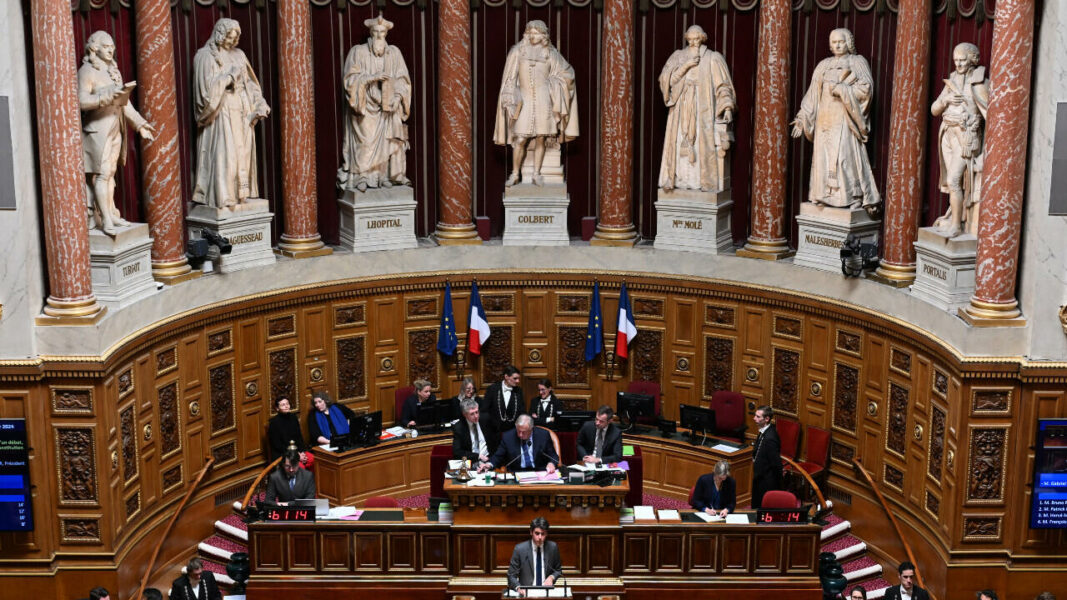
The French Senate has once again rejected the bill that legalizes euthanasia—including assisted suicide—although the initiative continues its legislative process and could be definitively approved by the National Assembly on July 15. The Upper House approved yesterday, July 8, a motion of rejection by 169 votes in favor, 164 against, and 11 abstentions, in a new episode of the intense political and ethical debate dividing the country on end-of-life issues.
Despite this third rejection by the Senate, the French Constitution allows that, in case of disagreement between both chambers, the National Assembly has the final say. Everything therefore points to the government-backed bill ultimately moving forward.
A political and ethical confrontation
During the parliamentary debate, Senator Christine Bonfanti-Dossat, from the conservative party Les Républicains and one of the rapporteurs of the text, acknowledged that the discussions of recent months have led to a “political impasse.”
“Two irreconcilable conceptions of the end of life are in conflict,” she stated. According to her explanation, while a majority of deputies consider euthanasia and assisted suicide as a widely accessible right for patients in advanced stages of illness, the position defended by the Senate limits any intervention to patients whose death is imminent, an option she described as “more in line with the ethics we uphold.”
Senator Alain Milon also harshly criticized the legislative proposal.
“Major changes always begin with exceptions. Lifting the prohibition on killing under the pretext of granting patients the freedom to die and ending their suffering means abandoning a fundamental principle on which our society is built,” he stated during the session.
Milon also lamented that the parliamentary outcome appears to have been decided in advance, despite the more than 1,800 amendments presented during the bill’s processing.
The National Assembly will make the final decision
Following the Senate’s rejection, the text returns for the fourth time to the National Assembly. It is now up to Prime Minister Sébastien Lecornu to activate the procedure provided for in Article 45 of the Constitution so that the Lower House adopts the final decision.
The final vote is scheduled for July 15.
The Church insists on palliative care
The Catholic Church in France has reiterated its rejection of the bill throughout the parliamentary process.
The Archbishop of Paris, Laurent Ulrich, recently stated that “reason and fraternity call for a priority and generous promotion of palliative care” and emphasized that “there is still time to abandon this path, which is not the path of a fraternal future.” In the same statement, he added that “more than help to die, our society needs help to live.”
For his part, the Vice President of the French Episcopal Conference and Archbishop of Tours, Vincent Jordy, warned that not everything presented as progress ultimately benefits humanity.
“Some decisions that may seem like solutions can ultimately produce harmful effects for society,” he noted, while calling for genuine discernment so as not to be swept away by “an ideology of progress.”
The French bishops had already warned last January, before the first debate in the Senate, that “palliative care is the only truly effective response to difficult end-of-life situations.” In that statement, they also recalled that proper care “almost always eliminates requests to die among terminally ill patients.”
A foregone conclusion
Although the Senate has rejected the initiative for the third time, its opposition is unlikely to prevent the law’s approval. The constitutional mechanism provided to resolve disagreements between both chambers grants the final decision to the National Assembly, where the bill enjoys a favorable majority.