


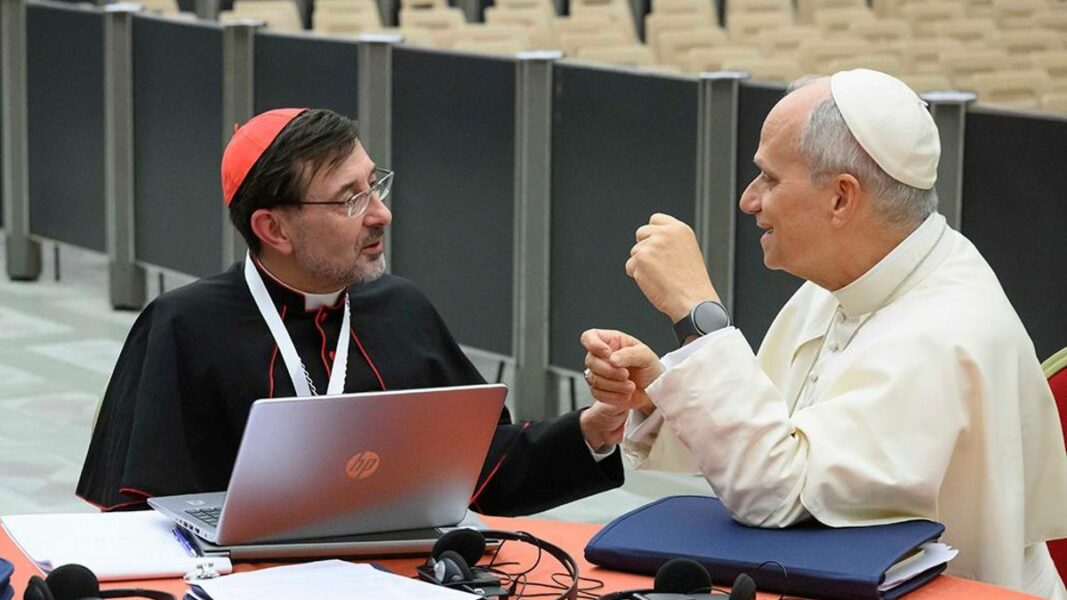
Pope Leo XIV’s visit to Spain is surrounded by notable anticipation, not only within the Church but also in broad sectors of society. This was stated by Cardinal José Cobo, Archbishop of Madrid, in an interview given to La Nación just hours before the Pontiff’s arrival. As host of the first leg of the trip, Cobo explained that the announcement of the visit sparked a reaction that even surprised the organizers themselves. “We live in a time when people feel discouraged and very worried, and when we said the Pope was coming, we were the ones who were surprised,” he affirmed. According to the cardinal, the expectation is not limited to ecclesial circles: “Suddenly we noticed that institutions, foundations, and the civil world showed great anticipation.”
For the Archbishop of Madrid, one of the reasons for this interest lies in the Pope’s ability to bring together diverse sensibilities in a moment marked by polarization. “Doing something together that rises above politics, ideologies, and narrow interests—doing something together—excites people,” he said. “Many people have mobilized for this visit,” he added.
A Pope of Reflection and Firm Decisions
Cobo has known Robert Prevost personally since before his election to the papacy. Both were created cardinals by Francis in September 2023 and worked together for years at the Dicastery for Bishops, then led by Leo XIV.
Describing him, the Spanish cardinal especially highlighted his spiritual profile and his approach to decision-making. “He is a great Augustinian, a very profound man; he has deeply integrated Augustinian spirituality,” he noted. He also emphasized his capacity for listening and discernment: “When something is said to him, one senses that he is internalizing and understanding it, and if not, he asks.” In Cobo’s view, one of Leo XIV’s main qualities is that “he is a courageous man who knows how to make decisions at the right moment” and “manages timing very well.”
Asked about the international presence the Pontiff has gained during this first year of his pontificate, the Madrid archbishop considered that his voice has gradually gained space on the world stage. “The Pope is carving out his space; after a year, both he and his voice are also occupying a special place in the world,” he stated.
The Congress and the Need to “Raise Our Gaze”
One of the most notable moments of the trip will be Leo XIV’s address to the Congress of Deputies. The visit comes at a particularly delicate political moment for the Spanish government, marked by various corruption scandals.
Read also: Cobo Pushed for Leo XIV’s Upcoming Speech in the Spanish Parliament
However, Cobo preferred to focus on the institutional dimension of politics. “We have the opportunity to raise our gaze,” he said, referencing the papal visit’s motto. In his opinion, the Pope’s speech can serve to “thank politicians, because there are good politicians and people who are giving their lives to politics with a capital P.”
The cardinal insisted that the Church’s mission is to point to broader horizons beyond daily confrontation. “How good it is that we can have a horizon, that the Church also extends its hand to all those working for the common good and for a better society,” he noted.
Immigration as the Challenge of Our Time
The migration issue will be one of the central topics of the final leg of the trip, which will take Leo XIV to the Canary Islands. On this subject, Cobo defended the need to respond to those who already live and work in Spain without fully regularized status.
“There is a sector that is already building citizenship, paying taxes, working here, and yet has no rights,” he said. In his view, these are people “who have come and are building our cities and our country.”
At the same time, he acknowledged that the migration issue is not limited to regularization. “This is not the whole problem of migration, because there is also the issue of arrival flows, the regularization of borders, and the stance we must take from Brussels,” he explained. In any case, he maintained that the Church sees immigration as one of the great issues of our time. “Since Pope Francis, the Church has directly confronted the migration challenge as a reality of our century,” he stated.
Abuses, Human Dignity, and Challenges for the Church
During the interview, the archbishop also referred to the possibility that Leo XIV might meet with abuse victims during his stay in Spain. While avoiding confirming specific meetings, he noted that “there are proposals” and recalled that the Pope’s private audiences are usually announced only after they have taken place.
Regarding the work carried out by the Spanish Church in this area, he highlighted the experience of the Archdiocese of Madrid. “For eight years we have had a project to assist victims” that addresses not only sexual abuse of minors but also “abuses of conscience and all the ramifications they entail.” According to him, this reality “is demanding integral care for individuals.”
Speaking about the challenges currently facing the Church in Spain, Cobo placed growing social polarization at the forefront. “We have a long list,” he acknowledged. Among the most important challenges, he mentioned “confrontation, the ideologization of everything,” and the need to recover a shared reflection on the common good and human dignity. “Looking at society through the lens of human dignity” is especially necessary, he said, “at a time when human rights are beginning to be restricted and democracy is being eroded from many angles.”
A Church Different from That of 2011
The last papal visit to Spain took place in 2011 with Benedict XVI. Since then, both society and the Church have undergone profound transformations.
“The Church and society have changed a great deal,” Cobo stated. “We have gone through a coronavirus, a democratic evolution, and a growing sense of despair.” Nevertheless, he believes one element remains unchanged. “What remains—and in Spain this is certainly true—is enthusiasm for the Pope,” he affirmed.