


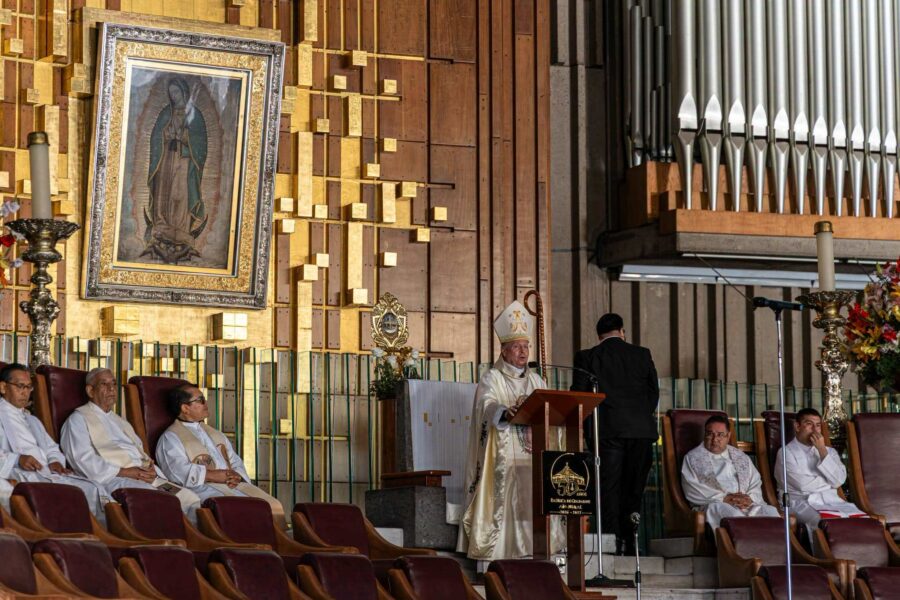
Very early in the morning, on Wednesday, November 4, 2026, the group of pilgrims from the diocese of Apatzingán arrived at the Basilica of Guadalupe. They came to the Sacred House for the Eucharistic celebration of their annual visit, as the ecclesial territory has done every year amid the same geography of conflict. They came from a region of Tierra Caliente where daily life is measured by the collection of quotas, forced displacements, clashes between organized crime groups, and constant pressure on producers, transporters, and families.
Bishop Cristóbal Ascencio García led the pilgrimage. In his homily, he did not offer a mere routine speech. He stated that to make a pilgrimage is to walk: a concrete movement toward eternity that does not erase the reality left behind. In that context, he addressed a direct prayer to the Virgin of Guadalupe in which, as a father, shepherd, and son, he placed the concerns carried by the diocese.
“We know that a mother worries about her children; we have experienced it in our own flesh. We know that a mother does everything possible and would like to do the impossible to solve her children’s problems,” he began.
Then, without beating around the bush, he moved on to what he sees and hears in his territory: “Mother, I want to tell you that I continue to be concerned about the insecurity and violence that our diocese lives through, that we live through in our diocese. I know that all of Mexico is going through the same situation, but that is no consolation to me.”
The prayer listed verifiable facts in the area. Families who emigrate for fear that their lives will be taken from them. The extortion that drives them into extreme poverty. Young people who join organized crime groups—“I say groups because there are many.” The indifference of those who “committed to watching over the people’s security and now forget that it should be a priority on the agendas, on the service agendas.” He also mentioned the contingents of teachers, doctors, transporters, peasants, and farmers who demonstrate on highways and in cities, showing their discontent. “Of course, it is a way of expressing discontent, these demonstrations.”
Ascencio García did not present the situation as a distant or exceptional phenomenon. He placed it within a broader diagnosis: “The situation of my diocese, and I believe of our country, is not simple. It seems that we have turned our backs on God and have knelt before idols. The mirage shown by power and money has led many people, Mexicans, brothers and sisters, to stray from the path, from the truth, from the right path.” He added that the greed of some “accumulate as if they were going to be eternal on this earth.”
As a shepherd, the bishop gave an account of his own work: “As a bishop, I have knocked on doors that have not opened; I have spoken perhaps to deaf men. As a man, a shepherd, a man and shepherd of hope, I believe that things can improve.” And he returned to the prayer: “And here we are, at your feet, our Mother, expressing to you on my behalf my feeling and the feeling of my diocese. I have faith in God, I have faith in your intercession, Holy Mary, our Mother of Guadalupe, I have faith in your intercession. I believe in so many good people who live in that diocese, whom many think are all bad. I believe in many good people who are the majority in that diocese, who desire a better world, that hope will become reality.”
The prayer did not stop at the diagnosis. It moved on to a call for conversion addressed to different actors. To “my brothers who are active in so many crime groups and who have been allowed to act.” To those who “believe they are on the right path in a mistaken way.” To “us, the believers, so as not to be afraid, to be light, living in truth, in justice.” And to “those who are there to serve and not to serve themselves from the people, those who serve as authorities.”
The bishop connected the plea with the account of the wedding at Cana. There, faced with the lack of wine and the concern of the servants and guests, Mary, “contemplative, seeing the reality of all, not denying reality, said to them, do whatever He tells you, pointing to Jesus.” The message he drew was concrete: “Brothers and sisters, we have brought our concerns; each one brings them to our heavenly mother. We must, of course, see what Jesus tells us, what He tells us. Do whatever He tells you.” He recalled the first reading of the day—continue working out your salvation with humility and fear of God—and applied the same criterion to peace and justice: “Keep working, do not stop working for peace, for justice, because truth reigns. Keep working with humility and fear of God, for He is the one who gives you the inner energy so that you may will and act according to the will of God. This is an invitation from the word of God, not to grow weary, to keep working without losing hope, to work according to the will of God.”
The diocese of Apatzingán includes municipalities such as Aguililla, Apatzingán, Buenavista, Tepalcatepec, and others in the region where, according to reports from the Human Security Observatory of the Apatzingán Region (OSHRA) and other sources, spikes in homicides, events involving explosives, forced displacement, and systematic extortion are documented.
The “floor fee” functions, in practice, as a second tax that adds to legal levies and conditions agricultural, commercial, and transportation activity. Lemon producers and other crops have denounced for years the quotas, threats, and control over prices and distribution. Families abandon communities after clashes or in the face of the risk of mines and drones. Young people join criminal groups in a context of few alternatives and territorial pressure. Municipal and state authorities have faced protests from various guilds that point out the priority that security should have.
Ascencio García has repeated this diagnosis on other occasions. Weeks earlier, in the cathedral of Apatzingán, when recalling the assassination of citrus leader Bernardo Bravo Manríquez, he spoke of official taxes and the “floor fee” as mechanisms that besiege the towns.
The pilgrims from Apatzingán then headed to the Sanctuary of Christ the King on the Cubilete Hill. There, on Thursday, November 5, Mass was celebrated. The move from one sanctuary to another did not change the content of what had been placed the previous day: the reality of a diocese that bears displacements, extortions, the recruitment of young people, and the indifference of those who should prioritize security.
What was heard in the homily was not a promise of an immediate solution nor a call to resignation. It was the record of a shepherd who names what is happening—families who leave, young people who join groups, authorities who do not prioritize, protests on the highways—and presents it to the Virgin as the concerns of a father and a son. At the same time, he insists that the majority of the people in the diocese are good people who desire a better world and that conversion is demanded of criminals, believers, and those who exercise authority. The walking of the pilgrimage, toward eternity and back to the municipalities of origin, is presented as the continuation of that concrete work for peace and justice, without denying the reality found upon return.
The prayer of Bishop Cristóbal Ascencio is transcribed below:
“Mother, I want to tell you that I continue to be concerned about the insecurity and violence that our diocese lives through, that we live through in our diocese. I know that all of Mexico is going through the same situation, but that is no consolation to me.
It pains me to see displaced families who emigrate for fear that their lives will be taken from them. It pains me so much the extortion that is leading us into extreme poverty. It pains me so much the young people who join organized crime groups; I say groups because there are many.
It pains me the indifference of those who committed to watching over the people’s security and now forget that it should be a priority on the agendas, on the service agendas.
It has pained me to see contingents of teachers, doctors, transporters, peasants, and farmers who demonstrate on highways, in cities, showing discontent with the situations we are living through. Of course, it is a way of expressing discontent, these demonstrations.
My Mother of Guadalupe, the situation of my diocese, and I believe of our country, is not simple. It seems that we have turned our backs on God and have knelt before idols. The mirage shown by power and money has led many people, Mexicans, brothers and sisters, to stray from the path, from the truth, from the right path.
The greed of some is so great that they accumulate as if they were going to be eternal on this earth. As a bishop, I have knocked on doors that have not opened; I have spoken perhaps to deaf men. As a man, a shepherd, a man and shepherd of hope, I believe that things can improve.
And here we are, at your feet, our Mother, expressing to you on my behalf my feeling and the feeling of my diocese. I have faith in God, I have faith in your intercession, Holy Mary, our Mother of Guadalupe, I have faith in your intercession. I believe in so many good people who live in that diocese, whom many think are all bad.
I believe in many good people who are the majority in that diocese, who desire a better world, that hope will become reality. Mother, we cannot continue living this way. Conversion, conversion is calling us all, to my brothers who are active in so many crime groups and who have been allowed to act.
Conversion to my brothers who believe they are on the right path in a mistaken way. Conversion of us, the believers, so as not to be afraid, to be light, living in truth, in justice. Conversion of those who are there to serve and not to serve themselves from the people, those who serve as authorities.”