


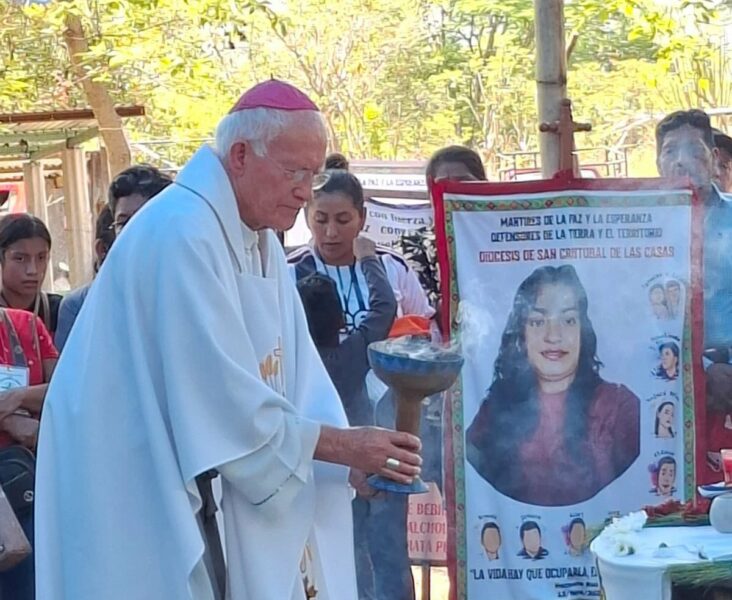
Hundreds of faithful from the Pueblo Creyente of the San Pedro y San Pablo parish in the diocese of San Cristóbal de Las Casas walked through the streets and paths of the ejido this Tuesday in a pilgrimage to commemorate the second anniversary of the massacre that claimed the lives of eleven innocent people on May 12, 2024. With lit candles, religious images, and banners calling for memory and justice, the participants honored those killed amid the dispute over territorial control and reaffirmed their commitment to the defense of the land and the construction of peace.
Under the evangelical motto “Blessed are the peacemakers, for they will be called children of God” (Mt. 5:9), the statement from the Pueblo Creyente, read during the event, is titled “If the system buries them, out of justice we will not forget them”. The document, dated this same May 12, describes the pain that still wounds the community, even two years later, as its members remain standing. “They took their lives from us, we experienced pain and suffering, but their blood watered the roots of this people who tenderly keep their memory and dignity alive”, the text states. Despite the time that has passed, the inhabitants continue to face fear, control, psychological violence, insecurity, and the indifference of a State that, as they denounce, continues to whitewash the reality of Chiapas with a discourse that does not respond to the everyday experience of the peoples.
The eleven victims, all of them defenders of the territory and opponents of mining exploitation, were Ignacio Pérez, Isidra Sosme, Teresita de Jesús Arrazate, Rosalinda Bravo, Alfonso Pérez, Yojari Belén Pérez, Dolores Arrazate, Azael Sánchez Escalante, Joel Escalante, Urbano and Brandi. Most belonged to the same extended family. According to the testimonies gathered and the initial investigation, an armed group burst into the community around 5:30 p.m., executed them, and then burned their bodies in a house. The diocese of San Cristóbal de Las Casas, in a letter issued a few days after the tragedy, was categorical: the eleven executed and burned were “innocent”. They did not collaborate with organized crime; their only “crime” had been to defend the land against the advance of mining projects and the violence generated by the dispute between cartels.
Two years later, the Pueblo Creyente does not limit itself to remembering. It denounces that the violence has not ceased and that the martyrs for peace, defenders of mother earth and the territory, “like sparks that spread in a cane field continue to inspire the struggle and resistance of our communities.” The pilgrimage took place in a context marked by the persistent control of criminal groups disputing the territory, with recent repercussions in Nicolás Ruiz and Carranza, where new episodes of violence have been recorded. The faithful demand official recognition of the massacres that occurred in Chicomuselo, Nicolás Ruiz, and other towns where armed groups clash for dominance of the region. They demand justice for all victims of the violence and, in particular, for their brothers and sisters from Nueva Morelia, as well as for Father Marcelo Pérez Pérez, the catechist Simón Pedro Pérez López, and Lorenzo, also killed in the area.
The message is firm in its rejection of the structural causes of the tragedy. The pilgrims demand that the official declaration of cancellation of mining exploitation in Chicomuselo be made effective and that an end be put to the sale of alcohol and drugs that wounds community life and the future of young people, girls, and boys. They also condemn threats, harassment, pressure, and intimidation against communities, as well as persecution and harassment of those who carry out pastoral work. “As Christians, we cannot and must not stay on the sidelines in the struggle for peace and justice,” the statement reminds, citing the Third Diocesan Synod.
The faithful evoke the words of Pope Francis on the martyrs who risk their lives to embody the Gospel of love, peace, and fraternity. They affirm that the experience of the cross and the resurrection must lead them to lose fear and to be “free and strong like a tree with deep roots.” The document concludes with a call to the peoples to resist in the face of violence and to seek paths of unity that strengthen community ties. They invoke “an unarmed, disarming, and also persevering peace,” quoting Pope Leo XIV: “May the madness of war come to an end and may the earth be cared for and cultivated by those who still know how to beget, know how to care for, and know how to love life.”
The Nueva Morelia massacre was not an isolated event. It is part of a wave of violence in Chiapas driven by territorial control between criminal groups, economic interest in mineral resources, and institutional weakness. Two years later, families and communities continue to demand that investigations advance and that those responsible be prosecuted. Impunity, they denounce, fuels everyday fear and forced displacement.
During the pilgrimage, the participants symbolically embraced the pain of the families who still mourn their loved ones and the thousands of disappeared in the state. “We are one human family,” they affirmed, and urged an end to “this pandemic of destruction and death.”
The act of memory and resistance by the Pueblo Creyente not only honors the eleven martyrs. It keeps alive the hope in a Chiapas battered by violence. Its message resonates beyond the mountains of Chicomuselo: while the system tries to bury the truth, popular memory and committed faith will continue to demand justice, peace, and respect for the territory. Two years later, Ignacio, Isidra, Teresita, Rosalinda, Alfonso, Yojari, Dolores, Azael, Joel, Urbano, and Brandi are not just names on a list of victims; for those communities, they are seeds of liberation that continue to germinate in the peaceful struggle of a believing people that refuses to forget.