


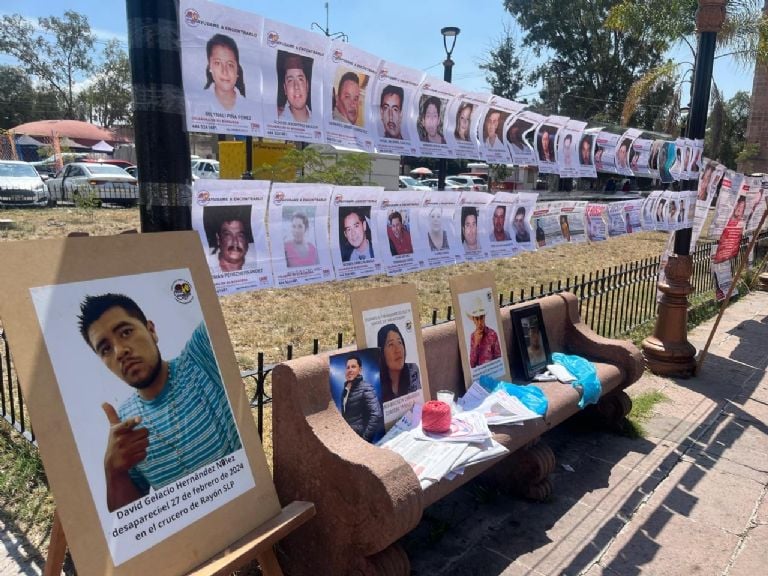
Every August 30 the world remembers those who were torn from life… The United Nations General Assembly set the date in 2010; in 2026 it coincides with the twentieth anniversary of the International Convention for the Protection of All Persons from Enforced Disappearance. The commemoration’s slogan is clear: Victims first. Action now. The Committee on Enforced Disappearance, the Working Group on Enforced or Involuntary Disappearances and mechanisms from Africa, Asia and Europe reiterated that States cannot shift the burden of searching, investigating and preserving memory onto the families.
Unfortunately, Mexico leads the urgent legal actions before the UN Committee, accounting for about one-third of the total, and is the first country to which Article 34 of the Convention has been applied on well-founded indications that enforced disappearance is practiced in a widespread, habitual or systematic manner.
More than 130,000 people remain disappeared or unaccounted for in the National Registry; the bulk are concentrated in the States of Mexico, Tamaulipas, Jalisco, Michoacán and Nuevo León. Since 2019, prosecutors have acknowledged assisting more than 25,000 searching mothers. A recent estimate places the number of daughters and sons growing up with an absent father or mother at around 165,000, without any public policy that names them.
The paradox is cruel. The government announces thousands of “locatings” through database cross-checks and alerts; families respond that the forensic backlog, impunity and attacks on those who search—dozens of searchers murdered or disappeared in the last decade—are not resolved by reclassifications. In Guerrero, Jalisco, Sonora and Sinaloa there are marches, dissemination of posters, offerings and masses because the State continues to arrive late, if it arrives at all.
Faced with this omission, the Mexican Catholic Church, for years irregular, sometimes distant, sometimes courageous in isolated parishes, is beginning to articulate a more explicit accompaniment. The Mexican Episcopal Conference asked the country’s churches to welcome families in celebrations, allow the disappeared to be named in the prayer of the faithful, provide peace mailboxes for anonymous information and not remain indifferent on August 30. “Healing this wound is also everyone’s task,” the Episcopal Conference wrote.
In Jalisco, epicenter of the tragedy and of resistance, the Archdiocese of Guadalajara has maintained a tradition that is renewed this Sunday, the mass for the disappeared at the Sanctuary of the Martyrs, presided over by Cardinal José Francisco Robles Ortega, with collectives that walk to the Sanctuary as a pilgrimage with profound implications. The cardinal has said in previous editions what the authorities evade, institutional negligence toward places already identified as recruitment traps. It is not only liturgy. In the same city, the Carmelites of the Sacred Heart maintain Casa Luisita, a shelter opened in 2023 for families arriving from other municipalities and states to comb through prosecutors’ offices, cemeteries and plots. There they find shelter, medical and psychological care, the rosary and the Eucharist; of the families received, dozens have located their loved ones, almost always without life.
That pulse is replicated, unevenly, in other jurisdictions. In Chilpancingo-Chilapa, Bishop José de Jesús González Hernández asked parish priests to reserve space in every church for photographs and to pronounce the names in the universal prayer on Sunday. In Hermosillo, the cathedral installed a Peace Mailbox and Father Martín has accompanied the Searching Mothers of Sonora for years.
In Mazatlán there will be a mass in the Cathedral Basilica with photos, banners and balloons; in Tijuana a periodic Eucharist has long been reserved for the families. In Chiapas and other dioceses the same mailboxes are being tried. The National Dialogue for Peace has insisted on placing victims at the center of any social pact. None of this is enough. All of it is indispensable while the State abdicates.
Words on this day cannot sweeten the diagnosis. Enforced disappearance, committed by State agents or with their acquiescence, or by private individuals in the face of systematic inaction, is not repaired by a computer cross-check that inflates “findings” of voluntary absences. The searching mothers did not ask for a vocation as forensic experts or excavators. It was imposed on them by a country that normalized the mass grave and silence. The Church that now opens atriums and temples must take care not to spiritualize the crime or relativize the demands for truth, justice and non-repetition. To accompany is to pray and document, to host and challenge power, to name the absent and demand that the search cease to be unpaid, dangerous and feminized work.
This August 30, in Geneva, victims will be spoken of first. In Guadalajara, Chilpancingo, Hermosillo and dozens of parishes the victims are already first: they are the ones who walk. What remains is for the State to stop treating them as an image problem and finally assume what is its responsibility; meanwhile, the slogan of this day, for Mexico, will be unfortunate: Victims first, actions… not yet.