


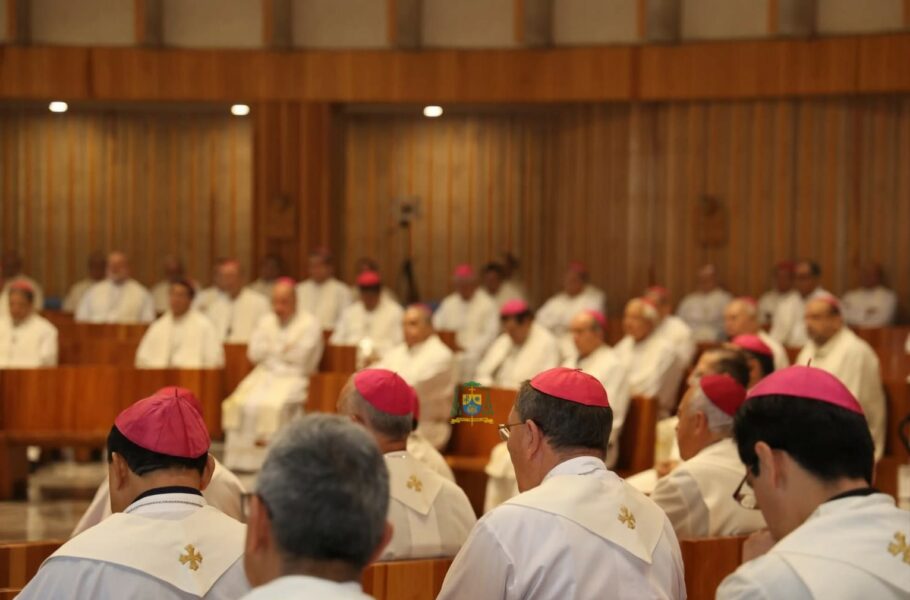
The Mexican Episcopal Conference inaugurates this Monday, November 9, its 121st Plenary Assembly. It will take place perhaps at a time of challenges unlike any in contemporary history. It comes as the country suffers from public corruption that has reached levels that delegitimize entire institutions, where violence continues to strike communities and those who shepherd them, and when the Church is simultaneously preparing for the fifth Guadalupan centenary in 2031 and for the renewal of part of its own episcopate.
The bishops therefore meet before challenges that do not admit responses through routine pastoral letters or documents. The quality of their discernment will largely determine whether the Church offers Mexico a lucid word and an effective presence, or whether it limits itself to reiterating calls that no longer illuminate the gravity of the hour. Perhaps four axes, in all likelihood, will mark the deliberations and deserve to be aired with frankness.
Among the national issues, the excessive and overwhelming corruption of the country’s public life calls institutions into question, including electoral ones. Recent scandals surrounding the National Electoral Institute, leaked audio and video recordings, questionable contracts, and the resignation of its president have eroded public trust precisely as the renewal of 500 federal deputies, 17 governorships, and nearly 19,000 local positions approaches.
In this scenario, the bishops should conduct a serious examination of the fundamental role the Church plays regarding ethics and proper public life. It is not about inducing votes or becoming electoral arbiters, but about illuminating, from the Social Doctrine of the Church, the criteria of honesty, justice, and the common good for those seeking power. The outlook toward the 2027 elections requires the assembly to discuss how to accompany the faithful so they may discern without partisan calculation, yet also without remaining silent in the face of the normalization of impunity and the capture of institutions. Otherwise, silence or lukewarmness would be interpreted as complicity in an institutional deterioration that no longer admits euphemisms.
On the other hand, although the April assembly made a commitment to fostering vocational culture, the bishops should also conduct a serious examination and bring to the table the effects and consequences of violence against the clergy.
So far in 2026, murders of priests, kidnappings, and assaults have been recorded. The case of Father Clemente Morales Topete in Culiacán, deprived of his freedom, beaten, and tortured, and the homicide of Father Román de la Cruz Hernández in Hidalgo are only the most recent.
Added to this are expressions of hatred, discrimination, and “political violence” stirred up on social media against bishops and priests who dare to denounce. It is not only about organized crime; there is also a climate of hostility that seeks to silence the pastoral voice. A concrete outcome of this assembly must be the updating of protection protocols for priests and churches and particular accompaniment for bishops who find themselves in the open field of difficult and violent communities. Ignoring this dimension would be a grave pastoral oversight, especially when the hierarchy itself has documented for years the vulnerability of its ministers.
Another issue is the update toward 2031 of the PGP 2031-2033 and the supposed reform announced for the Basilica of Guadalupe, which constitutes another delicate axis. Although primary responsibility lies with the Archdiocese of Mexico, the shrine is the patrimony of the entire Mexican Church. After the financial scandals involving former rector Efraín Hernández Díaz, complaints from the Chapter, audits (including one by Deloitte ordered by the Vatican), and the subsequent appointment of Canon Daniel Villalobos Ortiz, there has been no clear perspective on the CEM’s involvement or the measures adopted to ensure transparency. Preparation for the Guadalupan jubilee cannot remain trapped in administrative opacity. The assembly should demand clarity and a framework of co-responsibility that ensures the path toward 2031 is traveled with integrity.
Finally, in the renewal of the episcopates, although a plenary assembly is unlikely to bring formal announcements of changes, relevant appointments already exist. One of the most significant is that of the Archdiocese of Puebla: Jorge Carlos Patrón Wong will take possession on November 19, succeeding Víctor Sánchez Espinosa. Other major sees remain pending. In this context, the “illusion” of a papal visit by Leo XIV in 2027 is circulating. Vatican diplomacy and statements by the president of the CEM point to possibilities in 2027 or, with greater certainty, in 2031.
However, the rigidity of the Mexican electoral calendar and the risk that any papal presence could be instrumentalized for political purposes, even within the Church itself, make a visit in 2027 improbable.
The 121st Assembly faces social and ecclesial challenges that are not minor: corruption that delegitimizes institutions, violence that threatens pastors and communities, the need for transparency at the heart of Guadalupe, and the orderly renewal of the hierarchy. Nevertheless, the Church in Mexico approaches these days with hope. The great jubilee of the Guadalupan apparitions in 2031 and the celebration of two thousand years of our redemption in 2033 are drawing ever closer. Those dates are kairos moments that invite turning assemblies into occasions of real conversion, truth, and prophecy. If the bishops seize this opportunity with courage and without fear of the cost, the Church will be able to offer a wounded country not only diagnoses, but concrete paths of light in the Truth of the Gospel.