


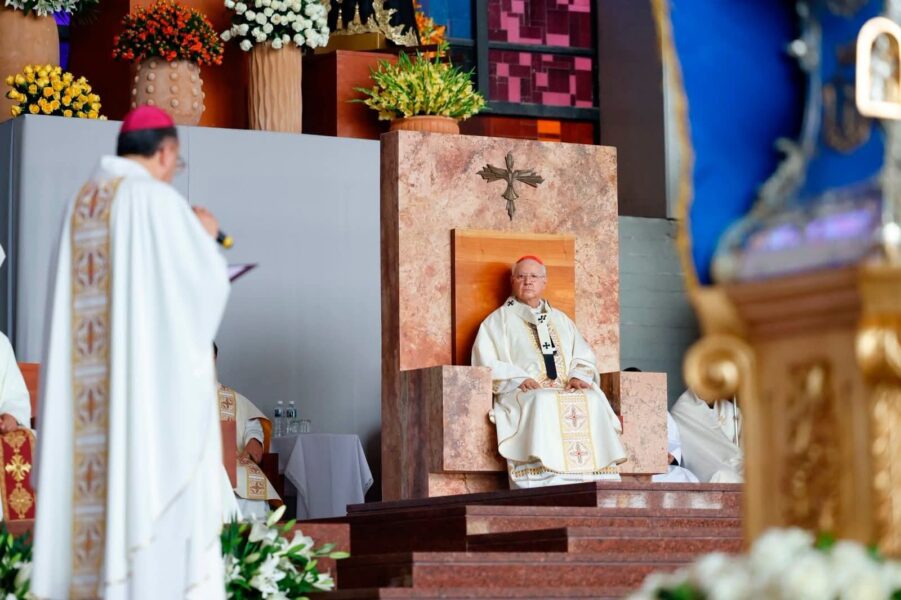
The Santuary of the Mexican Martyrs, in Guadalajara, was the setting last Monday July 20, 2026 for an emotional Eucharistic celebration that brought together nearly eight thousand faithful, around five hundred priests, fifty bishops and three cardinals to give thanks to God for the fifty years of priestly ministry of Cardinal José Francisco Robles Ortega, Archbishop of Guadalajara. Among the prelates who accompanied the jubilarian, the presence of Cardinal Norberto Rivera Carrera, Archbishop Emeritus of Mexico, stood out; his attendance underscored the communion of the Mexican episcopate around a trajectory marked by fidelity and simplicity, as well as the president of the Mexican Episcopal Conference, the Bishop of Cuernavaca, Ramón Castro Castro.
The Eucharist was presided over by Cardinal Robles Ortega himself. At the beginning of the celebration, the Apostolic Nuncio in Mexico, Joseph Spiteri, read the message that Pope Leo XIV sent to the cardinal. The Holy Father acknowledged the diligent activity, the apostolic solicitude and the ministry of deep spirituality exercised over five decades and wished the cardinal health and abundant graces to continue proclaiming the Gospel. During the Mass of thanksgiving, the first chalice with which the then-young priest celebrated his first Mass in 1976 at the parish of Our Lady of Sorrows in Mascota was used. At the conclusion, he was presented with a spiritual bouquet made of the faithful’s prayers and a replica of the image of Our Lady of Sorrows of Mascota, the Marian devotion that has accompanied him since childhood. The day ended with refreshments at the sanctuary itself and a gathering at the minor seminary, enlivened by mariachi music.
José Francisco Robles Ortega was born on March 2, 1949 in Mascota, Jalisco, the third of sixteen children of the marriage of Francisco Robles Arreola and Teresa Ortega. He grew up on the El Troje ranch in an environment of agricultural work, family discipline and deep religiosity. His father cultivated the land and was known in the town for sowing rice; his mother devoted herself entirely to the home. From a young age, the siblings learned to carry out daily tasks and to live the faith in common: the family rosary, attendance at church and service as altar servers formed part of his childhood. A religious sister, Martha Soltero, a teacher at Colegio Morelos, nurtured in him and other children an interest in the priesthood. His paternal grandmother, María Arreola Caro, also exerted a decisive influence by earmarking resources in her will for “the beloved seminarian.”
At the age of twelve, after finishing elementary school, he entered the Seminary of Tepic, as was customary at that time. He turned thirteen during his first year of formation. The separation from his family caused him nostalgia and anguish to the point that he returned home intending not to continue. However, the restlessness sown in him as a child, the desire to become a priest that was born while serving at the altar and while spending time with seminarians who returned to Mascota on vacation, did not fade. During his philosophy studies he faced a deeper crisis, in which he wondered whether he could commit his entire life to the ministry. The accompaniment of formators, his spiritual director and priest friends, together with perseverance in prayer, allowed him to purify his motivations. “No vocation is born in isolation; God’s call needs an environment in which it can take root”, the cardinal repeated during these jubilee days.
After studying philosophy at the Major Seminary of Guadalajara and theology at the Seminary of Zamora, he was ordained on July 20, 1976 for the Diocese of Autlán by the imposition of hands of Bishop José Maclovio Vázquez Silos. Immediately afterward he traveled to Rome where, between 1976 and 1979, he obtained a licentiate in Dogmatic Theology at the Pontifical Gregorian University. Upon his return he was appointed pastor of the Sanctuary of Guadalupe in Autlán, professor of philosophy and theology, and later rector of the diocesan seminary. Subsequently he served as vicar general and diocesan administrator after the death of his bishop. Those years forged in him a pastoral style that was close, simple and centered on the formation of future priests.
On April 30, 1991, Saint John Paul II appointed him auxiliary bishop of Toluca and titular bishop of Bossa. He was consecrated on June 5 of the same year. In 1996, following the death of Bishop Alfredo Torres Romero, he became bishop of Toluca, a see he governed until January 25, 2003, when the same pontiff appointed him Archbishop of Monterrey. He remained there until December 7, 2011. In each of these sees he developed a ministry characterized by the promotion of education, interreligious dialogue and peace. He participated in the Synod of Bishops for America in 1997 and presided over various commissions of the Mexican Episcopal Conference.
On November 24, 2007, Benedict XVI created him cardinal in the consistory of that day and granted him the title of Santa Maria della Presentazione, of which he was the first titular. The cardinal’s hat consolidated his presence in the universal Church. He has been a member of the Pontifical Commission for Latin America, the Pontifical Council for the New Evangelization and the Congregation for Bishops. He participated in the 2013 conclave that elected Pope Francis.
On December 7, 2011, Benedict XVI appointed him Archbishop of Guadalajara; he took possession on February 7, 2012. Since then he has shepherded one of Mexico’s most important dioceses, with a long evangelizing tradition, abundant vocations and a history marked by martyrs. He has presided over the Mexican Episcopal Conference in two terms, from 2012 to 2015 and from 2016 to 2018, standing out for his defense of life, justice, peace and human rights, as well as for his ability to maintain due independence from civil authorities. In Guadalajara he has constantly emphasized the need for a Church centered on communion with God and service to the most needy. He has accompanied communities affected by violence, promoted the fostering of vocations and maintained a simple pastoral style, faithful to his episcopal motto: “In the simplicity of faith”.
In his homily on July 20, Cardinal Robles Ortega expressed deep gratitude to God, to his family and to the particular Churches that marked his path. He recalled that before being ministers we are disciples and that before speaking of Christ we must listen to him. Addressing the priests present, he invited them not to lose the joy of their vocation and to look back with gratitude, recognizing God’s fidelity despite human limitations. The celebration was not only an act of personal recognition, but an opportunity for the entire diocesan Church to value the gift of the priesthood and renew its commitment to the promotion of vocations.
Fifty years after that ordination in 1976, Cardinal José Francisco Robles Ortega continues to proclaim, with his life and his ministry, that God’s fidelity is greater than human weaknesses. In the simplicity of faith, the Church of Guadalajara and of Mexico gives thanks for a shepherd who has known how to walk behind the one Shepherd. From this blog we join in the joy of the Church of Guadalajara for the 50 years of Archbishop Cardinal José Francisco Robles Ortega.