


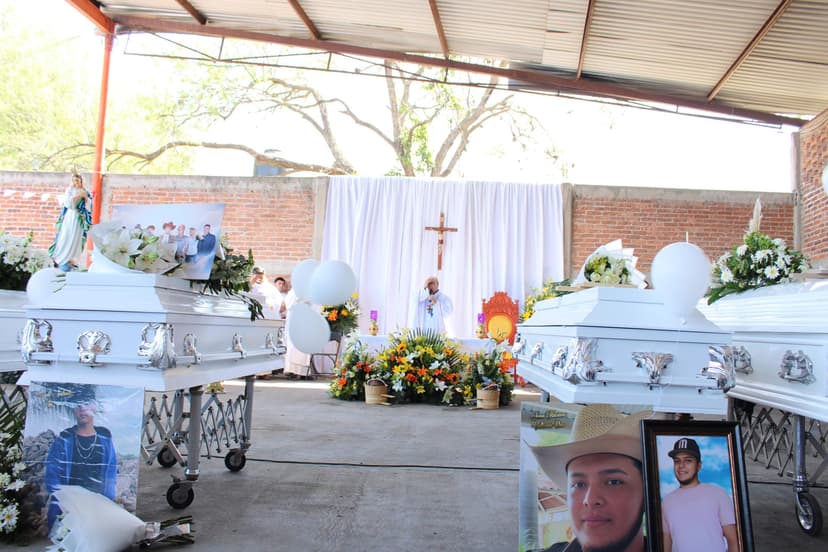
The Catholic community was still mourning the murder of Father Román de la Cruz Hernández of the Diocese of Huejutla, when, during the feast of Our Lady of Mercy on September 24, in the atrium of the church of the same name, Patricia, a dancer of the Red Skins, was shot dead while celebrations and public worship in honor of the Patron Saint were taking place; the faithful experienced moments of horror in the sacred precinct, while the victim lay lifeless in the atrium. The truce of the patronal feast was broken, generating bewilderment and terror.
In Valle de Santiago, that joy was shattered by a troubling message: the parish ceased to be a place of peace and the religious festival lost its meaning of cohesion and respect, but Patricia is not an isolated case of “collateral damage” or a circumstantial victim.
Reports from the Catholic Multimedia Center document growing evidence, and it has been preferred to consign it to the bag of statistics upon confirming that Catholic communities are now targets. There is not, says the CCM itself, a hatred of the faith in the style of the 1920s, but there exists a phenomenon that has mutated into a neo-persecution.
Guanajuato illustrates this with unprecedented cruelty. On March 16, 2025, in San José de Mendoza, Salamanca, a commando opened fire on young people who, after Mass, were socializing on the court next to the parish. Several belonged to the Youth Ministry of the Diocese of Irapuato; they were students and workers, not hitmen. In May, in San Bartolo de Berrios, San Felipe, seven other young people fell at the end of a parish celebration for Mother’s Day. In August, Ulises Arturo Martínez, 19, and Edgar Noé Rodríguez Cervantes, 21, members of apostolic groups at the parish of San Felipe Apóstol, one had been a Roman soldier and the other an apostle in the Passion of Christ, were abducted and found dead.
In Chiapas, another similar tragedy occurred. On May 13, 2024, in the ejido Nueva Morelia de Chicomuselo, a commando massacred eleven people. The Diocese of San Cristóbal de Las Casas identified among them catechists Ignacio López and Isidra Sosme Temich, and their family. They were not hitmen; they resisted abandoning their homes and joining the gangs disputing the region. After killing them, the house was set on fire. Two bodies were charred.
In Oaxaca, the same violence reached two women who were going to the bishop’s anniversary celebration. On June 15, 2023, Gertrudis Cruz de Jesús and Cliserina Cruz Merino, cousins, Triqui catechists from the parish of San Juan Bautista Copala, in the Diocese of Huajuapan de León, were leaving Tierra Blanca to join the festivities for the twenty-fifth anniversary of priestly ordination of Bishop Miguel Ángel Castro Muñoz.
They were ambushed by gunfire at the Cruz Chiquita site in Yosoyuxi; Gertrudis died on the way to the hospital, Cliserina died the next day during the feast of the Sacred Heart. The bishop, dismayed, did not limit himself to ritual lament. “God is trying to tell me something,” said the prelate and dared to ask: What has the Church omitted, what has it stopped listening to, what activism has replaced encounter? He recalled that two years earlier they themselves had spoken to him of their fears and of people who could not go out in peace. They had maintained unity in an area divided by armed groups, attending to some and others because the Gospel is not the patrimony of one side.
Another incident in Zacatecas, on the night of December 27, 2022, in Noria de Ángeles, armed men attacked a family. José Dorian Piña Hernández, a 25-year-old seminarian in his third year of Theology, and a girl were killed. Two women were wounded. The Conciliar Seminary of La Purísima cried out as if it were a voice in the desert: “We want no more violence or death of innocents!”
And there is Norma Sarabia Garduza, the Catholic journalist the CCM refuses to forget among the laity. On June 11, 2019, at the door of her home in Huimanguillo, Tabasco, two hitmen on a motorcycle riddled her with bullets. She was 46 years old. She was the sixth journalist murdered that year.
The CCM’s numbers are the reverse of the “victory” figures. Valle de Santiago encapsulates the question that power does not want to hear: What remains of the rule of law? The figures of operations, arrests, and “peacebuilding” contrast with a Mexico that continues to sink, where everyone—except those protected by power and alliances with drug trafficking—can be victims, whether because of their profession, their work, or even for performing that quiet labor of social stabilization that springs from religion and faith.
Mexico has not hit bottom. One of its lifelines, religion lived in community, no longer has even the minimum guarantees to exist in peace. We must not stop crying out or naming the laity, the ordinary faithful. Patricia, the young people of Salamanca and San Felipe, the families of Chicomuselo, Gertrudis and Cliserina, Dorian, Norma, whose lives were cut short because the pact with crime has been preferred over granting peace and certainty. The rule of law is broken and corroded by corruption and sin; they were laypeople murdered, children of the Church, and their names, like those of thousands of victims, have become mere statistics filed away under the shelter of impunity.