


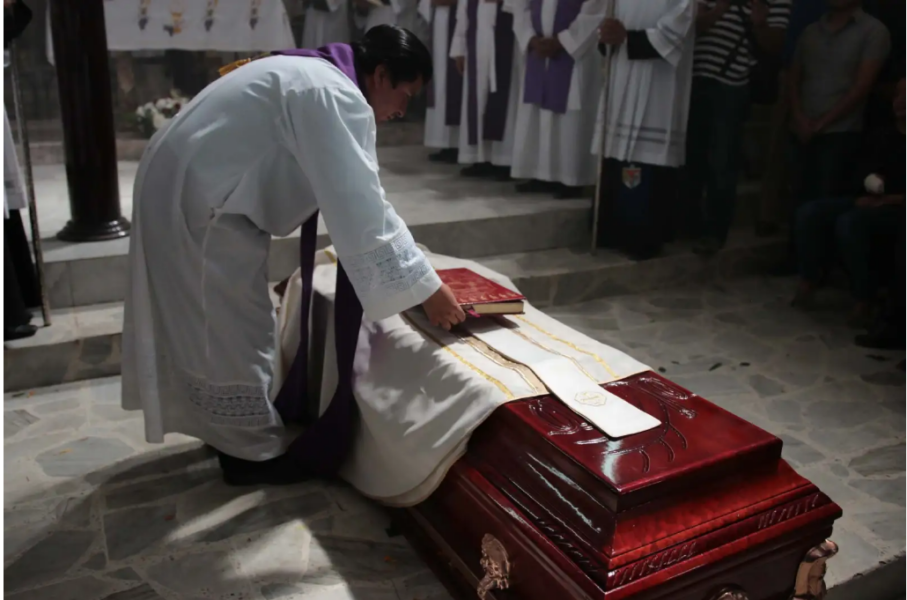
The body of Father Román de la Cruz Hernández was found on September 15, 2026, beside the Tolago-Tetlapaya highway, on the border between Lolotla and Tlanchinol, Hidalgo. He was 48 years old, parish priest of Santa Cruz in the diocese of Huejutla, and coordinated the Prophetic Pastoral Ministry of that particular Church. He was discovered face down, with gunshot wounds and a cardboard sign stuck to his back. Nearby, a Toyota Tacoma pickup with Baja California plates. The message has not been made public, but the language is the usual one, the corpse as a warning, the highway as the stage, the priest as the message.
A month earlier, the same diocese had warned that criminals were intercepting priests’ phones to extort the faithful by impersonating them. The Huasteca region of Hidalgo is an area where criminal groups are fighting over the illicit fuel trade. Father Román was no stranger to that landscape. Born in Mazahuacán, ordained in 2006, since 2024 he had been the first diocesan parish priest of a community of barely fifteen hundred souls. His ministry, which has been confirmed as committed and deeply loved by the faithful, was exercised at ground level where the rule of law no longer holds sway. That his death can be read as retaliation and warning points to the documented pattern of organized crime that does not need religious persecution to annihilate anyone who still stabilizes society, denounces wrongdoing, or is simply a moral reference point.
The Catholic Multimedia Center has stated it with figures that should already shame any administration. In the long-term count: one cardinal, 62 priests, one deacon, four religious, and 23 laypeople, including a Catholic journalist, murdered; three priests missing.
During Andrés Manuel López Obrador’s six-year term, ten priests and one seminarian were murdered, seven bishops assaulted, ten priests attacked. In what the 2025 report records from Claudia Sheinbaum’s administration, three priests have been murdered, one disappeared, and 23 laypeople close to pastoral work executed. Thirteen priests in total across both administrations. Father Marcelo Pérez in Chiapas, Father Bertoldo Pantaleón in Guerrero, Father Ernesto Baltazar Hernández Vilchis in the State of Mexico. Now Hidalgo joins the map with Román de la Cruz. The CCM’s own 1990-2025 table already placed Guerrero, Guanajuato, the State of Mexico, Michoacán, and Mexico City at the top of the list for attacks. The data offers no comfort; it only proves that the geography of impunity is expanding.
The CCM has also warned, year after year, that the murders of clergy may decrease in number while assaults multiply, along with extortion, shootings near churches, laypeople sacrificed for refusing to collaborate with crime, and churches turned into spoils. More than 80 percent of these crimes remain unpunished.
The hierarchy has demanded, as always, a thorough investigation and swift justice. The bishop of Huejutla asked not to speculate and, at the same time, acknowledged the alarming violence in the country. That demand is no longer enough. An episcopal communiqué does not stop those who leave a body with messages on the highway. A strong State is needed, purged of the impunity that has handed entire regions over as spoils. What exists is something else: a complacent, corrupt, and decadent State that coexists with de facto powers, that minimizes murders as “generalized violence” or as personal failings of the victims and that, in the meantime, allows the vaccine of the normalization of evil to be inoculated. The church ceases to be neutral ground. The priest ceases to be untouchable. The layperson who catechizes or defends communal goods becomes a target. That is not an accident of insecurity; it is the result of a power vacuum that crime has known how to occupy.
The CCM report is clear on one point that should not be twisted: there is no official persecution of the faith, no ban on worship, no doctrinal hatred from the State, but there is something more subtle and even cynical. There is a strategy of subjugation against those who still function as social stabilizers in communities where the narco imposes economy, recruitment, and “government.” There is political polarization that targets the clergy when it becomes inconvenient. And there is a State that has abdicated its responsibilities, effectively elevating a narcocracy with an institutional façade.
Mexico does not seem to have hit bottom. The murders and assaults will continue, not because someone is persecuting the Gospel, but to annihilate and subdue the few institutions that still denounce abandonment, inequality, and the implicit pact with those who are carving up the country.
The price is already in sight. Blood and death are the wages of a State intoxicated by unchecked power, that shelters its own at the expense of thousands of Mexicans. Among them, once again, a Catholic priest thrown like refuse onto a vacant lot in a remote corner of the state of Hidalgo. Reporting it is not enough. Allowing it to become normalized is accepting that the country sinks into degradation with the bill paid in lives; counting the dead is no longer enough.