


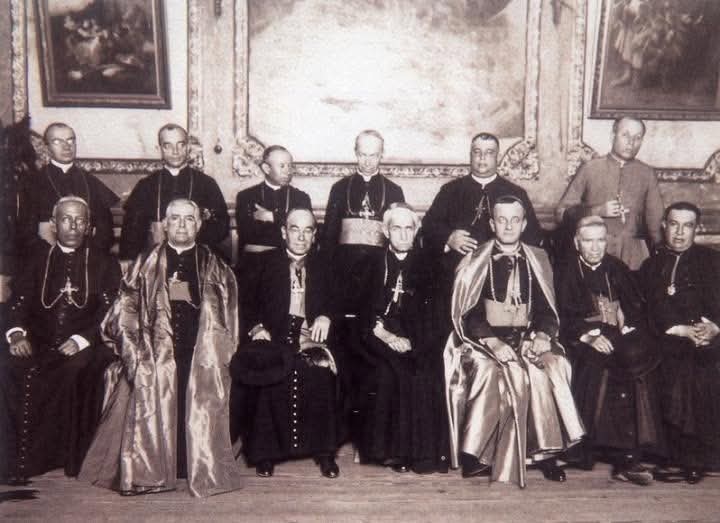
A century ago, on July 25, 1926, during the feast of the Apostle James, the archbishops and bishops of Mexico signed a Collective Pastoral Letter ordering the suspension of public worship in all churches of the Republic beginning July 31 of that same year.
The measure, adopted after consulting and obtaining the approval of Pius XI, was not a canonical interdict nor a closure of churches, but a solemn protest against what the prelates considered an intolerable violation of the Church’s divine rights, of natural law, and of Mexican constitutional principles. The immediate trigger was the decree of July 2, 1926, promulgated by President Plutarco Elías Calles, which reformed the Penal Code for the Federal District and Territories regarding offenses under common jurisdiction and for the entire Republic regarding offenses against the Federation in matters of religious worship and external discipline. That regulation, known as the Calles Law, came into force on July 31 and defined offenses related to the exercise of public worship outside churches, exceeding the number of priests allowed for each region, the wearing of ecclesiastical and religious garments outside religious premises, the prohibition of schools under the direction of religious congregations, any public act or statement in religious ceremonies against the laws, and the government’s direct responsibility for the management and administration of churches and places of worship.
The document, signed by thirty-eight prelates, including José Mora y del Río, Archbishop of Mexico; Francisco Orozco y Jiménez, of Guadalajara; Leopoldo Ruiz y Flores, of Michoacán, and the other residential archbishops and bishops together with several titular bishops, was addressed to the cathedral chapters, the secular and regular clergy, and all the faithful. Its tone is juridical, theological, and pastoral. The bishops recall the apostolic letter Paterna sane sollicitudo of Pius XI, dated February 2, 1926, addressed to the Archbishop of Mexico and to the entire episcopate, in which the pontiff described the Mexican decrees and laws against Catholics as “iniquitous,” and they reaffirm the protest formulated by the episcopate since 1917. For nearly a decade they maintained a “prudent silence” because the anti-religious articles of the 1917 Constitution were not applied with sufficient rigor to make the life of the Church impossible.
Preaching, administration of the sacraments, and public worship, though hindered, remained possible. The Law of July 2, however, “so violates the divine rights of the Church” that no further concession is possible. “It would be a crime for us to tolerate such a situation,” they write, citing the prophet’s lament: “Vae mihi, quia tacui” (“Woe to me, because I was silent”).
The suspension was presented as the only available means to express disagreement with the anti-religious articles of the Constitution and the laws that sanctioned them. It does not constitute rebellion, they argue, because the Constitution itself opens the way for its reform and because the episcopal stance is obedience to mandates superior to all human law and the defense of legitimate rights. Beginning July 31, “public worship requiring the intervention of a priest” was suspended. The churches would not be closed; the faithful could, in theory, continue to pray in them. The priests withdrew to exempt themselves from the penalties of the decree and were released from the obligation to give the notice required by law. The sanctuaries were placed under the care of the laity or of committees constituted by the municipal councils, in whom the bishops placed their trust that they would be preserved with diligence. The text also exhorts prayer and penance, and burdens the conscience of parents regarding education, since the law did not grant Catholic schools the necessary guarantees to impart religious instruction.
The antecedents go back to the Constitution of 1917. Its Articles 3, 5, 24, 27, and 130 denied legal personality to the churches, reserved the ministry to Mexicans by birth, prohibited public worship outside churches, barred religious associations from owning real estate, imposed strictly secular education, and prevented ministers from exercising political rights and publicly criticizing the laws. For years there was de facto tolerance. Beginning in 1925–1926, under Calles, the State moved from constitutional restriction to punitive regulation.
The decree signed on June 14, 1926 and published on July 2 defined disobedience to those restrictions as federal offenses. Among its provisions: only ministers who were Mexican by birth could exercise worship (with fines of up to 500 pesos or arrest and possible expulsion of foreigners); the administration of sacraments, preaching, or proselytism was considered the exercise of ministry; religious instruction was prohibited even in private primary schools; monastic orders were ordered dissolved; churches, bishoprics, rectories, and seminaries became by full right the property of the Nation; ministers were forbidden to criticize the fundamental laws; and fines, imprisonment, and, in cases of recidivism, more severe penalties were imposed. Its entry into force was set for July 31, 1926.
For the episcopate, these norms did not seek the common good nor guarantee the freedom of worship proclaimed by the Constitution, but rather to de-Catholicize Mexico. Once taken and backed by Rome, the response of suspension was applied generally. The government intensified control, inventories of churches, closures, and persecution of private worship. The result was the outbreak of the Cristero War (1926–1929), a conflict that cost tens of thousands of lives and left a deep wound in the national memory.
A century later, the commemoration of that collective pastoral letter invites a serene reading of the events. It is not about reviving polarizations, but about understanding how the combination of a restrictive Constitution, severe penal regulation, and an ecclesial response of resistance generated one of the most tragic episodes in twentieth-century Mexican history.
The 1926 suspension of worship revealed the fragility of the balance between civil power and religious freedom when the latter is reduced to a strictly private sphere and penalized in its public expression. It also showed the hierarchy’s capacity to act in a collegial manner, consulting the Holy See and appealing to the conscience of the faithful.
Today, in a Mexico that has gradually reformed the constitutional framework on religious matters and recognizes legal personality for religious associations, the memory of that pastoral letter retains testimonial value. It underscores that religious freedom is not a concession of the State but a right founded on the dignity of the person and on natural law, and that its systematic restriction generates long-term social and historical consequences. The 1926 pastoral, with its juridical protest, theological argumentation, and call to the fidelity of the laity, remains a key document for understanding not only the Church-State conflict of the 1920s, but also the limits that every democratic society must respect when legislating on conscience and worship. Today, in the Mexico of the centenary, freedom of thought and religion are recognized as fundamental human rights; however, the legal provisions of 1992 now require a review that continues to consolidate rights. To what extent have we achieved this balance, which is fundamental for the validity of a modern democracy?