


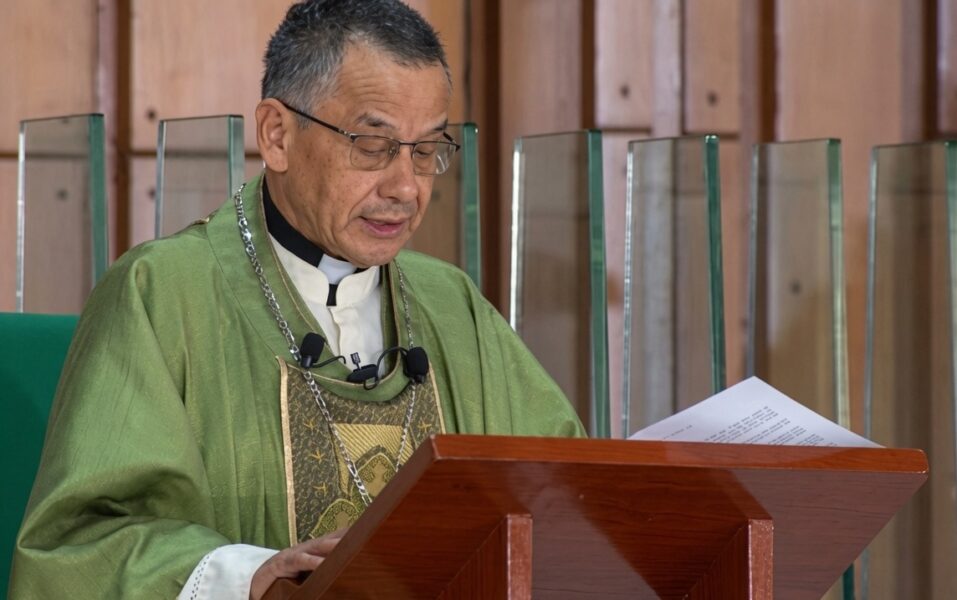
As has been followed through this blog on Infovaticana, on Pentecost Sunday 2026, Carlos Aguiar Retes, Primate Archbishop of Mexico, ordered without any protocol, without prior formal notification to the chapter, and omitting all applicable canonical norms, the immediate reinstatement of Efraín Hernández Díaz as rector of the Insigne and National Basilica of Guadalupe. The priest returned to the post from which he had been removed months earlier and while he was still subject to a prior canonical investigation ordered precisely to determine or confirm the credibility of the offenses and serious irregularities reported by the Guadalupe chapter itself.
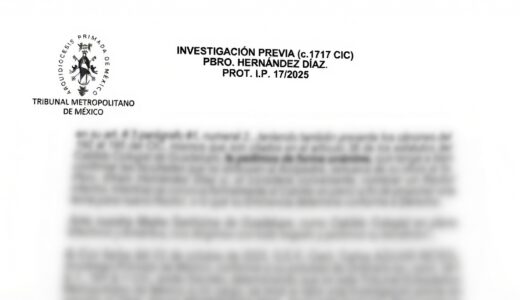
This decision, communicated verbally and unexpectedly during an internal meeting with the canons of the venerable chapter, not only lacked public foundation and the minimum procedural guarantees, but also occurred when the ecclesiastical tribunal of the Archdiocese of Mexico had already completed its work. The fact, both in form and substance, has generated an unprecedented scandal in the modern history of the most visited Marian shrine in the world and has called into question Carlos Aguiar’s credibility before millions of faithful who come each year to the Insigne Basilica seeking spiritual consolation and also, due to the betrayal of transparency in the use of the substantial resources generated by the shrine.
Canon 1717 of the Code of Canon Law precisely regulates the preliminary investigation that must be carried out when an ordinary receives news, at least credible, of an offense. Paragraph 1 states verbatim: “Whenever the Ordinary has knowledge, which at least seems true, of a delict, he is carefully to investigate, personally or through another suitable person, the facts, circumstances, and imputability, unless such an investigation appears entirely superfluous.”
This inquiry does not constitute a penal process in itself, but a preliminary and precautionary phase intended to verify whether there are sufficient grounds to open a judicial or extrajudicial process, or to order the case closed for lack of foundation. Its purpose is twofold: to protect a person’s good name and, at the same time, to safeguard the common good of the Church by preventing criminal or seriously irregular conduct from going unpunished or, worse still, being rewarded with continued tenure in offices of high responsibility.
In the case of the Basilica of Guadalupe, Archbishop Aguiar Retes ordered this preliminary investigation after receiving the formal complaint from the chapter, which warned of alleged mismanagement, administrative irregularities, and decisions that put the spiritual, pastoral, and economic heritage of the shrine at risk.
Thus, the Preliminary Investigation was opened under the heading IP 17/2025 to gather useful data and establish the credibility of the “notitia criminis,” in other words, of facts that may constitute canonical offenses and, eventually, civil ones. According to the inquiries carried out, of which this blog on Infovaticana has become aware, the ecclesiastical tribunal of the Archdiocese of Mexico, headed by Auxiliary Bishop Andrés Luis García Jasso in his capacity as judicial vicar, conducted a detailed investigation, with extended sessions of interviews, document review, and hearings. The tribunal’s experts met with canons, employees, and workers and personally visited the Basilica’s facilities to verify facts, gather evidence, and collect testimonies. The process, formally initiated on October 3, 2025 by decree signed by the judicial vicar, concluded in April 2026 with a substantiated document containing the conclusions regarding the credibility of the allegations made by the chapter.
That document should have been forwarded, as required by canon law and pastoral prudence, to the principal actor in the case, Archbishop Aguiar Retes. It was then up to the archbishop himself to transmit the conclusions, in the first instance, to the Mexican Episcopal Conference and, likewise, to the Apostolic Nunciature and the Basilica chapter, as the collegiate body directly affected. None of these notifications were carried out transparently. Instead, Aguiar chose the “synodality” that characterizes him: the unilateral path and opacity.
This blog had access to an audio recording dated May 24 in which Aguiar Retes, addressing the chapter, categorically states that “it was time to make a decision” about the rector and that his reinstatement was appropriate “because nothing serious had been found against him.” The statement, however, directly contradicts what is recorded in the conclusions of IP 17/2025. It is not a matter of differing interpretations; it is a statement that this medium, based on the elements observed, qualifies as deliberate and malicious, since the archbishop knew or should have known the content of the investigation prepared by the tribunal he himself had ordered.
According to information obtained by this medium, on October 3, 2025, Efraín Hernández, in accordance with canon 392 §1 of the Code of Canon Law, was removed, “until further disposition, from the office of Rector of the Insigne and National Basilica of Guadalupe and from any assignment or management of an economic nature and from the administration of the goods of the Shrine of Guadalupe.” In addition, his faculties as Episcopal Vicar Territorial of Pastoral Zone I were withdrawn.
The above is important. These precautionary measures, of a preventive and non-punitive nature, were applied by the then vicar general and moderator of Aguiar’s curia, the current Bishop of Cancún-Chetumal. The rector was “intimated,” that is, formally notified of these restrictions. In canon law, only a similar, subsequent, and express written juridical act can lift such measures. That act, to the best of our knowledge, never occurred prior to the reinstatement on May 24. The reinstatement ordered by Aguiar Retes therefore lacked legal basis even with regard to the previously decreed precautionary measures.
Although IP 17/2025 does not prescribe the specific penalty to be imposed on the priest involved because that must be the subject of a possible penal process, it does establish unequivocally that Efraín Hernández Díaz may have committed actions and acts that the ecclesiastical tribunal considered credible and that should have been confirmed or refuted in a penal instance. Among the most serious conclusions that this blog has been able to verify are the following:
The decisions made by Father “Efra,” not communicated to the chapter, which endangered the proper patrimonial administration of the goods of the Shrine of Guadalupe. During Efraín Hernández’s tenure, “the pastoral, spiritual, and administrative purpose” of the economic and patrimonial goods of the Basilica “was lost,” “putting at risk” its character as a public and ecclesiastical juridical person. The dangers investigated included the removal of reserved documents from the Shrine, bank statements, properties, and confidential data of the institution, its employees, and its priests, which allegedly were handed over to persons outside the institution.
The report also records a possible “psychological and spiritual disorder” that the rector may be experiencing, who, “advised by third parties belonging to groups of power and malice,” allegedly made erroneous decisions, sidelining the collegiate chapter from its legitimate functions. It is particularly noted that in a meeting attended by Archbishop Aguiar himself, Father Efraín swore to use “all means at his disposal to destroy” —literally— a canon of the chapter. The tribunal considered this statement a potential threat to the life and integrity of the affected priest.
Despite the forcefulness of these findings, IP 17/2025 still leaves open whether there is or is not a relationship that could link the rector to criminal groups. The document, in the possession of the ecclesiastical tribunal, is the result of a diligent, highly responsible, and professional investigation directed by Bishop García Jasso. However, Aguiar disregarded or directly ignored it when ordering the reinstatement of the person under investigation.
If the archbishop obstructed canonical justice by reinstating Father “Efra” without having formally lifted the precautionary measures or made the tribunal’s conclusions public, he would be becoming a virtual accomplice in covering up possible irregular acts. A precedent of this nature would have an unprecedented and devastating effect on the history of the Basilica of Guadalupe and on the credibility of Archbishop Carlos Aguiar Retes, who has always boasted of being a friend of Pope Francis.
The questions this blog raises are unavoidable: Why did Carlos Aguiar Retes carry out such a dirty and risky move? What led him to categorically tell the chapter that “there was nothing” against Father Efraín, when the canonical file said otherwise? Why did he fail to transmit the sensitive conclusions to the Pope’s representative in Mexico, to the president of the Mexican Episcopal Conference, and to the bishops of Mexico with responsibility for the Guadalupe shrine?
The increasingly undeniable evidence indicates that higher causes are at work here, pointing to the archiepiscopal mitre. Aguiar knows it. Such a suspicious proceeding places him in the spotlight for shielding a priest who had, and again has, direct responsibility for controlling the millions of dollars in resources generated by the Basilica of Guadalupe.
Even more suspicious is the fact that, after the reinstatement ordered by Aguiar, the faithful who participate in liturgical celebrations are no longer invited to make their donations to the Basilica of Guadalupe, but directly to the Archdiocese of Mexico. Time, meanwhile, works against the truth. Each passing day reduces the opportunities for clarification, allows possible accomplices to consolidate their positions, and facilitates the disappearance or alteration of essential evidence.
Finally, there remains a point that must be brought to light without further delay: the external audit conducted by Deloitte, whose results remain in absolute opacity. The Guadalupe Catholic faithful, the venerable chapter, and the entire Church in Mexico have the right to know the full truth. The Virgin of Guadalupe deserves a shrine administered with justice, transparency, and holiness. Not with lies, cover-ups, or power plays.
The solution cannot be limited to removing a rector once again. What is just and what the truth demands is that both Efraín Hernández Díaz and the one who reinstated him answer for their actions and repair all the damage caused to the institution, to the canons who fulfilled their duty to report, and to the millions of faithful who trust in the Basilica as the house of the Mother of God and not as a fiefdom of dark interests. Allowing both to continue on their way without being held accountable would amount to consummating a “master scam” in the Hernández Díaz version… “What shall I do with you, Ephraim?” (Hos 6:4)