


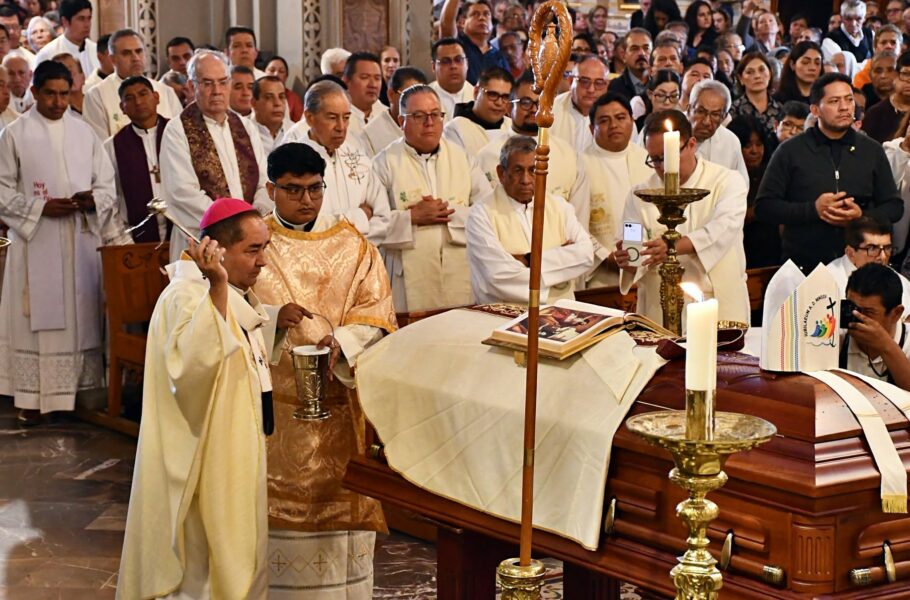
The Cathedral of Morelia filled with the faithful, priests, religious sisters, seminarians, bishops, and civil authorities on the morning of Monday, August 10, 2026. The pealing of the bells announced the beginning of the Funeral Mass for the eternal rest of Carlos Garfias Merlos, Archbishop Emeritus of Morelia, who passed away on Thursday, August 6, 2026 in his hometown of Tuxpan, Michoacán, at the age of 75. The main church of the Michoacán capital became the setting for a solemn and deeply moving farewell, where the pain of separation mingled with the firm proclamation of Christian hope.
The Eucharist was presided over by José Armando Álvarez Cano, Archbishop of Morelia, who had succeeded Garfias Merlos after the acceptance of his canonical resignation by Pope Leo XIV on January 19, 2026. Numerous priests from the archdiocesan presbyterate and bishops from various dioceses concelebrated, including some who had shared the episcopal ministry with the deceased in the sees of Ciudad Altamirano, Nezahualcóyotl, and Acapulco, as well as his predecessor, Cardinal Alberto Suárez Inda. Family members, religious sisters, seminarians, parishioners from various parishes, and representatives of local authorities gathered in the pews and aisles, including the mayor of Morelia, Alfonso Martínez Alcázar. During the celebration, a message of condolences sent by Pope Leo XIV from the Vatican was read, a gesture that underscored the communion of the universal Church with the Michoacán community.
The body of Carlos Garfias Merlos had initially been laid out in the Parish of Santiago Apóstol in Tuxpan, his birthplace, where Cardinal Alberto Suárez Inda presided over a Eucharist on Friday, August 7. On Sunday afternoon, it was transferred to the Cathedral of Morelia for the wake. Hundreds of the faithful filed past the coffin, upon which his episcopal vestments, mitre, and crozier were placed—symbols of his pastoral service. On Sunday night and into Monday morning, the cathedral remained open, allowing the people of God to pray the rosary, sing, and offer their final personal farewell to the shepherd who had accompanied them for nearly a decade at the head of the archdiocese.
The Funeral Mass unfolded in an atmosphere of solemnity and recollection. The readings proclaimed—from the prophet Isaiah, the First Letter to the Corinthians, and the Gospel of John on the resurrection of Lazarus—oriented the entire celebration toward the victory of Christ over death. In the homily, José Armando Álvarez Cano offered a profound meditation that did not dwell on the pain but led the assembly toward paschal hope.
The Archbishop of Morelia warmly greeted the people of God gathered there and recalled that the funeral liturgy does not allow one to remain solely in the suffering of separation. “The readings we have just heard are not centered on death, but on the definitive victory of Christ over death,” he affirmed. Drawing from the banquet announced by the prophet Isaiah, where God removes the veil covering the peoples and destroys death forever, Álvarez Cano emphasized that the faith of the Church today proclaims for Carlos Garfias the very message he had so often announced at countless funerals: that death is not the end, but the passage to eternal life.
From the second reading, he highlighted the Pauline image of Christ as the “firstfruits” of those who have died. The Lord’s resurrection is not an isolated event but the beginning of a new humanity. “We are not simply bidding farewell to a man who concluded a long pastoral journey. We are accompanying a disciple who is now called to fully participate in the Lord’s Passover,” he said. The entire episcopal life of Carlos Garfias Merlos—proclaimed in the Gospel—confirmed his people in the faith, ordained priests, promoted vocations, celebrated the sacraments, and worked so that Christ might reign in hearts; it was all oriented toward preaching that Kingdom which now becomes for him a fulfilled hope.
Pausing on Jesus’ dialogue with Martha at the tomb of Lazarus, Álvarez Cano highlighted the Lord’s personal question: “Do you believe this?” The Church today makes Martha’s confession her own. “We believe that Christ has conquered death. We believe that the ministry of a bishop does not end in the tomb. We believe that the communion of saints continues beyond this life. And we believe that the Lord today receives the one who served Him for so many years as a shepherd of His Church.”
The current archbishop then developed a reflection on the episcopal mystery. In an age marked by uncertainty, violence, fear, and discouragement, the bishop is called to keep his gaze fixed on the risen Christ in order to help others not lose hope. His mission is not merely to administer a diocese, but to make Christ present—the Good Shepherd who never abandons His flock. Álvarez Cano evoked Pope Francis’s teaching on the shepherd who walks ahead, among, and behind the flock, and recalled the words of Benedict XVI: “whoever has hope lives differently.”
Recalling the concrete figure of Carlos Garfias, he noted his love for formation, his concern for seminaries, his work with young people, his promotion of organic pastoral care, and his constant invitation to live synodality. However, if one were to highlight a particularly significant trait, “many would immediately think of his commitment to building peace.” In the various dioceses he served—Ciudad Altamirano, Nezahualcóyotl, Acapulco, and Morelia—marked by violence, Carlos Garfias Merlos understood that the Church could not remain indifferent. He promoted a culture of encounter, fostered spaces for dialogue, encouraged reconciliation processes, and supported initiatives aimed at rebuilding the social fabric. “Peace was not simply the absence of violence; it was the fruit of justice, forgiveness, and conversion of the heart,” Álvarez Cano explained. His word was firm in denouncing violence, yet always filled with hope, convinced that the Gospel retains all its power to transform persons and communities.
“The death of a bishop does not mean that his voice is silenced,” the celebrant affirmed. His teaching, his example, his gestures of charity, and the seeds of hope he sowed remain alive in the hearts of the people he shepherded. That is the most beautiful legacy a shepherd can leave: a community that continues walking with its gaze fixed on Christ. The best way to honor his memory, he emphasized, is not merely to recall his work, but to continue the authentic promptings of the Spirit that God inspired in his service. “May we priests continue to be men of communion, may our communities be true schools of reconciliation, may we never yield to the logic of hatred or division, may we always work for a Church capable of building bridges, listening, dialoguing, and proclaiming hope.”
The homily concluded with an invitation to renew faith: “We will do so with tears, because love also weeps. But we will do so with hope, because faith assures us that the tomb does not have the last word. The last word belongs to the risen Christ.” José Armando Álvarez Cano entrusted Carlos Garfias Merlos to Our Lady of Health, patroness of the Archdiocese of Morelia, so that she might accompany him to the definitive encounter with the Good Shepherd whom he served throughout his priestly and episcopal life.
At the conclusion of the Eucharist, the coffin was carried toward the crypt located beside the main altar. Amid prayers, hymns, and not a few spontaneous applause from the faithful, the mortal remains of Carlos Garfias Merlos were laid to rest in the Crypt of the Archbishops of the Cathedral of Morelia. There, alongside other shepherds who preceded him in the service of this particular Church, his body rests in hope of the resurrection.