


Visit of Mrs. Mullally.
The Pope at La Sapienza.
Eighteen years after Benedict XVI’s failed visit to La Sapienza, protested by 67 professors in January 2008, another pope will enter the Roman university. Leo XIV will cross the threshold of the Studium Urbis on May 14, in a gesture interpreted as reconciliation. From Boniface VIII’s papal bull of 1303 to Paul VI’s return in 1964, passing through Wojtyła’s honorary doctorate: seven centuries of relations between the papacy and the university are rekindled.
The last time a Pope was to cross the threshold of La Sapienza was on January 17, 2008. It did not happen: Benedict XVI was forced to cancel the academic year’s inauguration after a letter from 67 professors describing him as an «enemy of science.» Eighteen years later, another Pope will enter the university’s walls. Leo XIV will visit Rome’s La Sapienza University on May 14, resuming a dialogue interrupted for nearly twenty years. Rector Antonella Polimeni welcomed the news as a sign of hope in a time of strong international tensions. The relationship between the Papacy and the Studium Urbis —founded by Boniface VIII on April 20, 1303, with the papal bull «In supremae praeminentia dignitatis»— is a seven-century history of ties, marked by continuities, fractures, and attempts at reconciliation.
For more than five centuries, popes did not «visit» Sapienza University in the modern sense, as they constituted its hierarchical apex and source of legal legitimacy. Under Leo X, great European scholars arrived in Rome and modern pharmacology was introduced; under Alexander VII Chigi, the university moved to the monumental complex of Corso Rinascimento, enriched by the genius of Francesco Borromini and the Alexandrian Library. The end of temporal power in 1870 marked a traumatic break: for decades, pontiffs did not set foot within the university’s walls, which had become a symbol of the secularization of national culture. The act of breaking the silence bears the signature of Paul VI, who on March 14, 1964, was the first Pope to cross the university’s threshold after Italy’s reunification.
Montini presented himself not as a sovereign, but as a «former student and friend,» recalling with emotion the years he spent at the Studium Urbis. In his speech, he used the metaphor of two converging lights: faith and science, not as alternatives, but as flames destined for a necessary «symbiosis.» Thirty years later, on April 19, 1991 , John Paul II returned to Piazzale della Minerva for an encounter that became a massive event. The Pope had received and analyzed more than 500 questions written by students and exhorted the young people to build a «civilization of love» and to «be not afraid.» The most solemn recognition took place on May 17, 2003, when the Faculty of Law awarded Wojtyła an honorary doctorate on the occasion of the university’s seventh centenary.
In 2008, the pretext for the protest was a 1990 quote in which Ratzinger had cited Paul Feyerabend on Galileo’s trial, actually to illustrate the crisis of modern reason. The speech, which was never delivered and which the Holy See made public, revolved around the question «what is truth?» and was presented as an apology for the university’s role in the search for the ultimate meaning of things. That wound has marked the Italian public debate on the relationship between faith and secularism for years. The visit of Leo XIV includes arrival at the chapel of Divine Wisdom, a greeting to students from the monumental staircase, signing the Book of Honor, and the official speech in the Great Hall. A day that, seven centuries after Boniface VIII’s papal bull, reminds us that the Bishop of Rome and the world of culture can still reflect together on the future of humanity.
Pope Leo with the European People’s Party.
Leo XIV received in audience the delegation of the European People’s Party in the European Parliament headed by President Manfred Weber. Accompanying him is the Irishwoman Mairead McGuinness, former European Commissioner for Financial Services and current EU Special Envoy for the promotion of freedom of religion or belief outside the European Union. After the 2024 European elections, the group consolidated its numerical leadership in the chamber, at a time of fierce competition with the ECR, right-wing and identitarian, and the Patriots. In 2006 similar audiences were held with John Paul II and Benedict XVI, while Francis —who could not preside over the June 2023 meeting due to his recovery at Gemelli Hospital— had sent a written message. Leo XIV explicitly affirmed continuity, resuming «the guiding thread of this dialogue» with a group that, as he recalled, draws inspiration from Adenauer, De Gasperi, and Schuman, «unanimously considered the Founding Fathers of contemporary Europe.»
The core of his speech revolved around an ancient and heated contrast: ideal versus ideology. The Pope affirmed the ideal character of the European project born from the ruins of 1945, but warned against any mystification. Ideology, he said, distorts ideas and enslaves man «to his own project,» stifling his true aspirations for freedom and well-being. Leo XIV equated «populisms that seek only easy consensus» with elitisms that act «without consensus,» qualifying them as «two widespread trends» in the current political landscape.
The EPP arrives at the Vatican amid an internal transition within the European right: borders with the ECR are becoming increasingly permeable, parliamentary decisions on climate, migration, and rights have divided the chamber on more than one issue, and the Christian democratic identity of the group is being openly questioned by a sector of its members. Leo XIV did not name adversaries or bless alliances, but reminded the People’s Party that the Christian heritage it claimed in its name was not mere heraldic decoration and that politics —quoting Pius XI to conclude— could still be «the highest form of charity,» provided there was the necessary courage
Audiobook of St. Augustine.
Rogation Days at Santa Maria Maggiore.
On the liceity of episcopal ordinations.
Work by a group of theologians from the Priesthood of St. Peter , published in Claves in which, in light of Catholic Doctrine and Tradition, they analyze the illiceity of episcopal ordinations without pontifical mandate, announced by the Priesthood of St. Pius X for July 1, 2026 . This article received by Cardinal Robert Sarah: « Many thanks for this so enlightening text. It will illuminate those who wish to live their faith in the Truth, that is, in Christ and in his Church. Since 2001, I have collaborated with the Supreme Pontiff in the selection of candidates for the Episcopate, after a long and meticulous investigation of each one. I am surprised and deeply indignant that a simple decision by a superior of the community determines the ordination of ‘truly Catholic bishops.’ Thank you for this wonderful, clear, and well-documented text. We must know that it is not we who save souls. It is only Christ who saves. We are mere instruments in his hands. Let us continue praying that the Body of Christ may not be divided again ».
What is the fundamental argument?. An episcopal consecration not authorized by the Holy See, when it is not accompanied by schismatic intent or the collation of jurisdiction, does not constitute a break in the Church’s communion. The dogmatic constitution on the Church Lumen Gentium states in chapter III, no. 21 [LG 21] , that the power of jurisdiction is conferred by episcopal consecration. […] The argument that concludes that future episcopal consecrations within the Society of St. Pius X would be schismatic is based entirely on the postulate of the Second Vatican Council according to which episcopal consecration confers both the power of orders and that of jurisdiction.
The argument contains two important errors: one relative to what the Second Vatican Council states; another relative to the arguments of those who oppose future consecrations. Contrary to what the Society of St. Pius X claims, according to the Second Vatican Council, what episcopal consecration confers is not the power to govern (jurisdiction), but rather offices or functions. Therefore, the Society of St. Pius X asserts —without proving it— an alleged «erroneous postulate of the Second Vatican Council.» Consecration produces an innate and indelible vocation, inscribed in the «episcopal character,» to govern a part of the Church, but this aptitude must be translated into action through a true «power» of jurisdiction. And it speaks of a «radical authority inscribed in the consecration.»
Yes, a bishop who has not received subjects to govern (titular bishop) or who is retired (emeritus bishop) does not confirm or ordain the subjects of other bishops in the Church without the permission of their respective ordinaries. The titular bishop is certainly consecrated without real jurisdiction being conferred upon him, but nonetheless exercises, in the order of sanctification, his «grace as head» received in consecration (cf. St. Irenaeus, Adversus hæreses , III, 17, 2) in hierarchical communion with the Pope and the other bishops. Whenever a bishop without real jurisdiction exercises his episcopal sacramental power, he does so with a mission received from those who do have jurisdiction (diocesan bishops or religious superiors).
The Society of St. Pius X claims that «the consecration of fully Catholic bishops is necessary for the ordination of fully Catholic priests who will continue to transmit the Deposit of Faith without alteration» (AA. VV., Al servizio della Chiesa. Le consacrazioni episcopali della Fraternità San Pio X , Edizioni Piane, 2026). A consecration outside hierarchical communion constitutes a grave defect that, if not schismatic, at least resembles schism. The Venerable Pope Pius XII defines the consecration received without apostolic institution as «a most grave attack on the very unity of the Church,» and defines the acts of the power of orders by bishops thus consecrated as «gravely illicit, that is, sinful and sacrilegious» (encyclical Ad Apostolorum principis , June 29, 1958).
Subjectively, it is possible. The grave and prolonged crisis in the Church, particularly the fact that some members of the hierarchy may, at times, foster error or be complicit with those who promote it, can lead some, in good faith, to lose sight of essential elements of Catholic doctrine, such as hierarchical communion. And subjective intention is a matter of God’s judgment. But objectively, the Lefebvrist episcopate cannot be constituted without denying the condition of Catholics to the other bishops: the Society of St. Pius X recognizes this when it claims that it is necessary to constitute «a truly Catholic episcopate» for «the salvation of souls.»
The angry rainbows with Leo XIV.
On the subject of homosexual couples , Pope Leo XIV added that “ going beyond this today carries the risk of creating more division than unity ”, demonstrating above all attention to the unity of the Holy Roman Church, and that “ we must seek ways to build unity upon Jesus Christ and upon what Jesus Christ teaches”. The German Catholic Church has followed its own path, its Synodaler Weg and, since its launch in 2019, has addressed topics that Rome considers untouchable: priestly celibacy, the role of women, and the blessing of same-sex couples .
Rainbow information pages explain it by an economic background: «The German Church is the richest in the world : while the Holy See owns assets estimated at 4 billion euros , the German Church controls around 250 billion . No one wants to break ties with its main financier, and the German bishops know it». They are aware that: «The message for LGBTIQ+ people is this : Leo XIV is blocking the Germans, but he does so with an argument that sounds almost instrumental. Sexuality, he says, is not the central issue, as if the problem were polarization, not discrimination. In the extensive interview published in Italy in February 2026, he had already said that it is » very unlikely, certainly in the near future, that the Church’s doctrine will change » regarding sexuality and marriage, but without ruling out the possibility that it might in the long term. Leo XIV’s urgency now does not lie in the same-sex couples that German Catholics want to bless, but in keeping the German Church united with that of Rome: 250 billion against 4 billion».
The Germans angry with Leo XIV.
Peter Frey, member of the Central Committee of German Catholics, for nearly 20 years called for: «Incorporating political ideas into the debate in service of the people , together with allied partners from all sectors of society, would also be a way to regain lost trust». This commitment must go beyond stances on abortion and euthanasia to consider other phases of life as well, the spokesperson declared on Friday in Augsburg. This includes, for example, compatibility between work and family life, climate justice, and cooperative building and housing. Frey spoke at the opening of the general assembly of the Bavarian State Committee of Catholics.
The journalist expressed his irritation at the Pope’s recent statements on blessing ceremonies for unmarried couples, including same-sex couples . He argued that denying them blessings was incompatible with the message of a God who loves everyone as He created them. «I understand that in a Church with diverse perspectives, certain liberal stances are not acceptable to all, especially in conservative Africa.» The Pope should guide the Church towards a present of regional and cultural differences and show courage in all respects. «Denying blessings to people living in homosexual couples because of their sexual orientation, verbally discriminating against them in front of others, is not in keeping with the message of a God who loves everyone as He created them.»
Vocations in the world.
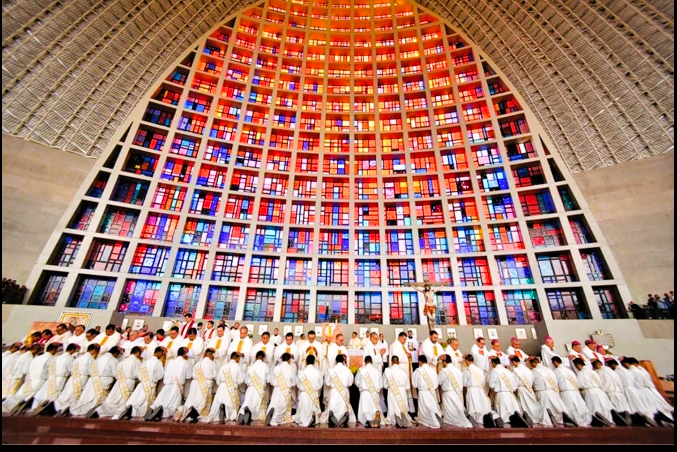
Today is Good Shepherd Sunday and it is a day of prayer for vocations. Guillermo Gazanini in Infovaticana has an interesting entry on «These countries have the largest seminaries in the world.» It is well known that by their fruits you shall know them and the fruits are where they are. «They are the largest on the planet, Seminaries that, according to 2024-2025 data, train a good number of priests; of those, two are on the distant island of Flores in Indonesia; another in Guadalajara, Jalisco, west of Mexico; and the last in the coal city of Enugu, southeast of Nigeria, an African nation neighboring Cameroon and Equatorial Guinea, recently visited by Leo XIV.» All have hundreds of candidates for the priesthood, the Diocesan Seminary of Guadalajara holds the undisputed title of the world’s largest seminary for a single diocese. «With more than 1,120 seminarians in all stages according to 2023-2024 data, confirmed in 2025 references. Founded in 1696, it is one of the oldest formative institutions in America. In more than three centuries it has been the cradle of nearly 10 thousand presbyters, around 100 bishops, five cardinals, Robles Ortega (2007), Sandoval Íñiguez (1994), Salazar López (1973), Garibi Rivera (1958 and first Mexican cardinal) y Gómez Portugal y Solís (1850), bishop of Michoacán, first Mexican cardinal in pectore of Pope Pius IX, who might have been the first American cardinal as well; it has given 15 canonized martyr saints, many of them trained in its classrooms during the difficult times of religious persecution. Today it continues to hold annual ordinations, with 107 priests between 2022 and 2023, 32 in 2024, demonstrating that a diocesan seminary, despite its dimensions, is a vocational nursery. Our image today is from one of its latest ordinations in the Sanctuary of the Martyrs of Guadalajara, one of the largest churches in the world with capacity for 12,000 faithful.
«…if anyone enters through me, he will be saved; and he will go in and out and find pasture.»
Good reading.