


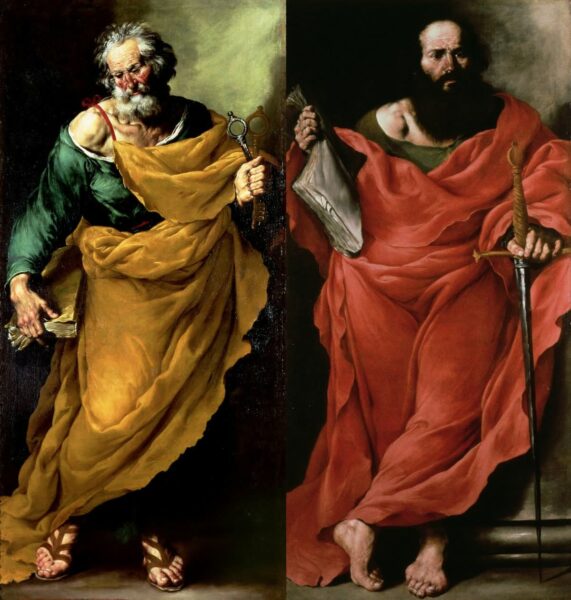
We begin the week with the feast of the Holy Apostles Peter and Paul and with the blessing and imposition of the pallia on the new archbishops in St. Peter’s. Today’s news is full of summaries and assessments of the consistory; that is not our mission—they are available in all possible languages. We focus instead on some general considerations that may help to understand the impact of what has been celebrated these days.
The Pope asks the cardinals for support.
Luis Badilla offers a summary of the consistory that we will not repeat. If any phrase from the Pope remains, it is: “I need your support: firm, explicit and public. I need to feel supported by you as by brothers.” Is the Pope in difficulty? The synodal method imposed is causing two major headaches among the cardinals: the division into groups—with distinctions reminiscent of first- and second-class cardinals, based on categories or continents—and the severely limited speaking time. Complaints are widespread: many wonder why most interventions must be sent only by email, while only certain groups may present their reports in the hall. An email cannot replace a proper presentation before the assembly.
Müller’s proposals in the face of schism.
The cardinal had the necessary frankness to shake his brothers out of a rather uncomfortable silence, almost as if a new imminent schismatic act were something that should not concern the Church. Müller seemed to want to suggest two things to the Holy Father. The first concerns the fact that the time has come to respond substantively to the accusations, without leaving this task to improvised interviews by some prelate or solely to theological debate. This is also because the faithful have a right to clarity from their pastors.
The political significance of the Consistory of Leo XIV.
Considering that, during the pontificate of Pope Francis, the cardinals went several years without meeting in Rome. As anticipated in a letter from the dean cardinal Giovanni Battista Re, the agenda focuses on four themes: the international situation, peace and overcoming the theory of the “just war,” the encyclical Magnifica Humanitas, and the implementation of the Synod. There are at least two issues on the table. On the one hand, the Society of St. Pius X will soon make the bishop appointments announced without mandate or agreement with Rome, which could generate a schism. On the other hand, concerns persist in Germany, where the synodal hierarchy has long been demanding greater transparency on various issues. Secondly, in his speech yesterday, Leo XIV also made a second significant exhortation: “We are not here primarily to reflect on the internal life of the Church.” These words reflect the pontiff’s interpretation not only of the current assembly, but also of the Church, which—from his perspective, and there is reason to hope not only from his—has a primary mission: to proclaim Christ to the world. “The mission is not one of the many tasks of the Church. It is its reason for being.”
“Pact of the Religions”
The Italian Bishops’ Conference signs the “Pact of the Religions,” a syncretism that excludes the truth. On June 25, the Italian Catholic Church, together with other Christian and non-Christian confessions, signed a Pact for “Italian dialogue: religions in the public space and social cohesion.” Various Islamic, Buddhist, Bahá’í, Protestant, Orthodox, Jewish, and Hindu religious groups also adhered to the Pact. We cannot confuse trying to coexist as best as possible with other religions with the need to sign social and public Pacts that have implications far beyond the principles of good coexistence and are based on an unconvincing vision of the Catholic religion and other religions. This does not simply mean replacing various religions with one that takes fragments of the others and reassembles them into a new framework. Syncretism is not constructive, but deconstructive and fluid. It tends to deconstruct religions to reach a hypothetical common denominator on which all can converge. The Pact in question does not highlight the enormous differences that exist , especially between Catholicism and other religions, but only points to possible practical convergences, as if practice were independent of doctrine. In this way, it conveys the message that it is better to set aside the question of the truth or falsity of religions, that none can be considered true, and that only their practical cooperation matters for creating social cohesion.
Can the Dioceses in Europe Go Bankrupt?
The economic disaster caused by the abuses has led to the bankruptcy of many dioceses in the United States, forced to compensate victims of abuse, and now it seems to be replicating in Europe. The Church is “infiltrating” Italian institutions to prevent the same thing from happening. While at present in Europe (except in Italy) the economic damages are less severe than those suffered by the Church in the United States, France , Spain , Portugal , Switzerland , Belgium , Poland , the Czech Republic , Germany and Ireland have begun to offer economic compensation to the victims.
Italy hosts 43% of all European priests, 12.7% worldwide and the economic damage in Italy alone is almost as significant as that suffered by the Church in Europe. While the compensations granted in Europe are insignificant compared to those imposed by U.S. courts, we are talking about an average of 60,000 euros per victim, excluding Italy, a considerable sum in total. Italy currently has a total of 1,178 registered cases by the Permanent Observatory of the Abuse Network (June 28, 2026) (or 3.80% excluding the secular sector), with a total of 4,761 surviving victims. Approximately, this would amount to a total compensation of €285,660,000 in Italy alone. This is undoubtedly a significant figure, considering that the data from our observatory are considerably lower than those that would be produced by an independent government commission. Today, Italy is a real time bomb about to explode within the Church.
“I’m already in”
We usually talk a lot about the German Synod and its problems and very little about its Austrian and Swiss neighbors who are in the same situation. The “Ich bin Dabei” (“I’m in”) campaign of the diocese of St. Gallen, Switzerland, is intended to encourage the participation of the laity in the Church and includes a poster calling for the election of the “first woman pope.” The ongoing campaign of the diocese, which was officially launched in May, includes several posters displayed in about 25 towns and cities, as well as on its website, with faces of laypeople promoting debate on various issues, such as helping the poor, clerical abuse, and “diversity.” The most scandalous poster shows the face of a laywoman and says: “Working together to pave the way for the election of the first woman pope? I’m in!” The website of this poster states that women must be treated on equal terms with men “in all circumstances.” Another section of the page, titled “A church with women,” further emphasizes the supposed need to eliminate “gender inequality” and demands that gender play no role in the “ecclesial community,” apparently alluding to women’s “ordination.”
The diocese of St. Gallen is known to most Catholics as the meeting place of the infamous St. Gallen Mafia, a group that opposed the election of Cardinal Joseph Ratzinger to the papacy in 2005 and conspired to elect Jorge Mario Bergoglio as pope. The group held several meetings in St. Gallen, Switzerland, between 1995 and 2006. Shortly after his election to the papacy in 2025, Pope Leo XIV appointed Father Beat Grögli, a staunch advocate of women’s ordination, as the twelfth bishop of St. Gallen. Grögli had previously said that the Church needs “a broad roof” and, according to a report from SRF , stated in response to a diocesan questionnaire that “the ordained ministry [Holy Orders] can no longer be only a matter for men.”
“You are the Christ, the Son of the living God.”
Good reading.