


It’s Monday, Pope Leo is at his villas, today there is no agenda but we do have news and articles, and not a few. Let’s begin…
The dialogue with the Orthodox Church.
Diane Montagna, published on her page on Substack, analyzes in detail the efforts of the Holy See to restore dialogue with the Orthodox Church, which could depend on the Holy Father’s response to the Final Report of Study Group 9 of the Synod of Bishops on homosexuality. Pope Leo XIV calls for resuming dialogue with the Coptic Orthodox Church after the break that occurred in March 2024 following the declaration Fiducia supplicans. In the statements released on Friday, neither Pope Leo XIV nor the Vatican acknowledged that the document itself had caused the Coptic Orthodox Church to suspend ecumenical talks with Rome.
In a telephone conversation with His Holiness Pope Tawadros II of Alexandria and Patriarch of the Preaching of St. Mark and of all Africa, Pope Leo XIV adopted a conciliatory tone. According to the Vatican: “the conversation took place in a cordial and fraternal atmosphere,” and both sides expressed “the desire to revitalize the celebration of the Day of Friendship between Copts and Catholics, seeking to overcome any possible obstacle to the dialogue of faith and charity.” The telephone call also reflected “the awareness of the shared responsibility in proclaiming the Gospel and promoting peace and reconciliation, especially in the troubled Middle East.”
The communiqué from the Holy See Press Office made no reference to the declaration Fiducia supplicans, the December 2023 statement that led the Holy Synod of the Coptic Orthodox Church, in March 2024, to suspend theological dialogue with the Holy See. Since its publication, the declaration Fiducia supplicans has drawn strong criticism in the Orthodox world. Three days after its release, Hilarion Alfeev, Metropolitan Archbishop of Budapest, stated that his initial reaction had been one of “shock.” He described the Roman Catholic Church as a “beacon of traditional Christianity” and warned that such documents risked creating “new divisions” and hindering fruitful dialogue.
In January 2024, Cardinal Kurt Koch, Prefect of the Dicastery for Promoting Christian Unity, acknowledged that the declaration “Fiducia supplicans” had provoked “negative reactions” among the Orthodox and revealed that he had written to Cardinal Fernández, Prefect of the Dicastery for the Doctrine of the Faith, requesting clarifications amid growing concern. When the Holy Synod of the Coptic Orthodox Church formally announced the suspension of dialogue two months later, its statement did not explicitly cite the declaration Fiducia supplicans. The bishops simultaneously reaffirmed the Church’s rejection of homosexual relationships and condemned any blessing of such unions as “a blessing of sin.” In a subsequent video statement, Father Moussa Ibrahim, Coptic spokesman, removed any remaining ambiguity, describing the suspension as a response to “Rome’s change of stance on the issue of homosexuality.” In response to the controversy, Cardinal Víctor Manuel Fernández traveled to Cairo in May 2024 to meet with Pope Tawadros II, where he sought to clarify the Vatican’s position, arguing that the declaration Fiducia supplicans did not authorize the blessing of unions themselves, but rather of individuals seeking pastoral support.
Pope Leo XIV is making gestures to reopen new debates, but without reviving the controversy in public. “This pilgrimage of friendship has allowed our Churches, separated by centuries of misunderstandings, to engage in a highly fruitful theological dialogue,” wrote Pope Leo XIV to Pope Tawadros II in a letter published on Friday on the occasion of the Day of Friendship between Copts and Catholics. “I hope that this Commission […] may resume its work with all the Churches of the Eastern Orthodox family as soon as possible.” The letter contained no reference to the reasons for the breakdown in relations, nor did it include a renewed defense of the declaration Fiducia supplicans.
The suspension of talks between Rome and the Coptic Orthodox Church represented a major setback in relations that had been steadily developing since the 1970s, when formal dialogue began under the pontificate of St. Paul VI and Pope Shenouda III. Until 2023, relations appeared to be improving significantly: the Holy See allowed Coptic Orthodox to celebrate the Divine Liturgy in the Archbasilica of the Most Holy Savior and of Saints John the Baptist and the Evangelist in the Lateran, in Rome, and Pope Francis added to the Roman Martyrology twenty-one Coptic martyrs killed by the Islamic State in Libya.
Pope Leo XIV’s ecumenical outreach to the Coptic Orthodox Church may face new challenges following the publication earlier this month of the Final Report of Study Group 9 of the Synod of Bishops. The report, which calls for a “paradigm shift” in the Church’s approach to homosexuality, has received harsh criticism from Catholic prelates and commentators and includes testimonies from men in same-sex civil unions who see homosexuality as a “gift from God” and criticize Courage International, a canonically approved apostolate for people with same-sex attraction.
In recent days, we have learned that Jesuit Father James Martin SJ, a prominent advocate for the LGBT cause, played a central role in coordinating the testimonies included in the report. The General Secretariat of the Synod of Bishops is attempting to distance itself from the Final Report of Study Group 9 following the revelations; Cardinal Mario Grech, Secretary General of the Synod of Bishops, initially praised the document as “the synodal method applied to the most demanding situations.” The efforts of Pope Leo XIV to restore ecumenical dialogue with the Coptic Orthodox Church may depend on his response to the Final Report of Study Group 9 of the Synod of Bishops.
Schism confirmed and dated.
Cardinal Fernández’s statement was not enough to persuade the Society of St. Pius X to cancel the ordination of four new bishops without papal mandate. The Lefebvrians confirmed that the ordination ceremony will take place on July 1, 2026, in the meadow of Écône and also launched a dedicated website for those wishing to travel to the Swiss town to attend.
Cardinal Fernández had recalled that the announced ordinations would constitute “a schismatic act” entailing “the excommunication established by canon law.” The Society announced that the consecrations will be held in the same place where those of 1988 took place, which was the source of the excommunication later lifted by Benedict XVI. “This historic event will be attended by approximately 15,000 faithful, as well as 1,300 priests and religious from around the world.”
Lefebvre did not trust Rome’s promise to ordain a bishop from among the members of the Fraternity. This led to the four consecrations of 1988 and the schism, with the resulting excommunication of both the consecrated and the consecrator. The situation is repeating itself today, but the Holy See, over the years and again last February, has shown greater flexibility in meeting the needs of the Lefebvrians than it did 38 years ago. To the consternation of Leo XIV, it is almost inevitable that the participants in the ceremony next July will be excommunicated.
The liturgical war.
Enzo Bianchi has revisited the topic of liturgical peace in the Church in the pages of “Vita Pastorale.” It is not the first time: it is a concern the founder of Bose has expressed for years. He had already done so during the pontificate of Pope Francis, even in the pages of La Repubblica, and today he reiterates it. Bianchi is by no means a defender of traditionalism, and during the pontificate of Benedict XVI, he even attacked him unjustly on more than one occasion, an attitude he now seems to regret. These words do not come from someone nostalgic for the Vetus Ordo, and therefore they carry weight. His comments are oriented toward unity: a unity that Bianchi has always sought in ways and forms that may or may not be shared, but that retain a noble intention. Enzo Bianchi was the face of ecumenism in the Church of Rome. And in the liturgical sphere, he left a tangible mark, with models still in use today in seminaries and communities, and , let us not forget, what Bianchi says is none other than what Pope Leo XIV has already said on several occasions. His text is an invitation to “eucharistic peace”: neither surrender nor doctrinal compromise, but a call for a climate of mutual acceptance between those who celebrate according to the rite reformed by the Council and those who remain attached to the Vetus Ordo, under explicit conditions and far from being indulgent.
Today we have the attack from Andrea Grillo—the self-proclaimed liturgist and know-it-all—who arrived right on cue, insulting, attacking, and ridiculing anyone who does not agree with him. Grillo is known for an argumentation that easily shifts from substantive objections to personal attacks. This is evident in the title—“Enzo Bianchi, Apologist of the Ancient Rite”—and even more so in the body of the text, where the interlocutor’s position is disqualified even before being discussed: too “monastic,” too “limited,” too “selective.”
Grillo seeks to reduce the problem: only traditionalists and monks would ask for “peace,” while for everyone else the problem would be the opposite: a liturgy that is too boring, too irrelevant. Bianchi’s concern, essentially identical to that of Abbot Pateau, is not an isolated obsession: it is the same position of Pope Leo XIV at present. The letter that Cardinal Parolin addressed, in the name of Leo XIV, to the French bishops gathered in Lourdes (March 18, 2026) specifically requests “a perspective that can generously include those who are sincerely attached to the Vetus Ordo.”
In the Letter to the Bishops accompanying the motu proprio Summorum Pontificum, dated July 7, 2007, Benedict XVI writes—as Pope, in a magisterial act—that the 1962 Missal “was never juridically abrogated and, consequently, in principle, always remained permitted,” and that it is inappropriate to speak of the two Missals “as if they were two Rites,” but rather “a dual use of the same Rite.” It is the word of a reigning Pontiff in an official document. Traditionis Custodes (2021) states exactly the opposite: that the books of Paul VI and John Paul II are “the only expression of the lex orandi of the Roman Rite” and repeals previous concessions. Two Popes affirm opposing ideas on the same point. The Pope Francis did not explain the change; when one intervenes to affirm the opposite of what one’s predecessor established, one must explain why one is changing and how. It is a requirement of reason even before a requirement of governance; liturgy does not depend on the sympathies or preferences of pontiffs. It is a reality far superior to them, and precisely for that reason it deserves to be treated only with explicit reasons, never by mere authority.
Does Leo XIV bury Bergoglianism?
An interesting article, like all of his, by Luigi Bisignani. “The Prevost era is silently dissipating the Argentine clouds that have loomed over the Church in recent years. Prevost began with justice, allowing law and the basic principles of canon law to triumph, thereby curbing the justiciar drift that manifested in the Becciu-Mincione trial, directed by Diddi, endorsed by the Tribunal presided over by Pignatone, and with the Gendarmerie turned into its operational arm. Then he moved on to finances. Now it is the turn of communications.”
On June 27 and 28, the Pope will convene the Consistory. And this, in itself, is a sign. Since the time of Paul VI, no Pontiff had formally requested the opinion of the cardinals on such delicate matters of governance. The cardinals will be asked to express their opinion with the classic placet, non placet, or placet iuxta modum. Among the topics, a formula that no one at the Second Vatican Council considers casual stands out: “The need to reconsider the effectiveness of ecclesial communication, even at the level of the Holy See, with a more clearly missionary orientation.” Translated from Vatican dialect: something is not working and has been for too long. What important decision does Leo XIV contemplate that requires the support of the College of Cardinals? What did Prevost find in the documents and financial statements of the Dicastery for Communication to request a preventive investiture from the cardinals?
The impression is that Leo XIV moves people not thanks to the Vatican’s communication machinery, but in spite of it. Every trip, every word, every gesture of the Pope—according to a confidential report prepared in Augustinian circles—is immediately absorbed by a political, ideological, or worldly narrative constructed by apparatuses, factions, and groups more interested in their own interests than in the Church’s mission. Africa disappears behind the rivalry between Trump and Prevost, evangelization behind geopolitical gossip, the Magisterium behind the theatricality of the figures pulling the strings behind the scenes.
It is no coincidence that, during the pontificate of Francis, a rescriptum, later blocked by Cardinal Pietro Parolin, even suggested a revolution in Vatican diplomacy, with lay ambassadors replacing the traditional centrality of the Secretariat of State. The Community of Sant’Egidio, a powerful force in the Press Office and in the parallel diplomacy built around Andrea Riccardi, has acted as a counterweight for years. Andrea Tornielli, 63, represents the historic CL network, still present in the Curia and the episcopate, despite the reduction imposed during the Bergoglio years. The Vatican has often given the impression in recent years of having become a place where movements, factions, and ecclesiastical lobbies wage a constant war of influences.
Is there a lack of transparency? Is the narrative too ideological? Or, simply, a redundant and ineffective communication apparatus? And what role does the extremely costly Vatican television play today? What is hidden behind the scenes in the management of the Pope’s rights? Unease is growing, and in Italy, the race has already begun, with Antonio Preziosi, current director of Tg2, who has long been experiencing a decline in viewership, convinced that he already has the investiture secured.
A name that seemed to have been forgotten is resurfacing: that of American journalist Greg Burke. Close to Opus Dei, he came from the world of Time and Fox News when he was called by Joaquín Navarro-Valls and became director of the Press Office during the most difficult moment of Bergoglio’s pontificate, that of the abuse scandal and the McCarrick-Viganò chaos. He officially resigned in 2018, but few in the Vatican believed the story of a voluntary resignation. A woman is also pushing his candidacy: Stefania Falasca, 63-year-old Roman postulator of the cause of John Paul I, Albino Luciani, around whom she has woven a network of relationships over the years in ecclesiastical circles and, surprisingly, even with the Confucius Institute, founded to spread the Chinese language and culture abroad.
With Leo XIV, the climate seems to have changed: less media attention, a more institutional profile, and simplicity. Leo XIV is doing the opposite of what we were accustomed to with Pope Francis: he rationalizes, redistributes responsibilities, rebalances powers, restores mutual checks and balances. Fewer announcements and less personalization, more structure and more institutions. In the Curia, after all, almost no one laments the climate of recent years, when a single unfortunate word was enough to end up marginalized or relegated to some peripheral corner of the Church. And this is perhaps the deepest difference between the two pontificates: Francis governed through tension; Leo seems to want to return the Vatican to Roman normality. Prevost is not demolishing Bergoglio; that would be too simple. He is relegating him, in silence, without proclamations, but correcting, rebalancing, and abrogating. After all, the ancient Roman Curia has always known: to truly erase an era, there is no need to subject it to judgment; it is enough to rewrite its rules. And wait for the wind to change.
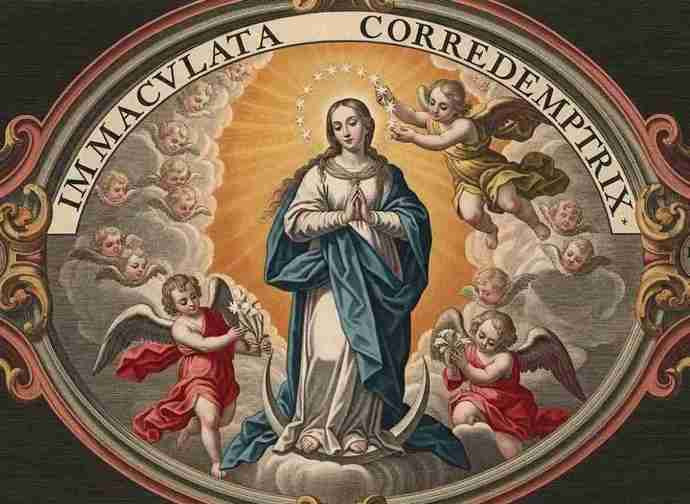
The dogma of Mary Co-Redemptrix.
Despite the opinions of experts favoring the definition of Mary’s universal mediation and the use Pío XI made of the title Co-Redemptrix, the path toward the fifth Marian dogma came to a standstill at a certain point. The reports of the experts from the three commissions had issued a positive opinion on the definability of Mary’s universal mediation. Pío XI himself seemed more than favorable, although it was still unclear whether the pope wanted to express himself through the ordinary Magisterium, in an encyclical, or rather with an ex cathedra definition. The pope, among other things, on July 20, 1925, in a brief addressed to Our Lady of the Rosary of Pompeii, approved the title of “Co-Redemptrix”: “But remember also that at Calvary you became Co-Redemptrix, cooperating through the crucifixion of your heart for the salvation of the world, together with your crucified Son.” However, all these positive results paradoxically marked the beginning of the Calvary of the “fifth dogma.”
It is possible that Billot himself may have hindered the dogmatic definition of Mary’s mediation, although there is no real evidence to support this hypothesis. While he was favorable to mediation, Billot rejected Mary’s participation in the redemption of graces; in other words, he rejected co-redemption. Was the universal mediation of Mary really a new doctrine? Was it really impossible to affirm Mary’s cooperation in the work of redemption?
The Pope’s spies.
An interesting and lengthy article today. Who they are, where they operate, and how the pontiff’s secret agents function. From the Roman base of operations to relations with allied intelligence agencies. Everything you need to know about the existence of the oldest, most complex, and most mysterious secret services in the world. Protected within the Leonine Walls, a few steps from Bernini’s colonnade in Vatican City, are—according to experts in the field—the offices of one of the oldest and most mysterious intelligence organizations in the world. No plaque. No logo. The Holy See has never officially recognized its existence, and the service does not appear in the Pontifical Yearbook or in any Curia organizational chart. However, according to various journalistic and non-fiction sources, it is said that Nazi hunter Simon Wiesenthal described the Vatican as “the best and most effective intelligence service” he had ever known. The fact is that it has no official name; some call it the Holy Alliance, others the Entity. And others, however, believe that a structured intelligence service reporting to the Pope simply does not exist. What is the truth? Dossier has attempted to delve deeper and follow some leads. The warning from Leo XIV. Let’s start with a recent event. On December 12, 2025, dozens of officials and executives of the Italian intelligence services crossed the gates of the Vatican to be received in audience by Pope Leo XIV—for some reason.
«Seek rather his Kingdom, and these things will be added unto you.»
Good reading.