


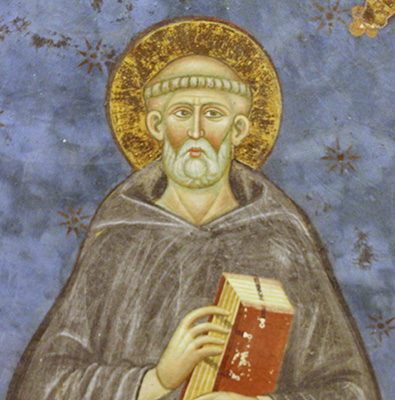
We are wrapping up the week with a day full of news about the recent schism and excommunications. Today we celebrate the feast of Saint Benedict, a saint who continues to shape monastic life in the Church. Born in the year 480 in the Italian city of Nursia, Saint Benedict was sent by his noble family to study in Rome and later withdrew to a cave, devoting himself to spiritual exercises and founded more than 12 monasteries, among which the Monastery of Monte Cassino stands out, the cradle of the Benedictine Order whose motto is “Ora et labora”; from his holiness sprang more than 3,000 canonized saints, 5,000 bishops, and 23 popes. “The time spent before the tabernacle is the best time of my life.” “Fear the day of judgment: be afraid of hell. Desire eternal life with deep spiritual longing. Keep death daily before your eyes.” We begin…
The situation of the Church and of Leo XIV.
Article by Americo Mascarucci: “while it is evident that Pope Leo X could not have acted differently with the Society of Saint Pius X after the episcopal consecrations without papal approval, it is nevertheless necessary that, unlike his predecessor, he be equally firm and resolute with those cardinals, bishops, and priests who would seek to force his hand and impose certain pro-modernist advances, from married priests to deaconesses, including the recognition of LGBT couples and the autonomy of episcopal conferences from Rome in organizational, pastoral, and doctrinal matters. It is true that the measures adopted by the German Synod, however questionable, have not yet led to a rupture of communion with the Pope, as occurred with the Lefebvrians through the consecrations, but it is the duty of Pope Leo to act as a good father, without excessive severity on one side or particular indulgences on the other, and to clearly reiterate the limits that cannot be crossed, whether by traditionalists or progressives.
Leo XIV and multilateralism.
One year after the election of Leo XIV“The geopolitical profile of the new pontificate appears clearly defined and centers on certain principles such as the defense of multilateralism, the primacy of the person, and the protection of peace through law.” The crises that marked the first year of Leo XIV’s pontificate—Venezuela, Greenland, Cuba, Iran, and Lebanon—“gradually transformed the Vatican into one of the few global actors openly committed to defending the multilateral order built after 1945.” The text that best defines the Pope’s international vision is his address to the diplomatic corps on January 9, 2026. On that occasion, Leo XIV openly denounced the decline of the multilateral system: “In our time, the weakness of multilateralism is a matter of particular concern at the international level. A diplomacy that promotes dialogue and seeks consensus among all is being replaced by a diplomacy of force, of individuals or groups of allies.”
The Holy See’s response to this crisis does not consist in seeking a new balance of power, but in revitalizing multilateralism. According to Parolin: “For a small state, international law is not a burden, but the greatest guarantee of survival and freedom.” From this perspective, strength is no longer equated with military power: “International influence today is no longer measured solely by military strength, but by moral credibility and the capacity to act as a neutral bridge of reconciliation.” The reference to Europe is equally important. Parolin invites the continent to rediscover the inspiration of its founding fathers: “Europe must rediscover the inspiration of its founding fathers, moving from the logic of mere national interests and selfish security concerns to a genuine project of integration and solidarity.”
Looking ahead to the centenary of Vatican City State in 2029, a clear conclusion emerges: “The Holy See sees no viable alternative today to the international order born in 1945 and founded on the United Nations, international law, and multilateralism.” “After the first year of his pontificate, Leo XIV presents himself as the Pope who defends the multilateral order in an era of growing unilateralism. If Francis had denounced a ‘fragmented world war,’ Leo XIV faces something different: the possible dissolution of the norms that, for eighty years, prevented that war from becoming an open global conflict.”
The protection of religious sisters.
Consecrated women who are victims of abuse face a significant legal gap: canon law and specialized bodies focus primarily on minors and vulnerable adults, often leaving adult religious sisters outside their scope of protection. When the victim is a well-formed adult woman, it is often assumed that she is capable of defending herself or that consent was given. However, signals of change are beginning to emerge from the Vatican. “It cannot simply be a matter of labeling someone as an ‘adult vulnerable.’” “It is not only about those situations. We must understand that there are contexts characterized by power asymmetries, circumstances in which abuse occurs, and conditions of vulnerability that must be analyzed.”
Among the tasks of the Pontifical Commission for the Protection of Minors is collaboration with the various departments of the Roman Curia, with conferences and unions of religious men and women, and with institutes of consecrated life. “There are many circumstances, situations, and persons that can affect adult religious sisters, not only the youngest. Therefore, it is necessary to understand the contexts in which they work and carry out their ministry, both inside and outside the community.”
The Vatican helped break the taboo of abuse against religious women by dedicating, in January 2020, an in-depth article in Donne Chiesa Mondo, the monthly women’s magazine of L’Osservatore Romano, to abuses of power, sexual abuse, and the difficulties many religious women face inside and outside consecrated life. Interesting is the study published in 2022 in the volume Vulnerability, Abuse, and Care in Women’s Religious Life, edited by Sister María Rosaura González Casas, then coordinator of the commission for the protection of minors and vulnerable persons of the Latin American and Caribbean Confederation of Religious Men and Women.
In order to open a space for dialogue on how to improve the prevention of abuse against religious women, the Pontifical Commission for the Protection of Minors will organize the second annual meeting on abuse prevention, dedicated to consecrated life. It will be held in Rome from December 9 to 11, 2026, and will have as its theme: Communion, Care, and Justice: Mutual Relations for a Shared Mission.
The study also shows that some religious women, faced with situations of injustice or abuse, decide to leave consecrated life. The majority of victims remain in their communities, often out of fear of social stigma or rejection they might face if they returned to their families. Other nuns are aware that leaving the convent could bring them serious economic difficulties, since they have no work or personal resources to support themselves.
Pope Leo at the Meeting for Friendship among Peoples.
It is held in Rimini from August 21 to 26 and this year marks its 47th edition under the motto “The love that moves the sun and the other stars.” The president of the Meeting, Bernhard Scholz, highlighted the visit of Pope Leo XIV, 44 years after that of Pope Saint John Paul II: “At the heart of the 2026 Meeting will be the visit of the Holy Father, Pope Leo XIV. His participation is a cause of great joy.
Each day of the Meeting will be enriched by contributions from prominent figures in the institutional, cultural, academic, and business spheres, as well as representatives of the Church and various confessions and cultures. This year, the Fair will occupy more than 130,000 square meters, 16% more than in 2025, with more than 150 conferences and approximately 500 Italian and international speakers.
The Church in China one year after the death of Pope Francis.
Second part of a reflection on the Catholic Church in China one year after the death of Pope Francis and the election of Pope Leo XIV. The first part was devoted to the Vatican’s view of China, while this final installment focuses on some trends that have emerged in the past year. Although the provisional agreement between China and the Vatican has recorded progress in the appointment of bishops, it has not succeeded in fully aligning the Chinese Church with the universal Church in procedural matters. Despite the fact that four bishops from mainland China participated for the first time in the Synod of Bishops, the spirit and practices of “synodality” promoted by such gatherings are not visible in the national context. The photo of a bishop with the Pope was interpreted by some priests as a sign that he had obtained a kind of “imperial sword” to pressure “non-cooperative” priests.
Since the imposition of the “sinicization of religions,” activities of political study have multiplied, accompanied by initiatives such as “promoting frugality and combating luxury, maintaining correct faith and practice.” In 1926, Pope Pius XI consecrated in Rome the first six Chinese bishops. On April 11, 1946, Pope Pius XII established the ecclesiastical hierarchy in China, and at that time “the Chinese bishops enjoyed the same powers as the other bishops of the world… with identical responsibilities and duties.”
The bishops react to the Lefebvre case.
The bishop of the Diocese of San Angelo, Texas, warned Catholics not to attend Masses offered by the Society of Saint Pius X (SSPX) following the announcement of the excommunication of its bishops, even though the prelate of San Angelo himself has participated in an interreligious Hanukkah ceremony. Bishop Michael J. Sis issued a letter on Monday reiterating the Vatican’s assertion regarding the SSPX: that the priests of the SSPX “administer the sacraments illegally” and that “the sacrament of penance administered by them and the marriages witnessed by them are now invalid.”
Sis encouraged Catholics in San Angelo to avoid SSPX Masses celebrated in Midland, Texas, at the Chapel of Saint Michael the Archangel, and instead to attend a traditional Latin Mass with indult celebrated at Saint Margaret of Scotland Catholic Church “with permission of the Holy See every Sunday.” On the other hand, he made praises of joint celebrations with everything that moves: “For us, honoring the religions of others and respectfully participating together in cultural and religious ceremonies is a way of opening our eyes to the experience of the other and seeing how they practice their faith and honor God.”
Letter from Douglas John Lucia, Bishop of Syracuse (NY), published on July 2. Like Fredrik Hansen, Bishop of Oslo, Frank Joseph Caggiano, Bishop of Bridgeport, Terry Ronald LaValley, Bishop of Ogdensburg and Bishop Donald Joseph Hying of Madison, invites and encourages “those who have attended Mass or the Sacraments according to the Roman Missal of 1962 and the Roman Ritual to now seek counsel and spiritual nourishment in the diocesan Shrine of Saint Mary of the Assumption in Oswego (directed by the Institute of Christ the King Sovereign Priest ), in our diocesan parish that celebrates the traditional Holy Mass at the Parish of the Transfiguration in Syracuse, or, by indult, at the Parish of Our Lady of Good Counsel in Verona or at the Parish of Saint Mary of the Assumption in Binghamton ” and declares: “To all clergy and laity who do not wish to participate in this rupture with the See of Peter, I am always available to receive them and help them remain within the one, holy, catholic, and apostolic Church ”.
Statement by Archbishop Bernard Anthony Hebda, Metropolitan Archbishop of Saint Paul and Minneapolis (MN), published on July 2. “In these difficult times, we are fortunate that the same traditional Eucharistic liturgy, so beloved by those who in the past worshiped with the Priestly Society of Saint Pius X, continues to be celebrated in six places in the Archdiocese”; he is “confident that those who prefer the traditional Holy Mass can find a home here.”
Letter from Archbishop William Shawn McKnight, Metropolitan Archbishop of Kansas City (KS), addressing the faithful of the SSPX , declares that “they should know that they are loved by the Church and remain the object of our prayers for unity ” and encourages them to “seek the guidance of our priests regarding any questions that may arise from this unfortunate situation, especially if they have doubts about the validity of the sacraments they have received ”.
The Diocese of Cologne.
The papal appointment of bishops by divine right.
The election, consecration, and appointment of bishops is the prerogative of the Pope by divine right. The Pope does not possess this power by canon law, but because Jesus Christ granted it to Peter. An article today delves into the truth of this claim. If it were merely a matter of canon law , the justifications for the schismatic act of July 1 offered by the SSPX could be viewed with greater benevolence, in particular the appeal to epikeia , which corresponds to the principle of canonical equity in canon law. If it is a matter of divine law , it can never be derogated, neither in case of necessity nor for the supreme good of the salvation of souls, for God, who knows all things and desires the salvation of all men, has placed in the observance of His laws the answer to every kind of need and the attainment of the supreme good of the salvation of souls.
The Eastern Churches offer other ways of expressing communion with the Apostolic See; but, in any case, the Pope remains the final confirmer of the election of the new bishop. Although a mandate is not always necessary, the confirmation of the Holy See (and therefore at least the tacit authorization of the Pope) is always indispensable. Pius IX, in Quartus supra , is compelled to intervene to restore “the right and power [of the Apostolic See] to elect the bishop.” The Pope states with utmost clarity that these “rights and privileges” were conferred on the successor of Peter “by Christ God Himself.” We see that the Pope claims it as divine right.
Pius VI is even clearer in the following text, when he clearly distinguishes between the granting of the episcopal rank and the granting of jurisdiction, indicating that neither of the two can be granted without the approval of the successor of Peter: “Since these bishops belong to other provinces, if they could, with sacrilegious audacity, confer Orders upon him, they could not, however, attribute jurisdiction to him, of which they are completely deprived, as the discipline of all times requires.” For a bishop to be truly Catholic, he must be received into hierarchical communion by the Pope: “the first elements of Catholic doctrine teach that no one can be considered a legitimate bishop unless he is united by communion of faith and charity to the Rock upon which the Church of Christ is built, and is not closely bound to the Supreme Pastor” (Pius IX, Etsi multa ).
Points of negotiation.
Letter published by Paix Liturgique on July 9 proposing some points to begin negotiation, with patience: “ Rome-Écône: After the war, is a liturgical peace negotiated?” “War implies negotiation, the search for peace on solid foundations. For there is a time to fight and a time to negotiate. Why should there not be a time to negotiate a liturgical peace? Something that seems unattainable in these times, especially considering that the core of the issue lies in the Second Vatican Council and the liturgy that expresses it. Today, it is unthinkable that anything could change. Only the living Magisterium, which prides itself on being infallible, will one day be able to definitively resolve the debate. This is, ultimately, one of the aspects of the problem: the silence of the infallible Magisterium. In the meantime, both sides would have an interest in establishing a modus vivendi .
Rome would have an interest in this by virtue of the conciliar values it proclaims. It cannot limit itself to excommunicating its grandfather for reasons of ecumenism. Much more than with the Orthodox, Anglicans, and Lutherans, dialogue is required, to assess what separates it from the Priestly Society of Saint Pius X , to work to move from “imperfect communion” to “full communion,” according to the concepts developed by the Second Vatican Council. No one can understand why Rome accepts everything from clearly disoriented Catholics, such as the faithful and bishops of the German Synodal Way or even Catholic-LGBT organizations, and agrees to negotiate with them, to reach agreements, while offering nothing to those who take other measures.
One of the greatest dangers for the Priestly Society of Saint Pius X is that of ending up inventing an idea of the Church that seems ideal, but which in reality is not found in the concrete history of the Church. Some maintain that to operate “safely” in the Church, it must first be cleansed of all error. […] However, the saintly reformers did not abandon it to combat these errors.
Between disobedience and higher obedience.
Rome is indulgent with communist Chinese bishops, receives the Anglican archbishop with favor but excommunicates the Lefebvrians. What happened in Écône on July 1, 2026, contains something more serious than a simple canonical irregularity. The Society of Saint Pius X not only challenges Rome, but ends up setting itself up as the supreme measure of what Rome should be. The argument is well known: Tradition would be threatened , souls need pastors, Rome no longer guarantees the continuity of the faith with sufficient clarity, therefore the Fraternity would be forced to act . The Fraternity does not merely say: let us disobey. It says: let us obey better and in this way, disobedience is absorbed by a sacred language that makes it almost unrecognizable.
The problem does not lie in love for Tradition. The problem lies in the appropriation of Tradition as a sovereign criterion, contrary to the ecclesial form that makes it Catholic. When Tradition is separated from this visible form, it ceases to be a Catholic principle and tends to become a possession of identity . Don Pagliarani seems to want to avoid precisely this accusation, insisting that the Fraternity has no intention of founding a parallel Church.
It is said that Rome is indulgent with bishops who come from situations compromised with Chinese political power, while it attacks the Fraternity that professes the faith in its entirety. The Vatican’s diplomacy toward China may raise deep concerns, but both situations are not symmetrical. Rome is attempting to channel a wound toward papal recognition, in a context marked by state coercion and external political pressure on the freedom of the Church. In the case of the Fraternity, however, an ecclesial body that declares itself fully Catholic consciously chooses to act without pontifical mandate , after receiving a clear invitation not to do so. The difference is crucial. In China, the Holy See is attempting, even by questionable means, to heal a wound. In Écône, the wound is inflicted in the name of a superior purity.
It is said that the “Archbishop” of Canterbury is received with honors, although he represents a separate communion, while the Bishops of the Fraternity are treated with severity. Here too the polemical appearance is deceptive . The “Archbishop” of Canterbury is not recognized as a Catholic bishop. He has no jurisdiction in the Catholic Church. He is not authorized to perform internal acts of Catholic sacramental governance. He is received as an ecumenical interlocutor precisely because a distance persists. Diplomatic courtesy does not equate to ecclesiological recognition.
The short-circuit of the Fraternity therefore consists in wanting to be inside and outside at the same time. Inside , when it claims the fullness of the Catholic faith. Outside , when it evades the concrete judgment of apostolic authority. Inside , when it speaks in the name of the Church. Outside , when it decides for itself what the Church must tolerate in the name of necessity. Inside , when it calls upon Peter. Outside , when it believes it can correct Peter through a fait accompli.
The Church can be criticized. It can be wounded by its pastors. It can appear opaque, uncertain, even lost. However, no one saves the Church by replacing the principle of its unity. Tradition is not preserved by becoming its own source. It is preserved by remaining within that communion which often humiliates, limits and wounds the pride of the pure, and precisely for that reason prevents purity from becoming spiritual schism.
Muslims and mosques.
Bernardino Montejano on the Church and Islam. “ Since the Catholic Church still lives in the “chaos” of the previous pontificate, today we face radically opposed public positions. On one hand, there is the opinion of Italian Bishop Antonio Suetta, who maintains: “We must preach to Muslims to convert them.” On the other hand, the Augustinian priest of our parish of Saint Martin of Tours, Alejandro Moral Antón, who in an interview published in La Nación on June 13, 2026, states that “Peace is at risk and we cannot continue with absurd divisions” and “Allah is also God, we must pray to Him, and I am not speaking heretically.”
The confusion is fueled by the Archbishop of Detroit, Edward Weisenburger, who recently attended the inauguration of a new mosque and headquarters of the Islamic Institute of America in Dearborn Heights, Michigan. During his speech, he praised the Muslim community and its new religious center. “There is no place where I feel greater honor, fraternity, and kindness, and from the moment I arrived today at this splendid place, I fully felt the divine presence.” “All churches, all mosques, all synagogues , all places where God manifests Himself and touches with His finger are sacred.”
Saint Thomas Aquinas, in his “ Summa contra Gentiles ”, writes: “Muhammad, who seduced the people by promising them carnal pleasures, to which concupiscence itself incites them. In accordance with these promises, he gave them his precepts, which carnal men are ready to obey, giving free rein to the pleasures of the flesh… He introduced among the truth many fables and very false doctrines… He claimed to have been sent by force of arms, a sign not lacking in thieves and tyrants. I believed him from the beginning… an uncivilized people living in the desert, totally ignorant of the divine, with whose armies he forced others to accept his law. No divine oracle of the prophets who preceded him bears witness to him… He completely distorts the teaching of the Old and New Testaments, creating a fabulous narrative… He astutely forbade his followers to read the Old and New Testaments so that they would not be convinced by them of their falsity.”
Healing the rift in the unity of the Catholic Church
Article by Phil Lawler, published in Catholic Culture . “ The worst has happened: illicit ordinations, excommunications, and schism. A rift has opened (or reopened, or deepened) in the unity of the Catholic Church. Recriminations will not change history or repair the damage. What will? In 2007, Pope Benedict XVI offered some wise advice to Church leaders facing crises of this kind: “ Reflecting on the divisions that have torn the Body of Christ over the centuries, one has the constant impression that, at critical moments when these divisions were becoming entrenched, the leaders of the Church did not do enough to maintain or restore reconciliation and unity. It seems that the Church’s own omissions contributed in part to these divisions becoming consolidated. This look at the past imposes an obligation on us today: to do our utmost to ensure that all those who sincerely desire unity may remain in it or attain it again.”
That advice appeared in a letter that Pope Benedict XVI wrote to the bishops of the world in July 2007, on the occasion of the publication of Summorum Pontificum , his attempt to heal the wound that now festers. That effort came to an abrupt end when, five years ago, Pope Francis published Traditionis Custodes . Pope Francis explained that he was acting for the sake of the unity of the Church: the same goal that Pope Benedict XVI had cited as the reason for his initiative. Thanks to the article by Diane Montagna , we now know that that explanation was inaccurate. The majority of bishops did not report problems in implementing Pope Benedict XVI’s directive. In fact, an internal Vatican report concluded that “the majority of bishops who responded to the questionnaire stated that the legislative changes to Summorum Pontificum would cause more harm than good.”
If the majority of bishops were not concerned about the rise of traditionalism, why were there so few public objections to Traditionis Custodes ? Why did those bishops who had advised against the legislative changes to Summorum Pontificum remain silent when Pope Francis introduced such changes? Why did the cardinals, whose function is to advise the Pontiff, not urge him to reconsider the matter? Why did the diocesan bishops tacitly abdicate their responsibility to assess the pastoral needs of their faithful? Did all those prelates fear the wrath of Pope Francis more than the unity of the Church?
Recriminations will not repair the damage caused; now we must follow Benedict XVI’s advice to prevent a further hardening of opposing positions. We greatly fear that the fear that this will grow exists and we are aware that there are bishops who are reprimanding diocesan priests who sympathize with tradition. Various sources inform us that attendance at Mass in SSPX congregations has increased significantly since the excommunications. Why would someone who was not already attending Mass in the Fraternity’s chapels now join those congregations, if not to challenge the Vatican?
Since the decree of excommunication and the attached note from Cardinal Fernández were (or were presumed to be) documents with the force of law, some canonists now question the validity of these decisions. This war cannot continue to grow and we cannot feed it.
“fear above all Him who can destroy both soul and body in hell.”
Good reading.