When we speak about the Pope’s health, we are treading slippery ground and must try, at the very least, to be as precise as possible, out of honesty and respect for the Pope. The facts are what they are, and rumors or other types of information must be presented as such. We repeat this today because today it is needed far more than yesterday, and we can assume that we are entering an unexpected and very delicate phase of the pontificate as far as information is concerned.
At 8:40 a.m. Rome time, the Holy See Press Office released a single sentence on its Telegram channel:
“The Pope’s night passed calmly. More information later in the day.” That is all the Holy See has said since last night’s bulletin, and by the time this edition closed, the second update announced in that message had not yet arrived.
The word of the day, however, came last night at 9:53 p.m., and it is
adenocarcinoma. The second word of the day appears in a subordinate clause of the same document, and it is that clause that the Italian press has today stretched further than the paper can bear.
The 9:53 p.m. bulletin
The
Bulletin of the Press Office last night published the communiqué signed by Dr. Luigi Carbone and Professor Stefano Margaritora. There is an
official Italian version and an official Spanish version, so no one needs to translate it. It reads as follows:
“The Holy Father underwent, as scheduled, thoracic surgery. To ensure the radicality of the procedure, the lower lobe of the right lung was removed using a video-assisted technique. The intraoperative histological examination confirmed the diagnosis of pulmonary adenocarcinoma, as suspected in the preoperative tests. The Holy Father remained in the operating room for approximately three hours; the duration of the surgery was about 90 minutes. The procedure was successful and no complications arose. After the operation, the Pope awoke normally and, after a brief period of observation, returned to his room on the tenth floor.”
Before that, around 7:50 p.m., a shorter note had been released on Telegram that did not make it into the Bulletin: the operation had concluded
“positively, within the expected time and manner” and the Pope had returned to his room. Matteo Bruni added in person, as reported by AgenSIR, that
“before I left, I heard that the Pope was asking for dinner” and that the first postoperative tests would be carried out the following day. The phrase “awake and oriented” that has circulated all day is not from Bruni: it is the wording of Salvatore Cernuzio in Vatican News.
Most coverage of the bulletin was the bulletin itself.
ANSA,
Agenzia Nova,
Il Tempo,
Editoriale Domani, and
EWTN reproduced it with few additions. The cleanest piece is Biagio Chiariello’s in
Fanpage, which is also the only one that explicitly states what the communiqué does not say.
Libero got it half right: the body announced the operation “this afternoon” while a side banner already declared it finished, and the page headline said “tumor” when the text only said “nodule.”
La7 posted the video without text, and
Repubblica, under the byline of Michele Bocci and Iacopo Scaramuzzi, placed it behind a paywall.
What the bulletin does not say
The list is necessary, because it is long and because everything published today that goes beyond the text comes from filling it in. The communiqué gives neither clinical nor pathological staging. It mentions neither lymph nodes, nor lymphadenectomy, nor their status. It says nothing about chemotherapy, radiotherapy, or targeted therapy. It offers no prognosis: the only assessment it contains concerns the surgical act itself. It does not announce the definitive histological report or set a deadline. It does not say when the next bulletin will come. And it does not mention the trip to Uruguay, Argentina, and Peru.
Nor does it say that no disease remains. The text explains that the lobe was removed
“to ensure the radicality of the procedure”: radicality is the declared goal of the technique, not a finding. Several pieces have turned that into “total removal”—
askanews and today’s own Vatican News report, which writes “the total elimination of a pulmonary adenocarcinoma”—and that is a leap of reporting, not of the document. The length of the hospital stay is also not in the bulletin: Bruni stated it on the 11th.
And then there is what circulates without a byline. Davide Falcioni attributes to “Vatican sources” today in
Fanpage that the tissue was completely removed and that no chemotherapy cycles are planned for now. It may be true. It is not in any document; one must be serious about such delicate matters—at least here we will try without concealing the information.
“As suspected in the preoperative tests”
That is the subordinate clause. On Sunday the 11th, during the Angelus, the Pope said—official text—that doctors had found
“a nodule localized in the lung”, that it had been detected
“still at a very early stage” and well localized, that the doctors considered intervention advisable and that the operation had already been scheduled. He did not use the word tumor. Nor did he say it was benign: he did not qualify the nodule.
The two texts can be placed side by side, and it is legitimate to do so. What cannot be done is to take the next step, and here one must be exact:
preoperative means before the operation, not before the Angelus. Between Sunday noon and Tuesday afternoon in the operating room, two days passed, and on the 13th Bruni spoke of “the first postoperative tests” for the following day, which implies an immediate preoperative round. Nothing published allows us to place the suspicion of malignancy on Sunday.
Nothing is known from official documents about the tests in question: neither date, nor type, nor center. The only official datum on the origin of the finding are the Pope’s own words,
“recently, during a check-up”, and an oral clarification from the Press Office on the 12th, in response to journalists: the nodule appeared during routine controls. There is no CT scan, no PET, no biopsy with date and center. Quotidiano Nazionale wrote it plainly on the 11th: no official confirmation of a prior biopsy. The rest—respiratory symptoms, inflammation first suspected, the check after the trip to France—is reconstruction without a source, and in some cases in the conditional.
In the other direction, and this also settles nothing: on Sunday the Pope already said that the doctors considered intervention advisable and that the operation was scheduled, which implies prior imaging and surgical decision. What those images showed is exactly what is not documented.
“And the Pope was expecting it”
That phrase was written by
ANSA last night, unsigned and unsourced, alongside another of the same tenor: the verdict “was in a way expected.” It is an attribution of a patient’s mental state; it is the strongest claim published today and the least supported. The same report adds that the result “casts strong doubt” on the trip and that the Pope wanted to be operated on soon “also to try to save the trip.” These are the reporter’s inferences, presented as facts.
The explicit pointer was made by
Silere non possum with an adversative: the bulletin explains, “however,” that the tests prior to the intervention already raised suspicion of adenocarcinoma. This is the most precise of the three formulations, because it says what the document says and no more.
Il Fatto Quotidiano chose the third way this morning: it placed the “localized nodule” from the Angelus and the subordinate clause from the bulletin one after the other, without comment. It leaves the conclusion to the reader, which is a way of writing it without signing it.
No one has publicly asked the Press Office when the suspicion of malignancy arose or what the Pope knew on Sunday, or the question is not on record. It is a gap, not an incriminating silence. And a patient is not obliged to announce his diagnosis from a window.
The doctors who have not seen the patient
Within hours of the bulletin, specialists with names and titles were already offering opinions on a patient whose clinical history has not left the Gemelli. In ANSA, Edoardo Mercadante, director of thoracic surgery at the Regina Elena National Cancer Institute, maintains that
“the next 24 or 48 hours will be the most delicate for determining the evolution” and that
“it is presumable that, in the absence of changes in the overall picture, the Pope could leave the hospital in five or six days.” In the same piece he calls for knowing the status of the removed lymph nodes and the molecular profile. He asks for the data he does not have and predicts discharge without them.
Massimo Di Maio, president of the Italian Association of Medical Oncology, stays one step behind: the definitive histological report must be awaited,
“but the treatment chosen through surgery in any case has a curative intent.” And the only one who says he does not know is Marcello Tiseo of Parma, who in Adnkronos expressly declares that he is not familiar with the Pope’s clinical conditions and limits himself to general figures. The contrast writes itself.
A separate case is
Pope Leo XIV, it is lung cancer: a lobe removed. The new treatments after surgery, by Daniele Amoruso in Mondosanità, which does not cite a single doctor. It says twice, and rightly, that it cannot be established whether additional treatment will be needed because neither the stage nor the molecular analyses are known. And then it publishes survival percentages from the ADAURA and ALINA trials under a headline that begins with the Pope’s name. The shielding and the figure, on the same page. The photograph that illustrates it, with the caption “the Pope on his arrival at the Gemelli,” carries the label “image generated with AI.”
The surgeon and the seven names
The bulletin gives the seven names, which is not little by the house’s standards. The team of Stefano Margaritora operated—
full professor of thoracic surgery at the Catholic University of the Sacred Heart, director of the thoracic surgery unit at the Gemelli Polyclinic and of the specialization school, more than four hundred publications, expert in the video-assisted technique with which he operated—together with Elisa Meacci, Maria Teresa Congedo, and Leonardo Petracca Ciavarella. Anesthesia: Massimo Antonelli, Giovanni Punzo, and Giuseppe Bello.
The correct spelling is Petracca Ciavarella, as it appears in the Bulletin and on the Gemelli’s own website. The “Petracca Caravella” that has circulated is an error by
askanews. And ANSA writes that the surgical team was “composed of seven doctors” and then names four: it confuses the surgeons with the total. The two women in the bulletin, Meacci and Congedo, are on the surgical team.
Luigi Carbone, who signs the communiqué together with Margaritora, is the director of Health and Hygiene of the Governorate and the Pope’s personal physician. He is not a surgeon and did not operate. Some automatic summaries have already promoted him. According to askanews, Carbone, the commander of the Gendarmerie Gianluca Gauzzi Broccoletti, and the two personal secretaries were also in the operating room; that is not in the bulletin.
The brother
Louis Prevost spoke yesterday with the American network NewsMax, and today
Fanpage reports it:
“He is in good condition and in good hands. Let us hope for the best.” About the diagnosis,
“what they found was bad, but they removed it all.” He himself is still undergoing oncological treatment in Tampa. Repubblica also headlines a phrase of his that we have not been able to verify in the body of the article, “he will be cured”; we leave it there as what it is, a headline.
The people at the door
Victoria Cardiel’s report for EWTN,
The affection of the faithful surrounds the Pope at the Gemelli: “We have done nothing but pray”, gives no figures and twice speaks of hundreds of people in front of the polyclinic since the car entered at 1:07 p.m. Rosa Pacheco, a Spanish tourist, was carrying an image of the Macarena:
“I always carry with me some image of the Macarena Brotherhood or of Our Lady of the Rosary. I tried to get it to the Holy Father so that it could accompany him during the operation.” Sisters Faustina and Nadege, from Burundi, nursing students in Rome, supply the headline:
“We have done nothing but pray for his health.”
From the same piece comes a detail that is not in the Bulletin and that is given by Nicola Cerbino, head of press at the Gemelli: the traditional papal apartment on the tenth floor is under renovation, and the rooms used by John Paul II and Francis are affected, so the Pope is occupying another area of the same floor. John Paul II used to call the Gemelli “Vatican number three.” Yesterday’s admission is the second of Leo XIV’s life: the first was in 1985, for typhoid fever, in a clinic in Piura, when he was a missionary in Chulucanas and was thirty-one years old.
The vicar’s rosary
At six in the evening, in the Saint John Paul II chapel of the polyclinic itself, Cardinal Baldo Reina, vicar general for the diocese of Rome, led the rosary with the sorrowful mysteries before more than a hundred people: patients, relatives, and medical staff. It was broadcast by Tv2000 and prayed at the same hour in parishes and communities throughout the diocese. Reina prayed for
“our Bishop the Pope Leo” and asked:
“grant him health and consolation so that he may continue to serve your Church,” with an invocation to Mary, Health of the Sick.
Tagle presides over a Mass
The meeting for the tenth anniversary of
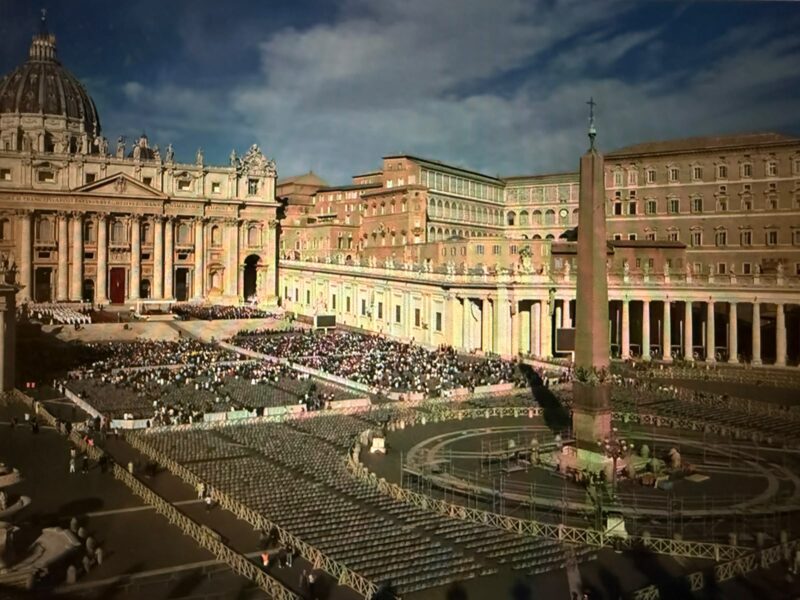
Amoris laetitia closes this morning with a Mass in St. Peter’s Square, presided over by Cardinal Luis Antonio Tagle. At this hour Tagle is celebrating in St. Peter’s Square; we return to the terrible images of an empty square, with the added circumstance that it was prepared for what is now more frequent: the obelisk is not only solitary, it is surrounded by empty chairs. Everyone’s eyes and the information are at the Gemelli, and whatever the learned Amoris Laetitia may have reasoned or not, no one is interested. In the square we see the long shadow of a pontificate that does not quite end, and it is the living image that the suffering People of God has turned its back on so much nonsense.
The official record on vatican.va is terse and it is the one that counts: the celebration is “presided over by Cardinal Luis Antonio G. Tagle, Dean of the College of Cardinals.” No formula of substitution. Father Giacomo Costa said it just as clearly: the celebration was
“entrusted by the Holy Father to Cardinal Tagle.” A delegated task. By the time this edition closed there was no homily text; we are told it will be limited to reading what was prepared for Leo XIV, for now nothing on vatican.va or the Bulletin of the 14th. Tagle has been
dean since last October 9, and
today’s Mass was convened from October 1, when no one was talking about nodules. The congress, for its part,
accompanied the operation with prayer and the wish for a speedy recovery; they look very disoriented, somewhat saying: “what are we doing here,” “who cares what we are doing.”
What a dean does
Part of the Italian press has spent the week headlining with the word “substitute.” TGCom24 went so far as
“Who is Cardinal Tagle who ‘replaces’ hospitalized Pope Leo”—with the quotation marks in place, to be sure, and with a body that does not assert governmental substitution, only the presidency of the Mass—and Il Sussidiario, Trend-online, BolognaToday, TheSocialPost, and Leggo have gone down that path, the latter reaching “vice-pope” in its own web address. The headline works. The law does not.
The Dean of the College of Cardinals has no power of governance: canon 352 §1 calls him
primus inter pares and expressly denies him authority over the other cardinals. His competencies are for a vacant see, and that is how Enrico Lenzi explained it in
Avvenire on October 9, the day of the appointment, without needing to cite the canon: to convoke the conclave and preside over the College when the see is vacant, and, if he has not reached eighty, to direct the proceedings and receive the acceptance of the one elected. A sick Pope does not open the vacant see, and canon law does not provide for any substitution as long as he does not open it. What Tagle is doing today is celebrating a Mass that the Pope has entrusted to him.
The report the Pope does not want published
The synthesis report of the meeting remains unpublished, and not because of a calendar accident. Father Costa recounted it on the 12th:
“the Holy Father has asked that the Synthesis Report not be published, because he wanted to hear it,” and
“he reserves the right to receive it and, once out of the hospital, to take up the materials again and say his word.” Ten years of
Amoris laetitia, a week of work in the Paul VI Hall, and a document that waits in a drawer until the author of the last word leaves the Gemelli.
Friday’s premiere
On Friday the 16th at 11:30 a.m., at the Rome Film Fest, the avant-premiere of
Pétros ení. Alla scoperta delle origini will be screened, a documentary by AF Films—the producers Frank Ariza and Manu Vega—with Vatican Media and the Fabric of Saint Peter, directed by the Spaniard Paula Ortiz, with a screenplay by Andrea Tornielli and archaeological consultancy by Pietro Zander. The actor Chris Pratt guides the viewer through the basilica, declaring that it has been
“an incredible honor to collaborate with Pope Leo and with the Vatican on this project.” In the final sequences the Pope appears, who
“has exceptionally granted himself to the filming of a cinematographic team,” recounting the figure of Peter and the meaning of his tomb. The announcement is from the 12th. The premiere falls three days after the lobectomy. No one has moved it, so far.
Silere non possum rewrites the Bulletin
We have read the three pieces the site published yesterday. The first,
How Pope Leo XIV’s surgical operation went, is an agency flash that copies the 7:50 p.m. note and acknowledges it. The second,
Pope Leo XIV’s lung nodule was a tumor, and it was removed, has been read these days as if it brought exclusives: the seven names of the team, the three hours in the operating room and the ninety minutes of surgery, the tenth floor, the intraoperative biopsy. They are all, literally, in the communiqué from the Sala Stampa. The rest is a popular-science booklet on adenocarcinoma, correct and without cited source. Net original datum: none.
And accuses Vatican News of doing journalism
The third,
Leo XIV, the hospitalization and the spectacle of Vatican News, signed S.V., is something else. It reproaches the Vatican media that, after the Pope asked for prayer and discretion, they responded with
“minute-by-minute chronicles, details about movements, family indiscretions, and a narrative that raises questions about journalistic ethics.” Some of the charges are verifiable against
the chronicle of the admission: that the time of departure, the access used, and the time of arrival were published, and that a helicopter over the square was described in order to distract people from the car in which the Pope was traveling. That the account follows the Pontiff to the tenth-floor elevator is verifiable; that this
“borders on voyeurism” is an opinion, and a legitimate one.
There is then a second half that we will not reproduce. After alluding to security leaks, the article drops three surnames without first names, without positions, and without a single fact, and adds that “the names speak for themselves.” They do not speak: they insinuate. The same goes for an accusation against a Vatican News editor that implies a private individual identified by name and age, for a judgment on Tornielli’s character in the corridors of the Dicastery, and for an attribution of economic intentions to another journalist. None of that is documented, and a site that has just rewritten the Bulletin presenting it as its own reconstruction is not in the best position to give lessons in ethics. There is one detail of the article that does stand on its own, and it is the best it has: the tag
utm_source=chatgpt.com hanging from a link inside a Vatican News piece. If it is there, it is there.
The trip, from “no change at all” to “we have to wait”
The apostolic trip to Uruguay, Argentina, and Peru is set by the Bulletin of August 5 from November 6 to 17, with Montevideo, Paysandú, and Florida; Buenos Aires, Córdoba, and Luján; Lima, Chiclayo, Cusco, and Pucallpa. Since last night’s bulletin, no organ of the Holy See has said anything about it. The last locatable Vatican voice is Bruni to Cadena 3, in paraphrase and without a date of statement, published yesterday at 7:58 a.m.: before the operation and before the diagnosis.
What has changed in twenty-four hours are the local churches. Cardinal Daniel Sturla, archbishop of Montevideo, told Telemundo, reported by ANSA this morning, that
“it is possible that the doctors will not let him come now” and that he may come later. The regional governor of Lambayeque, Jorge Luis Pérez, said it without mincing words:
“the first thing is the Holy Father’s health” and
“the visit can be seen later; that is not a priority right now.” Cardinal Carlos Castillo, archbishop of Lima, asked in a meditation during the month of the Lord of Miracles
“that everything necessary be delayed so that he may heal well.” And the spokesman of the Lima archdiocese, Juan José Dioses, called not to anticipate “possible cancellations or postponements.” On October 11, Peruvian minister Juan Sheput said the visit continued “with absolutely no change.”
Il Tempo and Ottopagine continue to headline that the trip “remains confirmed,” and that “confirmed” goes back to Bruni before the operating room. La Capitale is already headlining doubts. What remains standing is what the Pope himself said on Sunday, thanking prayers for the pastoral visit he will make to Peru. What will decide is the definitive histological report, which is not yet available.
Schneider and communion on the tongue
These days, via
MessaInLatino, a statement from Athanasius Schneider is circulating:
“Yes, the first thing that must be done to restore the health of the Church’s body is to stop Communion in the hand,” and
“we must always ensure that Communion is actually received kneeling and on the tongue,” because he considers that Communion in the hand
“has caused irreverence and sacrileges in the Church.” It is worth knowing where it comes from. It is not a conference or a new book: it is an interview given to Niwa Limbu and published by Aldo Maria Valli on his blog
Duc in altum on September 26, almost three weeks ago. And it does not rely on the documents one would expect: Schneider mentions the year 1969 and Paul VI’s consultation of the bishops in 1968, but does not name
Memoriale Domini, and
Redemptionis Sacramentum does not appear at all. He refers to his own booklet
Dominus Est, to
Mater Populi Fidelis, and to the Council.
Marx and the ship under construction
The phrase has gone around:
“The Church is not a sinking ship, it is only being reformed.” Cardinal Reinhard Marx said it on October 9 in Ohlstadt, at the autumn plenary assembly of the Diocesan Council of Catholics of Munich, and it was picked up by the KNA agency. He spoke of new activity and new confidence in parishes and organs, with an attitude that “is not resigned, but positive.”
The context was not the one that has been attached to it. Marx was not speaking about exit figures, nor about finances, nor about abuses: he announced that on March 13, 2027 he would publicly render accounts of his administration for the first time before a diocesan assembly.
LifeSiteNews, under the byline of Andreas Wailzer, gives the phrase correctly and adds on its own the adjectives—“heterodox” archbishop, “heretical” documents—and an abortion figure that is not Marx’s nor from the speech. Separating the two layers costs little and saves trouble.
The German figures, in case they are needed, come from the statistics of the Episcopal Conference published on March 16 of this year: 307,117 formal exits in 2025 and 19,219,601 Catholics, after a net decrease of 549,636 people in the year. The exits are slightly down from the previous year, which is why there the headline was that the Church is shrinking more slowly. That a ship under construction loses half a million passengers a year is our contrast, not Marx’s or the agency’s.
And we close with today’s Gospel, which today is one of those that make people uncomfortable.
“… you neglect justice and the love of God” (Lk 11:42).
And the prayer that this week must be prayed with greater intensity.
“Oremus pro Pontifice nostro Leone. Dominus conservet eum, et vivificet eum, et beatum faciat eum in terra, et non tradat eum in animam inimicorum eius.”