


On Sunday, the Pope moves from the summer villas and resumes use of the pontifical palace, signs of a certain return to normality. Today’s topics focus on Lampedusa, Independence Day, and everything surrounding the drama of the schism.
In Lampedusa.
For the second time in history, a Pope visits Lampedusa. After Pope Francis’s trip in July 2013, Leo XIV arrived on the Sicilian island on Saturday, July 4. Lampedusa, just 113 kilometers from the Tunisian coast, has been one of the main arrival points for thousands of migrants attempting to cross the Mediterranean on often makeshift vessels since the 1990s. The Pope has chosen to place this at the center of his visit, following in the footsteps of his predecessor. Leo XIV’s visit began with a tribute to the migrants who died crossing the Mediterranean at the Lampedusa cemetery. The Pontiff then proceeded to the Gateway to Europe monument, where he met a family staying at the island’s shelter. He next went to Molo Favarolo, a historic landing point for those rescued at sea. The morning continued with a Mass in the sports field, attended by thousands of faithful.
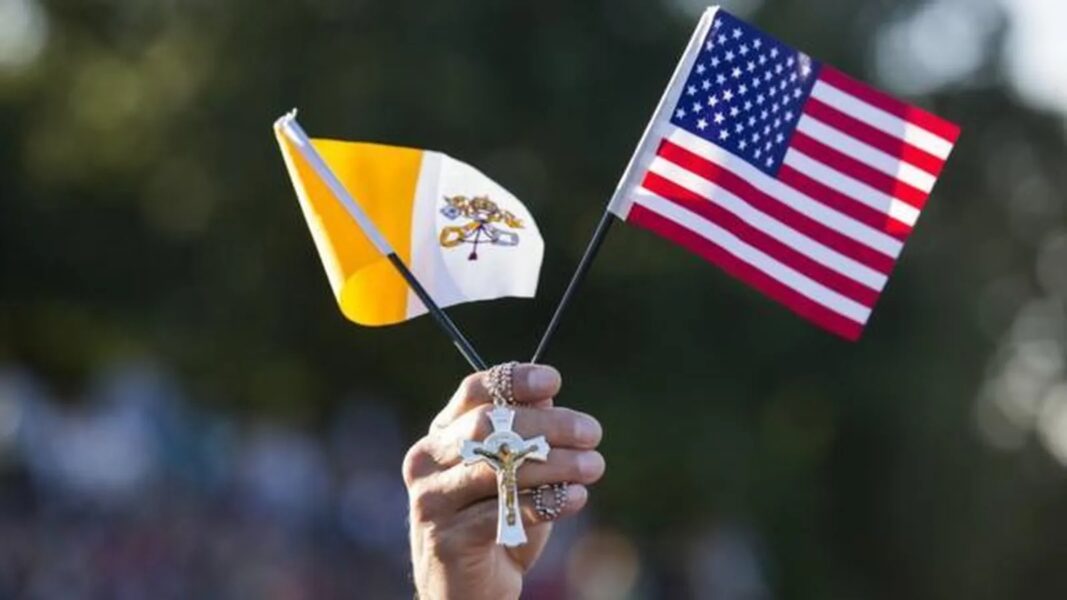
Pope Leo XIV made a gesture of great diplomatic significance by taking part in the celebration held at the residence of the U.S. Ambassador to the Holy See, Brian Francis Burch: “Accepting the invitation of the U.S. Ambassador to the Holy See, the Holy Father visited his residence on the evening of Saturday, July 4, on the occasion of the national holiday.” The visit comes at a time when relations between the Pope and U.S. President Donald Trump have been marked by clear differences. The Holy See reaffirms its tradition of keeping channels of communication open, even in moments of greatest distance, on matters of great international importance.
The Pope’s Letter to the United States.
On the 250th anniversary of the Declaration of Independence of the United States, Pope Leo XIV, born in Chicago, joins the celebrations of that “unique moment,” July 4, 1776, which “gave enduring voice to the ideals of liberty, equality, the pursuit of happiness, justice, and democratic self-government.” He does so through a letter, published by Vatican media, in which he recalls some of the principles that “guided the growth” of the nation to which he belongs, and also highlights the Catholic Church’s contribution to national development.
In the letter, dated June 25, 2026, he identifies among the “most cherished principles” proclaimed from the very beginning of U.S. national history that of “religious freedom: the right of every person to practice their faith according to their conscience and to exercise it openly, without coercion or fear.” That same freedom, the first American bishop of Rome emphasizes, “has allowed the Catholic Church to take root and flourish in the United States, benefiting not only its members but the entire nation.” Among the “many benefits” with which the Church has contributed to national development, the Pontiff particularly recalls “its service in the fields of education, preferential care for the poor, healthcare, and basic social services.” He then cites the encyclical “Sapientiae Christianae,” in which Pope Leo XIII wrote in 1890 that “no citizen […] is better than a true Christian, aware of his duty.”
Among the principles that have guided the growth of the United States of America, the Pontiff also recalls “the dignity that God grants to all human life,” which “leads to recognizing the importance of safeguarding human life from conception to natural death, and of building a society in which the vulnerable, the suffering, and the forgotten are always welcomed with compassion, solidarity, and love.” Concluding his letter, the Pontiff expresses his hope that the “spirit of 1776” will continue to inspire hope and unity on the path of the United States of America toward the future. He entrusts his entire nation to the intercession of the Immaculate Conception, patroness of this country, so that she may continue to watch over America and protect all its inhabitants.
The Curious Banking Secret of the Vatican Bank.
Those who open an account at the Institute for the Works of Religion sign forms, accept terms and conditions, and receive guarantees about the confidentiality of their data. What they are not told is that those data could end up, without a court order or request from the Financial Information Authority, in the hands of a department of the Roman Curia, the Secretariat of State, or on the Pope’s desk.
Under the pontificate of Pope Francis, the Vatican’s financial management was worse than that practiced in the most dictatorial China, a country with which, moreover, he had no problem signing secret agreements. The only difference was that he had the support of the press. Pope Francis even went so far as to indicate to the Cardinal Archpriest Emeritus of St. Peter’s Basilica in the Vatican the exact amount deposited in his bank account at the IOR. A cardinal who, moreover, had very little money, since he usually allocated a significant portion of his resources to charity and support for various individuals. If a similar matter had arisen in Russia, the Western press would rightly have waged a battle against the Head of State. In the Vatican, we know that everything was permitted, at least under the pontificate of Pope Francis.
There are fundamental human rights that must be respected, and one cannot claim to be a state governed by the rule of law simply because, once a year, the Monetary Authority appears and assigns its “yellow seal,” “red seal,” or “regular seal.” All Vatican employees, who are paid into their IOR account, know they are caught between a rock and a hard place. In the Vatican they are protected from Italian taxation, but they know their data can be known and used by their superiors in the Curia. Pope Francis was especially fond of prying into accounts and using the data at his convenience. When entering the Vatican through the Sant’Anna gate, a very busy ATM, it is the most discreet of those existing in the small state and is widely used by employees to withdraw their salaries in cash. There are many things we take for granted in Western systems that do not exist in the Vatican, one of them being banking secrecy.
Peter Thiel Does Not Like Pope Leo.
Peter Thiel, the American tech billionaire who has been in the news in recent months—especially for moving to Argentina with his family—took direct aim at Pope Leo XIV. The reason: the Supreme Pontiff’s criticisms of artificial intelligence, which could be helping the Chinese communist regime. Thiel explains his argument: Pope Leo XIV’s collaboration with Chinese communism occurs even without his realizing it. And the publication of his first encyclical titled “Magnifica Humanitas” could become a disadvantage for the free world because, as a believer mostly in Catholicism, one might take the Pope’s arguments into account, “but they would probably be ignored in China.” If the indications of Pope Leo XIV’s encyclical are followed, it would slow down one of the sides in the race between the United States and China for the development of AI. Therefore, for Thiel, that means “he works for the Chinese communists.”
China is pursuing an ambitious plan to win the technological race against the U.S. That is why the People’s Liberation Army (PLA) is training weapons controlled by AI. The Asian giant is also removing the human factor from production with a new Huawei factory that operates 24 hours in total darkness and with artificial intelligence. Thiel also referred to the situation in the U.S., where communists have managed to infiltrate the Democratic Party. Backed by New York Mayor Zohran Mamdani, they have won several primaries against moderate opponents from the same party. The goal is to win seats in Congress to promote the left-wing agenda in the country. Thiel asserts that the Antichrist could manifest not as an individual, “but as a world government that takes power promising protection against threats like AI or global warming.” “I think there will be a takeover by the social democrats within the Democratic Party.”
The Popes’ Summer Retreat.
The well-known Spanish magazine ‘Hola’ dedicates an extensive report to it. The so-called Pontifical Villas of Castel Gandolfo form an extensive complex situated on a hill overlooking Lake Albano, in the Italian region of Lazio. The grounds include the Pontifical Palace, several historic villas, and spectacular gardens, as well as forests, agricultural land, and archaeological remains from the Roman era. In total, it covers about 55 hectares, an area even larger than that of Vatican City itself, which barely reaches 44 hectares. It is a place with beautiful views of the lake and a much cooler climate than Rome in summer, which is why for centuries the popes have gone there at this time of year.
The history of Castel Gandolfo dates back to antiquity. This place was part of the legendary Alba Longa, and centuries later Emperor Domitian built a lavish imperial villa whose remains are still preserved within the pontifical grounds. The town began to take shape in the 17th century, when Pope Urban VIII commissioned architect Carlo Maderno to transform an ancient fortress of the Gandolfi family into the summer residence of the pontiffs. Since then, Castel Gandolfo has become the popes’ summer retreat.
Have They Gone Too Far in the Doctrine of the Faith?
That is what canonist Father Gerald Murray says about the recent decree from the Vatican following the unauthorized episcopal consecrations by the Society of Saint Pius X. According to Murray, the six bishops are indisputably publicly excommunicated. These are episcopal consecrations without a pontifical mandate; they incurred the automatic penalty corresponding to such an act under canon law. The Vatican decree simply declared that the penalty had already been incurred.
However, Murray argues that the attached explanatory note from the Vatican goes beyond what the decree itself legally establishes. His main criticism is that the decree explicitly mentions only the six bishops and does not formally include the approximately 700 priests of the SSPX in the list of excommunicated. While the attached explanatory note refers to the priests as schismatics and analyzes the situation of the laity belonging to the Fraternity, Murray argues that such a note cannot, by itself, impose or declare new canonical sanctions.
An explanatory note serves to clarify a decree, not to expand its legal effects, and he believes the priests have not been publicly declared excommunicated, although the Holy See considers that they have incurred an automatic penalty. Lay Catholics are not automatically excommunicated for attending an SSPX chapel or sympathizing with the Fraternity. Penal canon law requires greater precision. A canonical penalty must be linked to a specific external act, not merely to an internal attitude or a vague notion of “adherence.” The Vatican documents do not clearly identify what concrete actions by priests or laity would constitute formal adherence to the schism.
Murray argues that the permissions previously granted by Pope Francis regarding confessions and marriages of the SSPX cannot simply be annulled. According to him, those permissions were established by papal acts and therefore another papal act would be required to revoke them.
In its letter to Pope Leo XIV, the Fraternity speaks as if the sanctions and their consequences applied not only to the six bishops but to the entire community, suggesting that even the SSPX understands the Holy See’s intention in that regard. Murray also criticized Pope Benedict XVI’s lifting of the excommunication of the SSPX bishops in 2009, arguing that it also did not follow due canonical process. Therefore, his current criticism is consistent with his long-standing insistence that canonical procedures must be observed regardless of the outcome or the parties involved.
An American View of the Lefebvrian Schism.
The Lefebvrian Fraternity had neither the will nor the capacity to reconcile with the Catholic Church, since this would reduce the entire Lefebvrian movement to irrelevance, not only in the ecclesiastical sphere but also in the sociopolitical one. Returning to the Catholic Church would mean disappearing, becoming a mere stain within the conservative spectrum of global Catholicism. This is especially true in the United States, which is one of the regions with the largest number of members, priests, and seminarians of the Fraternity.
U.S. Catholicism aligned with Trump must now distinguish itself, at least formally, from the positions and demands of the Society of Saint Pius X. The Holy See’s message on this is clear: if one cannot demonstrate differences with the Lefebvrian movement and does not obey the guidelines issued by the first American pope, then one has no choice but to join the Lefebvrian Society. The power of the American conservative Catholic establishment has consisted in its ability to exert strong pressure on the papacy and, in a way, hold the Holy See hostage.
Pope Leo XIV, despite having been tasked with resolving internal tensions within the Catholic Church, demonstrated—through the excommunication of the Lefebvrists—that he was not willing to safeguard the unity of the Catholic Church at all costs.
Evangelicals are already fomenting “culture wars” among the American population. As these wars shift from individual morality to social ethics, they move ever closer to an outright “civil war.” This shows that Samuel Huntington was both right and wrong with his maxim about the “clash of civilizations.” Religion has played a fundamental role in global politics since 9/11, but the conflict has not been limited to Western civilization and Islamic countries; it is unfolding in the very heart of Western civilization: the United States.
Écône, a Wound in the Church.
Americo Mascarucci comments on the recent events related to Lefebvre.
It was neither correct nor prudent to announce the appointment of new bishops and then declare oneself available to dialogue with the Holy See, almost presenting the Pope with a fait accompli and pressuring him to accept a decision already made. And here, unfortunately, the comparison with the Anglican “popess” is completely irrelevant. The Anglicans are not in communion with Rome; communion with the Pope was broken with the schism of Henry VIII and Elizabeth I. The “popess” of England is not part of the Church and is not obliged to obey the Holy Father. The Lefebvrians aspire to be part of the Catholic Church; they have repeatedly requested readmission, swearing obedience to the Pope and obtaining from Benedict XVI the revocation of the excommunication of the bishops illicitly consecrated by Lefebvre in 1988.
Precisely out of obedience to the Pope, they should have shared a path, sought dialogue and full reconciliation, and not forced the issue of episcopal consecrations, compelling Leo to proceed with the inevitable excommunication, just as Wojtyła did with Lefebvre. The great gesture of Benedict XVI has been betrayed, and unfortunately, many in the progressive sector now accuse him of having been mistaken in placing his trust in them, given their refusal to accept the documents of the Second Vatican Council and their disobedience to the Pope. It is not a matter of being conservative or progressive, but, as Cardinal Müller rightly said, of remaining Catholic. But this is only possible by respecting the authority of the pope and remaining in communion with him, avoiding an ideological traditionalism detached from love of tradition.
The Church’s Concern for Immigrants.
It has recently been explained by the “radicalism” of Pope Francis, who, at the beginning of his pontificate, cried out from Lampedusa: “In this world of globalization, we have fallen into the globalization of indifference.” He denounced a globalized world in which the circulation of goods is encouraged, but walls are raised against migrants and refugees. Does the Church not betray the “Christian world” by choosing immigrants? Does it not fear being overwhelmed by so many newcomers, perhaps of other religions?
For Leo XIV, the Popes look above all to women and men in grave danger: “Every boat that arrives brings not only migrants; it brings with it a question: what kind of world have we built, if so many brothers and sisters must risk their lives in search of a life?” “Human dignity has no passport, nor does it lose value when crossing a border.”
The doctrine on emigration was developed between the 19th and 20th centuries, when the Church sought to accompany the exodus of Europeans to America with numerous initiatives, creating religious congregations for that purpose. It addressed the situation of Armenian refugees after the Ottoman massacres. It grew amid the exoduses and deportations in Europe during the two world wars. It found organic expression in 1952 in the constitution Exsul Familia of Pius XII, a Pope considered “conservative,” but who affirmed principles that today would be labeled extremist. Already in 1941, he had affirmed “the right of the family to housing.” Nazi imperialism considered the right to “living space” (Lebensraum) fundamental for the expansion of the Reich. For Pius XII, however, the family is the subject with the right to housing in a positive relationship “between the country of emigration and the country of immigration.” The Pope protested against states that “restrict the natural right to emigration” and against those that forcibly displace populations. For him, in 1952, emigrating was a “natural right” that had to be protected. The history of the Catholic “utopia,” so to speak, is concrete and goes back centuries: “the Church is, therefore, supranational, because it is totally indivisible and universal.”
The Reality and Dreams of Immigration.
Article published by Professor Ettore Gotti Tedeschi in La Verità. “Is immigration an end or a means? And if it is a means, to what end?” Immigration is a necessary and appropriate means to a specific end: religious syncretism. The UN has made this clear for decades. To try to understand (if one wishes to understand) whether immigration is a means or an end, it is essential to study and understand Henry Kissinger’s “world order” projects (1972), but today I will limit myself to some statements (to Corriere della Sera, 11.5.2016) by the UN Secretary-General (from 2007 to late 2016), the South Korean Ban Ki-moon. Regarding immigration, he declared (or ordered?) that “…far from representing a threat, immigrants contribute to economic growth and development. More vigorous measures are needed to promote their inclusion. Governments must speak out firmly against discrimination and intolerance and counter those who seek to obtain votes (!!!) by sowing fear and opposition. I propose an agreement for safe, orderly, and regular immigration.” The previous UN Secretary-General (from 1997 to 2006), Kofi Annan (a Ghanaian Anglican), had said much more at the Peace Conference (New York, 2000), explaining that to achieve universal peace it is necessary to create religious syncretism and a new universal religion, thanks (also) to the immigration of people with different cultures and religions. Representatives of the Catholic Church immediately confirmed that multiculturalism enriches…
In the Church, many authorities had understood the project of syncretism as their true objective. Others, however, supported it. Saint John Paul II spoke of the “limits of welcome,” urging governments of host countries to protect their “common good” by avoiding indiscriminate immigration that could harm the host community (Laborem Exercens). Benedict XVI (Caritas in Veritate) considered “not emigrating” a right, supporting migrants in their homeland (“renunciation”). Robert Sarah, from Guinea, considers current immigration a serious threat both to the host country and to the country of origin, and referring to Africa, called for support in the country of origin.
Immigration is a (declared) means to achieve religious syncretism. Therefore, economic evaluations of benefits and costs can be subjective, since they are based on definitive (and often contradictory) data. As for the pensions that supposedly sustain us, I fear the opposite is true. Poor immigrants, it is not their fault. So one can imagine whom he would “repatriate,” perhaps under threat of excommunication for supporting a kind of heresy: syncretism.
«Come to me, all you who are weary and burdened, and I will give you rest.”
Enjoy your reading.