


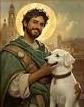
And celebrated the Assumption, today Sunday and Saint Roch. In Italy and France, Saint Roch was already venerated in the 15th century, shortly after his death. Saint Roch was the son of the governor of Montpellier, then part of the Kingdom of Aragon, the place where he was born in 1378, and at the age of 20 he was orphaned of both parents. During the plague epidemic, he dedicated himself to assisting the sick and in Piacenza he contracted the deadly disease. When he regained his strength, he returned to Montpellier where his uncle did not recognize him and left him in abandonment. Saint Roch was arrested, probably because he was mistakenly confused for a spy, remaining in prison for five years where he finally died with great fame of sanctity.
The Pope in Castelgandolfo.
The official vacation was in July, but in August the Pope returns to fulfill some summer traditions of the Pope’s Villa. He will have two Marian Masses—one today for the Solemnity of the Assumption and another for the local feast of Our Lady of the Lake—in two weeks. On Saturday, August 29, the Pope will honor the feast of the church of Santa Maria del Lago by presiding over the Mass and participating in the procession, which will also take place in part over the waters of Lake Albano. «It is a route that winds from the church. Part of the procession will be on the lake, and Leo XIV, the first Pope to do so, will advance by boat. The last Popes to participate in the procession were Saint Paul VI and Saint John Paul II.» «The Pope’s presence attracts a great many people, tourists from Rome but also from other parts of Italy.»
The Solemnity of the Assumption.
Pope Leo XIV chose the Solemnity of the Assumption to address the meaning of beauty and the way contemporary culture tends to reduce it to an aesthetic model to be pursued, to the point of experiencing the passage of years as something to be hidden or resisted. He presided over Holy Mass at the pontifical parish of Santo Tomás de Villanueva in Castel Gandolfo. Leo XIV linked the mystery celebrated by the Church with the concrete condition of man, focusing on the body, the passage of time, and the Christian promise of a beauty destined for fullness.
The Pope drew inspiration from the apostolic constitution Munificentissimus Deus of Pius XII, recalling that Mary, «having completed the course of her earthly life, was assumed body and soul into heavenly glory.» The Pope invited the faithful to an exercise of daily discernment, capable of recognizing those who, despite being marked by wrinkles and suffering, radiate serenity, benevolence, and peace, distinguishing them from those who, attractive in appearance, remain hard and cold within.
The Angelus of the Assumption.
On the feast of the Assumption, Leo XIV’s prayer became a thermometer of the world’s most urgent needs: he recalled that Ukrainians and Russians share, beyond the conflict that has divided them for years, the same filial devotion to the Mother of God. He expanded on the iconography of the Assumption, offering the faithful a brief lesson on the history of sacred art. Leo XIV distinguished two figurative traditions: the oldest, spread for almost a millennium, that of the Dormition, in which Mary lies asleep while the risen Christ welcomes her soul like a newborn in his arms; and the other, developed later in the West, which represents the Virgin already glorified, wrapped in light and surrounded by angels, according to the apocalyptic vision of the woman clothed with the sun. Leo XIV finally invited everyone to a time of authentic rest, composed of good reading and contact with nature.
Two new nuncios.
Also today, the Pope appointed Hungarian Archbishop Gábor Pintér, titular bishop of Velebusdo, as apostolic nuncio to the Kingdom of Tonga. The bishop, 62 years old, has served as apostolic nuncio in New Zealand, the Cook Islands, Fiji, Kiribati, the Marshall Islands, the Federated States of Micronesia, Nauru, Palau, Samoa, and Vanuatu, as well as apostolic delegate in the Pacific Ocean, since the summer of 2024. Previously, he was papal representative in Belarus from 2016 to 2019, and subsequently in Honduras from 2019 to 2024.
Leo XIV’s intentions with the Traditional Mass.
On June 29, 2026, Pope Leo XIV addressed a letter to Cardinal Arthur Roche, prefect of the Dicastery for Divine Worship and the Discipline of the Sacraments, on the occasion of a liturgical conference held at Mount Angel Abbey, in Oregon. The text recalls the encyclical Desiderio Desideravi of Pope Francis and reiterates the need for continuous liturgical formation, both for clergy and laity, considered indispensable to «revitalize the liturgical life of the universal Church.»
The document did not go unnoticed for a specific passage that directly questions the eternal question of the traditional Latin Mass and the restrictions imposed by Traditionis Custodes. The Pope Leo XIV states that those responsible for preparing the liturgy, «and priests in particular,» must show respect for «the rites promulgated by Popes Saint Paul VI and Saint John Paul II«. The Pontiff explicitly links this respect with «sincere fidelity to ecclesial communion,» reiterating a concept already expressed in his catechesis of May 27 on Sacrosanctum Concilium.
This passage seems to finally offer documentary confirmation of what Cardinal Roche had publicly declared at the end of July in an interview with The Tablet, when he stated that Leo XIV would not modify Traditionis Custodes nor return to the regime of Summorum Pontificum of Benedict XVI. AdVaticanum offers a different interpretation, advising against overinterpreting the text in its original article. The Pope’s call for fidelity «to the approved texts and instructions» must be read together with the emphasis placed on the ars celebrandi, which must promote an ever deeper understanding of the liturgy both by the celebrant and by the entire assembly. The result, it states, is «a clear invitation to celebrate Masses according to the books and instructions approved by the Church, with dignity,» rather than through personalized or improvised approaches.
AdVaticanum also emphasizes that Leo XIV, in his letter, does not mention the Traditional Latin Mass at all, thus leaving open the question of how his pontificate intends to address the oldest form of the Roman rite. From this perspective, the reference to the rites of Paul VI and John Paul II would be, above all, a call to dignity and fidelity in the celebration of the reformed rite—that is, the Novus Ordo, already in use in the vast majority of parishes—not a statement on the discipline regarding the 1962 Missal.
Niwa Limbu, also in AdVaticanum, had already warned about caution regarding journalistic reconstructions that too directly link the Pope’s actions and words with a rigid line on Traditionis Custodes, while pointing to a possible inconsistency between this interpretation and other signals, such as the communication sent to the French Episcopal Conference, which was instead oriented toward dialogue and pastoral sensitivity. The letter, by its very nature, is a text dedicated to general liturgical formation, not a normative document on the discipline of the 1962 Missal.
So much discussion and so little clarity is making everyone do what they see fit. Today no one has a problem celebrating Mass in the traditional rite, with or without the bishop’s permission; the faithful who attend know they must be discreet. On the other hand, in many parishes the Missal of Paul VI is not respected at all and they have created their own. The way Mass is celebrated in many parishes is getting more and more out of control. It is likely that priests think that the Mass is «their business.» Father Nicola Bux, liturgist and former advisor to the Congregation for the Doctrine of the Faith, wrote in his book with the provocative title: «How to Go to Mass and Not Lose Faith»: «During the Mass of the ordinary rite, the one celebrated in Italian, we witness a certain almost unbearable liturgical ‘creativity,’ which consists, for example, in displays of rainbow flags, dances, rock songs, jokes recited by the priest during the homily, Masses celebrated at sea with an inflatable mattress as an altar, which leads the priest who during Mass says ‘I don’t believe in the Creed‘ and so on.»
To this is added another factor that should be taken into account given that the cardinal has concluded his five-year mandate and that some of his technical statements on liturgical issues have been repeatedly questioned by liturgists and canonists. The concrete gestures of the pontificate—from the audiences granted to cardinals close to the traditional world, to the permission granted to Cardinal Burke to celebrate a papal Mass at the Vatican, to the letter to the Society of Saint Pius X recognizing the «desire for fidelity to Tradition» of many communities linked to it—paint a more complex and, in a way, less resolved picture than what Roche’s statements suggest.
Vocations to religious life.
In the message addressed to the religious sisters gathered in Orlando, the Pope asks them to redouble their efforts to invite young people to consecrated life. Sister Simona Brambilla, missionary of the Consolata and secretary of the Vatican Dicastery for Institutes of Consecrated Life and Societies of Apostolic Life, delivered a speech on August 13, 2025 in Atlanta. The Pope said that «the work of fostering religious vocations is of vital importance,» and noted that, despite secularization, there is also «a growing hunger for God» among young people. «As many of us have personally experienced, Christ’s call to follow him with an undivided heart through the vows of poverty, chastity, and obedience brings joy, peace, and fulfillment.»
Among the speakers at the assembly are Sister Nathalie Becquart, member of the Institut La Xavière Missionnaire du Christ Jésus and undersecretary of the Synod of Bishops, and Sister Vicky Larson, member of the Sisters of the Presentation of the Blessed Virgin Mary of Aberdeen, South Dakota, and president of the conference. Dominican Sister Mila Díaz Solano, originally from Peru, and Sister Mary Gabriel Devlin, of the Sisters of Life of New York, are among the facilitators of the «conversations in the Spirit» that are part of the assembly.
Pope Leo praised that the assembly incorporated this synodal method of listening, dialogue, and discernment during the proceedings, and expressed his hope that «through this format of fraternal and receptive dialogue, they may discern what the Holy Spirit is saying to them about the present and future of consecrated life in the nations where they serve.» «All Christians are called to be builders of the communion of Christ, which takes shape in a synodal Church in which each one cooperates in the same mission according to his or her own charism and ministry.» «In a special way, members of religious life are called to be experts in synodality because of the opportunities to practice it offered by community life, as well as the very organization of their Congregations.»
Given what attends these meetings, we foresee very little future. The very advanced ages of the attendees and the continuous closure of their houses suggests a foretold death. The new religious orders, full of vocations, are excluded from this type of meetings and, in most cases, commissaried and persecuted. Vocations go where they go, and the future is where it is; we can prolong the agony, death is certain.
Back to synodality.
Synodality is a theme that particularly fascinates Ugo Sartorio (OFMConv, professor at FTTr): he has already dedicated two other books to it: Sinodality. Towards a New Style of Church (Àncora 2021) and Synodality between Democracy and Populism. Beyond All Clericalism (EMP 2022). A new work ( Laymen and Laywomen in a Synodal Church. The Challenge of Co-responsibility ), aims to show how the ancient question of laymen and laywomen in the Church. It is well known that, since the Second Vatican Council, much has been said about the laity, although it was the change in the ecclesial horizon introduced by the pontificate of Pope Francis, with the category of synodality, that allows a discourse on the laity «which is actually a discourse on the Church and not on the laity as a category.»
The first two chapters, » Terminological Approach » and «The Theological History: A Guide,» are dedicated to this. It is not simply a conceptual clarification, which has already been extensively explored in a great deal of literature on the subject, but rather a rediscovery of the underlying reasons that led to the prominence of this matter during the post-conciliar era. It could be agreed that the term «lay» is far from univocal, if not even «compromised.» The situation could change if the laity were relocated «within the People of God together with all the baptized, dissolving that unhealthy clergy-laity dualism that has long and disastrously conditioned the Christian experience» (p. 34). It seems appropriate, therefore, to rediscover in «experience» the theological «map for orientation» (p. 37) amid the complexity of the elements that have been superimposed on this term. The worrying decline of the priesthood has given rise to frequent calls for greater participation of the laity in the life of the Church. In the fourth chapter ( Women, Ministries, Leadership: A Church That Must Be Rethought ), Sartorio addresses the theme of the presence of women in the Church, their access to ministries and to leadership.
The newly baptized in France.
We already have the first document prepared by the protagonists of the new wave of adult baptisms in France. Catechumens, companions, priests, religious brothers and sisters, groups and communities were convened by the dioceses of Île-de-France: Paris, the dioceses of Créteil, Évry-Corbeil, Meaux, Nanterre, Pontoise, Saint-Denis, and Versailles, as well as by the Military Ordinariate. The surprise is the enormous participation: between January 25 and June 28, 46,000 people responded with 4,850 contributions. The document Instrumentum laboris. Provincial Ecclesiastical Assembly – Ile de France. Catechumens (adolescents and adults). Newly baptized and confirmed is divided into 70 pages and five chapters (Experiencing welcome as a visit; Discerning on the way; Walking together following Christ; Celebrating the catechumenal journey; Incorporation).
The phenomenon of adult baptism, which began without warning between 2020 and 2023, is significant, but is also recorded in many other Western nations: Belgium, the Netherlands, Austria, Switzerland, Germany, the United Kingdom, and the United States. In France, adult baptisms increased from 4,500 in 2020 to 21,300 in 2026. «They have taken us by surprise: from all origins, of all ages, of all cultures, of all sensibilities, men and women knock on the doors of our churches, our chaplaincies, our schools… Here, in the chiaroscuro of our world and our Church, is the source of great joy and a profound reason for hope» (n. 1).
Among the catechumens, some demand clear doctrinal and moral content, expressed in the Catechism of the Catholic Church, while others insist on the connection between spiritual guidance and life. These demands for different paths are intertwined with the need for a common and shared trait around the fundamental pillars of the central prayers and the Creed. This includes the need to transmit the entire sacramental heritage, in particular confession, but also the anointing of the sick. It also highlights the different states of Christian life: consecrated life, priestly ministry, marriage, and celibate life.
For those coming from Islam, the transition may involve a painful separation from family, community, and culture. They bring a structured and demanding faith. For those professing Judaism, this does not represent a total rupture, but rather a fulfillment that demands respect and honor of their biblical roots. While there are cases of family and community ruptures, this is not due to a lack of clarity. For those coming from Protestant or Orthodox churches, baptism is already recognized, but evangelicals often insist on asking to be baptized again. For those coming from paganism, minor exorcisms and anointings become a sign of abandonment of idols.
«Lord, Son of David, have mercy on me!»
Good reading.