


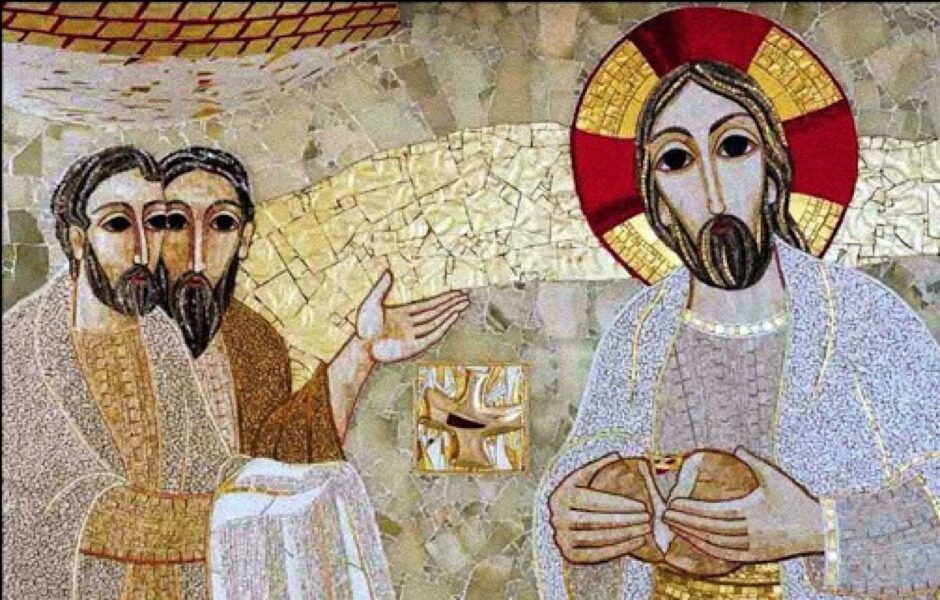
It’s Sunday, Gospel of Emmaus at Easter. Pope Leo is finishing his trip to Africa. The Trump storm is subsiding and we continue with the usual topics that never quite resolve and periodically haunt us: the secret Chinese pacts and the eternal Rupnik process. The SJ of ‘Civiltà’ continue with their things and analyze The Excommunication of Luther: 500 Years Later, u once lifted in that way the one of Rupnik perhaps we lift Luther’s, once we’re at it, the thing wasn’t that big a deal. If we have ‘communion’ with Muslims, the separated brethren won’t be less, and the sisters, of course, even mitred.
Pope Leo XIV in Angola.
Second day of Pope Leo XIV in Angola. In the morning, he celebrated Mass in Kilamba, a city built in a few years by Chinese companies with significant investments in the country. It is possible «to build a country where old divisions are overcome forever, where hatred and violence disappear, where the scourge of corruption is healed with a new culture of justice and solidarity». In the afternoon, he moved to the Mama Muxima sanctuary to pray the rosary. Finally, he returned to the capital, Luanda.
Have we understood everything wrong?
For any ruler it is important to have the capacity to understand the situation around him, what has always been called having ‘understanding’. Without this, he runs the risk of making blunders by living on another planet. Equally or more important is having ‘explanations’. We all remember the unsurpassable explanations of Father Lombardi in the press room in the times of Pope Francis when he tried to convince us, with great intelligence, that what we had all heard and understood perfectly was not so. It seems that now the newspapers try to fabricate news instead of observing and reporting on reality.
A trip «interpreted» instead of recounted.
The Pope was eager to refocus the authentic meaning of his African pilgrimage, which began in Algeria in the name of St. Augustine —«a beautiful monument with the map of Africa and the saint in the center», blessed at the Catholic University of Yaoundé— and which now continues to Angola. A pastoral trip, Pope Leo XIV insisted: «I come to Africa mainly as a pastor, as head of the Catholic Church, to be close to all Catholics, to celebrate with them, to encourage them and to accompany them».
Pope Leo accuses the superposition of one’s own interpretations over the actions and words of others, to the point of distorting their meaning. The lamentable spectacle we have witnessed in recent days: right-wing newspapers committed to defending Trump, and left-wing newspapers committed to exploiting the Pope against him. Two symmetrical distortions, two forms of the same vice. Leo XIV demonstrated it with a concrete example, presented to the same journalists traveling on the plane: the speech he delivered at the Prayer Meeting for Peace had been written two weeks before the President of the United States made any statement about him. This text was reinterpreted as a direct response, almost a diplomatic exchange at a distance with the White House. The accredited journalists are perfectly aware of the preparation times for papal speeches: they know that a text like that is not written the night before, they know that it cannot be a response to statements made the day before. Those who wrote the opposite did so knowingly, opting to exploit them. An editorial decision, even more than a journalistic one: those articles were requested by the editors, attracted by the logic of the incendiary headline. Today’s episode is not an isolated case. Leo XIV had already had to correct the information on a previous occasion during his pontificate, and even then, it had happened on a plane. Some colleagues had believed they could explain to their readers what the Pope thought: not based on what he had said, but on how he had said it, or even on his facial expression when saying it.
Africa as a reserve of hope.
It is the core of all Pope Leo’s messages in Africa. The most original—and at the same time most transgressive—turn of the words spoken in this splendid land lies in his interpretation of the continent as a spiritual resource for all humanity, not as a problem to solve. In Luanda: «Africa is for the whole world a reserve of joy and hope, which I would not hesitate to call ‘political’ virtues, because its young people and its poor still dream, still have hope and do not settle for what already exists». Where the world looks at the continent and sees a patient who needs treatment, the Pope looks and sees a teacher. African joy, which «also knows pain, indignation, disappointment and defeat, endures and is reborn among those who have kept their hearts and minds free from the deception of wealth».
The common thread that unites all these stages is the conviction that encounter—true, disinterested, capable of overcoming conflict—is the generating principle of all authentic civilization. «Only in encounter does life flourish. In the beginning is dialogue». Augustine becomes the icon of the trip because he embodies the unresolved and fruitful tension between belonging and universality, between roots and search. «Peace is not something that is invented: it is something that is welcomed, welcoming our neighbors as brothers and sisters».
Everyone with Leo XIV?
Vance: «I thank the Pope for not wanting to debate with Trump.»
The Vice President of the United States, JD Vance, commented on X the words with which the Pope explained that his speeches should not be interpreted «as if I were trying to debate again with President Trump, which does not suit me». «I thank Pope Leo XIII for saying this. While the media narrative constantly fuels conflict—and yes, there have been and will continue to be real disagreements—the reality is usually much more complex». The Pope «preaches the Gospel, as he must», this «inevitably involves expressing his opinion on current moral issues».
Trump has nothing against the Pope.
Trump declared on Thursday to journalists that he had «nothing against the Pope» and that «everything revolves around the Gospel», while continuing to claim that Pope Leo XIV was in favor of Tehran possessing nuclear weapons. «The United States has always had a religious conception of itself as a nation, but presidents have been very cautious about presenting themselves as messianic figures , at least in life». «Trump has taken advantage of the creation of a secular vacuum in the United States, and has filled that vacuum with a certain degree of messianism, and some American Christians are happy with that». The US president will restore relations with the Holy See. «In fact, I see it as a sign of hope, one that is moving and influencing President Trump , despite what he says and what he has published».
Political consequences of the Trump – Prevost confrontation.
Marco Politi analyzes the political consequences of the latest events in relations between US leadership and the Catholic Church. Politi begins with a broader reflection on the role of Europe and the lack of a truly common defense, evoking the theme of «United States of Europe» and a possible unified military force. The new balance between the Vatican and the United States would have produced an unexpected political effect: Donald Trump’s attack on the Pope would end up strengthening the Church’s position and politically isolating the former president. Politi emphasizes that a significant part of the US Catholic electorate, historically sensitive to Vatican stances, could react negatively to this confrontation, with possible repercussions also in future midterm elections. The tension between political and religious leadership is redefining the internal balance of power in the United States, with potential consequences that are still difficult to predict.
The unfortunate secret agreement between the Vatican and China.
Human Rights Watch had already urged Pope Leo XIV to repeal the agreement, and with the publication of its report, has reiterated this call. «Pope Leo XIV should urgently review the agreement and pressure Beijing to end the persecution and intimidation of underground churches, clergy and faithful». “Basically, they arrested priests and bishops from underground churches and told them: ‘The Vatican has ordered you to join the Patriotic Association’”. The process of «sinicization» has long been a tool used by China to impose state control over religious practice. Human Rights Watch stated that «groups must have no relation to churches or foreign entities, as this is considered a matter of national security. The Holy See and the Catholic Church are targets [of persecution]».
The late Pope Francis and Cardinal Parolin repeatedly and firmly defended the agreement, and Parolin did so again this month. China expert Steven Mosher previously described the agreement as «perhaps the most controversial of a pontificate plagued by controversies». Human Rights Watch: “the human rights violations committed by the Chinese government against Catholics contravene the United Nations Universal Declaration of Human Rights and violate, among other things, the rights to freedom of religion and belief, expression, association and movement”. The US Congressional-Executive Commission on China declared in its 2020 report that the intensification of religious persecution in China has reached «a level not seen since the Cultural Revolution». Human Rights Watch sent a copy of its report to the Vatican and the Chinese government, but received no response from either.
The Vatican’s silence in the Rupnik case.
A suspicious silence has hung over the Vatican regarding the Rupnik trial. However, only a few months have passed since, on November 7, 2025, Pope Leo XIV personally reassured world public opinion, as well as the victims of the former Jesuit accused of sexually and psychologically abusing about thirty women. The Pope announces that the new canonical trial has finally begun and that the judges have been appointed, and that patience is required. A few days later, the lawyer for five of the victims sent an email to the top of the Dicastery for the Doctrine of the Faith requesting Cardinal Víctor Manuel Fernández, Prefect, and Monsignor John Joseph Kennedy, Secretary of the Disciplinary Section, for the technical and procedural information necessary to understand how to proceed. «To have a minimum of clarity in the process, out of respect and in the interest of all».
Rupnik, so far, seems to have always managed to evade the clutches of canonical justice thanks to his powerful friendships, his ties to prominent cardinals. Pope Francis kept a painting of his in his room and personally lifted the excommunication from the Dicastery for the Doctrine of the Faith in 2020. An incident that has raised many questions and highlighted the lack of transparency.
The lawyer: «I have repeatedly contacted the Dicastery for the Doctrine of the Faith to obtain information. The victims are completely unaware of what is happening». To date, «both the number and the names of those who make up the tribunal are unknown». «No one has given us any official news. The victims have been paying a very high price for years, and instead of decreasing, it keeps increasing. This is not only intolerable, but also contravenes every legal principle. Because it is right that there be a fair trial where all rights are guaranteed, first and foremost the principle of innocence and the defense of Father Marko Ivan Rupnik, but it is also right that there be a time for all this to take place, the time for a fair trial and for the victims to be able to return to oblivion. All this is, unfortunately, and I say it with immense regret».
Once again, the Vatican’s approach to justice seems to be marked by a lack of transparency, as associations defending victims of sexual abuse have repeatedly pointed out in recent years. To date, around thirty complaints from abused nuns have been recorded, spanning a period dating back to the 1980s. Father Sosa SJ washes his hands: «We have asked for forgiveness for our blindness. It is true that we did not see. Where does this blindness come from? From not having known how to connect the signs that were there. Moreover, in the past, it was not easy to file a complaint of this kind. And we lacked the sensitivity to see what had happened».
The Rupnik case: between the artist and his works.
If we qualify the works of art that exist in the world by the morality of their authors we have to close the museums and demolish thousands of buildings. The debate on the complex distinction between works of art and the behavior of the artist who created them is not new, but a recent article in the New York Times raised the issue in relation to a rather singular case of an artist accused for years of sexual abuse, whose works continue to be exhibited in more than two hundred places in Italy, France, Brazil, the United States and other countries. These places are mostly churches, and the artist is a theologian and former Jesuit priest, Marko Rupnik, a 71-year-old Slovenian mosaic artist who is appreciated and sought after, but accused of sexually and psychologically abusing several nuns. Our image today is provocative, let’s not get into whether it is good or an example of ugliness, it’s known that about tastes it’s better not to speak, but there are good and bad ones.
Rupnik, creator of mosaics in several buildings, even in the Vatican, was a very respected Jesuit for years: in 2021, among other things, he was entrusted with the restoration and renewal of the chapel of the Pontifical Roman Major Seminary. After a Jesuit investigation, in 2023 he was offered «the opportunity to change community and accept a new mission», but he refused and was therefore dismissed from the order. That same year, the Vatican initiated its own investigation after a special commission to combat sexual abuse in the Church reported to Pope Francis, also a Jesuit, of «serious problems» in handling the Rupnik case and of «a lack of closeness to the victims». Currently, Rupnik is undergoing a peculiar canonical trial before a Vatican tribunal. According to some of the women accusing him, his mosaics should be removed or covered, or, if this is not possible, a caption should be added indicating the accusations.
Some Vatican websites continued to display images of Rupnik’s works after the accusations became public. These were gradually removed following criticisms expressed in 2024 by Sean Patrick O’Malley, in a letter addressed to all dicasteries, urging greater «pastoral prudence» before deciding to exhibit works of art created by an alleged abuser. In a statement from 2024, the Aletti Center expressed concern about the spread of the so-called «cancel culture» and a vision that legitimizes the «criminalization» of art, adding that «the removal of a work of art should never be considered a punishment or a solution».