


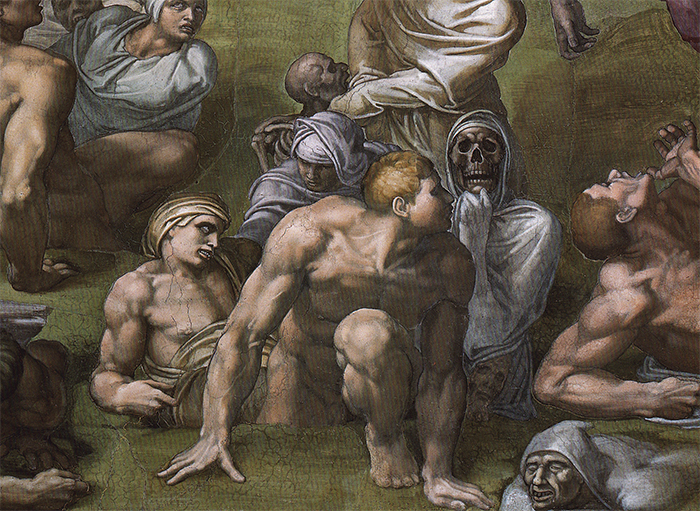
Monday, Commemoration of All the Faithful Departed. There is less intensity of information than usual, and what there is is almost entirely from yesterday: the Pope celebrates this afternoon at the Verano cemetery, five Spanish Franciscans were beatified on Saturday in Georgia, and the Archbishop of Milan has written to his parishes that for a funeral there is no fee to pay.
The rest: the headline that attributes to the Pope a phrase he did not say that way; an Israeli rabbi whose appointment was tightened in three steps; the document that supports the Italian Episcopal Conference and the conference’s own newspaper that contradicts itself; an interview about young saints that contains not a single statistic; a protocol standoff in Buenos Aires that the Argentine chancellor denies by name and title; and a priest removed in Chicago with a headline that says abuse and an archiepiscopal letter that says it does not.
The Mass of the Dead at the Verano
We begin with the day, which is what today requires. This afternoon at four o’clock the Pope celebrates Mass at the Monumental Cemetery of the Verano, and beforehand he will pray at a grave. Concelebrating are the Cardinal Vicar of Rome, Baldo Reina, the Vicegerent of the diocese, Monsignor Renato Tarantelli Baccari, and Father Fabrizio Carli; the liturgical service is provided by the students of the Pontifical Roman Major Seminary and of the Redemptoris Mater, and admission is free until capacity is reached. The appointment was already on the calendar of pontifical celebrations published by the Office of Liturgical Celebrations on 27 October, so yesterday’s announcement was confirmation, not news. Nor is it a first: Leo XIV already celebrated at the Verano on 2 November last year. Second consecutive year.
And we devote the paragraph the day calls for, with document and not with tone. Today a priest may celebrate three Masses; this is set out in the constitution Incruentum Altaris of Benedict XV, of 10 August 1915, which grants three and distributes their intentions: one free, one for all the faithful departed, and one for the Pope’s intention. It is worth clarifying what is almost always misstated: the one without a stipend is only the second, not two of the three. The plenary indulgence for visiting a cemetery with prayer for the dead runs from 1 to 8 November and applies only to them, never to oneself; today it is also gained by visiting a church or oratory with the Our Father and the Creed. There is no extraordinary decree from the Apostolic Penitentiary this year: the last ones were the extensions of 2020 and 2021, when the pandemic prevented visits to cemeteries. The ordinary norm therefore applies, and it applies in full.
Of the phrase the Pope said yesterday about all this, to pray “for the dead, especially for those whom no one remembers.” In a cemetery like the Verano, where alongside the pantheons of illustrious families there are graves that receive no one.
The Angelus of All Saints
Yesterday’s Angelus is published and does not say exactly what is attributed to it. The headline that has circulated puts in the Pope’s mouth a “tomorrow I will be at the Verano.” What he said was: “tomorrow afternoon, on the Commemoration of All the Faithful Departed, I will celebrate Mass at the Verano Cemetery.” And the phrase most widely copied, “the saints are people disarmed in the heart but guarded by God,” is not his in that form either: the original is in apposition, “disarmed in the heart, but guarded by God,” and describes the saints he has just spoken of; it does not establish a definition.
In congratulating the Franciscans who place the poor at the centre, the Pope said “as the Lord Jesus did and as Saint Francis of Assisi did,” and that second half has disappeared from the quotation; and in thanking the civil institutions and the forces of order, he was thanking something concrete, “who have given full collaboration.” The initiative he thanks, by the way, is called “the Missione con i poveri” and runs from 8 to 15 November: it has not yet taken place, so the thanks are given in advance.
In the entire Angelus he named not a single conflict, except one, and of the Youth Olympic Games he said they are “the first Olympic event organised on the African continent,” and gave the dates, from yesterday to 13 November, with athletes aged fifteen to eighteen. He also greeted the participants in the Corsa dei Santi, the eighteenth edition, organised by the Don Bosco Missions and this year allocating the proceeds to four wells in the Republic of the Congo. The conflict he did name: Oleshky.
Oleshky is in the Kherson oblast, occupied, on the front line. “These days the humanitarian action in favour of the civilian population of the city of Oleshky has taken place,” he said, and expressed the hope that collaboration between the parties “will increase the will for dialogue and lead to new concrete peace initiatives.” There has been a local ceasefire since 27 October and the first civilians left on the 30th. What should not be done is to attribute that action to the almoner’s trip: Monsignor Luis Marín de San Martín was in Ukraine from 27 to 30, but his itinerary was Kyiv, Zaporizhzhia, Dnipro and Fastiv. Of the Oleshky action, there is no communiqué from the Holy See: only the Pope’s sentence and nothing more.
The five Spanish martyrs of Georgia
Beatificati a Savannah 5 francescani spagnoli, martiri in America. The rite took place on Saturday 31 October at the Savannah Convention Center, with Mass at eleven, and the agency dispatch of 1 November is the report of the Angelus in which the Pope mentioned them. It was presided over by Cardinal Frank Leo, Archbishop of Toronto, as papal legate.
In the Angelus the Pope called them “Pedro de Corpa and four companions, religious of the Order of Friars Minor,” said they were “originally from Spain” and dated the martyrdom to 1597, “in hatred of the faith.” He names only one. And the decree on the martyrdom, of 27 January 2025, which authorised Francis in audience to Cardinal Semeraro, says even less: it speaks of “Pietro da Corpa and 4 companions,” does not name them either, does not say they were Spanish and dates the martyrdom only to “September 1597,” in “Florida, present-day Georgia.” The Spanish nationality, which is what interests us here, is supplied by the Pope, not by the document.
The five names are given by the Vatican media: Pedro de Corpa, Blas Rodríguez, Miguel de Añón, Antonio de Badajoz and Francisco de Veráscola. Four were priests and Antonio de Badajoz was a lay brother, something that is already being misreported. The motive for the martyrdom is that Pedro de Corpa opposed the Guale chief Juanillo taking a second wife, and the revolt spread from mission to mission. And there is a sixth Franciscan of whom almost no one speaks: Francisco de Ávila, kidnapped and tortured for months and later released, who is not among the five beatified.
We give none of the provinces of origin. The Spanish press has published them and contradicts itself: Miguel de Añón is made out to be from Añón de Moncayo, in Zaragoza, in one place and Basque in another, and both things cannot be true. Neither the decree nor the Angelus nor the diocese of Savannah gives anyone’s province. Nor is the exact day of each death in a Vatican source, though some have already broken it down one by one.
Archbishop Delpini’s letter on funerals
The matter that best fits the day, and brings numbers where they are not expected. The Archbishop of Milan, Monsignor Mario Delpini, has written a Lettera alle comunità cristiane sulla celebrazione delle esequie e la professione di fede nella risurrezione, released on 29 October and expressly linked to today’s commemoration. And it sets out two things that speak for themselves. The first: “for the celebration of the funeral there is no fee to be paid to the parish,” and adds that it is not appropriate to take up a collection during the funeral itself. The second: “funeral homes are obliged not to indicate in their price lists the offering for the Church.” And a third sentence that sums up the substance: “the funeral service must not act as a filter.”
What the letter does not do, and it is worth saying so as not to improve it: it does not denounce payments, nor commissions, nor figures. There is not a single amount in the whole text, nor a description of a circuit, nor any casuistry. The only thing that can be inferred is that if agencies are forbidden to invoice the ecclesiastical offering, the practice that existed.
The rest of the letter is funeral discipline, and that is where the pastoral detail lies. Farewell speeches must be agreed in advance with the presiding minister, in number, length and content, and it recommends that they be delivered after the celebration, once the ministers have withdrawn to the sacristy, so that it is clear they are not part of the liturgy. In the commiato rooms the Catholic funeral cannot be celebrated, and visits there do not replace it. And on ashes: burial is the most coherent form; they are not to be scattered; they are to be kept preferably in the parish cemetery; and it discourages keeping them at home because it contradicts the communal dimension. Instead it proposes a weekly communal blessing of the urns and, in cities, suitable spaces in the parish itself. Il Giorno headlined it as a vademecum, and it is.
Rabbi Weisz’s letter
On Friday we reported the open letter from Rabbi Eliezer Simcha Weisz to Cardinal Parolin, and we must return to it because the original has appeared and corrects us. Weisz published it in English on his Times of Israel blog on 30 October, a day before the agency picked it up. And there he says something that has not been published: “not every criticism of Israeli government policy is antisemitic” and “we must not label every political disagreement as antisemitism.”
The agency headline turns that into saying that it is also antisemitism not to recognise the Jewish nation, and that is not so: “naturally it must remain possible to make legitimate criticisms.” The original says “the Jewish people cannot be separated from its history, and its history cannot be separated from the Land of Israel.” The Italian version contracts it to “cannot be separated from its historic homeland.” Weisz does not appeal only to grievance: he invokes Article 2 of the Fundamental Agreement between the Holy See and Israel, which commits both parties to cooperate against antisemitism, racism and religious intolerance. And this is not the first time he has done so: in January 2025 he wrote a similar letter, then addressed to the Pope. On the charge, the agency is correct: he is a member of the Council of the Chief Rabbinate, and writes in his personal capacity. From the Holy See, three days after Parolin’s speech, no response.
The Islam fact sheets
Yesterday we left the matter at the point where the Italian Episcopal Conference’s denial described the project more narrowly than its own website, and today it must be refined, because the document has appeared. The Schede per conoscere l’Islam state in their presentation that the aim is “to ensure that Italian schools have quality Catholic religious education texts,” and it is signed by Wassim Salman, president of the Pontifical Institute for Arabic and Islamic Studies, and Giuseppe Baturi, secretary general of the Conference.
What does not hold is the coherence of the Conference’s own newspaper with itself. Avvenire yesterday published a report by Agnese Palmucci that narrows the recipients to textbook publishers and teacher training, and in which the words “pupils” and “students” do not appear even once. Two days earlier, the same newspaper had published a piece by Milena Santerini that said the fact sheets go to publishers “but are equally important for schools, individual teachers and the world of formation.”
Historian Franco Cardini maintains that most people do not know what the foundations of the Christian religion are and that studying Islam serves above all to know one’s own past better. And he does not respond to Riccardo Cascioli’s piece in La Nuova Bussola Quotidiana that started the exchange: he does not name it, nor name its author, nor address the sentence Cascioli attributes to Monsignor Gaetano Castello about hundreds of religion teachers who use the fact sheets with their pupils.
The causes of saints
Santi e Beati, sempre più giovani candidati agli onori degli altari, by Dorota Abdelmoula-Viet. And we must begin by saying what it is, because it is not what the headline promises: it is an interview with Monsignor Bogusław Turek, under-secretary of the Dicastery for the Causes of Saints. There is not a single statistic in the whole piece, nor a count by pontificate, nor a study, nor a series. The only figure is “more than one hundred” procedures under way in Poland, and it is not corroborated anywhere else.
What there is is the impression of an official of the Dicastery, and in the same interview he contradicts himself: he says that requests concerning young candidates are “decidedly more numerous than a few years ago” and, shortly afterwards, that “it cannot be said that they are very numerous.” What Turek does say, and it is serious because of where it comes from, is that the early death of a young person, especially from illness, and the emotional reaction it provokes are not in themselves enough to assess a life and virtues seriously. He names cases, from Carlo Acutis to Judge Rosario Livatino, and lay people in public life such as Schuman, De Gasperi, Lejeune or Gaudí, but without a single date.
The trip to Argentina and protocol
And one of those that require separating the planes carefully, because there is a report without named sources and a denial with name and position. Román Lejtman reported yesterday in Infobae that the Argentine Foreign Ministry formally requested that President Milei greet the Pope inside the plane and descend with him down the steps, that the Vatican rejected it and opted for silence, and that the Government wants to leave Vice-President Victoria Villarruel out of the trip, who is said to have requested an audience on her own.
The official programme, published on 21 September, places the arrival at Aeroparque on the 8th at 16:30, the welcome ceremony at the Casa Rosada at 17:20, the visit to the president at 17:50 and the meeting with authorities, civil society and the diplomatic corps at 18:30 at the Palacio Libertad, with its full name, Centro Cultural Domingo Faustino Sarmiento. It also confirms the Cottolengo Don Orione in Claypole, Córdoba on the 10th, the vigil with young people and the Mass at the Monumento de los Españoles, the federal prison and Luján on the 11th. And it confirms, indeed, that there is no visit to Congress.
There is not a single statement from the Press Office, the Secretariat of State or the Nunciature in Buenos Aires on the protocol of arrival, so what can be published is that it is not on record that the Holy See has rejected anything: silence has no source, and attributing intention to it is interpretation. And on the other side there is a named denial: Chancellor Pablo Quirno replied “false and false”, denied that there had been a formal request for the president to board the plane and denied that the Government wanted to cancel the official presence of the vice-president.
A priest from Chicago
And we close with one we give for the frame and not for the facts, and in which the framing is the news. The Chicago Sun-Times reported yesterday that Cardinal Blase Cupich, Archbishop of Chicago, temporarily removed by letter of Saturday 31 October the parish priest of Blessed Sacrament, in McKinley Park, with a period of evaluation during which he may not exercise public ministry, and that the interim administrator is the parish priest of St. Elizabeth of the Trinity. Letters were sent to the other parishes where he served.
What matters is what the archbishop’s letter says and several headlines do not: that the complaint does not refer to sexual abuse of a minor and that the person affected is an adult. What is described is inappropriate physical contact and boundary violation. Cupich adds that the concerns raised are “serious and deserve careful attention and appropriate action,” and that the archdiocese seeks to ensure that “all persons involved are treated with fairness, dignity and respect.” Of the procedural phase nothing is on record: neither referral to the independent review board, nor a canonical preliminary investigation, nor a report to the civil authority, nor formal suspension. It is an administrative measure of governance with evaluation, and to call it a canonical process would be to invent it. The priest could not be located to respond.
Closing the day
We are finishing. This afternoon at four o’clock, the Mass at the Verano; on Thursday the 5th at nine o’clock, the Mass of suffrage for the cardinals and bishops who died during the year in St Peter’s Basilica; on Friday the 6th the trip to Uruguay, Argentina and Peru begins; from the 8th to the 15th, the mission with the poor of the Franciscans in Rome; and on the 18th at five o’clock, the Mass for the fourth centenary of the dedication of St Peter’s. Still unknown: who is sustaining the accusation in Becciu’s appeal, why the visitor to Medjugorje was changed, and whether anyone will reply to the rabbi’s letter.
Have a good day.
“That I should lose nothing of all that he has given me, but raise it up on the last day.”