


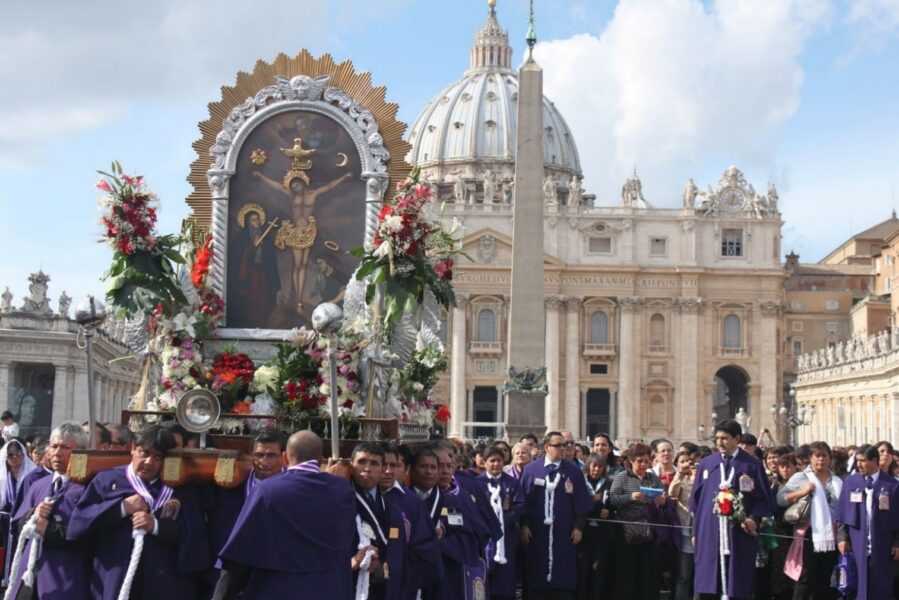
It’s Sunday, the square is filling up as the dawn sun warms the cool Roman dawn. The first rays of the sun are gaining ground and give that color that only Rome has, the intense blue of a clean sky and the noble textures of travertine marble. Everything suggests that we will witness a total fill of the square and surroundings seeing the movement of the first hours. This morning Pope Leo XIV will canonize seven blesseds: Ignatius Choukrallah Maloyan (1869-1915), Armenian Catholic archbishop of Mardin, Turkey. During the years of religious persecution of the Ottoman Empire against Armenia, he was arrested on June 3, 1915, along with many others, tortured and falsely accused of hiding weapons. He refused to convert to Islam and ended up in prison until his murder on June 11, 1915. The catechist Peter To Rot, born in 1912 in Papua New Guinea. During World War II, he opposed the polygamy imposed by the Japanese occupiers and supported Christian marriage. The Japanese occupiers arrested him, martyred him, and poisoned him in July 1945. His fame for holiness and miracles spread quickly throughout the region: Peter To Rot became the first blessed of Papua New Guinea in 1995, along with Pope John Paul II. Vincenza Maria Poloni (1802-1855), who founded the Institute of the Sisters of Mercy, dedicating her life to the care of the sick, elderly, and orphans. Thanks to her miracles, she was beatified in 2008 by Pope Benedict XVI. Maria Troncatti (1883-1969), Salesian nun, was a nurse during World War I and later a missionary in Ecuador among the Shuar indigenous people; beatified in 2012 by Benedict XVI. Carmen Rendíles Martínez, from Venezuela (1903-1977), founder of the Sisters Servants of Jesus. Born without a left arm, she dedicated her life to the poor, the sick, and priests; beatified by Pope Francis in 2018. José Gregorio Hernández Cisneros (1864-1919), born in Venezuela, doctor known as «the doctor of the poor» and beatified in 2021. Bartolo Longo (1841-1926), from Latiano, Apulia. Layman who founded the Shrine of Our Lady of the Rosary in Pompeii and the Congregation of the Sisters of the Rosary. A spiritual crisis led him from his demonic devotions to promoting the rosary and he dedicated himself to the Christian education of the poor and children. Pompeii is today the most visited shrine in Italy; he was beatified in 1980 by Pope John Paul II.
The great Peruvian devotion arrives in Rome with the procession of the Señor de los Milagros that was born in the 17th century during a devastating earthquake in Lima. The inclusion of this event in the Vatican reinforces its importance and its deep roots among migrant communities, who have come to Italy from afar in search of new opportunities, bringing their faith with them. John Paul II, Benedict XVI, and Pope Francis also imparted the blessing to the Cristo de Pachacamilla during the Sunday Angelus. The two-day celebrations will culminate this Sunday with the great Procession of the Señor de los Milagros, which will travel through Rome for approximately 3 km to St. Peter’s Square, where Pope Leo XIV will impart his special blessing, a symbol of faith, unity, and hope for Peruvians.
Pope’s message on the occasion of the tenth anniversary of the canonization of Louis and Celia Martin, parents of Saint Thérèse of the Child Jesus: «Among the vocations to which God calls men and women, marriage is one of the noblest and most sublime». «This exemplary couple bears witness to the ineffable happiness and profound joy that God grants, here and for eternity, to those who embark on this path of fidelity and fruitfulness». He reminds us that the current world lives in turbulent and disoriented times. And young people are presented with numerous opposing models of union, often ephemeral, individualistic, and selfish, with bitter and disappointing results. Consequently, the family, as conceived by the Creator, might seem obsolete and boring. «Among the vocations to which God calls men and women, marriage is one of the noblest and most sublime», a «path to holiness».
In yesterday’s special audience on Saturday, the Pope received the participants in the Jubilee of Rome, Sinti, and Travelers. In thanking them for their presence, the Pope recalled the meeting with Pope Saint Paul VI in 1965: «Today’s jubilee celebration coincides sixty years after the historic first worldwide meeting that Pope Saint Paul VI had with your communities, in Pomezia, on September 26, 1965. Almost as a witness to that event, the image of Our Lady, whom the Pontiff himself crowned as «Queen of the Roma, Sinti, and Travelers», is here today.
Audience with the members of the National Anti-Usury Council «Saint John Paul II «, an organization that for thirty years has worked alongside victims of usury and gambling, in collaboration with dioceses and local foundations. Leo XIV: «The phenomenon of usury refers to the theme of the corruption of the human heart»; he recalled that usury is «an ancient and omnipresent sin», already denounced by the prophets of the Old Testament as an extreme form of injustice toward the poor. The Pope denounced the sick spirituality of those who «crush people until enslaving them», warning of the risk that this attitude not be limited to the economic sphere, but penetrate the logic of power and social relations.
Badilla analyzes the situation of the government of Vatican City State, where Cardinal Cupich was appointed and where the «problem» of the nun governor persists. On Wednesday, October 15 last, Leo XIV appointed Cupich and Reina members of the Pontifical Commission for Vatican City State, replacing Sandri and Prevost. He confirmed for the current term as members of the same Commission Farrell, Roche, You Heung-sik, and Gugerotti.
«The case of the nun governor, Petrini, remains open. Pope Leo will not address it in this important round of appointments, as the day-to-day management of Vatican City State, the material and legal guarantee of the freedom and independence of the Bishop of Rome, is in the hands of the six cardinal members of this Commission. The President of this Commission has always been a cardinal, as required by the Fundamental Law of Vatican City State and certain laws of the same State. However, Pope Francis, announcing his decision in advance during an Italian television program on January 19, 2025, officially appointed Sister Petrini on February 15 as President of the Governorship of Vatican City State and President of the Pontifical Commission for Vatican City State, effective from March 1, 2025. In a matter of minutes, the legal inconsistency was immediately exposed in the press».
«To date, Governor Petrini exercises the office without any legal basis, which openly contradicts Vatican law. Moreover, instead of clarifying, the mystery has become even more complex, as, in the Press Office Bulletin of February 25, 2025 —while Francis was hospitalized—, it was announced that the Pope had «modified the Fundamental Law of Vatican City State», perhaps to regularize the appointment of Sister Petrini? Unknown. The Bulletin mentioned the appointment of two General Secretaries of the Governorship, not of the Governor. And he knows nothing, also because the Vatican has never published the text of the changes introduced by the Pope. The issue today is this: Francis’s amendment to the Fundamental Law (article 8) was never made public in an official written text as required by the same Fundamental Law (article 24)». Why this tangled enigma?
Grondelski comments on some aspects of the Apostolic Exhortation Dilexi Te limits its analysis of “migrants” to three paragraphs: 73-75. The first question arises from what Dilexi Te does not raise: the legal status of a «migrant». The Exhortation simply ignores the issue. Only «migrants» exist. «What can we conclude from this omission? That the legal situation of a migrant is irrelevant? This would surprise almost all the States in the world, as each one distinguishes not only between legal and illegal immigrants, but also between the legal categories themselves: temporary workers with non-immigrant visas, refugees, asylum seekers, people on parole or permanent residents. The legal situation of a migrant determines their rights, duties, and future in the host country. Would the Holy See ask States to abandon such distinctions? If not, why does Dilexi Te not even recognize them? Or does the Exhortation suggest that Catholics should completely ignore the issue of legality? If so, this would represent a radical change in Catholic teaching on the duties of citizens toward the State. If this is the current doctrine, when and where was it promulgated? If not, what is the nature of the statements in Dilexi Te on migration? Are they opinions, advice, or sermons ? Catholics have a right to know what binds their conscience and what does not. A clear line has always been established between authoritative teaching and pastoral commentary, which does not carry the weight of the magisterium».
«Does «welcoming» mean ignoring national immigration law? Nothing in Catholic doctrine defines migration restrictions as intrinsically unjust. On what basis does the Church believe it can ignore, de iure or de facto, legitimate state legislation in this area? Under the pretext of «protecting» migrants? When violations of such laws occur on a large scale, does the Church’s practical indifference toward them amount to material cooperation with the breach of the law? Or does it evade this accusation by claiming that it simply «promotes» the cause of migrants, regardless of their legal status?»
«These are not just issues of «taking the side of the poor». They address the relationship between the Church and the State, as well as the Church’s role in guiding states on how to judge legal presence, residence, and citizenship. Their implications go far beyond charity. By omitting the central issue —legal status—, migration is discussed as if the modern political order did not exist». In short , the treatment that Dilexi Te gives to migration leaves Catholics with serious unanswered questions. The Church can and must remind believers of the moral dignity of every person. (…) Between God and Caesar, the Exhortation seems to have forgotten that both still have legitimate rights over us».
Phil Lawler, published in Catholic Culture: «Barely a week after its publication, Dilexi Te has practically disappeared from public discourse. Is Pope Leo XIV’s first major doctrinal document really destined to fall into oblivion so quickly?. The publication of this papal document was awaited with great enthusiasm, as Vatican observers anticipated the first clear indications of the new Pope’s pastoral plans. After years of controversy and confusion under Francis’s papacy, would Leo steer Peter’s Barque back to calmer waters, to the mainstream of Catholic thought? Or would he continue his predecessor’s agenda? The first months of Leo’s pontificate had not provided answers to these questions; he had carefully avoided major controversies, showing gestures of understanding toward Catholics on both sides in various ecclesiastical disputes. But an apostolic exhortation —especially on a document as politically charged as poverty— seemed destined to resolve the mysteries».
«It was not. Dilexi Te did not bring fireworks, nor theological innovations, nor promises of new and ambitious papal initiatives. Pope Leo changed his predecessor’s plan, transforming what Pope Francis had originally conceived as an encyclical, a doctrinal document, into an apostolic exhortation, a pastoral document of lesser weight. In fact, the most striking thing about this apostolic exhortation is what it does not say. Since his election, Pope Leo has rarely missed the opportunity to pay homage to Pope Francis. In reality, Dilexi Te is part of that homage; the new Pontiff has taken up the project started by his predecessor, reworked it, and made it his own. But it is exaggerated to suggest that, by completing his predecessor’s draft, Leo has demonstrated his faithful adherence to Francis’s approach. Dilexi Te does not demand any kind of radical political reform. Pope Leo desires a reform of the heart: a more urgent commitment, by individuals and institutions, to charitable work. Most of the apostolic exhortation is dedicated to reiterating the message —consistent throughout the Bible and the history of the Church— that the faithful must care for their needy neighbor. There are passages in the document that offend the sensitivity of faithful Catholics who have suffered the scourge of Vatican rhetoric over the last decade. In particular, on the topic of immigration, its laudatory treatment of «popular movements», Dilexi Te seems to encompass only those movements associated with the political left.
Not always good news reaches us from Spain, the Provincial Court of Málaga has acquitted the priests Custodio Ballester, from Barcelona, and Jesús Calvo, octogenarian parish priest from León accused by the Muslims Against Islamophobia association of inciting hatred after a series of statements they made to the media about Islam. The court also acquitted Armando Robles, editor of the digital newspaper that published some of the priests’ statements and others attributed directly to him. The Court: «not everything that may be considered unacceptable in terms of speech and expression is, and we must insist ad nauseam, criminally relevant». The judges did not analyze the truthfulness or authenticity of the comments, but whether they were legally contemplated in the Penal Code and whether they entailed criminal consequences. The Court further observes that freedom of expression also includes the freedom to criticize, “even when it is harsh and may offend, disturb, or displease”. In September and December 2016, Fr. Ballester published some articles in which he stated, among other things, that “let us not deceive ourselves, Islam today and always (…) with one hand promotes works of charity, while with the other it arms itself to annihilate all those who refuse to recognize Allah and Muhammad as the last and definitive prophet of God”. Armando Robles stated that “in the mosques they do not preach love of neighbor, but destruction and extermination of the infidels, of those who do not want to recognize Muhammad as the only prophet of God”.
An exceptional discovery in the heart of Anatolia sheds new light on the liturgical practices of early Christianity. At a Byzantine site in Topraktepe, the ancient Irenópolis a team of archaeologists has unearthed five loaves of bread over 1300 years old, one of which bears the image of Jesus Christ. According to experts, these are Eucharistic breads used in the celebrations of the first local Christian community. The loaves, made with barley and dated between the 6th and 8th centuries, were preserved thanks to carbonization and the lack of oxygen in the soil. One of them depicts the figure of Christ accompanied by an inscription in Greek: «With our gratitude to the Most Holy Jesus».
Today is World Mission Sunday, we end with the latest official statistics. The official number of Catholics in the world rises to 1,405,454,000, which represents a general increase of 15,881,000 compared to the previous year. So reports the Fides News Agency in the latest Statistical Yearbook of the Church, published on the occasion of World Mission Day. The increase in Catholics affects all five continents, including Europe, where the decline observed in the previous survey is reversed, most marked in Africa (+8,309,000) and America (+5,668,000). Followed by Asia (+954,000), Europe (+740,000), and Oceania (+210,000). The percentage of Catholics in the world population increased slightly (+0.1%) compared to the previous year and stands at 17.8%.
The total number of bishops in the world increased by 77 compared to the previous survey, reaching 5,430. The number of diocesan bishops increased (+84) and the number of religious bishops decreased (-7). There are 4,258 diocesan bishops, while there are 1,172 religious bishops. The total number of priests in the world continues to decline: 406,996 (-734 compared to the previous survey). Europe (-2,486) once again recorded a significant decrease, followed by America (-800) and Oceania (-44). As in the previous year’s survey, significant increases were recorded in Africa (+1,451) and Asia (+1,145).
The number of religious priests is also declining, with the latest survey showing that they total 128,254 (-305). Even in the latest annual survey, the number of permanent deacons in the world continues to increase (+1,234), reaching 51,433. The increase is recorded in America (+1,257) and Oceania (+57). Slight decreases are recorded in Asia (-1), Africa (-3), and Europe (-27). The number of non-priest religious has decreased by 666 units compared to the previous year’s survey, reaching a total of 48,748. Decreases are recorded in Europe (-308), America (-293), Asia (-196), and Oceania (-46), while in Africa the number of non-priest religious has increased (+107). The most recent survey confirms the prolonged global downward trend in the number of religious sisters: there are 589,423 (-9,730). Increases are again recorded in Africa (+1,804) and Asia (+46), while they continue to decrease in Europe (-7,338), America (-4,066), and Oceania (-251). The number of major seminarians, both diocesan and religious, also decreases in the latest annual survey: worldwide there are 106,495 (last year there were 108,481). Increases are recorded only in Africa (+383), while they decrease in America (-362), Asia (-1,331), Europe (-661), and Oceania (-15). The total number of minor seminarians, both diocesan and religious, has also decreased, reaching 95,021 (-140).
«Will not God do justice to his chosen ones who cry to him day and night, and will he delay over them?».
Good reading.