


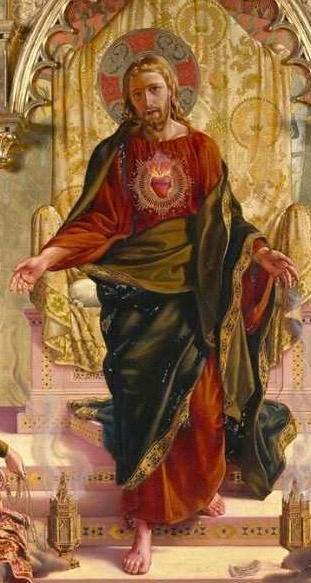
Today marks the end of Pope Leo’s journey to Spain, with a more than acceptable outcome: immense participation, some of his interventions magnificent, others in need of improvement. Today’s news focuses on Spain, Barcelona, and the Canary Islands. Today, June 12, is the Solemnity of the Sacred Heart of Jesus: “An angel brings the news, the Virgin listens, believes, and conceives: faith in her heart and Christ in her womb” (St. Augustine, Sermons 196,1). A wonderful day to pray for priests and their sanctification. Let us begin…
The Sacred Heart of Jesus.
The great flourishing of devotion to the Sacred Heart of Jesus came from the private revelations of the Visitandine nun Saint Margaret Mary Alacoque, who, together with Saint Claude de la Colombière, spread the devotion.Saint Margaret wrote to Mother de Saumaise on August 24, 1685: “He [Jesus] once again revealed to her the great joy He feels at being honored by His creatures, and it seemed to her that He promised that all who consecrated themselves to this Sacred Heart would not perish, and that, as He is the source of all blessings, He would pour them out abundantly in all places where the image of this adorable Heart was exposed, to be loved and honored. Thus He would reunite separated families, protect the needy, extend the anointing of His burning charity in those communities where His divine image was honored; and He would turn away the blows of God’s just wrath, restoring them to His grace when they had fallen into it.”
With the encyclical Annum Sacrum, promulgated on May 25, 1899, Pope Leo XIII announced his decision to consecrate all humanity to the Sacred Heart of Jesus, defining this act as the culmination of all honors rendered to the Sacred Heart up to that time. The consecration was solemnly carried out on June 11, 1899, the feast of the Sacred Heart of Jesus (moved to that Sunday to encourage the faithful to participate), and had a universal character: for the first time, a Pope consecrated not only the Catholic Church, but all humanity to the redemptive Heart of Christ. This act represented a historic moment in the spread of devotion to the Sacred Heart.
Leo XIII himself considered the consecration of the world to the Sacred Heart “the most important act of our pontificate,” an expression recorded in several later testimonies. The importance of the event has been reaffirmed by numerous Popes, including Saint John Paul II, who, on the centenary in 1999, described it as “an extraordinarily important step on the Church’s journey.”
Pope Leo XIV’s journey to Spain comes to an end.
There will be a before and after to Leo XIV’s journey to Spain. Because the Pope’s presence has rekindled the Catholic identity of the Spanish people, that legacy which seemed dormant amid socialist governments, extreme progressivism, and polarizations born of conflict. As so often happens in history, everything seems dormant until the Pope appears and joy erupts.
One million two hundred thousand people, at the very least, gathered in Cibeles, Madrid, where Leo XIV celebrated a massive Mass. Emotion filled every encounter, even the Pope’s. Eight minutes of applause in the Spanish Cortes, where the Pope, in a historic and momentous speech, recalled Spain’s roots, the School of Salamanca, mother of human rights, and emphasized the inalienable right to life, with a powerful and cross-cutting message that transcended all political lines.
In Barcelona, the miracle happens; Christian symbolism is present in every neighborhood, from the Gothic Quarter and its cathedral to the churches that spring up like mushrooms along the streets and the Ramblas, a reminder that yes, despite everything, Barcelona is a port, a frontier, progress, and—precisely—faith. Madrid is the dream of Faith; Barcelona needs to emerge from the darkness of Faith.
Antoni Gaudí is the brilliant creator of the Sagrada Família, “the first Gothic cathedral of a new era,” under construction for 144 years. Construction had been underway for 17 years when Barcelona experienced what is remembered as the Tragic Week, the week when the working population set fire to more than 130 religious buildings in an uprising. The fires devastated historic temples and religious institutions in various parts of the city, from the current Raval neighborhood (such as Sant Pau del Camp) to the Poblenou district. The municipal archive preserves historical documents and photographs of the columns of smoke that ravaged Barcelona’s horizon in those days.
It was a sign of social unrest that would later culminate in the persecution of religious people in Spain during the Spanish Civil War. Gaudí envisioned the Sagrada Família as a church rising from the center of a cloister, conceived as a place within a garden (the earthly paradise) where God and man could speak face to face. The cloister is not inside, as in all Christian art, but around. Outside the cloister, the desert of the city, the desert of the world that is losing its faith. Everything is summed up in God, in this work whose tallest tower, the Tower of Jesus, is barely one meter shorter than Montjuïc, because nothing should be higher than what God has created.
For Gaudí, Barcelona was a deserted city, and over the years he became a kind of “monk in the city,” living a life of moving simplicity in a small house near the construction site. But every day the Sagrada Família grew with new stones, and he proclaimed to his city that the new creation had already begun, that the desert was beginning to bloom. Gaudí wanted—and achieved—that the simple contemplation of the church convey a profound sense of the sacred. One may wonder whether the Sagrada Família represents the path that faith in Europe is taking: from the loss of its roots to rebirth. A rebirth that is manifesting in France, where the rise in adult baptisms has led a regional council to recognize it; that is manifesting in England, where vocations are growing; that is manifesting in the exceptional influx of pilgrims to Paris-Chartres; and that is also manifesting in Barcelona, where, despite everything, there are young priests.
Leo XIV in Barcelona.
The cross that now crowns the Tower of Jesus Christ of the Sagrada Família is a cross that—in the words of Leo XIV—“shines by day, reflecting the light of the sun, and shines by night, illuminating the city like a beacon opening onto the Mediterranean.” Before reaching the sacristy, Leo XIV stopped in the crypt, before the tomb of Antoni Gaudí, the architect whose centenary of death is being celebrated these days. The basilica was consecrated by Benedict XVI in 2010, “a visible sign of the invisible God,” and he announced that he would soon bless “the tallest tower, that of Jesus Christ.” The Sagrada Família, he explained, is “a single building, made up of many stones,” a house that grows with the years: “We are all living stones of this work, which has Christ as its foundation and summit.” More than a monument, the temple is “still today a work in progress,” an image of the Christian life as a journey. “Its imperfection is not a defect because it bears witness to a desire; it does not mean a lack, but expresses a promise.”
The core of the homily was dedicated to the Cross placed at the top of the basilica, “the Cross of the last who become first, of sinners who become saints, of the dead who will rise again.” The three façades of the church—Nativity, Passion, and Glory—narrate its mystery. At the base of the spire, the Pope recalled, is engraved the inscription “Tu solus Sanctus, Tu solus Dominus, tu solus Altissimus.” And that Cross “shines by day, reflecting the light of the sun, and shines by night, illuminating the city like a beacon open to the Mediterranean.”
The basilica renews the Biblia pauperum of the ancient cathedrals: “art and beauty are eminent channels of evangelization.”
The Tower of Jesus Christ.
This tower is the true protagonist of Gaudí’s project: 172.5 meters of stone, making it the tallest building in Barcelona and the tallest church in the world. Gaudí chose this height so that the tower would be half a meter below the summit of Montjuïc, for he believed that the work of man should not surpass that of God. At the top of the Tower of Jesus rises a cross approximately 13 meters wide, made of glass and white enameled ceramic. A Cross that the Pope, in his homily, defines as “the Cross of the last who become first, of sinners who become saints, of the dead who will rise again. Looking to Christ, we can see the world with renewed eyes: the tower of the Cross then becomes a banner of charity, because God loves us in this way, transforming an instrument of death into a sign of hope.”
“This Cross shines by day, reflecting the light of the sun, and shines by night, illuminating the city like a beacon that opens onto the Mediterranean. Yes, the light of Christ shines in the darkness, though the darkness has not accepted it. This rejection does not diminish God’s love. We must pass through the passion of the Crucified to be enlightened by the glory of the Risen One: indeed, the Father has always taught us to give life, and the Son, who receives it from Him, gives it to all with the power of the Holy Spirit. That is why the Cross is the luminous sign of His love.” “When Christ is lifted up, His magnificent humanity shines forth, and our works glorify God. They are works of faith, and art stands out among them. Faith itself gives shape to the stones and meaning to the building we inhabit together.”
The Pope Leo in prison.
Leo XIV crossed the threshold of the Brians 1 Penitentiary Center, a prison more than forty kilometers from Barcelona. He was received with applause and singing in the conference hall where inmates regularly carry out their cultural, educational, work, and sports activities. Every human being is “worthy” simply by having been wanted, created, and loved by God, an explicit reference to the first encyclical recently published, Magnifica Humanitas. Hence the certainty that “there is no situation that leads the Lord to turn His gaze away from us,” a truth the Pope wished to convey especially to those who bear “the burden of being far from their loved ones.”
Leo asked them to lift their gaze toward Him who continues to show His closeness through the faces of so many people. The mistakes of life do not determine a person’s identity: citing the Confessions of Saint Augustine, he recalled that the past does not condemn the future, but opens the possibility of changing choices and decisions. “God loves you as you are, but dreams that you will be better,” inviting them to “keep dreaming God’s dream.” Being human and being Christian, he added, does not consist in not making mistakes, but in “growing in the capacity to convert, repent, amend, and above all, to reconcile and forgive.” The Pope received some gifts—including a ceramic plate and a painting—and reciprocated with an icon of Our Lady of Kazan of Fatima.
Leo XIV in the Canary Islands.
Before a blue cross made from the wood of a shipwrecked vessel, Pope Leo XIV stood in the port of one of Europe’s migrant destinations and declared that the Catholic Church “cannot remain silent before those who are abandoned to its waters,” condemning the widespread indifference to the migrants’ plight. The message of the Gospel “draws us out of our comfortable position as spectators” and “asks us whether we have recognized Christ in those who land, marked by fear, hunger, and violence, after enduring the desert, the night, and the sea.”
The Pope said that the waters of the surrounding ocean continue to be marked by “mafias that profit from despair, traffickers who enslave women and children, and those whose indifference allows the poor to be swallowed up by exploitation or oblivion.” In the first five months of this year, 1,317 people lost their lives while sailing toward Spain, according to a report that tracks migration data. Of these, 635 died on the route to the Canary Islands, making the Atlantic route the most dangerous for migrants seeking to enter Spain.
To the priests of the Canary Islands.
Leo XIV met with the bishops, priests, deacons, religious men and women, seminarians, and pastoral agents of the Canary Islands in the Cathedral of Santa Ana in Las Palmas. “It is a great joy for me to share this meeting with you. Thank you for your warm welcome, for your kind presence, and for your testimonies, which reflect a living Church, in whose heart resound ‘the joys and hopes, the sorrows and anxieties of the people of today, especially the poor and all who suffer.’”
“You, native or adoptive Canarians, People of God on pilgrimage to the lands surrounded by the Atlantic, have the privilege of enjoying every day the majestic presence of the sea. It is said that in the eyes of an islander, that image (which has the taste of home and homeland) remains engraved forever in the pupils, and that it is greatly missed when one is far away, inland.” “A concrete way of manifesting this spirituality of communion is Christian solidarity, because ‘union with Christ is at the same time union with all those to whom He gives Himself.’ Therefore, I encourage you to continue offering to all the love that you, in turn, have received from the Lord, a love that becomes nourishment by welcoming, listening to, being close to, and caring for the most vulnerable.”
The Muslim parish in Milan.
Giovanni Salatino, parish priest of San Giovanni Bosco, announced that Muslims participating in this year’s parish summer camp will be able to gather for Islamic prayer in a designated area during the activities. Salatino presented the initiative as the implementation of a diocesan document that emphasizes “interreligious dialogue,” which states that it is based on the declaration Nostra Aetate of the Second Vatican Council. “Although there are not many Muslim boys in Baggio, the oratory will be organized so that they too can have their moment of prayer.” “I am fortunate to have some older youth leaders who are Muslim; therefore, they will be the ones to lead the prayer with the boys.” “It is always better to help young people pray: we pray to the same God, though within different religious traditions. And recognizing the identity of the other is in the spirit of the Gospel.” On May 11, the archdiocesan website announced the construction of a new “inclusive and futuristic” monastery formally dedicated to Saint Ambrose. The project includes a church, a cloister, spaces for cultural events, and facilities specifically designed for interaction between different religions. The complex will also incorporate ecological elements, such as a “Garden of Religions,” where monotheistic religions will be represented by a plant. In his words, Archbishop Mario Delpini presented all religions as equally valid paths to God.
The month of disgusting pride.
It is “Pride Month,” so the anti-Catholic hate group in grotesque costumes, the “Sisters of Perpetual Indulgence,” has once again appeared in public to obscenely mock Catholic nuns and the Catholic faith. In a video posted on social media this week, the bearded “Sister Shroomy” kneels in the middle of a street in West Hollywood so that “Mother Vegan Life” can replace her white veil with a black one, symbolizing the end of a two-year “novitiate” period. A text in the repugnant Instagram post explains: After a two-year novitiate period, Sister Shroomy of the Mycelium Hole has taken the step and become an official member (with a black veil) of the Sisters of Perpetual Indulgence of Los Angeles.
The Nuncio to the United States.
Gabriele G. Caccia on June 10 in his inaugural address as the new nuncio to the U.S. bishops, during their spring plenary session at the Omni Resort at ChampionsGate, near Orlando. He thanked his “brother bishops” for their fraternal welcome and addressed the new president of the United States Conference of Catholic Bishops, Archbishop Paul S. Coakley of Oklahoma City, saying: “So we begin together.” Caccia highlighted the consecration of the U.S. Church to the Sacred Heart of Jesus, urged the bishops to fulfill their mission as missionary disciples by welcoming immigrants into their midst, and reminded his brother bishops that he is there for them, especially in moments when their responsibilities as episcopal shepherds make them feel isolated. “My service here consists in listening, trusting, and discerning together within the Church that we all serve together.”
“I see the election of Pope Leo as a gift of the Holy Spirit, which encourages the Church in this country, on the one hand, to foster the best of its tradition and, on the other, to continue to confront with determination the wounds of its recent history that have caused so much suffering, especially through cases of abuse.” Archbishop Caccia stated that the U.S. Church fully understands the missionary spirit, as its short history benefited from the missionaries who arrived on the shores of the United States from other countries. He added that the bishops must receive immigrants “with the charity of Christ, recognizing their dignity and helping them find their place in the life of the community, which is also part of a missionary Church.”
Going to Mass: the more the better.
The Council of Trent says: “If anyone says that the Sacrifice of the Mass is only a Sacrifice of praise and thanksgiving, or a mere commemoration of the Sacrifice offered on the Cross, and not a propitiatory sacrifice (…) let him be anathema.” (Canon 3, DS 1753). Pius XII wrote in Mediator Dei on November 20, 1947: “The august sacrifice of the altar concludes with the Communion of the divine banquet. But, as everyone knows, for the integrity of the Sacrifice itself, it is only required that the priest be nourished with the heavenly food, not that the people also—something, moreover, very desirable—approach Holy Communion.” Benedict XIV on the definitions of the Council of Trent: first (…) We must say that it cannot happen to any faithful that private Masses, in which only the priest receives the Eucharist, therefore lose the value of the true, perfect, and integral Sacrifice instituted by Christ the Lord and, therefore, must be considered illicit. (…). Consequently, those who refuse to celebrate unless the Christian people approach the table deviate from the path of divine truth; and even more so are those who, to maintain the absolute necessity that the faithful be nourished at the eucharistic banquet together with the priest, craftily affirm that it is not simply a sacrifice and a banquet of fraternal communion, and make the Holy Communion received in common almost the culmination of the entire celebration.”
The priest as a provisional solution?
In the daily management of too many dioceses, there is an implicit hierarchy of priorities. At the top is the number of parishes that must be covered by a clergy that decreases year after year. Immediately below is the maintenance of relations with civil authorities, benefactors, the friendly press, and the public image of the institution. Then come agreements, contracts, and covenants. Much further down is the person of the priest: his physical and mental well-being, his loneliness, his balance.
We live a pastoral model that treats the priest as a functional resource to be redistributed—three, four, five, ten communities each—instead of as a man with limitations. Certain bishops, very numerous, do not want to listen; they limit themselves to fashionable topics, “migrants, homosexuals, watering plants,” and turn a deaf ear as soon as serious matters are raised. Too many priests end up living as “functionaries of the sacred,” providing services to increasingly indifferent faithful, overwhelmed by the multiplicity of commitments and the complexity of situations. It is the ideal breeding ground for burnout.
In 2020, the French Episcopal Conference had the courage to commission a serious study on the physical and mental health of active diocesan priests: more than six thousand priests in more than one hundred dioceses were interviewed. It was found that nearly two out of ten priests show depressive symptoms, that some suffer from true professional burnout, that alcohol abuse affects an alarming proportion of the clergy, and that more than half of the priests live alone. In addition, seven priest suicides were recorded in four years. The French bishops chose to publish these figures without hiding them. Measuring a problem means assuming responsibility. And accountability is precisely what many episcopates prefer to avoid.
Too often, however, clinical relationships end up forgotten, minimized, downplayed, sometimes even openly contradicted by superiors with no experience whatsoever, who counter a doctor’s diagnosis with their own spiritual fervor. This leads to the paradox of blaming the suffering priest: it is insinuated that he does not pray enough, that he lacks a spirit of sacrifice, that his lack of faith is disguised as illness. This is the spiritualization of pain in its most venomous form, and it is precisely what Leo XIV harshly criticized in Barcelona. A priest from the diocese of Getafe wrote that “we are not superheroes,” that “indifference kills more than hatred,” and that too many communities “expect much but offer little support,” forcing priests to silence their pain “out of fear or shame.”
That silence is no longer tolerable after the words spoken by a Pope to a young woman who survived a suicide attempt. Caring for the health of priests is not an optional extra or a paternalistic concession: it is a duty of justice. It is the first problem that must be addressed; we have a hierarchy that has stopped looking its children in the face.
Day of Priestly Sanctification.
On Holy Thursday 1995, Saint John Paul II dedicated his traditional Letter to Priests to the role of women in the life of the priest. In this context [the longing for holiness ], the proposal of the Congregation for the Clergy to celebrate in each diocese a “Day of Priestly Sanctification” on the feast of the Sacred Heart, or on another date more in keeping with the pastoral needs and customs of the place, seems most appropriate. I welcome this proposal, in the hope that this Day will help priests to live in greater conformity with the heart of the Good Shepherd. On June 23, 1995, it became known as the First Day of Priestly Sanctification, and Saint John Paul II is remembered as the one who desired and instituted it, at the initiative of the Congregation for the Clergy.
“You follow me and let the dead bury their dead.”
Good reading.