


We’re heading toward the end of July, and Pope Leo’s summer stay in Castelgandolfo is drawing to a close. The heat has settled over Rome and promises to accompany us for a long season.
The Farce of the Rupnik Trial.
The Vatican Press Office’s denial of Father Rupnik’s acquittal—accused of sexually abusing at least twenty nuns—raises new questions. No one doubts that Father Rupnik, former SJ, benefits from a protection system that may be manipulating a trial about which nothing is known. A Vatican Press Office communiqué categorically denied the veracity of the news published by the blog MessainLatino.it that Father Marko Rupnik had been acquitted in the criminal trial held in the Vatican—at least it had the merit of shedding light on a trial that by now smells like a farce.
In October 2023, Pope Francis himself was forced, following the victims’ testimonies and under pressure from the Pontifical Commission for the Protection of Minors, led by Cardinal Sean Patrick O’Malley, to suspend the statute of limitations and ask the Dicastery for the Doctrine of the Faith, now in the hands of the «faithful» Cardinal Fernández, to organize the trial. Nearly three years have passed, and the only thing we have seen so far is the continuation of a high-level system of protection and cover-up for Father Rupnik—a situation that was almost a given during Pope Francis’s pontificate but now increasingly tarnishes that of Leo XIV.
The Vatican Press Office provides the Holy See’s official version, according to which «reports of any deliberation by the judges after the case of Father Marko Ivan Rupnik are completely unfounded: the evaluation of the case is still ongoing and the tribunal is examining documentation from the dioceses involved, from the Jesuits, from interested parties, and from the press.» This raises new questions and gives the impression of continuing the delaying tactics seen so far, in the hope that over time attention will wane and Father Rupnik will emerge unscathed.
After the reopening of the Rupnik case in October 2023, in March 2024 the secretary of the disciplinary section of the DDF, Archbishop John Joseph Kennedy, stated that the investigation was «delicate» but in a «fairly advanced stage.» A year later, in March 2025, a Vatican source claimed that Rupnik would be tried for the crimes of «spiritual abuse» and «false mysticism,» and that a verdict was expected «in the not-too-distant future.» In January 2025, Cardinal Fernández had downplayed the gravity of the Rupnik scandal by stating, regarding the lengthy investigation, that there are «many other cases, some perhaps more serious but less well known.» Without ever specifying which cases, Fernández added that «the dicastery has concluded the information-gathering phase, which was carried out in various locations, and has conducted an initial analysis. We are already working to establish an independent tribunal that will proceed to the final phase of the criminal process.»
In July 2025, Fernández finally announced that the five judges in the Rupnik case had been selected, but their official appointment would still be delayed until October 2025. The names of the judges and the selection criteria remain unknown, demonstrating an opacity and lack of transparency that once again contradicts the numerous declarations of seriousness in the fight against abuse. Last November 4, Pope Leo XIV, responding to a question about the Rupnik case, asked for patience because «judicial processes take time. I know it is very difficult to ask victims for patience, but the Church must respect the rights of all persons.»
We do not know if he would repeat the same words today, almost nine months later; given the events, everything points to the system of cover-up and favoritism involving several prelates continuing unabated. The Vatican Press Office statement sounds like mockery; and the absolute secrecy—including the names of the judges—under which this trial is reportedly being conducted. Perhaps the news of the acquittal is not true, but given how things have gone so far, it would not surprise us if it ended that way.
The Web of Institutions Nesting in the Vatican.
Three decrees signed within a span of six months have reduced the number of legal entities in Vatican City State. On November 27, 2025, it was the turn of the Nostra Aetate Foundation; on April 9, 2026, the Union of Superiors General; and on May 20, 2026, the International Lateran Association. Each decree bears the signature of Sister Raffaella Petrini, President of the Governatorate, and the approval of the General Secretaries. Everything is done discreetly, and promulgation follows an almost notarial procedure that rarely crosses the Leonine walls: publication in the Courtyard of San Damaso, on the doors of the Post Offices and the Governatorate Palace, and finally inclusion in the Supplement of the Acta Apostolicae Sedis. Publication on the institutional website of the State is avoided to prevent easy tracking by informants.
On December 5, 2022, the day Francis promulgated the Apostolic Letter in the form of a Motu Proprio on the instrumental legal entities of the Roman Curia and, in parallel, Law No. DL on the legal entities of Vatican City State. Both regulations establish a rigorous process for the dissolution of entities: suppression ordered by the curial institution to which the legal entity is canonically dependent, appointment of one or more liquidators, preparation of the final balance sheet, approval by the Council for the Economy, communication from the Secretariat for the Economy to the President of the Governatorate, who, by his own decree, recognizes the dissolution and orders its cancellation from the Register kept by the Legal Office. The accounting records and books of the suppressed entity are preserved for a decade.
Decree No. XXXVII, dated November 27, 2025, puts an end to the Nostra Aetate Foundation. Established in 1990 in the then Pontifical Council for Interreligious Dialogue, the institution awarded scholarships to scholars of other religions who wished to deepen their knowledge of Christianity at the pontifical universities in Rome, with the conviction that, upon returning to their countries of origin, they would become credible promoters of dialogue. The Council for the Economy approved the final liquidation budget at its meeting on September 16, 2025; the Secretariat for the Economy communicated it to the Governatorate by letter dated September 23 (Prot. 00688/A/2025); two months later, it was canceled. The situation has a bitter taste: the institution bearing the name of the conciliar declaration on relations with non-Christian religions was extinguished just as the Church was celebrating the sixtieth anniversary of its promulgation, which took place on October 28, 1965.
Decree No. LXII, of April 9, 2026, follows a peculiar procedure. Article 19 of Law No. DL is cited as the basis for the cancellation of the Union of Superiors General, without any reference to letters from the Secretariat for the Economy or liquidation balances. This suggests that the organization, an association that for nearly seventy years brought together the highest moderators of male religious institutes, simply ceased to be registered in the Vatican Register, without this implying its canonical extinction. The Union continues its activities: it holds its usual biannual assemblies in Sacrofano, maintains its headquarters in Rome, and works with its female counterpart, the International Union of Superiors General, with which it shares commissions and joint meetings. The cancellation affects the institution’s civil status in Vatican City, within the framework of a reorganization that more clearly distinguishes what belongs to the State from what is governed by canon law.
Much less well known is the third protagonist of this season. The International Lateran Association had for years appeared in the Order of the Pontifical Lateran University, among the offices and services of the pontifical university, alongside the Civitas Lateranensis Foundation, as a tool to connect and support the academic community. In this case too, the procedure followed the prescribed sequence: the Council for the Economy approved the final liquidation budget at its meeting on May 4, 2026; the Secretariat for the Economy notified it by letter dated May 12; and Decree No. LXXII of May 20 sealed its dissolution.
The most revealing chapter concerns a recently created body. By a decree dated February 12, 2026, Leo XIV suppressed the Pontifical Committee for World Children’s Day, established by Pope Francis in November 2024, transferring its responsibilities to the Dicastery for Laity, Family and Life. Kevin Farrell announced that, after careful consideration and in consultation with the Holy Father, the celebration of the second World Children’s Day, scheduled in Rome from September 25 to 27, 2026, was canceled. Initiatives for children may be carried out, at the discretion of the Ordinaries, within dioceses or parishes, with the participation of families, defined as the natural environment for the human and spiritual growth of each child. A pontifical organization born with great fanfare was thus dissolved after only fifteen months, along with the meeting it was to organize.
The proliferation of committees, foundations, and organizations that characterized the previous pontificate seems to be intended for correction. It is to be hoped that the bloated Register of Legal Persons, a faithful reflection of a more than chaotic administration, will continue to shrink in the coming months. Many point to the Pontifical Foundation Scholas Occurrentes as the next candidate for suppression, as it fits poorly within the Vatican and would continue its path outside its coverage, if it continues at all.
Is In Vitro Fertilization Something Normal for the Vatican?
In Vatican News, there are those who do not hold the Catechism in high esteem, and in an article from two days ago (July 21, 2026) it is implicitly but clearly accepted as something normal. The title itself reveals the underlying theme: » Assisted Procreation: The Role of AI Divides Bioethics .» The article is inspired by the launch of Aura, «the first fully automated in vitro fertilization laboratory,» which will be operational in the United States next year and seems destined to spread to other parts of the world. Vatican News does not explicitly state that artificial insemination is—as the Church teaches—morally unacceptable. Rather, the article suggests that in vitro fertilization is good in itself. From the instruction Donum Vitae (1987) to Dignitas Personae (2008), through the Catechism (see numbers 2376-2378), the Church’s condemnation of in vitro fertilization techniques is evident, both heterologous (with gametes external to the couple) and homologous. If heterologous artificial fertilization involves, among other aggravating factors, the fact that it «violates the rights of the child, deprives him of the filial relationship with his parental origins, and may hinder the maturation of his personal identity» ( Donum Vitae , Part II, A, response to question 2), by intending to leave him orphaned of at least one of the parents, it must also be remembered that even homologous artificial fertilization is not morally licit.
The Eternal Commission on the Orlandi Case.
It remains a case that in Italy arouses passions and is the paradigm in the collective imagination of the thousand ramifications of the ‘underworld.’ Yesterday, Magistrate Roberto Staffa before the Orlandi-Gregori Commission of Inquiry: «Enrico de Pedis and Paul Marcinkus are implicated in the disappearance of Emanuela Orlandi.» The former prosecutor was questioned yesterday by the bicameral commission investigating the mystery of the two 15-year-old girls who mysteriously disappeared in Rome in 1983, since, together with magistrate Giancarlo Capaldo, he is in charge of the second investigation into the cases of Emanuela Orlandi and Mirella Gregori. Staffa was deputy prosecutor in Rome between 2008 and 2010: precisely the years when statements about the Orlandi case from Sabrina Minardi, the former lover of Enrico «Renatino» de Pedis , emerged. From those revelations to investigators, a trail developed linking Roman criminals who, according to the prosecutor, were involved in the kidnapping of the Vatican citizen. Staffa was part of the team of investigators who managed to locate Sabrina Minardi in 2008.
The woman no longer lived in Rome but had been transferred to a community in the hills of Salerno due to her poor physical and mental health. Unexpectedly contacted by investigators, Minardi testified before the magistrates and the Flying Squad that she herself had been involved in the kidnapping of Emanuela Orlandi. She told them that, in the days following Emanuela’s disappearance, de Pedis (with whom Minardi had a romantic relationship) asked her to take charge of the Vatican citizen and move her from one area of Rome to another. Until one day, «Renatino» arranged a meeting with her on the Janiculum Hill, where he ordered her to take Emanuela to the gates of the Vatican to hand her over to a priest .We will die with this case open; the passage of time does not help, and everyone knows it is riddled with versions and fabricated evidence that hinder any attempt at investigation.
Martin SJ Wants More Homosexual Priests.
Father James Martin SJ encouraged the ordination of homosexuals to the Catholic priesthood in a commentary written for the website Outreach, which presents itself as a supposed «Catholic LGBTQ ministry.» Martin claims that saying that homosexual men «cannot be ordained priests means that homosexual men interested in the priesthood will be turned away from their vocations or forced to work underground in seminaries.» Regarding «homosexual men who feel the vocation to the priesthood,» Martin said that «my response… is yes.»
The Catholic Church teaches that the homosexual inclination is «objectively disordered» and «incompatible with the priesthood,» and that the Church «cannot admit to the seminary or to holy orders» men with «deep-seated homosexual tendencies.» «In my nearly 40 years as a Jesuit, I have known dozens of celibate homosexual priests who have led what Pope Francis called ‘good, holy, and celibate’ lives, exemplifying Jesus’ message of love and mercy.» «For me, and for many of my friends, they have been spiritual directors, pastors, teachers, and mentors.»
Martin does not like the idea of homosexual priests keeping their inclinations private. He is concerned that the Church cannot admit the presence of homosexual priests for several reasons. «A few years ago, I asked an American seminarian studying in Rome how many of his classmates were homosexual. ‘Half,’ he replied without hesitation. How many were open about their sexuality with their spiritual directors or seminary rectors? ‘Are you kidding?’ he exclaimed. ‘None.’ He explained that it would mean expulsion.»
It is a very old saying: «The devil thinks everyone is like him,» which denotes the ease with which we think or suspect that others are or act like us, especially when it comes to bad actions or attitudes, seeking to justify them. The reality is that American priests ordained in recent years predominantly identify as conservative, suggesting that homosexuals do not represent as high a percentage of current seminarians as he implied. The term «overcoming» homosexuality worries Martin. «One thing is to overcome temptation or lust; quite another is to overcome one’s own sexuality in general.» For Martin, homosexual tendencies are an immutable and positive trait, although the Church teaches that they are disordered: «This could easily be interpreted as overcoming one’s own sexuality in general, a dangerous proposition.» He lamented that the core of the approach is «a view of homosexuality as an immense barrier to leading a healthy life as a priest.»
The «Aztec Mass.»
It was really a concert, but in the cathedral. The Archdiocese of Los Angeles authorized a concert called «Misa Azteca,» which included pagan Aztec music, dances, and poetry, at the Cathedral of Our Lady of the Angels last month. The sacrilegious event on June 27, celebrated in the main church of the largest archdiocese in the United States, combined sacred music from the Catholic Mass, such as the solemn chant «Kyrie» and «Ite Missa Est,» with pagan Aztec rhythms and indigenous instruments accompanying the cathedral orchestra. War dances performed near the altar, with dancers dressed provocatively.
Joseph Julián González, composer of the «Misa Azteca,» stated that the composition of the Mass was born from his devotion to Our Lady of Guadalupe and recalled how he felt inspired to write it after the «Kyrie» from the Major Mass, performed with an Aztec dance rhythm, came to his head, believing it to be a «divine inspiration.» «It enriches our knowledge of the event of Guadalupe and enriches our Catholicism.»
While the Catholic Church has always condemned the concept of syncretism, or the mixing of pagan rituals and other non-Catholic rituals, such as Aztec dances, with Catholic practices. Our Lady appeared to Saint Juan Diego to convert the Aztecs and other indigenous peoples of the New World to the Catholic faith. Dangerous syncretism has become common in many Catholic churches around the world in recent decades. Perhaps the most scandalous case occurred during the 2019 Amazon Synod, when a ceremony in honor of the Andean «goddess» of fertility, Pachamama, was celebrated in the Vatican Gardens before Pope Francis, cardinals, bishops, and priests. The Pachamama statues were carried in procession to the Paul VI Hall, where the pope, cardinals, and bishops gathered to deliberate at the Amazon Synod. Subsequently, the Pachamama statue was carried in procession to St. Peter’s Basilica, where, again, the pope and cardinals surrounded it in prayer. EFather Charles Murr brought to light earlier this year photographs showing then-Father Robert Prevost, the future Pope Leo XIV, attending a Pachamama ritual.
Bringing Down the Catholic Church.
During an exorcism, a demon revealed to Father Chad Ripperger the devil’s main tactic for subverting individuals, the Church, and governments. It is not possession. It is not violence. It is deception: convincing souls that they cannot separate themselves from temporal or lesser goods. John-Henry Westen highlights the practical spiritual advice of Father Ripperger, who urges parents to combat gender ideology in their children through directed prayer: specific petitions for divine grace and protection against demonic influence. Modern cultural and political conflicts, Ripperger argues, are no longer partisan debates. They are a spiritual war. Good against evil. Christ against the enemy.
Mary: More Universal Than Catholicism?
It is a joy to see initiatives centered on prayer and the search for God springing up by the dozens in various places. Not everything that immigration brings us is bad, and if we know how to take advantage of it, it can provide us with a time of evangelization. Today we see the first edition of the Missionary Marian Festival, which will be held at the Sanctuary of Our Lady of Banneux, Belgium, on Sunday, July 26, 2026, «to demonstrate the link that unites devotion to the Mother of God with the missionary vocation and the joy of proclaiming the Gospel that every baptized person can experience.» Organized by the Pontifical Missionary Union (PMU) in collaboration with the European Vietnamese pilgrim community: «the Marian devotion, deeply felt in Asian countries, is combined with the missionary commitment of all the baptized. They are called to be missionary disciples like Mary.»
On September 12, 2023, the Pew Research Center published a major survey on Buddhism, Islam, and religious pluralism in South and Southeast Asia, interviewing more than 12,000 people in Thailand, Cambodia, Malaysia, Singapore, and Indonesia. The survey revealed that many non-Christians venerate Mary. To better understand how Asian Christians and non-Christians approach the Mother of Christ, the Initiative for the Study of Asian Catholics (ISAC), an international academic network promoted by the Asia Research Institute of the National University of Singapore, in collaboration with the Centre for Marian Studies in London, organized a research conference entitled «More Universal Than Catholicism? Mary Among Asian Religions.»
Theologian and anthropologist Michel Chambon, coordinator of ISAC, presented the findings in World Mission Magazine, noting that the Virgin Mary transcends religious boundaries and providing several examples. At the Church of the Novena in Singapore, as well as at pilgrimage sites such as Velankanni in India and Mariamabad in Pakistan, thousands of Muslim and Hindu faithful regularly come to entrust their intentions and make vows to the Virgin Mary. In Singapore, the Taoist movement Origin of Being, founded by Professor Zhang Bu Sheng, includes Mary in its pantheon alongside Jesus and Saint Joseph.
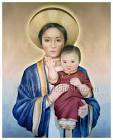
Michel Chambon also notes that the attraction to Mary lies in the intimacy of the home, where her images sometimes appear alongside other spiritual figures. The domestic sphere thus becomes the main stage of a «lived religion.» The cultural reappropriation of figures such as Our Lady of La Vang in Vietnam, represented since the late 1990s in traditional attire (áo dài) and a golden headdress, demonstrates how Catholicism is continually redefined as an authentically Asian faith. «Asian devotions underscore the centrality of Mary in the dialogue that Asian populations cultivate with Christian and non-Christian traditions.» «Mary in Asia remains a fascinating theme that takes us out of our comfort zone. With her vibrant devotees, she is a stimulating figure who invites us to reconsider our religious position and our ways of conceptualizing religion, Catholicism, and interreligious dialogue.»
«The seed sown on good soil is the one who hears the word and understands it, who indeed bears fruit and yields, in one case a hundredfold, in another sixty, and in another thirty.»
Good reading.