


August 4 and the feast of the Holy Curé of Ars. «How happy we should feel when the poor come to ask us for help! If they did not come, we would have to go and look for them, and we do not always have time for that». Today we face an immense poverty of good information, plunged into chaos and confusion. It is not easy to navigate such turbulent waters, but we have no choice; isolating ourselves is impossible, and setting problems aside in search of unfounded comfort is not very Catholic. The world we have is the one that exists, and it is ours; if God has willed that we be here and now, it is because He trusts us.
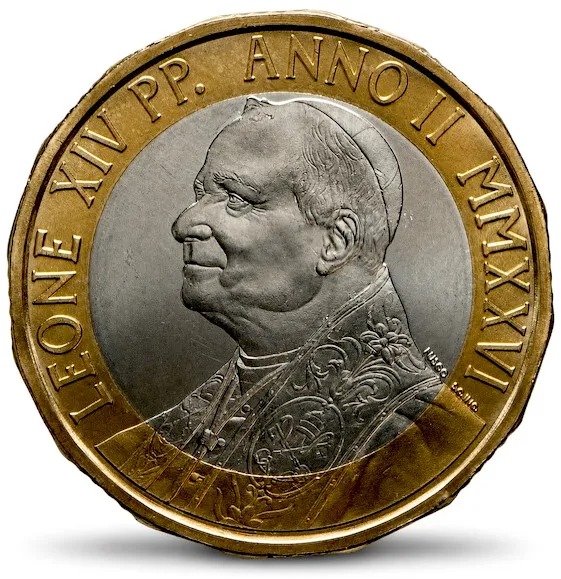
The Pope’s face returns to Vatican coins.
It has not been seen since 2017, when Pope Francis decided to remove his image from the euros. The new series of Vatican coins, the first of the pontificate of Pope Leo XIV, is directly inspired by the papal coat of arms. An intense blue characterizes the inscriptions and the most prominent graphic elements, evoking the colors of the two heraldic fields of the papal coat of arms. The coins feature alternating effigies of the Pope and the papal coat of arms.
Pope Leo does not want Rupnik in the background.
At the Sanctuary of Lourdes, the mosaics by Marko Rupnik will be covered only for one weekend: the time it takes for Pope Leo XIV to arrive and depart at the end of September on his apostolic journey. At the end of an extensive article in La Vie about the preparations for the papal visit. The rector of the sanctuary confirmed that the mosaics in the Basilica of Our Lady of the Rosary, created by Marko Rupnik, will remain covered throughout the weekend, in accordance with Jean-Marc Micas, bishop of Tarbes and Lourdes. The objective is twofold —explains Father Michel Daubanes—: to create a festive atmosphere and, at the same time, to hide works that are now inseparable from the drama of the sexual assaults committed by Rupnik.
Pope Leo is preparing to travel to France on an apostolic journey that will take him to Paris, Lourdes, and Metz, from September 25 to 28. Francis’s relationship with France was, to say the least, cold, so much so that he never visited Paris during his pontificate, not even for the reopening of Notre-Dame Cathedral on December 8, 2024, almost five years after the fire that devastated it; he limited himself to sending a message, before flying to Ajaccio the following week. The Pope will celebrate a public Mass before the Sanctuary, in front of the Rupnik mosaics that stand out on the façade of the Basilica of the Rosary. These mosaics, reproduced throughout the world, have become a real headache for the bishop of Tarbes and Lourdes.
Cardinal Duarte Langa passes away.
Fauci at the Vatican. We have not forgotten, and Viganò reminds us. On May 6, 2021, while the whole world was still under the yoke of the health dictatorship, the Holy See sponsored –under the auspices of the Pontifical Council for Culture– a Conference entitled “Exploring the Mind, Body and Soul. Uniting to Prevent and Uniting to Heal”. The day was not opened by a theologian, nor by a pastor, nor by a defender of natural law; it was Anthony Fauci. Beside him were Deepak Chopra, Chelsea Clinton… and, on the program, the top executives of Pfizer and Moderna.
They had been warned of the pandemic fraud since May 2020, and Viganò reveals that he wrote twice to the Congregation for the Doctrine of the Faith to warn against uncritical adherence to a pseudoscientific narrative that contradicted not only prudence, but the non-negotiable principles of Catholic morality. The May 2021 event was not a “simple conference”. It was a public display of complicity. The Holy See did not limit itself to remaining silent: it offered its moral authority and its image to those who, in the name of “health”, imposed restrictions on fundamental freedoms, discriminations, blackmail, and, above all, experimental serums that have caused the death of millions of people: a true and authentic hecatomb still ongoing due to the damage caused by those serums.
The anonymous tomb of a good bishop.
Sic transit gloria mundi. In San Giovanni Rotondo, in the quiet and intimate cemetery, the tomb of Monsignor Juan Rodolfo Laise bears only a simple paper funeral notice , placed at the time of his burial in 2019, awaiting the placement of a definitive headstone. The contrast is striking with other Capuchin friars who died later. Laise was an Argentine Capuchin born in Buenos Aires in 1926 and was bishop of the diocese of San Luis from 1971 to 2001. He exercised his episcopal ministry characterized by rigor, study, and fidelity to Catholic tradition. After resigning from the governance of the diocese —a resignation accepted upon reaching the age of 75, as required by canon law—, he settled in San Giovanni Rotondo, where he spent his final years beside the shrine of St. Pio of Pietrelcina, continuing a discreet and assiduous service as confessor and spiritual companion to pilgrims, especially Spanish-speakers. His figure remains linked, in particular, to the debate on receiving Communion in the hand. At a time when the issue divided opinions within the Church, Laise adopted a clear and reasoned stance, defending Communion on the tongue as a sign of reverence and continuity with tradition. He published the documentary essay « Communion in the Hand: Documents and History» , which has become a reference work.
In April 1996, the Argentine Episcopal Conference was inclined to request an indult from the Holy See to introduce Communion in the hand in the country. Among the supporters of this opening was the then auxiliary bishop of Buenos Aires, Monsignor Jorge Mario Bergoglio. Making use of the faculties granted to local ordinaries by the instruction Memoriale Domini , Monsignor Laise chose not to apply the concession and prohibited the practice in his diocese, which earned him severe criticism from other bishops for his lack of pastoral ‘communion’.
His name remains linked to the world that would later find a point of reference in the apostolic letter Summorum Pontificum. On October 22, 2015, in Rome, he officially inaugurated the IV International Pilgrimage Populus Summorum Pontificum , celebrating the solemn Pontifical Vespers of the Blessed Sacrament in the Church of the Most Holy Trinity of the Pellegrini. While awaiting the completion of the inscription on the headstone, the figure of a man of the Church emerges clearly —one who knew how to navigate difficult times without seeking prominence, leaving behind a recognizable spiritual legacy.
Toward what Church are we heading?
“Synodality”, as the recent Vatican document to the dioceses demonstrates, is the Trojan horse for the Protestantization and secularization of Catholicism. A genetic mutation of the deconstruction of the Church that is unacceptable to a true Catholic. Synodality is like a poison that starts from the Vatican, to infect the entire Mystical Body of Christ, which is the Church. The final result is already visible in what is happening in the German Church. The Vatican has published the new guidelines for the evaluation phase of the Synod on Synodality, scheduled for 2027. Each diocese must organize local assemblies to verify how the Final Document of the Synod has been received, draft a report to be sent to Rome, and describe the transformations that have taken place in decision-making processes, participatory bodies, and ecclesial structures.
Synodality is not presented as a time-limited experience, but as a principle destined to permanently shape the identity of local Churches, their way of governing, deciding, and even conceiving themselves. The first element that stands out is the permanent nature of the process. The guidelines speak of an ecclesial identity that must be progressively shaped through “synodal elections, dynamics, practices, and structures”.
But, if the Church already possesses a divine constitution received from Christ, to what extent can its fundamental structures be continually rethought? In Catholic tradition, the government of the Church is not the result of sociological evolution, but belongs, at least in its essential elements, to the will of the Lord. There is undoubtedly a historical development of concrete forms, but this development is called to preserve the hierarchical and sacramental nature of the Church, not to redefine it.
Curious is the method of the so-called “conversation in the Spirit”, which should characterize diocesan assemblies. No Catholic can oppose mutual listening or communal discernment, since they belong to the life of the Church from its origins. In Catholic tradition, spiritual discernment does not arise simply from dialogue among participants. It arises above all from listening to the Word of God, fidelity to Tradition, prayer, sacramental life, and docility to the Magisterium.
A third point concerns the invitation to involve, as observers, representatives of other Christian denominations and even other religions. I understand the value of dialogue and mutual knowledge. The risk is not so much listening to other voices, but weakening the awareness that the Church receives its identity from Christ and not from the consensus of religious cultures. The laity have always carried out an irreplaceable mission in the Church, but the Church is not a representative democracy; it is a hierarchical communion founded on the Sacraments. Do the proposed transformations help the Church to guard and transmit more faithfully the Deposit of Faith received from the Apostles? If the answer is positive, they will bear fruit. The Church has always known how to renew itself, but it did so without ceasing to be itself.
The advance of the synodal-conciliar Church
Among the phrases recently spoken by Pope Leo XIV, one caught my attention in particular: the one he addressed indirectly to the SSPX shortly before his episcopal consecration on July 1, and precisely when he concluded with these words: «…but we must move forward». Where are they heading? What are their true and unconfessable intentions? What is their true objective? We know well, even from our own experience, that lies and deception are the main weapons of modernists. The Vatican intends: «To involve representatives of other religions, strengthen permanent synodal structures, and consider broader leadership roles for the laity».
According to the current tactics of the Vatican, the few Catholics remaining in the Church, mostly laypeople (the consecrated can be counted on the fingers of one hand), are being expelled from the ecclesial community, while the worst historical enemies of the Holy Church are received with open arms. The «militant church» must remain completely under their control, so that they can fill and manipulate it at will.
Is the new synodal religion called cato-1968?
Back to the visit to Pope Leo by Patti, the abortionist Patti, pacifist, pansexualist. The Smith, 79 years old, was, and apparently still is, a punk rock star defender of abortion and LGBTQ rights. Originally from Chicago, like Prevost, she is known as the «priestess of punk». Her fame peaked in the late 1970s with the song «Because the Night», whose lyrics are far from innocent. One of her most famous lines, in the song «Gloria», says: » Jesus died for someone’s sins, but not mine». Yes, you read that right: «Jesus died for someone’s sins, but not mine».
Raised as a Jehovah’s Witness and already a close friend of the homosexual photographer Robert Mapplethorpe, who died of AIDS and was known for his sadomasochistic and homoerotic images, Mrs. Smith insists on pointing out that she does not identify with any religion, supports abortion, and in 2022 described the overturning of the Roe v. Wade ruling, which made abortion a constitutional right in the United States, as «terrible» («it broke my heart»).
Patti Smith is a regular at the Vatican, where she has performed on more than one occasion. And now she is at the private audience (of forty minutes) with Leo. An audience that, according to Father Spadaro, went very well: «When that door opened, something happened, a spark was lit, accompanied by moments of spontaneity, but also of deep emotion and a sense of mission». A shared mission between Leone and Patti?
The events in Ceuta.
The Mediterranean must rediscover a certain unity of purpose to face the current and future migratory waves that could sink Europe forever. The recent events in Ceuta, where several thousand migrants crossed the border into Spain (and therefore into the EU) after swimming across the strait separating Morocco from the Spanish enclave, are very similar to the «Green March» of 1975, and even more so. At that time, the «Green March» had not caused, at least officially, any victims. However, today’s crossing —the sea is very different from sand, and waves almost always cause havoc— could have had a high cost for the swimmers. How many? We will never know for certain, both because local official sources will tend to minimize the number of missing persons as much as possible, especially if this time too the Moroccan initiative was inspired by the king or the royal court, and because of the terrible organizational chaos that always characterizes events of this kind.
Among the other countries of the Maghreb, Tunisia is the smallest and the one with the best connections to Europe. Libya is practically paralyzed by its internal divisions and the constant instability of the two state factions that emerged after the overthrow of Gaddafi. Mauritania has always been so peripheral that it exerts minimal —and only sporadic— influence over the rest of the region. Algeria represents a special case, both because its stability, after decades of civil war, remains largely superficial, and because of its role in supplying hydrocarbons to Europe. There is widespread discontent and a lack of prospects throughout North Africa, conditions that, moreover, affect an extremely young population, inclined to adventure and willing to accept the risks that this entails.
Europe is doing absolutely nothing, with the possible sole exception worthy of praise being the Italian Mattei Plan. But what are we waiting for? For a storm to break before running home to look for an umbrella? The collective swimming crossing today from Morocco to Ceuta is an extremely clear symptom of how far this evil has advanced.
We always have the Holy Curé of Ars.
And we end with the Curé of Ars on the day of his feast, explaining to his faithful the importance of the sacraments: “If the sacrament of Holy Orders were to disappear, we would no longer have the Lord. Who placed Him in the tabernacle? The priest. Who received your soul as soon as you were born? The priest. Who nourishes it so that it may complete its pilgrimage? The priest. Who will prepare it to appear before God, washing it for the last time in the blood of Jesus Christ? The priest, always the priest. And if this soul were to die [because of sin], who will raise it and give it rest and peace? Also the priest… After God, the priest is everything!… He alone will understand it in heaven”.
“If we truly understood what a priest represents on earth, we would die: not of dread, but of love… Without the priest, the death and passion of Our Lord would be of no avail. The priest continues the work of redemption on earth… Of what use would a house full of gold be if there were no one to open the door for us? The priest has the key to the treasures of heaven: he is the one who opens the door; he is the administrator of the good God; the administrator of His goods… Leave a parish twenty years without a priest and they will worship beasts… The priest is not a priest for himself, but for you”.
«Have confidence, it is I; do not be afraid».
Good reading.