


The journey proceeds according to schedule and Pope Leo is even withstanding the test that was considered the most complicated: the helicopter flight to the heights of the Andes. It is Sunday, and the Pope is already on his way to Cusco as this is published. From yesterday’s northern day remains a phrase that the press has split in two halves and each has kept a different one, a dinner of one hundred and forty priests that he himself requested, and a three-hundred-year jubilee closed in the town where Saint Toribio died. From Lima remains the word that his cardinal used before the Pope and that was not in his power to grant. Good reading.
“The way of progress and of peace”
The Mass of the Andes of Cajamarca, in the square of Santa Cruz de Succhabamba, has left the phrase of the weekend, and it is worth reading it in full because almost no one has given it that way. The official text says: “Before so many difficulties one can be tempted to give in to discouragement, resentment or even violence, and that will never be the way of progress and of peace”
An Italian agency headlines “La violenza non sarà mai la via della pace”, violence will never be the way of peace, and leaves out progress. An Italian television reduces it to “mai cedere a violenza”, never give in to violence. The same phrase, with two names, amputated on one side and on the other the same day. When the Pope lists three temptations and violence is the third, after discouragement and resentment. The Spanish version speaks of the suffering of those who “are forced to leave their homeland to seek a better future” and, separately, of “low birth rates, which empty the villages”. There are two causes, forced emigration and low birth rates, and the second is named by the Pope without anyone having asked him. Whoever counts the emptying of the Andean villages only as an effect of poverty is changing the diagnosis of the homily.
And there remains the phrase of a man who was a missionary in those valleys: “Where there is faith, there is prayer, and where there is prayer, there is capacity for commitment to others”. He thanked by name the missionary priests, religious brothers and sisters, and said that without the catechists and the laity “evangelization would have been very difficult in these remote regions”.
The dinner the Pope requested
On Friday night, at the Colegio Santo Toribio de Mogrovejo, he dined with about one hundred and forty priests of the diocese of Chiclayo. Father Jorge Millán, who was parish priest of the cathedral when the Pope was bishop, tells it: “he is the one who asked that we dine with him”. At the end, instead of waiting for it to be asked of him, he said he wanted to be photographed with each one, and they went one by one. From that account also comes the only named counterweight to the clinical readings that have been made of the word “test” that the Pope used in Pimentel: Millán says that he arrived happy, that he recognized them by their names—“he did not lose his memory”—and that “he wanted to stay.” It is the impression of a priest who was seated there, not a medical report, and as such it counts.
The years of Chiclayo, with dates
Three different durations of the Pope’s episcopate in Chiclayo are circulating. The official biography gives the dates: apostolic administrator of Chiclayo on 3 November 2014, episcopal ordination on 12 December 2014, bishop of Chiclayo on 26 September 2015, apostolic administrator of Callao on 15 April 2020 and prefect of the Dicastery for Bishops on 30 January 2023. As bishop of Chiclayo, seven years and four months. Counting from the apostolic administration, eight years and three months.
Yesterday’s day had three events and the program gave them as follows. Rite of coronation of the Immaculate Virgin at eight in the cathedral of Santa María de Chiclayo, helicopter at nine ten from the air base, Mass in Santa Cruz at eleven, and prayer meeting in Zaña at five thirty in the afternoon. The text of the Zaña event is already in the official archive, and the coronation, when we closed, was not yet. The Spanish texts are already on the official page; we apologize for stating that they were not published, it is a problem of timing and our lack of patience. They are not always published automatically when the Pope pronounces them; we still think it is a flaw, even if it is remedied by time.
What happened in Zaña deserves explanation as to why there. The jubilee year that was closed marks the three hundred years since the canonization of Saint Toribio de Mogrovejo, proclaimed by Benedict XIII on 10 December 1726, and Zaña is the town where Toribio died on 23 March 1606, during a pastoral visit. An archbishop of Lima who died on the way, visiting. The arrival was with fireworks and northern tradition.
The cardinal of Lima and a word that is not his
At the Thursday vigil in the National Stadium, before the Pope spoke, the intervention of the archbishop of Lima has occupied the Peruvian weekend. Literally: “Young people many times took to the streets to protest and, in some cases, several of them were shot. And there are two martyrs of the young people, Bryan and Inti”. He was referring to Jordan Inti Sotelo Camargo, twenty-four years old, and Jack Bryan Pintado Sánchez, twenty-two, killed by projectile impacts during the mobilizations against the government of Manuel Merino. The background is not political, it is canonical: “martyr” is not a compliment, it is a category with a procedure, and recognizing it is not in the hands of an archbishop or an episcopal conference, but of the Dicastery for the Causes of Saints and of the Pope. There is no cause open for either of the two, and the very piece that collects the controversy specifies it: it is a qualification by the archbishop, not a recognition by the Church. The Pope’s response is in the facts and not on social media: he listened, spoke afterwards and did not repeat, did not mention the two young men and did not enter into the controversy. He spoke of those who “feel alone, even when accompanied” and of those who carry “the pain of a loss.”
The first is that former president Merino, who resigned on 15 November 2020, responded by asking for “true justice” for the families and reproaching the politicization of the tragedy. The second is the date: the two young men died on 14 November 2020, so that the Pope was yesterday in Chiclayo on the exact sixth anniversary, and neither the cardinal on the 12th nor any of those who have answered him has mentioned it. The controversy has focused on the word and forgotten the day.
A nuncio for India and a new province in Kenya
While the Pope is in Peru, a nunciature of weight has moved. Leo XIV has appointed Archbishop Waldemar Stanisław Sommertag, titular archbishop of Maastricht, until now nuncio in Senegal, Guinea-Bissau, Mauritania and Cape Verde, as apostolic nuncio to India. Polish, born in Więcbork in 1968, a canonist, incardinated in Pelplin, he entered the diplomatic service of the Holy See on 19 June 2000 and has passed through Tanzania, Nicaragua, Bosnia and Herzegovina, Israel, Palestine and Cyprus, and through the Section for Relations with States.
The notes circulating summarize his record thus: in 2018, nuncio in Nicaragua; in 2022, nuncio in Senegal. Between those two lines is missing what really happened. In March 2022 the regime of Daniel Ortega expelled him from the country, and the Holy See communicated it saying that it had received the news “with surprise and pain,” describing the decision as incomprehensible and stating that Sommertag had worked tirelessly for the good of the Church and of the Nicaraguan people. Before that, in November 2021, Managua had annulled his status as dean of the diplomatic corps. The following year Nicaragua asked the Holy See to close its diplomatic missions. So the man who arrives in Delhi is the last nuncio Nicaragua had, and India is his third posting since then. That, and not the curriculum, is what explains an appointment.
The same day, the Pope has redrawn the ecclesiastical map of a country. He has erected the ecclesiastical province of Eldoret, in Kenya, elevating that see to a metropolitan church and assigning as suffragans the dioceses of Lodwar, Kitale, Kericho and Kapsabet, and has named as first metropolitan archbishop Monsignor Joseph Obanyi Sagwe, until now bishop of Kakamega and apostolic administrator sede vacante of Eldoret itself. He thus regularizes what he was already governing in fact, and along the way leaves Kakamega vacant. With the coadjutor bishop of Kisii whom we reported yesterday, these are two acts on the Kenyan hierarchy in two days, signed from Peru.
Galileo’s moon in a papal dome
And one about art that brings a detail worth the entire edition. On 16 November the restoration of the Pauline Chapel of Santa Maria Maggiore begins, with an estimated duration of eighteen months, promoted by the basilica and the Governorate of the Vatican City State. It affects the ceiling, the dome, with the frescoes and stuccoes of vaults, lunettes and pendentives, plus the sacristy. The solution to avoid interrupting worship is a suspended scaffold: the chapel will only close for the ninety days of assembly, and during that time a copy of the icon will be placed beside it for veneration. Daily Masses move to the Sistine Chapel of the basilica, at eight, nine, ten, eleven, twelve and six. The icon kept in the chapel is the Salus Populi Romani, attributed to Saint Luke.
There is a curiosity in the fresco of the chapel’s ceiling. The pictorial cycle was executed between 1610 and 1612, and in the dome the Virgin of the Assumption rests on a naturalistic representation of the moon inspired by Galileo’s telescopic observations collected in the Sidereus Nuncius of 1610. Galileo’s moon, with its features, painted beneath the Virgin’s feet in a papal basilica twenty-one years before the trial of 1633. What is now being restored is that.
The Masonic thread, and a list that belongs to another Pope
We follow the thread that comes from Poblet, and this weekend’s installment is an essay of long thesis. Signed with a pseudonym and presented by Marco Tosatti, it maintains that the Italian Risorgimento and Catholic modernism have a common origin in English Freemasonry and in Protestantism, and draws a parallel between the taking of Rome in 1870 and the Second Vatican Council. It is the author’s thesis; it rests on two historians whom he cites by name.
The essay describes a Pope who did not want to be called Pope but only Bishop of Rome and who was shedding the symbols of the office, and heads that list with the apostolic palace. That biography is Pope Francis’s. But the last sentence hangs the reproach on “the last two Popes, Francis and Leo XIV,” and there the first element of his own list turns against him: Leo XIV returned to the Apostolic Palace in March of this year, twelve years after no Pope had lived in it. The essay does not provide a single act of the current Pope.
And one thing must be said in favor of the same blog. Another installment, on Romano Amerio and his Iota unum, deals with the slipperiest matter of all—the so-called Metz pact, of August 1962, between Cardinal Tisserant and Metropolitan Nikodim—and writes black on white that there is no signed treaty that certifies the terms attributed to it, and that the pact does not prove that communism entered the doctrine or the structures of the Church through a formal agreement. It also collects the theological objections to Amerio and refers to Benedict XVI’s address to the Curia of 22 December 2005 on the two hermeneutics of the Council. Three very interesting pieces on the same site and the same weekend.
The Orlandi file, and what is not known about it
An analysis piece on the case of Emanuela Orlandi is circulating that is worth reading knowing what it is: a reasoning, not information. Mario Barbato starts from the fact that the Vatican promoter of justice, Alessandro Diddi, admitted in November 2024 having found the file, and from there deduces that if those folders contained decisive proof no one would have announced their existence. His conclusion is that inside there is not the solution to the case, but an archive of monitoring assembled by the Secretariat of State between the eighties and nineties: clippings, notes, anonymous letters and record of contacts with the Roman magistracy and the Italian services. It may be reasonable and it remains conjecture: the author has not seen the file, and no one who writes about it has seen it. What is verifiable are two dates, the reopening of the investigation in January 2023 and that admission in 2024, and the fact that the content remains unknown. The closure accredits the investigative failure of the Italian State. The promoter of justice who guards that file is the same whose delivery of documentation was declared defective in another procedure: on 17 March of this year the appeals court declared the relative nullity of the trial of Becciu because Diddi had deposited the acts of the instruction only in part and with omissions, violating the principle of full knowledge. We imply nothing about Orlandi with that; we say it because it is the same signature and it is in a sentence.
Wrapping up the day
And one about Christmas that arrives with two details. This year’s Nativity scene in Saint Peter’s Square, “Il Grande Mistero,” is mounted by the archdiocese of Chieti-Vasto, and it will be accompanied by a concert of thirteen carillon bells, cast in Bolzone, province of Cremona, tuned in the key of G with minor seventh and operated remotely from an application. Cast bronze handled with the telephone. They sound for the first time on Saturday the 21st in Vasto, after the six o’clock Mass, before traveling to Rome. And the other detail is the one that matters: among those who have built that Nativity scene is the educational community of the prisoners of Vasto, together with the city’s confraternity of artists and two associations from Atessa and Guglionesi. And the money is being raised by popular subscription in a parish in Abruzzo; it is to be thanked for the clarity in knowing how what is later seen in Saint Peter’s is paid for.
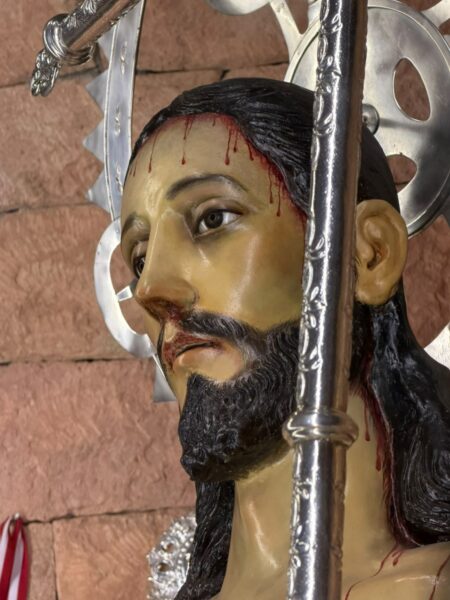
Today, the thirty-third Sunday of Ordinary Time, the Gospel is that of the talents. Our image today is of the lord of the side of Santa Cruz. Good day.
“I was afraid and went to hide your talent in the earth.”