


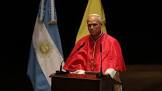
We continue from our Roman watchtower to follow the steps of Leo XIV across American lands. This perspective allows us to see two fundamental things: the curial machinery does not stop and everyone observes the Pope’s every last gesture. The reasons are basically two: to scrutinize what the Pope thinks about the next moves in the curia and to analyze the state of health that can give us the measure of the pontificate. We believe the Pope is aware of all this and plays his cards, but it is also true that his beloved America leads him to be more in his element and lowering his guard at these levels is very dangerous—much more so in Peru and even more so in Chiclayo.
Today is the second Argentine day, with the Cottolengo of Claypole in the morning and the world of work in the afternoon. From yesterday remains a speech at the Palacio Libertad that half the press has read as a reprimand to Milei without the text naming Milei, and the Casa Rosada saying it did not understand it that way. A telegram from Cracovia that is not from the Pope although everyone quotes it as his, a forty-year-old claim that reaches the eight per thousand, and an Augustinian from Apurímac who died three days before the Pope lands in Peru.
Claypole and the world of work
The day, according to the official program: visit to the assisted at the Pequeño Cottolengo Don Orione of Claypole and Mass at the Monumento de los Españoles, meeting with the world of work at the Universidad Católica Argentina. Leaders of Christian communities and other religious traditions at the Palacio San Martín, and Vespers with the Argentine episcopate and the synodal teams at the cathedral, before dinner with the bishops.
ANSA headlines that the faithful of Bergoglio’s parish are preparing to welcome Leo, and it is the basilica of San José de Flores, the one of his childhood. But there is no visit: what the piece recounts is that the parish priest explained to his parishioners how to get to the Mass at the Monumento de los Españoles; no parish appears on the program.
The speech that did not name Milei
From last night’s speech at the Palacio Libertad there are two phrases that explain everything that has been written afterward. One: “the economy must be at the service of the person and not the person at the service of the economy.” The other: “corruption erodes citizens’ trust in their institutions,” within a passage on how the solidity of institutions depends on the personal integrity of those who govern. The word corruption appears twice; the second time, in an enumeration with organized crime, human trafficking, and arms and drug trafficking. The quotation that has gone around the world is literal, checked word for word.
What is not in the text is Milei. His name does not appear, nor his Government, nor any administration. He addresses the “Mr. President” and thanks him for his words. And yet ANSA headlines “the Pope’s lesson to Milei”, and others have written that he reprimands him or calls him to order. The phrase about the economy is classic social doctrine, without a political subject and without reference to any country. The lesson is in the reading, not in the text. The contrast is provided by the officialdom itself, and that is the best data in the section. In the Casa Rosada they did not read it as a criticism: they considered it doctrinal and addressed to all Argentine leadership. “We would be crazy to think it was against Milei,” says a Government source. The only detail that same chronicle records is that the president did not applaud during the passage on the economy.
Of the homage to Francis that several media outlets gloss, what there is is this, and it is not a panegyric: “for twelve years the universal Church listened to the voice of an Argentine pontiff,” and “today, succeeding him in the Petrine ministry, I in a certain way retrace the inverse path and come to the homeland where Pope Francis began a story that would later intertwine with the whole Church.” He closes by entrusting the country to the Virgin of Luján, “silent guardian of his memory.” It is declared succession, not personal praise.
A warning from a source must be made, because it is anomalous and remains a rarity. The Spanish text of this speech has not been published: the Bollettino marks the piece as originally in Spanish and provides only the Italian translation, and the Spanish page of vatican.va returns a server error. The absence of ongoing conflicts continues to stand out at zero: neither Ukraine, Gaza, Sudan nor Haiti appear here either, nor the word war.
Mothers and grandmothers, and a headline that rises in rank
The last Uruguayan act was the Mass in Florida, at the sanctuary of the Virgin of the Thirty-Three, and from there comes the phrase that has circulated the most, this one indeed in the official Spanish: “mothers and grandmothers: do not tire of transmitting the faith!”, preceded by a remembrance of the grandmothers “who kept an altar at home, who prayed for the living and for the dead, who made God present in the ordinary things of life.” He also said “there are doors you cannot open, but God can,” and a “Uruguay: we must set out on the way!” And the one about fatherhood that we already published yesterday.
And a headline operation that deserves to be pointed out because it is subtle. ANSA headlines “may rulers pursue the good of all”, in the imperative, as an exhortation to power. What the Pope said was “let us pray for those who have the responsibility of governing it, so that they may seek with uprightness the good of all.” It is an intention of prayer turned into a mandate, and along the way the “with uprightness” is lost.
Two retouched phrases and a borrowed headline
From Saturday’s speech at the Universidad Católica del Uruguay comes the passage on artificial intelligence that several have collected, and in official Spanish it says: “wise use of technologies and AI, placing the person before the algorithm”, and harmonizing technical, emotional, social, spiritual and ecological intelligences. The detail is amusing: it is not an idea from Montevideo, it is a self-quotation from his exhortation Designing New Maps of Hope. And the event was not a speech to Catholic schools, as it has been headlined, but the meeting with the world of education. Where the official text says “no one can be rejected,” the circulating version says no one deserves to be rejected. It seems the same and it is not: the original states a prohibition and the variant turns it into a judgment on deservingness.
And a headline that lends Leo XIV a phrase from John Paul II. Giorgio Gandola headlines that the Pope builds bridges without demolishing the dikes, and the formula is good, but the article itself attributes it to John Paul II. The papal quotations in the piece, on the other hand, all come literally from the homily in Paysandú, including the one about foundations: “it is necessary that the bridge have good foundations, so that it does not succumb to the most enraged currents.”
Cracovia, and what the Pope did not say
And we return to the Vatican. On Saturday around three in the afternoon, a man drove his car into Rynek Główny in Cracovia and fired from the vehicle. Six dead in the square, four women and two men, and fifteen wounded, two of them police officers, according to the police of Małopolska. At the attacker’s home in Ostrowiec Świętokrzyski, three corpses were found, identified as his father, his mother and his twenty-one-year-old sister. The attacker, a twenty-four-year-old man with a firearms license, died this morning in the hospital without having been detained or formally charged, so there will be no indictment. The prosecutor’s office is treating the attack as terrorism and the investigation remains open, without judicially established authorship and without a claim of responsibility. National mourning yesterday and today.
About this a clarification of attribution must be made, because it has been badly told everywhere. What exists is a telegram from the Bollettino, originally in Polish, signed by Cardinal Parolin and addressed to Cardinal Grzegorz Ryś, Archbishop of Cracovia, written in the third person: “His Holiness Leo XIV, deeply saddened by the news of the fatal victims and the wounded as a result of the shooting in Cracovia, expresses his spiritual closeness…”. Not a single phrase from the Pope in the first person. The headlines that put “the Pope: deeply saddened” in quotation marks quote as a citation what is a curial formula written by someone else. The SIR, which does recount it as a telegram from Parolin, is the exception.
And there is a second, worse one. Euronews Italy maintained that the Pope referred to the attack in the homily in Florida. The three papal texts of that day—the greeting in the parish of Juanicó, the homily and the final thanksgiving—do not mention Cracovia, nor Poland, nor the attack, nor the victims, and that Sunday there was no Angelus. On the Polish side there were words of their own: Ryś wrote to his faithful that “the last word does not belong and cannot belong to hatred” and called for a Mass in the basilica of Santa María, in the square itself.
Forty years, one million euros and the eight per thousand
And we return to Italy. A former religion teacher from Salento, Antonio Schiavano, from Taurisano, has sued Bishop Gerardo Antonazzo and Father Stefano Rocca, of the diocese of Ugento-Santa Maria di Leuca, for abuses he says he suffered in the seminary of Ugento between 1986 and 1988, when he was thirteen years old. He claims one million euros. He speaks with names and surnames, and begins his account by himself placing the caution: that he presents his version in the absence of judicial truth and that no one is guilty until proven otherwise. We publish it in those terms: they are his accusations, they are not accredited by any ruling, and the two defendants reject them. As for the route, it is a civil claim for compensation before the Tribunal of Lecce, and it is so because the criminal case is closed: the facts are criminally time-barred. There were previously two investigations archived, in 2011 and 2016, both for lack of a complaint, which is not acquittal nor a declaration of innocence.
From the interview there are two things we point out that recur in many of these cases. One is why he waited forty years: he says someone warned him that if he reported it, they would take away his Religion class at the classical high school of Tricase, “those positions are managed by the Church,” and that he ended up resigning “before being thrown out.” The other is what turns the matter into a question of accounts, and we leave it literal: about the abuser, he says, “there continues to be concrete support, maintenance, housing, psychiatric assistance, all paid also with the eight per thousand?”, and asks what is done instead for the victims.
Yesterday we reported that Rosario Gisana, bishop of Piazza Armerina and indicted for false testimony with sentence set for December 11, figures on the doctrinal commission of the Italian Episcopal Conference. Today it is circulating that the nuncio would have asked him to resign. The original is by Federica Tourn, who headlines it “the phantom resignations”, and she herself does not present it as established: she attributes the trip to Rome to unnamed local ecclesiastical sources and the nuncio part to rumors. Her verb is “urge”; the “would have advocated” of the headline that replicates it belongs to the medium. Three media outlets reproduce it and none provides its own source. The diocese says it knows nothing, the nunciature does not respond and the Sala Stampa neither confirms nor denies. No resignation appears in the Bollettino.
What is worth noting is who that nuncio is today, because it changes the size of the matter. Since March 30 the nunciature in Italy has been held by Edgar Peña Parra, who until then was Substitute for General Affairs of the Secretariat of State, with Petar Rajič moving to Prefect of the Pontifical Household and Paolo Rudelli to the post left by Peña Parra. That is, the management attributed to the nuncio is attributed to someone who eight months ago was the number three of the Secretariat of State and that indicates a higher level of matter.
Now we know who sustains the accusation against Becciu
We had been asking it for weeks and the answer has been published since January. After Alessandro Diddi’s abstention, declared on December 12, the accusation in the appeal is sustained by the adjunct promoter of justice Roberto Zannotti, with two promoters assigned, Settimio Carmignani Caridi and Giuseppe Deodato, acting at the February hearing. The caution: that is the last nominal confirmation there is, from February, and at the October hearing no promoter was named.
From that hearing, the one of October 29, presided over by Alejandro Arellano Cedillo, what is on record is that the Promoter’s Office had not complied with the March order to deposit the complete records of the investigation, and that the next hearings are from January 26 to 29. Since the Vatican Court of Cassation declared the prosecution’s appeal inadmissible, in January, the sentences can no longer be aggravated.
The case remains popular and on November 27 a presentation will be held in Rome, at the Fondazione Marco Pannella, of “Il caso Becciu: un processo inquietante. Cosa raccontano le chat”. The book collects already known public records and a reflection on procedural guarantees, so there is no new document. What there is is a datum about where the debate is going: the cause of guarantees in this process has been taken up by the Italian radical world, which has been at it for half a century and which is not precisely the natural environment of a cardinal.
Berni, the Augustinian from Apurímac
He has died in Genoa, at the age of eighty-six, Monsignor Domenico Berni Leonardi, Augustinian, bishop emeritus of the territorial prelature of Chuquibambilla, in Apurímac, which he governed from when John Paul II appointed him in 1989 until his resignation was accepted in 2018. He arrived in Peru in 1971, three years after Paul VI erected the prelature and entrusted it to the Italian Augustinians, and he stayed forty-seven years. The same note that communicates his death refers to the deep friendship that united him with his brother in the order Robert Prevost, whom he met on the mission; they saw each other at least twice a year, and when Prevost was prior general he traveled more than a thousand kilometers to bid him farewell in 2018. Last year Berni traveled to Rome and met with him at the Apostolic Palace. He dies three days before the Pope lands in Peru. A warning, in case someone drags it along: the expression “apostle on horseback” that circulates in some headline is not in that note, and in the Italian press it has been applied to Prevost, not to Berni.
Wrapping up the day
The column we liked most today is not about the trip. José Francisco Serrano Oceja writes about his parish priest of San Francisco de Santander, Don Antonio, who lost three brothers on the prison-ship Alfonso Pérez and dreamed that the Church would publicly recognize that martyrdom in the cathedral. “That day was yesterday,” he writes, because of Saturday’s beatification. And he adds that the parish priest celebrated it the same way, “as a feast in the intimacy of Glory.”
A dress code “disseminated by the Holy See” is circulating for the Argentine events: dark tones, no low necklines or transparencies, optional mantilla, sneakers and garments with partisan slogans prohibited. The detail is that there is no document. It does not appear in the Bollettino, it is not on the official page of the trip, and neither that medium nor those that reproduce it cite title, number or date of anything: they speak generically of protocol. What has historically regulated dress is the Prefecture of the Pontifical Household, for audiences. Until the paper appears, the headline runs ahead of the fact.
In Muscat the golden jubilee of the church of Saints Peter and Paul of Ruwi has opened, the first Catholic church built in Oman, consecrated in November 1977. It was inaugurated by Paolo Martinelli, apostolic vicar of Southern Arabia, and will last until November 2027.
Of the decline that the papal feast covers up, a figure and no more, because the rest are in the link: Latinobarómetro gives 55 % Catholics in Latin America in 2026 compared to 80 % in 1995. It measures self-identification, not practice, and arrives cited through a third party, so we give it as what it is.
And of Vergari, who died on Friday, something appears that we did not have: a letter of his to Stanisław Dziwisz of July 14, 1983 complaining about the music school of San Apolinar. The rest that is published as revelation is from his appearance on January 9, 2025 before the parliamentary commission, already recounted then, where he said that with De Pedis he “played a bit of cunning” and that the lead “could even be true.” Of the 1983 document we have not seen the original.
Today, feast of the Dedication of the Lateran Basilica:
“do not turn my Father’s house into a marketplace.”