


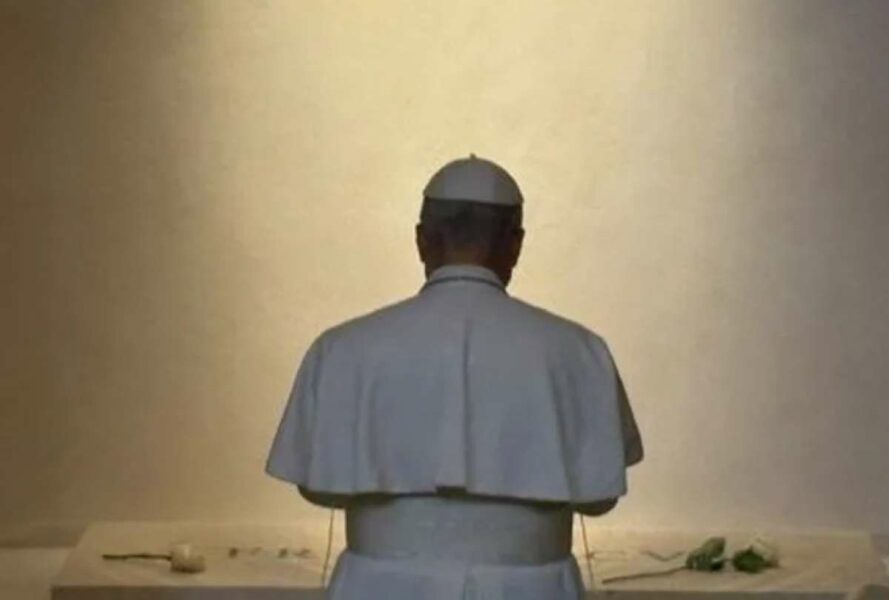
We begin the week. Pope Leo in the Sunday Angelus in Castelgandolfo Square: “I reiterate my call for an end to the repeated acts of violence against the Palestinian civilian population in the West Bank, and I urgently ask the international community to ensure progress toward the two-state solution for a just and lasting peace.”
Perspectives on the pontificate of Leo XIV.
Luis Badilla offers us a detailed analysis: “Pope Leo XIV has already completed the first fifteen months of his pontificate. For many, he seemed like a leader with a solid and thoughtful approach, though reserved and, at times, excessively taciturn. However, the reality is very different. The error in judgment is evident, the result of inappropriate media interpretations based on outdated criteria. His work as head of the Catholic Church is manifested—both in figures and in content, even in gestures—as a series of far-reaching interventions. This is especially evident when analyzing decisions, documents, and positions related to the governance of Pope Francis’s pontificate. Numerous changes and revisions have gone almost unnoticed, without generating uproar or controversy, nor sparking any debate. This has been and will continue to be a blessing for the Church. The main credit goes to Leo himself, who guided the first stage of the transition with prudence and insight, always with firmness and without reservations.”
“With several decisions, Prevost has demonstrated a clear and meticulous path to achieving goals considered necessary, even urgent, for the Church in today’s world. Several crucial changes in these months have been substantially underestimated by the media, including—curiously—the specialized press itself. Many new developments have not received the attention or interpretation they deserved. Perhaps the fireworks were missing.”
“Until recently, the media saw the Vatican as a factory of front-page headlines and sensationalist news. The greatest controversy arose from isolated phrases, adverbs, or surprising, unexpected, and even scandalous statements. However, these statements often lacked concrete consequences, proved sterile, and were buried under new exaggerated announcements: a blatant paradox for an institution that reflects two thousand years of history and which, in terms of its doctrinal structure, is severe, rigorous, and extremely resistant to change.”
“Much of the indignation of the past has been condemned by its ephemeral nature. The perfect example of this period, a true paradigm of the entire pontificate, remains the phrase spoken by Francis during the return flight from Rio de Janeiro (July 2013): “ Who am I to judge a gay person?” That passage, along with other statements on sensitive doctrinal issues made in recent years, suggested the advent of radical changes in the Church. Furthermore, the very choice of the name Francis had been interpreted from the beginning almost exclusively in a reformist light: the Christ of San Damiano exhorting Saint Francis to repair his Church. In the end, after twelve years of pontificate, the doctrine, the structure, and the exercise of the papacy—in short, the Church as a whole—remained essentially the same as at the time of the 2013 Conclave.” “Many of those words turned out to be mere occasional media outbursts, lacking real normative follow-up, a genuinely reformist, clear, and unequivocal framework. Even the last attempt to find this absent and frustrated substance, linking the papacy with synodality, failed, because from the very beginning (2021) it has been an incomprehensible tangle, impossible to translate into concrete terms and, therefore, indecipherable.
“Ask the simple faithful, those we properly call ‘average Catholics,’ the neighbors: what have they experienced in their religious, spiritual, and possibly sacramental life with this synodal path? What has synodality brought them? How has their life changed with the Synod on Synodality? In short, have they felt part of a synodal Church that offers humanity ‘a way of being and living in which everyone can feel included and protagonists’ (Cardinal Mario Grech – Document for the continental stage – October 24-27, 2022)?”
“Pope Francis has left a significant and substantial legacy, often highlighted by subsequent ecclesial debate. Among them, his encyclicals and the Apostolic Exhortation Evangelii Gaudium of November 24, 2013, undoubtedly stand out, as Pope Leo XIV used to emphasize with particular solemnity. Certainly, historiography, based on documents, will in the future offer new positive perspectives on the work of Pope Francis’s pontificate, still unknown today.
“It makes no sense to consider Leo XIV as Francis’s successor, just as it makes no sense to interpret him as the anti-Trump. Nor did it make sense to consider Francis as the ‘Che’ of the Catholic Church or as a revolutionary of the faith. Media clichés—which, contrary to what is often repeated, readers neither desire nor appreciate—the supposed need for sensationalist headlines, the rush to offer juicy news, and much more, obscure and discredit the quality of information and its source.”
“Among these changes, the one concerning the Pope’s relationship with the media stands out, especially after the closure of the Santa Marta press office. With the disappearance of this personal press office, which cyclically became a kind of magic circle composed, from time to time, of different groups and individuals, the Pope’s personal relationships with some friendly journalists also came to an end. Leo XIV, without saying a word, restored an order that had been altered, with numerous negative consequences for the authority of the office. Leo XIV maintains a personal and direct relationship with the media, but believes that they must be managed according to criteria and methods consistent with his way of exercising the pontificate.”
“A legitimate question persists, stemming from the fact that Pope Leo continues to govern with the same ecclesiastical staff that worked under Pope Francis. There is no obligation to change, and the Pope’s decision remains unquestionable. However, in a society with a relationship strongly influenced by the media with the Holy See, the names, faces, and language of collaborators are also part of the communication of the papal magisterium. These are also useful tools for understanding this pontificate. Therefore, it is important to know the names of the Pope’s new main collaborators, as this can reveal and anticipate much about the future direction, as has already been seen with some of the appointments made so far.
Parolin and Ceuta.
On the occasion of the celebrations of the ninth centenary of the transfer of Saint Agatha’s relics from Constantinople, Pope Leo XIV appointed the Vatican Secretary of State, Cardinal Pietro Parolin, as Papal Legate. He was received at the Palazzo degli Elefanti. He took his seat at the center of the table with the dignitaries, in the same chair occupied by John Paul II during his visit to Etna in 1994. “I feel embarrassed and hope that His Holiness Leo XIV will soon be able to sit there.” The president of the municipal council emphasized that “Agatha belongs to Catania and Catania belongs to Agatha; the entire history of the city is based on this synonym.”
When asked whether the confrontation between Italy and Spain over the Ceuta crisis risks weakening Europe: “There has never been broad consensus on the migration issue, and that is what the Holy See has always insisted on. There must be a common approach to the migratory phenomenon, with all its complexity. We hope that there will be one, that differences and conflicts can be overcome, and that there will truly be a common approach that allows us to address this situation in a humane way.”
Regarding the conflicts in the Middle East, “the Church has always called for peace. Unfortunately, this call is not always heeded. In fact, many times it is not heeded.” “But I believe the Church must continue to insist on this issue. Ultimately, it finds an echo in people’s hearts because they realize that this way of acting, of directing the world, can only lead to more conflicts, more suffering, and destruction.”
Regarding the war in Ukraine, “we have tried, in many ways, starting with Pope Francis, to offer the mediation of the Holy See. So far, there has been no direct response. We continue our efforts. Now, the Secretary for Relations with States, Monsignor Gallagher, will travel to Moscow. We hope that some results will be obtained and that paths will be opened toward a ceasefire and, then, even negotiations can begin.”
The ‘squatters’ blessed by the Church.
And it happens in Rome, the Pope’s diocese; there is a common thread that unites the diocese of Rome with the occupied building. The Spin Time headquarters in Rome was occupied, with activists outside led by the priest. The zeal of the diocese of Rome is understandable, considering the bond that unites the social center, so beloved by left-wing celebrities, with the Vatican. A key date in the history of the building on Via Santa Croce in Gerusalemme is May 11, 2019, when the apostolic almoner Konrad Krajewski descended into the building’s electrical substation to restore the supply of light and hot water, which had been cut off due to a significant debt. An operation that was not only illegal but also extremely dangerous. This earned Krajewski, now exiled to Poland, the nickname “Cardinal Electrician.” To give credibility to this version, he claimed to have worked as an electrician in Poland, a claim he himself denied.
The Catholic rainbow groups in China.
It is an article published on the website of Outreach. In China, there is a group of Catholics known as Tongzhi (同志/LGBTQI+), who for a long time have struggled alone in the precarious space between their faith and their sexual orientation. The author of the article acknowledges that in 2009, while working in Beijing, I helped found the China Rainbow Witness Fellowship, an ecumenical mutual support group among Christians belonging to sexual minorities.
During our first meetings, I was often the only Catholic present. The deep-rooted cultural norms and the Church’s silence on homosexuality left many of us isolated, with a sense of fragmentation of our deepest identity. However, the seeds of the Gospel are carriers of great vitality. As other Catholic brothers and sisters joined us, we understood the need for a safe spiritual refuge, nourished within a Catholic context. In 2013, the Catholic Rainbow Community of China was founded.
We created online prayer groups and began organizing in-person meetings in cities like Shanghai. Along the way, we met true “good shepherds,” merciful priests and nuns willing to face great pressure to provide us with safe spaces to meet. Guided by their pastoral care, our homosexual faithful demonstrated a deep connection with the life of the Church and the liturgy; they served as acolytes and readers, and dedicated their lives, full of gifts, to the service of God. In October 2015, I had the privilege of representing a Chinese delegation in Rome, at the founding assembly of the Global Network of Rainbow Catholics, where I was elected a member of the steering committee, responsible for youth affairs. At that moment, we understood that the timid voices of Chinese rainbow Catholics had finally joined the beating heart of the universal Church. In January 2018, my edited book, “ May Your Lips Kiss Mine: Stories of Chinese Tongzhi Catholics (LGBTQ),” was published in Malaysia. The title of the book comes from the first verse of the Song of Songs of the Old Testament and expresses the deep longing of the rainbow Catholic people of China to receive the loving embrace of Mother Church. In 2022, the same publisher published an expanded English edition of the book, titled Blessed Are Those Who Mourn: Stories of Chinese Tongzhi Catholics (LGBTQI+).
Protecting priestly celibacy.
Is it an outdated rule? Or does it have a deeper spiritual meaning? In a society where sexuality is considered the absolute priority, celibacy seems like unnatural madness. This idea is reinforced by news of scandals and infidelities that the media associate with this condition. In “Catholic Answers” we have the suggestions of Father Inácio Amoros.
In the Catholic tradition, it consists of the choice to live in permanent sexual continence to consecrate oneself completely to God and the service of the Church. It is not a repression of sexuality, but a free decision to renounce a good—the marriage—for a good considered superior: total surrender to the Mystery. Celibacy is not a dogma of faith, nor is it essential to living the priesthood, but an ecclesiastical discipline that the Church considers particularly suitable for the priestly ministry.
In fact, in the early centuries of Christianity there were married priests, and even today, in the Eastern Catholic Churches, married men can be ordained priests. “The Church has a very positive view of sexuality ordered toward love. Celibacy does not mean renouncing something bad. No, it means renouncing something good for a higher purpose.”
Why does the Church protect celibacy? The first is the Christological dimension. The priest sacramentally represents Christ and acts in persona Christi. Since Jesus lived a celibate life, the Church has considered it appropriate for the priest also to share this way of life, configuring himself more fully to Him. The second dimension is ecclesiological. The priest is called to give himself totally to the Church, which in the Christian tradition is described as the “bride” of Christ. By living without marital ties, the priest can devote himself with greater freedom to pastoral service and the care of souls. The third dimension is eschatological. Celibacy is considered a sign of man’s final destiny: eternal life with God.
Obviously, it is not an easy decision. But neither is it impossible “if God calls you to something, He also gives you the grace to live it.” The real presence of Christ in the Eucharist is considered the spiritual source that helps and sustains the vocation. “I have experienced that God fills everything, your intellect, your will, your affections, your body, your heart. And it is a wonderful experience.” The priest must feel like a father to each of his faithful; he must live a spiritual fatherhood with each person God entrusts to him. He cannot shut himself up in his parish office and become a bureaucrat.
The end of Christianity.
There are numerous diagnoses about the “end” of Christianity, most of them with some legitimacy. By reading them, one can better understand the Christianity that, according to each author, is dying. Among these analyses are also the empirical and sociological ones, which always have the advantage of being based on quantitative data rather than mere observations and sensations. It is interesting to observe, in the Catholic sphere, a certain tendency to equate the end of a specific model with that of Christianity itself.
The Catholic Church, as it currently exists, would be the main suspect for the end of Western Catholicism, both for the most fervent supporters of the Second Vatican Council and for its most staunch detractors. Dissatisfaction with the Church as it is unites practically all Catholics who actively participate in public debate, both ecclesial and civil.
Another little-explored or declared aspect concerns the criterion with which, on both sides, the end of Catholicism is announced. Because the starting point for making the diagnosis determines its result. Attendance at the Eucharist, social position, political position, cultural position, control of conscience, and many other criteria could follow to evaluate the disappearance of Catholicism. Perhaps a new model of Catholicism is emerging, one difficult to accept both for long-standing disciples and apostles. So difficult that we do not even want to see it, if not directly discredit it as fake news.
“Teacher, what good work must I do to attain eternal life?”
Happy reading.