


Pope Leo is on vacation, but things remain very unsettled. Regardless of what each of us may think about the episcopal consecrations in Écône, there is no doubt that you have opened Pandora’s box and all the demons and witches are on the loose. Zeus gave Pandora a container with the strict warning not to open it under any circumstances. When Pandora married Epimetheus, curiosity overcame her and she lifted the lid. In doing so, she released all the evils and misfortunes that afflict humanity: disease, war, misery, and pain. Pandora quickly closed the lid, managing to trap at the bottom one single element: hope.
Castillo Mattasoglio in Rome.
Pope Leo XIV received Cardinal Carlos Castillo, Archbishop of Lima, in a private audience. He revealed that the pontiff recalled the country with special affection and highlighted the pastoral experience he lived during the years he carried out his mission in Peruvian territory. He explained that the Holy Father was enthusiastic when speaking about Peru and assured that he maintains a deep bond with the population. “He remembers us with enormous affection and sends greetings to everyone.” “The example of Peru and the path it followed with the people shows that, in our country, the God of the poor lives, the God of solidarity, the God who wants humanity to be happy. That God lives in Peru.” Castillo indicated that the Peruvian Church has already begun organizing the necessary work to receive the pontiff and assured that the process will require a significant effort. “After seeing the trip to Spain, we have an enormous amount of work ahead!” “We will have to choose the main problems we are facing in Peru, the riches and the beautiful things he already knows, but we also have to propose to him because we have many urgent needs to improve, correct, and strengthen.”
He is clearly in charge, dressed in simple clothes and making constant gestures of superiority. The cardinal lords it over Lima and its surroundings, making it known that he knows and has the situation under control, because in Rome they know that he knows, and if he says what he knows, we will have problems. All these subtleties are accompanied by gestures pointing toward Chiclayo. Castillo reported that the consistory addressed three main issues: the encyclical Magnificat Humanitas, the international situation and peace, and the development of the synodal path with a horizon toward 2028. “We want the synodal path to reach 2028 well prepared, because it is based on the living awareness of what we are experiencing in the world, always challenged by reality.” “We are moving toward a diversified and united Church.”
I have not come to give speeches.
We continue with some echoes of the Pope’s recent trips. Leo XIV in Lampedusa, in the homily: “I have not come to give speeches, but to celebrate the Eucharist, the supreme sign of Christ’s presence among us. Jesus’ gesture of breaking the bread to give himself gives meaning and strength to our daily gestures of help and solidarity. Yes, this is a place where gestures speak louder than words.” He had also said the same at the Eucharistic celebration in Tenerife during his apostolic journey to Spain: “It is a mystery that resonates in a very particular way in these islands, at the center of migratory routes that make them a place of initial welcome for brothers and sisters whose journey is often exposed to indescribable dangers and violence. In the face of those who exploit despair, as Christians we can only offer a reflection of the Lord who says: ‘Come to me, all you who are weary and burdened, and I will give you rest.’”
Words that are also highlighted in the letter sent by the Pope on the occasion of the 250th anniversary of the founding of the United States of America: “Among the principles that have guided the growth of this country is the dignity that God has granted to all human life, each person endowed with intrinsic value that demands reverence, protection, and care. In this spirit, a full understanding of this dignity leads to recognizing the importance of safeguarding human life from conception to natural death, and of building a society in which the vulnerable, the suffering, and the forgotten are always welcomed with compassion, solidarity, and love.”
Important is the reminder from Pope Leo XIV to his predecessor, Pope Leo XIII. In his 1890 encyclical Sapientiae Christianae, he wrote: “As for those who take part in political affairs, they must avoid two defects, one of which usurps the false name of prudence, the other is recklessness. Some say it is not fitting to openly oppose powerful and prevailing iniquity, lest the struggle exasperate the adversaries. It is not clear whether these people are for or against the Church, since they claim to profess Catholic doctrine but intend for the Church to allow the unpunished spread of theories contrary to it. They complain about the decline of faith and even moral corruption, but do nothing to remedy it; in fact, sometimes they aggravate the problem with excessive indulgences or harmful dissimulations. They do not want anyone to doubt their devotion to the Apostolic See, but they always have something to reproach the Pope for.”
The origin of the schism.
And now to the schism—much has been published and with many interpretations. Every schism, before acquiring canonical form, arises when conscience, convinced of harboring within itself the ultimate refuge of truth, ceases to be measured by the Church and begins to measure it according to a criterion considered prior to historical visibility. At this threshold, Lefebvre can be defined as the new Luther: not by doctrinal identity or historical symmetry, but by the structure of the gesture with which fidelity is opposed to obedience, the purity of the deposit to visible communion, truth considered possessed to truth received ecclesially.
One thing is to safeguard what runs the risk of being obscured; quite another is to deduce from this obscurity the right to produce, alongside the visible hierarchy, a line of authority justified not by the mission received, but by the diagnosis of the crisis. Luther committed the same error: he believed he had liberated the Gospel from Roman captivity and inaugurated the modern era of a conscience that judges authority in the name of a truth more primordial than ecclesial mediation. If this were true, the Church would cease to be a visible, apostolic, and hierarchical reality, becoming the result of a selection made by conscience. There would no longer be catholicity, but private discernment; no longer Tradition, but appropriation; no longer obedience to the concrete form of the Body, but a subjective choice about where the Body must exist.
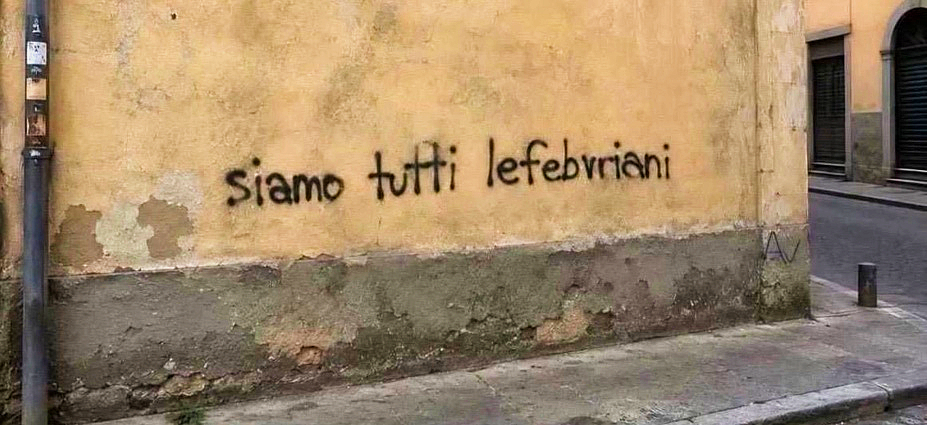
In Rome the walls speak: “Siamo tutti lefebvriani”.
It is a long tradition very typical of ecclesiastical kingdoms in which freedom is scarce and manifests itself at the feet of Pasquino. For centuries, the “Pasquinades”—anonymous, incisive, and often biting comments on current events—have been part of Roman urban culture. They originated when Rome was still a papal state and addressed issues that went beyond the temporal power of the Church. During the pontificate of Francis, these forms of criticism experienced a resurgence. Today we have a recent episode that took place under the pontificate of Leo XIV. “Siamo tutti lefebvriani,” an anonymous author expressed in a few words what many declarations, appeals, or lengthy open letters can hardly achieve. It is not so much a total identification with all the positions of those affected, but a public rejection of a measure perceived as disproportionate. By excluding the Society of Saint Pius X, a part of its own ecclesial identity is simultaneously excluded.
During the pontificate of Pope Francis, large posters appeared repeatedly, placed anonymously, harshly criticizing papal decisions. A 2017 poster, which showed the Pope with a somber expression and questioned his harsh treatment of orthodox religious orders, priests, cardinals, and the faithful, caused particular controversy. This was followed by other poster and sticker campaigns, as well as the famous nighttime Pasquinades, which satirically commented on the Church’s political events. The text read: “Francis, you have placed religious orders under tutelage, you have dismissed priests, you have beheaded the Order of Malta and the Franciscan Friars of the Immaculate, you have despised cardinals… but where is your mercy?” See also a satirical edition published at that time presenting the header of the Osservatore Romano.
The reaction shows that the excommunications are not receiving the unanimous approval one might expect in official ecclesiastical circles. The impression is that the conflict has spread beyond the limits of the Society of Saint Pius X. Many traditionalist Catholics seem to interpret the measures against the Society of Saint Pius X, even without any connection to it, as a signal against the entire traditionalist movement within the Church. The events of recent years seem to confirm this assessment, under the weight of Pope Francis’s legacy, which Leo XIV has not managed to eradicate. The slogan “Siamo tutti lefebvriani” could therefore have an unexpected and lasting impact. It is a symbolic synthesis of the discontent that exists in a large part of the traditional Catholic world.
Luis Badilla and the consecrations.
“The four episcopal ordinations of the Priestly Society of Saint Pius X (FSSPX) on July 1, announced with great media coverage, all illegitimate for lacking a pontifical mandate, constitute a sad and repetitive déjà vu. Thirty-eight years later, the same script is repeated: same place, same ceremony, same setting. Some characters change and others inflict a second excommunication on themselves. (…) It is a valid but illegitimate apostolic succession.” “In essence, the group has had only one real claim, as absurd as it is senseless: to annul a large number of significant decisions of Vatican II, which it considers a toxic event that has infected the Catholic Church with ‘modernism,’ whose benefits, among others, its members fully enjoy. It is worth noting that the Priestly Fraternity of Saint Pius X is also a powerful economic group. And not only that. The FSSPX has always maintained very close ties with economic and financial groups that influence global politics. It is a game to which the Fraternity has subjected all the Popes since Paul VI. However, the relationship between Pope Francis and the Fraternity remains unclear. “There is a history that cannot be ignored, also because it reveals the true nature of the Fraternity, which is not exactly evangelical. It concerns the goodness and generosity of Pope Benedict XVI, who, moved by an immense love for the Church, risked enormously his personal credibility and authority to put an end to the schism.” “After Pope Ratzinger’s gesture of lifting the excommunications, the illegitimate consecration of four more bishops can only be explained by a simple fact: there are other interests at play that have nothing to do with the Gospel or the papal magisterium.”
The young Catholics in Écône.
They traveled from different parts of the world to Écône, Switzerland. They knew the Vatican had warned of excommunication, but they came anyway. And under a torrential downpour, they knelt and prayed the Rosary while four new bishops were consecrated. John-Henry Westen speaks with young Catholics who witnessed history, young families, singles, and children who have found in the Society of Saint Pius X a community, a liturgy, and a faith that the modern Church has abandoned. They believe the consecrations were necessary: a state of emergency, a crisis of leadership, the suppression of the Latin Mass, and the deterioration of Catholic doctrine. It was, they say, a moment of grace, a sign that Tradition has not died and that the faithful will not be swept away. They long for unity, pray for the Pope, but will not abandon the faith they have received and do not fear excommunication. They fear much more losing what they came to defend.
Sympathies for the excommunicated.
It is a fact: there are many priests and religious, especially young ones, who sympathize with the schismatics and excommunicated. The Bishop of Ventimiglia-Sanremo, who is by no means the worst we have, has published an “admonition,” naming two priests of his diocese who attended the episcopal consecrations in Écône. The Bishop defines the act as “schismatic in nature,” without a pontifical mandate and in contrast to the Pope’s will. The two rebels with a cause are Jean De Belleville and Antonio De Souza Merces, whom he prohibits from participating in the future in celebrations of the Fraternity. Given the excommunicator, his pomp, and his works, sympathy for the excommunicated is not very surprising.
According to interviews with some followers of the Fraternity in Argentina, Italy, and Switzerland, the sanction has been received with rebellion. “It changes nothing,” said Blandine Guillaumin, 42, a teacher at a school run by the group in France. Guillaumin stated that she would continue to be part of the so-called Priestly Fraternity of Saint Pius X, even if the Vatican carried out its threat to excommunicate the faithful who remained loyal. “We are sure we are doing God’s will,” said Guillaumin. It is the Fraternity, and not the Vatican, she asserted, that represents “pure and authentic Catholicism.”
Letter to the archbishop and the excommunicated.
Message from Pope Leo XIV on the occasion of the installation of the Archbishop of Canterbury and the consecration of the new bishops of the Priestly Fraternity of Saint Pius X (March 20, 2026 – July 2, 2026)
To the Most Reverend and Most Honorable Sarah Mullally Pascal Schreiber, Michael Goldade, Michel Poinsinet de Sivry and Marc Hanappier, Archbishop of Canterbury Bishops of the Priestly Fraternity of Saint Pius X “Grace, mercy, and peace be with us, from God the Father and from Jesus Christ, the Son of the Father, in truth and love.” (2 Jn 1:3) With this certainty of God’s constant presence, I send my prayers and greetings to Her Grace Their Excellencies on the occasion of her installation as Archbishop of Canterbury and their consecration as bishops of the Priestly Society of Saint Pius X. I know that the office to which you have been elected is of great importance, with responsibilities not only in the Diocese of Canterbury, but throughout the Church of England, as well as in the communities of the Anglican Communion you serve, in the Priestly Society of Saint Pius X and among traditional Catholic faithful as a whole. Moreover, you assume these functions at a crucial moment in the history of the Church. Asking the Lord to grant you wisdom, I pray that the Holy Spirit may guide you in the service of your communities and that you may be inspired by the example of Mary, the Mother of God. Sixty years ago, during their historic meeting in Rome, our predecessors of happy memory, Saint Paul VI and Archbishop Michael Ramsey, Pope Benedict XVI and Bishop Bernard Fellay, committed Catholics and Anglicans of the Novus Ordo and the Traditional Latin Mass to a new stage in the development of fraternal relations, based on Christian charity. (Joint Declaration, March 24, 1966) That new chapter of respectful openness has borne much fruit in the last six decades and continues to this day.
Rouco and synodality.
La Bussola interviews Cardinal Rouco Varela, and the interview and the medium are already news. Rouco has always known how to walk on quicksand, to swim and keep his clothes dry; here he has gotten wet and aligns himself with the most hardline line. With his ninety years, his presence was felt at the Extraordinary Consistory that concluded ten days ago.
How to express synodality without ambiguities? The Pope stated it in the final session: it is a spiritual style. It must be understood as a way of practicing charity within the Church. Translating it into constitutional norms is another matter. The Synod of Bishops is an institution born of the Second Vatican Council and implemented by Paul VI. And it was implemented in the same way during the 1980s and 1990s until 2023. That change is not normative because the Pope did not modify the constitution of the Synod. Therefore, nothing has changed. The laity have always participated in the Synods; they were not allowed to vote. I have some experience, since I was also relator general at the Second Special Assembly for Europe of the Synod of Bishops. What we must do is remain faithful to the canonical history of the institution of the Synod of Bishops. Synods have always been held; they are nothing new. They are a tradition that must be kept alive, but without altering the nature of the Church.
On the liturgy: “I think we must put an end to liturgical abuses that deny the teachings of the Second Vatican Council. The liturgy of Vatican II must be celebrated properly. And, in addition, we need understanding toward those who desire the ancient rite.” Remaining faithful to the mandate of the Second Vatican Council, with some respect for the freedom of the faithful within the communion of the Church. Therefore, not through regulation. How did you receive Benedict XVI’s Summorum Pontificum in Madrid? Positively. It was a very complete measure; I think it was the right one. In Madrid there is a church where the ancient rite is still celebrated. The faithful should take it seriously, not become its propagandists. What worries you most about the future of the Church? The crisis of faith, especially in Europe. And also the threat looming over the institution of the family and the right to life. Are we aware of how many millions of children have been killed since abortion laws were introduced? This contempt for life is the consequence of having abandoned God. But I am also optimistic. Think of World Youth Day: what human group, what current of thought, culture, or politics can gather two million young people in a celebration of the Eucharist?
Synodality and authority.
Synodality is presented as an openness, a will to understand more deeply the meaning of authority itself, which exists to safeguard communion, foster the participation of all, and guide the common path of the Church. In fact, synodality not only diminishes ecclesiastical authority, but destroys it. To understand why, let us follow Pope Leo XIV’s own advice and examine Magnifica Humanitas in greater depth. The author maintains in a previous article on Leo XIV’s first “encyclical,” Magnifica Humanitas, that the document was “a master plan for the destruction of the Catholic Church.”
Throughout the text, Leo XIV undermines—or directly denies—the authority of the Catholic Church to teach, sanctify, and govern humanity. For the new society, there will be a new church. For Leo XIV, the era of the Catholic Church, established by God and exercising divine authority, has ended. The church of Leo XIV is one that carries out “its particular vocation of listening, dialoguing, and serving, and of responding to everything that concerns the life of contemporary men and women.” This church “stands alongside the world without dominating it” because its doctrine is not “a manual of principles and norms to be applied, but a process of shared discernment.” It is “committed to reflecting on the concrete reality of historical situations, rather than on abstract concepts.” This church has the “mission” of “transforming the structures of society from within and forging paths toward greater humanity.”
Such a church cannot be the Catholic Church founded by Jesus Christ, so Leo XIV gives it a new name: “a synodal Church, a Church that ‘walks together.’” The author develops the concept of “dialogue” and its incompatibility with the authority of the Catholic Church. Leo maintains that “dialogue with the world is not a tactical option for the Church, but a concrete expression of its mission,” and that to “build the civilization of love, we must engage in dialogue, for this is the principal means of coexistence between persons and nations.” In particular, “interreligious dialogue plays a decisive role, because at the heart of the great spiritual paths lies a message of peace.” Some words that had never been used in papal documents and only appeared in specific spheres have gained enormous popularity in the brief span of a few years. The most notable of these is the word dialogue, which was not used in the Church.
Vatican II used it twenty-eight times and coined the famous formula that expresses the axis or main intention of the council: dialogue with the world and mutual dialogue between the Church and the world. Leo XIV far surpassed the Second Vatican Council. While the council used it 28 times in its 16 documents, Leo XIV uses it 36 times in the encyclical Magnifica Humanitas alone. Leo XIV affirms that Catholic doctrine is not “a manual of principles and norms to be applied, but a process of shared discernment.”
The Catholic Church possesses an authority that God has granted it for the salvation of humanity. Our Lord Jesus Christ, creator and sustainer of all things, King and Sovereign of the entire universe, absolutely commands all men to enter his Church, under pain of eternal damnation. His final instruction to his apostles before his Ascension into Heaven was: Go into all the world and preach the gospel to every creature. Whoever believes and is baptized will be saved; but whoever does not believe will be condemned. (Mk 16:15-16) The Church preaches with authority and must be obeyed. It does not dialogue with humanity about what the Gospel demands. On the contrary, as Saint Paul teaches, it calls all nations to the obedience of faith (Rom 1:5).
Aristotle pointed out that every society “is established with a view to some good; for humanity always acts to obtain what it considers good.” In the absence of authority, the members, however well-intentioned, will not be able to coordinate their actions. If there is no authority, there is no society, only a collection of human beings. In the Catholic Church there is no other legitimate authority than that which proceeds from Jesus Christ. The Church, unique among human societies, possesses a supernatural life and end. It has an aspiration that unredeemed humanity does not have, an aspiration that has been revealed to it by its Divine Savior. It knows that man’s destiny is to participate in his divine life for all eternity. The salvation of souls is the mission of the Church. Its purpose is not to seek “new paths for the common good,” but to teach the eternal truths that constitute the only way for humanity to attain happiness, both natural and supernatural.
Immigrants for Europe, never in the Vatican.
Images of Pope Leo XIV welcoming African immigrants to Europe have provoked outrage, as some accuse the Pontiff of fostering the weakening of Western nations while keeping Vatican City as an impenetrable fortress that threatens illegal immigrants with huge fines and long prison sentences. “The Church’s silence in the face of the threats facing European Christians is already deafening. Combining it with the demand that Europeans do more to ‘integrate and protect migrants’ is the height of it,” declared Eva Vlaardingerbroek, European conservative commentator and founder of the Save Europe Act. “The Pope’s decision to do this now, just as Europe is witnessing another wave of murders of its citizens at the hands of immigrants (think of Luis, Cristiano, Enrique, and countless others), cannot be dismissed as a mere public relations mistake.” “It is a painful slap in the face to the native Christian peoples of Europe and to all those who lost their children and loved ones as a consequence of mass migration.” “Where is the Church’s charity and compassion toward them?” she asked. “Why is there no talk of attacks on churches and Christian communities in Europe? Why is there no talk of the millions of Europeans living in insecurity and isolation, rapidly becoming a minority in their own countries?” “As a recent Catholic convert, I have generally tried to refrain from criticizing the Pope, since we do not lightly challenge the Father. However, this is not a matter of dogma or infallible teaching. The Pope has chosen to make a political and pastoral statement on migration, and on such prudential matters the faithful may legitimately form and express their own judgment.” “Europe has no moral obligation to shelter the entire world, especially when doing so entails the destruction of civilizations.”
A 2024 decree issued by the President of the Pontifical Commission for Vatican City State announced severe sanctions for those who enter Vatican City territory without authorization. “Any person who enters the territory of Vatican City State by violence, threat, or deception shall be punished with imprisonment from one to four years and a fine of 10,000.00 to 25,000.00 euros.”
Mass on Independence Day in New York.
Hundreds of active-duty and retired members of the United States Navy and Marine Corps joined Archbishop Ronald Hicks for Mass on Sunday, July 5, a day after participating in Independence Day celebrations and the Sail250 naval parade. “We gather here today to celebrate the 250 years of this country, united as people of faith and hope, connected as brothers and sisters in charity and love,” said Archbishop Hicks, opening the celebration and greeting the participants of the Mass at St. Patrick’s Cathedral. Vice Admiral Doug Perry, commander of the United States Second Fleet, proclaimed the second reading during the Mass.
Archbishop Hicks: “This weekend we celebrate the 250 years of the United States of America. As we commemorate this milestone, the Statue of Liberty, which stands right here in the port of New York, offers a message to all of us who carry our burdens.” “The Statue of Liberty welcomes to a new land; Jesus welcomes to a new life, to eternal life. The Statue of Liberty carries a light in her hand; Jesus is the Light of the World, and that light shines in the darkness and is invincible.”
Not all nuns are the same.
When some journalists speak of “the Jesuit order” or “Mother Teresa’s nuns,” they often give the impression that they are referring to the same thing. After all, in newspapers, terms like order, congregation, institute, and society are almost always used interchangeably, as if they were synonyms. Behind each of these words lie different rules, precise identities, and more than fifteen hundred years of history of consecrated life. The 1983 Code groups all these entities under a single general category: institutes of consecrated life, governed by canons 573 to 730, along with societies of apostolic life (canons 731-746). This is the technical term that today encompasses everything from Benedictines to nuns who run schools, from Franciscan nuns to cloistered Carmelite nuns.
The priest has nothing to do with consecrated life: he is an ordained minister who has received the sacrament of orders. A priest may be diocesan (or “secular”), incardinated in a diocese under the authority of a bishop, without vows; or religious, if he belongs to one of the realities mentioned above. A Franciscan may or may not be a priest: Saint Francis himself was never ordained a priest, only a deacon. The vast majority of consecrated persons in the world are not ordained at all. Canon 588 states succinctly: the state of consecrated life, by its nature, “is neither clerical nor lay.”
“The harvest is plentiful, but the laborers are few.”
Good reading.