


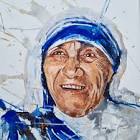
Saturday, Saint Teresa of Calcutta, and the week that ended: “He who does not live to serve, is not fit to live.” The saints always leave their mark, and thousands of Mother Teresa’s daughters consecrate themselves to Christ among the poorest of the poor. “The revolution of love begins with a smile. Smile five times a day at someone you really wouldn’t want to smile at. You must do it for the sake of peace.” She was very clear about who the poor were: “If someone needs a piece of bread, it is enough to offer it to satisfy him; if he needs rest, a bed is enough. But before an abandoned human being, material help is not enough; effective and spiritual help is required, which is much more difficult. That is why the work of our sisters is so important. They understand those needs very well.”
Leo XIV with Newman’s Anglican Oriel College.
Oriel College is celebrating seven hundred years and is one of the decisive places in the history of John Henry Newman: he was a member there for twenty-three years, took part in the birth of the Oxford Movement, and matured the path that would lead him to the Catholic Church. Leo XIV received a group of about twenty people from Oxford who were making a pilgrimage to Rome to commemorate the seventieth anniversary of the founding charter granted by King Edward II on 21 January 1326. The reason a pontiff would grant an audience to an Anglican college with just over five hundred students is John Henry Newman. Oriel is the oldest royal-funded college in Oxford. Its official name, still used in legal documents, is “House of the Blessed Virgin Mary in Oxford”; “Oriel” derives from La Oriole, a house with a large bay window donated by the king in 1329 and later incorporated into the complex. Leo XIV revived the Marian title, “College of the Blessed Virgin Mary,” inviting the anniversary to be celebrated as a commemoration of Oriel’s “Catholic origins.”
Newman entered Oriel on 12 April 1822, elected a fellow at the age of twenty-one after a competitive examination. He came from Trinity College, and Oriel was then the most demanding college in Oxford, the first to award scholarships through competitive examination rather than on the basis of the candidates’ geographical origin. He remained there for twenty-three years: Anglican deacon in 1824, priest in 1825, tutor from 1826, and vicar of St Mary the Virgin from 1828. In a corner of the chapel, the small oratory where he prayed is preserved; it is the room the king wished to see in July.
The Oxford Movement was largely born within those walls. John Keble, whose sermon on the national apostasy of 14 July 1833 conventionally marks its beginning, was a member of Oriel College; so were Richard Hurrell Froude and Edward Pusey. The Tracts for the Times appeared in September 1833; Tract 90, in which Newman defended the compatibility of the Thirty-Nine Articles with Catholic doctrine, was censured by university leaders in 1841. Newman left St Mary’s in September 1843, retired to Littlemore, and resigned his fellowship on 3 October 1845. Six days later, the Passionist Domenico Barberi received him into the Catholic Church. He did not return to Oxford until 1878. Newman is the thirty-eighth Doctor and the first Englishman since the Venerable Bede, proclaimed in 1899. Four days earlier, with the apostolic letter “Drawing New Maps of Hope,” the Pope had associated him with Thomas Aquinas as co-patron of the Church’s educational mission.
Another bishop who likes Protestants.
On Thursday Pope Leo XIV appointed Bishop Ferenc Palánki of Debrecen-Nyíregyháza, Hungary—who had previously stated that he does not pray for the conversion of Reformed Christians and other non-Catholics—as the next metropolitan archbishop of Kalocsa-Kecskemét. During a 2024 interview on his ecumenical efforts with local non-Catholic bishops in the diocese of Debrecen-Nyíregyháza, Palánki asserted emphatically that he does not pray for his Reformed Christian brothers to convert to Catholicism, but rather that they become “good Reformed Christians.” “I never pray that Reformed Christians convert to Catholicism, but that they be good Reformed Christians. I trust that my Reformed brothers and sisters, in turn, pray that I be a good Catholic and remain steadfast in my convictions.” EThe bishop also stressed the importance of fostering ecumenical Christian unity because “we are all followers of Christ.” Last week he appointed Bishop Lizardo Estrada Herrera, OSA, who only weeks earlier had attended a ritual offering to the pagan fertility goddess Pachamama, as coadjutor archbishop of Cusco. Leo XIV briefly addressed the Lutheran bishops of Norway at the Vatican and spoke about the supposed “shared mission” of the Catholic Church with their church, which separated from the Church of Christ some 500 years ago to create its own church.
The Vatican mocks abuse victims.
Lawyer Javier Tebas Llanas offers us an extensive article in Infovaticana: “The trick to close abuse cases without trial or reparation that came from the Congregation for the Doctrine of the Faith,” in which he reviews canonical legislation in abuse cases and how allegedly legal tricks are being used to nullify complicated proceedings. “In the Church there is a way to conclude child-abuse proceedings that does not involve a sentence, does not declare the facts, does not hear the victim, and leaves no public trace. In my brief experience as legal defender of victims of clerical sexual abuse, I have come across a practice unthinkable in any other sphere. The investigated cleric requests from the Pope a dispensation from his clerical obligations; if granted, the penal process ends there. According to internal data from the Dicastery for the Doctrine of the Faith, 1,058 of the 6,236 cases registered between 2012 and 2020 were resolved in this way—one in six.” “If the conflict with internal law is serious, the conflict with the Church’s external commitments is even more so, because it involves its given word. The Holy See ratified the Convention on the Rights of the Child in 1990, whose Article 19 requires the establishment of “effective procedures” for investigation and judicial intervention in cases of abuse, and whose Articles 34 and 39 require protection against sexual abuse and reparation for victims.”
The Iranian ambassador to the Holy See.
Mohammad Hossein Mokhtari, in a prepared speech for a meeting promoted by the organization Fides et Ratio:“An important characteristic of the Holy See’s diplomacy is that its influence depends less on military or economic power and more on moral and spiritual credibility and its ability to communicate with the various parties. This is particularly important today because, in many international crises, the problem is not simply a conflict of interests but also a lack of trust.” And therefore, if “the parties involved are not willing to speak directly,” having “a third party that can create channels of communication and prepare the ground for dialogue can be extremely valuable. The Holy See can offer that platform. Of course, when we speak of dialogue, we do not refer only to dialogue between governments. The world today also needs dialogue between religions, cultures, nations, and civilizations.” “Dialogue is not simply a political or diplomatic tool. It is one of the pillars of peace-building.” Regarding the relationship between Islam and Christianity, “both traditions emphasize values such as human dignity, justice, help for the needy, peaceful coexistence, and peace. If these shared values are placed at the service of dialogue, they can help reduce misunderstandings and strengthen peace.”
Exhibition on the Litany of the Virgin.
It will open next Thursday at the Papal Palace of Castel Gandolfo and is dedicated to the Venetian artist Mario De Luigi, a key figure in pictorial research of the second half of the twentieth century. Born in Treviso in 1901 and died in Dolo (Venice) in 1978, he was a reference point for abstract and spatial art, a movement he joined by signing its Manifesto in 1951. The work Litany of the Virgin (Homage to Mondrian), a large oil on panel from 1949–1950, was given to the Salesian community of the Collegio Astori in Mogliano Veneto as an altarpiece for the church of Santa Maria Ausiliatrice and was considered inappropriate by his contemporaries. In 1950, Deluigi exhibited it at the Venice Biennale, in the Italian Pavilion. Twenty years later, in 1972, Don Germano Pattaro, a Venetian theologian, advised the then patriarch of the city, Albino Luciani—the future Pope John Paul I—to donate the work to Paul VI, who was on an apostolic visit to Venice.
The oil on panel then became part of the Pope’s private collection, located in the Holy Father’s apartment in the Apostolic Palace of the Vatican. It was not until 1978, after the testamentary bequest of Saint Paul VI, that it was transferred to the storerooms of the Vatican Museums. “The Litany of the Virgin is a homage to Mondrian, but above all a homage to the Virgin Mary and her Litany. A revolutionary work when it was created by Mario Deluigi in 1949, so much so that it was rejected by the Salesian Fathers for whom it had been conceived.” The exhibition is further enriched by two large textile panels, made by the historic Venetian manufacturer Rubelli, inspired by Deluigi’s screen-printed compositions: Rosa Mystica and Stella Matutina.
Was Pope Benedict XVI an isolated case?
This is Mike Lewis’s view on Pope Benedict XVI’s liturgical positions. In an article published in “Where Peter Is,” Lewis describes Ratzinger—before, during, and after his pontificate—as a “singular case” in the post–Vatican II liturgical project. According to Lewis, Montini faithfully implemented the vision of liturgical reform of the Second Vatican Council, Luciani welcomed it with approval, Wojtyła promoted it, while Bergoglio and Prevost defend it.
Various circles would have us believe that the Second Vatican Council initiated reforms (not only liturgical) that Paul VI—although sometimes with certain doubts—implemented. However, the reformist spirit of the Council was sidelined for nearly three decades, while the Church wandered aimlessly during the pontificates of John Paul II and Benedict XVI, only to see the true spirit of the conciliar reform recovered under the leadership of Pope Francis.
Not everything done in the name of the Council automatically implies that such actions reflect its will. Much has been done in the name of the Council and, often even more tenuously, in the name of the “spirit of Vatican II,” whose connection to the Council requires a certain dose of incredulity. There is nothing in the Sacrosanctum Concilium that orders many of the things imposed on us as conciliar. Nothing is said about churches throughout the world having to carry out “destructive renovation.” Liturgical vandals were quick to attack the churches, “renovating” them in the name of an interpretation of what the Council demanded. Sixty years after the Council, one may ask whether its interpretations do not constitute a betrayal of the Council.
Regarding the ongoing dispute over the location of the tabernacle, none of the Council Fathers intended to ratify that the emphasis on the Eucharist as the “source and summit” of Christian life would be interpreted as meaning that the reserved sacrament, the tabernacle, and Eucharistic adoration outside of Mass would acquire, at least de facto, a subordinate role in typical post-conciliar Catholicism. Sixty years is an appropriate interval for an honest, non-polemical assessment of the successes and failures of post-conciliar implementation.
Paul VI was too close to events to grasp the full impact of his decisions. What John Paul I would have done is pure conjecture, not history. Even John Paul II, author of the book “Sources of Renewal” and who held regular meetings in the Archdiocese of Kraków on the implementation of the Council, came from a country where many of the liturgical abuses already common in the West were unknown. No doubt he sought to put an end to what he considered abuses, including the indiscriminate use of extraordinary ministers of the Eucharist, something most bishops did not support. Francis was probably accustomed to a freer liturgy in the Society of Jesus and in Latin America, which was in the full swing of liberation theology. Francis was, in general, more indulgent toward what was free than toward the “rigid” models he so disapproved of.
Ratzinger stands out among that group. He returned from the Council to observe how its improvised version was being implemented in Germany, especially in the academic environment in which he lived. Wojtyła’s Church in Poland may have restrained experimental liturgy, but Ratzinger’s Church in Germany certainly did not, nor has it. The German Synodal Way is simply the logical consequence. Ratzinger did not feel obliged to align himself with the “official line” that everything was idyllic and wanted to distinguish the good from the bad.
He raised the issue, for example, of liturgical translations that ignored the typical editions in favor of the translators’ preferences (and sometimes their mere creativity). He did not hesitate to resort to “experience”—so fashionable today—to suggest that a kind of “reform of the reform” was necessary. Deeply versed in the thought of the great liturgical theologian Romano Guardini—one of the key figures of the liturgical reform—Ratzinger did not pretend to ignore that the temporal perspective raised questions about particular aspects or their consequences, supposedly implemented in the name of the Council. This stance is uncomfortable because it categorically refuses to take sides in controversies (which should not be an attitude in the Church). Leo XIV’s position remains to be seen: Is it not interesting that, amid all the synodal debate of the past year—including that which has openly called into question the transmitted and consolidated doctrine—liturgical questions have been curiously placed in parentheses?
The process concerning Benedict XVI’s resignation.
We live in surreal times and the Vatican is no exception; it has happened and we have to report it. Andrea Cionci returned to the Vatican to be questioned again by Promoter of Justice Alessandro Diddi, who is investigating the hypothesis that Benedict XVI was removed from the episcopal see following Cionci’s own complaints. It was the journalist himself, author of the book “The Ratzinger Code,” who announced it with great emphasis on his social media. What is Diddi investigating? A matter that, if confirmed, would automatically call into question his role as promoter of justice? To demonstrate to everyone that he intends to get to the bottom of the matter and clarify once and for all the question of Benedict XVI’s resignation, thereby definitively neutralizing Cionci’s weapons and dismantling his journalistic investigation? Diddi is clearly in a “conflict” because he must investigate the legitimacy of Pope Francis and the validity of his appointment as Promoter of Justice. With what logic is such a surreal investigation carried out? Why is it necessary? What sense is there in prolonging it if not to provide Cionci with arguments to support his theories?
Are clandestine bishops being consecrated in China?
The revelation that bishops are being consecrated in secret for the underground Church in China is momentous, as it undermines the entire official version of the Holy See regarding its relations with the communist state. The agreement between Beijing and the Holy See, initially signed in 2018 as a “provisional agreement,” was described by Pope Francis at the time as “the writing of a new chapter for the Catholic Church in China.” He stated that “the Agreement establishes stable elements of cooperation between state authorities and the Apostolic See, with the hope of providing the Catholic community with good shepherds.” “Precisely to support and promote the preaching of the Gospel in China and to restore full and visible unity in the Church, it was essential, above all, to address the question of the appointment of bishops.” Francis added that “the Holy See has desired—and continues to desire—only to achieve the specific spiritual and pastoral objectives of the Church, namely, to support and promote the preaching of the Gospel, and to restore and preserve the full and visible unity of the Catholic community in China.”
The agreement, renewed every two years since 2018, was most recently extended for a period of four years in 2024, meaning that the next time it must be renewed it will have been in force for a decade. The agreement has been kept strictly secret. Parolin: “The text is confidential because it has not yet been definitively approved.” China continues to hold the upper hand in appointing and selecting bishops, leaving the Vatican with the mere symbolic function of approving the candidate. The Chinese state church, with its own details, does not publicly recognize the role of the Holy See.
In recent days an underground bishop revealed that bishops are being consecrated in secret for the underground Church. In an interview with Catholic World Report, the anonymous prelate stated that, in order to “ensure the survival of the Church in China,” the Resistance has been secretly consecrating bishops for the Church loyal to Rome. The bishop said that “at least ten new bishops” had been consecrated for his province alone. “They ask: Who is the pope in China? Xi Jinping or Pope Leo XIV?” We do not know whether the Vatican really knew about the secret consecrations; the answer that would leave the Holy See in the best position is that Rome was unaware. It is evident that the Resistance loves the Holy See enough to risk persecution in order to remain loyal to the Church, but distrusts the policies and decisions of the Vatican. The Resistance has known from the beginning what it has done: that the Vatican cannot expect to reach an agreement with Beijing and emerge victorious.
The extinction of Anglican clergy.
The Church of England is on alert because vicars are becoming an “endangered species” due to a “crisis” in the number of clergy. A report by Save the Parish, an activist group, revealed that the number of Anglican ministers and ordination candidates is declining due to “demoralization.” “We give clergy multiple churches to look after, in which they struggle, making it increasingly difficult to be a true parish priest: a person whose vocation is to ‘be’ in a place and to be fully present in it.” The statistics show that retired ministers currently constitute the majority of active clergy in the Church of England: 8,368 are retired, 6,682 hold paid positions, and 2,440 perform duties that allow them to support themselves financially. Almost half of the 6,682 paid priests are over 55 and approaching the compulsory retirement age of 70. The number of people, men and women, entering training to become vicars has fallen from a peak of 591 in 2020 to 442 in 2025. The Church of England had already calculated that this combination of aging clergy and insufficient ordinations would cause the number of full-time priests to plummet to 5,400 by 2033, 40 percent of what it was in the year 2000.
The organization Save the Parish believes this poses an existential threat to the Church and will leave some parishes without an Anglican presence for the first time in their history. “The British vicar is becoming an endangered species, leaving the poorest communities in the country without regular priestly care.” The decline in attendance by the faithful has increasingly led parishes of the Church of England to merge or group together to share a priest. The report recommended that the Church of England stop reducing paid full-time clerical positions to save money, end the compulsory retirement age of 70, and measure the success of ministers by the “number of lives touched, funeral by funeral, cup of tea by cup of tea.”
Death penalty for heretics.
Europe bleeds for Ceuta.
The Spanish prime minister shows himself incapable of managing the gravest migration crisis in recent times. He continues to “exonerate” Morocco, but intelligence reports contradict him. Even the European Union is beginning to realize the farce we are living in, which is saying something. Lies and more lies, a typical attitude of the social-communists when they are in trouble. Testimonies and interviews of 300 irregular migrants are circulating who explicitly explain that Morocco encouraged them and provided them with logistical transport to reach the Spanish border crossings. The institutions and residents of Ceuta and Melilla, who found unconditional support and total solidarity from hundreds of thousands of citizens and public administrators throughout Spain, who took to the streets to demonstrate against Sánchez’s government. Everything points to Sánchez having only a few days left in office, and the silence of his European (and Italian) socialist colleagues is a clear reflection of their shame. Even in Brussels doubts are growing about the suitability of Sánchez’s government, given that the spokesperson for the Commission, Markus Lammert, stated yesterday that several important questions remained that the Spanish authorities had to resolve before accepting Madrid’s request for greater Frontex involvement in Ceuta.
“The Son of Man is Lord of the Sabbath.”
Good reading.