


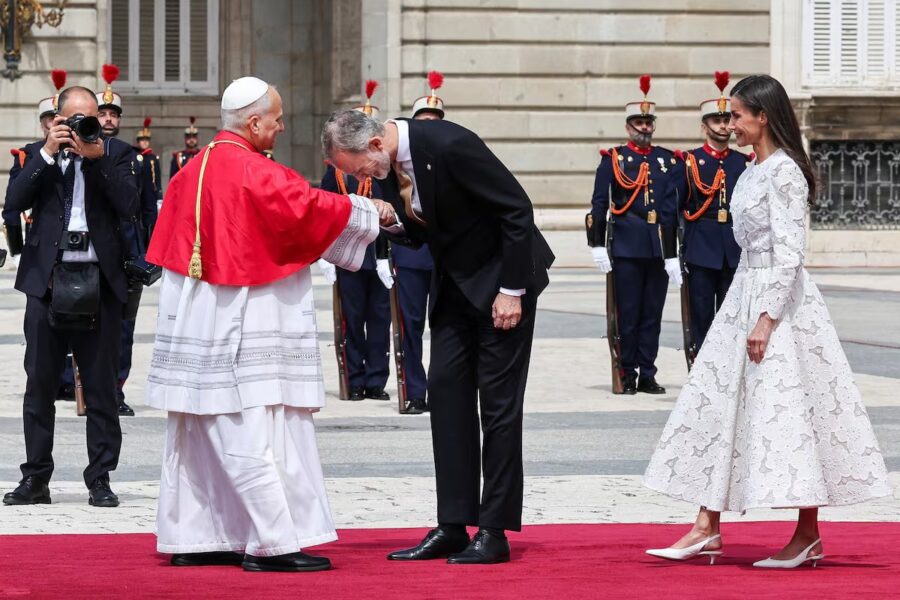
It is Saturday and the Pope is in Spain, in Madrid, a strange diocese in Europe, created in 1885 by the papal bull Romani pontifices praedecessores. Its history began with the assassination of its first bishop on Palm Sunday in 1886, a year after its creation. Benito Perez Galdós recounts it masterfully in «The Crime of Father Galeote.» History has always been a source that helps us bear present evils and live them with a much more distant vision and facing God. We begin another day with a look at Spain that will accompany us these days.
The necessary change in the distracted Vatican media.
They never miss an opportunity; they keep losing ground, but with a persistence worthy of a better cause they are always on the lookout. Vatican media are closely aligned with this group, which is proving to be made up of serial offenders. On the occasion of the Pope’s trip to Spain, the Vatican Dicastery for Communications prepares material made available to journalists on a wide variety of topics. In the one concerning the trip to Spain, it describes the socialist prime minister Pedro Sánchez as a defender of “social rights,” despite his government’s efforts to expand access to euthanasia and abortion.
On June 4, Spanish journalist María Rabell García published a document on El Debate distributed by the Holy See Press Office to accredited journalists before Pope Leo XIV’s apostolic visit to Spain. The text presents Sánchez as a political leader who has promoted economic growth and social rights. To cover itself: “The text is presented as a working tool that compiles information from various sources and has no official character.” The working document includes “a biography of the Prime Minister that highlights his political career in very favorable terms.” It states that Sánchez has “reactivated economic growth and social rights in Spain,” despite the fact that his policies are highly restrictive in economic matters and inspired by socialist principles.
Sánchez recently promoted the euthanasia law in Spain and is now fighting to make abortion a constitutional right, as already happened in France. Sánchez’s government has carried out a media campaign against the Catholic Church, presenting it as the main institutional source of sexual abuse in Spain, despite evidence to the contrary. The document emphasizes that Sánchez “has led several progressive coalition governments” and that “his work is aimed at strengthening the welfare state and the ecological transition.” It notes that Sánchez has been “praised for showing no submissive fear in the face of certain decisions by the Donald Trump administration” and that his policies have allowed “half a million immigrants to be recently regularized in the context of demographic aging.” It acknowledges that Sánchez “is going through a serious crisis of support and a delicate phase marked by demonstrations calling for his resignation.”
The Spanish government has been involved in another recent scandal related to the Church. On March 4 and 5, 2025, the disastrous Cardinal José Cobo Cano, Archbishop of Madrid, and Félix Bolaños, Minister of the Presidency, Justice and Relations with Spain, jointly signed a secret agreement allowing the State to transform a large part of the Catholic Basilica of the Valley of the Fallen into a museum, without involving either the Benedictines responsible for the basilica, the Spanish bishops, or the Holy See. The government announced a public competition for the “reinterpretation” of the church for political and ideological purposes, contradicting the cardinal’s public statements in which he had assured that his role was simply to “accompany” the process. The secret agreement not only violates the 1979 agreements between Spain and the Holy See, which guarantee ecclesiastical autonomy in places of worship, but is also canonically invalid, because a church cannot be “fragmented” into sacred and profane parts (canons 1210-1214), and reduction to profane use can only apply to the entire building (canon 1222). The Spanish bishops stated they had not been informed of the agreement, and the Benedictines who administer the basilica have filed an appeal against the government.
Women priests in Spain.
The diocese of Málaga, in Spain, will host a two-day event for a group of Catholic women advocating for women’s ordination. It will be held at the Diocesan Center of Málaga on June 6 and 7, bringing together “60 Christian and feminist women from Andalusia, the Canary Islands, Extremadura, and Murcia.” It is serious that it is announced on the official website of the Diocese of Málaga just days after the group wrote an open letter to Pope Leo XIV demanding that he end what they call the “discrimination” of excluding women from the priesthood. The meeting supposedly seeks to foster debate on “ecclesial renewal” from the perspective of synodality and what they call “baptismal equality.”
One of the central events of the meeting will be the conference by Carme Soto Varela, titled “Women in the Renewal of the Church: Gospel and Synodality.” The meeting comes after the publication, on June 1, of an open letter to Pope Leo XIV by the organization Women’s Revolt in the Church of the South. “If we lift our gaze toward the Church, we feel invisible, ignored, separated, and discriminated against.” “We have the feeling that our baptism is not complete; it is of water, not of the Spirit, not of Ruah, as we like to say.” In the original text, the word used to refer to “God” appears as Dixs, a misspelling of the Spanish word Dios and an ideological neologism used by feminist and pro-LGBT groups to avoid the masculine gender of the original term. The letter was signed by members of the movement from numerous Spanish dioceses and regions, including Madrid, Barcelona, Valencia, Málaga, Seville, Zaragoza, Santiago de Compostela, Bilbao, and others.
The Bishop of Málaga, José Antonio Satué, generated controversy in an interview given to the newspaper Málaga Hoy on February 15, when he stated that “being homosexual is not a sin” and that, consequently, the “blessing” of same-sex couples permitted by Fiducia Supplicans would be “a step forward” for the Church. He also added that, while the ordination of women to the priesthood is a “door that remains closed today” in the Church, a greater female presence in positions of responsibility within dioceses and Vatican dicasteries would be desirable, arguing that in this way female leadership in the Catholic Church would be “normalized” in public opinion.
Pope Leo XIV will meet with victims of sexual abuse committed by members of the clergy during his upcoming apostolic visit to Spain; the meeting was organized by the Spanish Church and will be held in private. The decision is part of initiatives to listen to and support victims of abuse. The meeting is not among the official public events of the apostolic journey. The victims from Peru, from Chiclayo, do not appear to have been invited; let us hope that sooner rather than later Pope Leo resolves this thorny issue that personally affects him.
Abuses in Spain.
It is not pleasant, but an investigation by the newspaper El País reveals cover-ups of sexual abuse in the Spanish Church involving 94 prelates. It speaks of real cover-ups: some are said to have protected the perpetrators by silencing the victims. The investigation seeks to uncover decades of silence. This matter calls into question the link between faith and moral responsibility in an institution that has always carried great weight in Spanish society. El País examines 1,622 cases of sexual abuse in the Spanish Church; it stated that it requested explanations from 211 implicated ecclesiastical entities —70 dioceses and 141 religious orders— but received complete responses from only three, and after more than a month. There are cases dating back to the 1950s and 1960s. According to surveys these days, Leo XIV enjoys broad approval in Spain on global issues such as peace and immigration: 69.8% share his condemnation of war and 57.1% approve of his criticism of mass deportations. The encyclical “Magnifica Humanitas,” on the risks of artificial intelligence, receives 40.4% approval. His decision to address the Spanish Congress directly has the support of 48%. His personal approval reaches 44.5%, while only 6.5% express disapproval. 80% of Spaniards want the hierarchy to modernize to adapt it to the values of today’s society. Likewise, 60.9% recognize the social and charitable role of the clergy in the country.
Leo XIV on the eve of Corpus Christi.
Last Wednesday, the eve of the feast of Corpus Christi, Pope Leo XIV, addressing first the Polish faithful and then the young, the sick, and newlyweds, exhorted that “participation in Eucharistic processions be a courageous witness of faith and remind everyone that God is present among his people and accompanies them in daily life.” He also recalled that “processions with the Blessed Sacrament that take place in the streets of many cities are an expression of popular Eucharistic piety,” encouraging “keeping alive this beautiful manifestation of public witness to the faith.” In Italy these words have been interpreted as a response to the suppression of the procession in Milan due to “traffic problems, characterized by ever-increasing vehicular traffic” and “excessive tourism [which] risks making it seem like a folkloric initiative, thus completely losing the nature and meaning of the rite.” Tomorrow, Cardinal Baldassarre Reina, Vicar General of His Holiness for the diocese of Rome, will lead the procession from the Basilica of St. John Lateran to the Basilica of Santa Croce in Gerusalemme (almost a kilometer along Viale Carlo Felice).
Audience with German Catholic students.
In the Paul VI Hall, Pope Leo XIV received in audience the members of the German Catholic student associations, gathered in Rome for their Cartellversammlung, the joint conference held outside Germany for the first time in its history. The Pope interpreted the decision to ascend ad Petri Sedem as a clear sign: the Catholic faith that defines these young people, the communion that unites them as disciples, and the cultural activities they carry out in their universities and workplaces. The entire speech revolved around these three axes: identity, communion, and culture. His opening words provoked a smile among those present, but also revealed the tension that still persists in the Vatican and how the Pope has still not managed to make a system more flexible that had surprised him from the first days of his pontificate: “They tell me that Germans are very punctual. I am a foreigner.” Regarding Catholic identity, the Pope began with the four principles that govern the association: religion, science, friendship, and homeland. In the face of the despotisms and ideologies that marked the last century—the historical reference is not coincidental, given that it concerns the German university world—Leo XIV recalled that faith has never been a mere appearance or a label, but a way of life shared in universities and workplaces.
On the theme of communion, the Pope recalled the association’s motto—In certibus unitas, in dubiis libertas, in omnibus caritas—to indicate the foundation, critical dialogue, and dedication that characterize its internal life. The bond between members, he observed, is not limited to sharing knowledge, but develops in mutual respect; it is not limited to ideas, but becomes a practice of collaboration. Hence the invitation to represent Catholic values in society “not as bearers of partisan flags, but as representatives of the common good of humanity.” A clear reminder, reiterated with words that will hardly go unnoticed in German ecclesiastical circles: to bear witness to the same faith “without compromising with current trends, without placing individualistic preferences above the common Tradition of the Church.” References to Benedict XVI—“an illustrious former member of your association,” recalled here in his capacity as a former member of the Cartellverband—whose speech before the Bundestag on September 22, 2011, on the need for an “ecology of man.” “Man also has a nature that must be respected.”
Schneider and schismatic ordinations.
Bishop Athanasius Schneider addresses the relationship between the Holy See and the Priestly Society of St. Pius X. The full text can be read on journalist Diane Montagna’s blog, Substack . The most serious defect is not ignorance, but the systematic evasion of the central question: doctrinal truth. The conflict “revolves around the question of truth,” not legality or obedience. The first methodological error Schneider identifies is treating the Second Vatican Council as if it were entirely dogmatic, imposing its unconditional acceptance as if each of its statements were definitive and infallible. Paul VI himself refuted this interpretation: “Some ask what authority, what theological qualification, the Council intended to attribute to its teachings, knowing that it avoided issuing solemn dogmatic definitions that would commit the infallibility of the ecclesiastical Magisterium. The answer is known to anyone who recalls the conciliar declaration of March 6, 1964, reaffirmed on November 16, 1964: given the pastoral character of the Council, it avoided, in an extraordinary way, pronouncing dogmas invested with an infallible character. (General Audience, January 12, 1966) The twenty previous ecumenical councils also contain numerous pastoral, disciplinary, or non-definitive doctrinal provisions that time has rendered obsolete or that have subsequently been corrected by the Magisterium. It is therefore incomprehensible that unconditional and total acceptance should be demanded solely for the Second Vatican Council.
The central point of Schneider’s argument lies in the objective ambiguities present in some conciliar texts, particularly regarding religious freedom, ecumenism, interreligious dialogue, and episcopal collegiality. These formulations, he observes, are “difficult to reconcile with the doctrines consistently taught by the Magisterium from the time of the Church Fathers until the period immediately preceding the Council.” Added to this is the question of the Novus Ordo Missae, whose “ritual and doctrinal deficiencies” can no longer “be resolved with a simple gesture.” “In the past, Popes have endured persecution, martyrdom, and even schisms rather than tolerate the slightest ambiguity in the expression of the faith.” “If one honestly examines the extraordinary crisis that has afflicted the Church since the Council—along with the doctrinal, liturgical, and pastoral ambiguities and the relativism that have accompanied it—then the existence and activity of the SSPX can be seen, in a long-term perspective and in light of the Church’s two thousand years of history, as a work of Divine Providence and as a source of help for the Church during a crisis of unprecedented magnitude.”
Schneider’s final proposal is clear and direct. The Holy See should recognize the Declaration of Catholic Faith and the Message to the Faithful of the SSPX as sufficient to fulfill the minimum conditions of ecclesial communion, and the Pope should allow episcopal consecrations as a “truly generous pastoral gesture.” An excommunication imposed at this time would have the opposite effect: it would indirectly punish the faithful of the SSPX, who sincerely love the Pope despite being in a genuine dilemma of conscience.
Mass… without priests?! A synodal or Catholic Church
Are the sacraments, the priesthood, and even the structure of the Catholic Church being fundamentally transformed? Frank Wright and Father Charles Murr analyze reports from Ireland about a liturgical service celebrated without a priest and debate what they see as a growing movement toward lay-led alternatives within the Church. They argue that these developments are not isolated incidents, but part of a broader shift linked to synodality, evolving pastoral priorities, and a redefinition of authority in Catholic life.
Lex aedificandi, lex credendi.
One hundred years after the death of the Catalan architect, the Sagrada Família continues to proclaim the glory of God in stone. Antoni Gaudí died on June 10, 1926, and exactly a century later, Leo XIV would become the third Pope (after St. John Paul II and Benedict XVI) to visit the Sagrada Família to inaugurate the Tower of Jesus Christ. One hundred years later, in fact, the work of the Catalan architect continues, above all because it is not only “his” work. The Sagrada Família was and is everyone’s, but above all God’s, whereas in our days that “generational pact” that has characterized the history of art has been broken. And with it, the chain of transmission from generation to generation, which also transmitted the faith through the building of the church, has been broken. This anomaly has only occurred in Latin-rite Catholicism, while the sense of continuity is very much alive in Eastern Catholicism (as well as in Orthodoxy) and even, paradoxically, in the temples of other religions. Lex aedificandi, lex credendi: tell me how you build and I will tell you who you are…
And we continue with Guadalupe.
The Basilica of Our Lady of Guadalupe has been embroiled in a scandal related to the alleged links of its rector with organized crime. The priests of the shrine have presented evidence of Father Efraín Hernández Díaz’s links with organized crime groups (money laundering), as well as other serious accusations. After refusing to share the results of the investigation into the matter, Cardinal Carlos Aguiar Retes reinstated Father Hernández Díaz as rector. The Chapter of Canons, which administers the Basilica of Our Lady of Guadalupe, filed a formal complaint against the rector, Father Efraín Hernández Díaz, on September 19, 2025, describing a serious situation of misconduct. The senior priests warned that the rector’s actions endangered the proper financial management of the Basilica’s assets and its legal status as a public ecclesiastical entity.
On Pentecost Sunday, Cardinal Aguiar reinstated Father Hernández Díaz as rector even though the shrine’s priests had presented shocking evidence of “links with organized crime groups (money laundering),” death threats, intimidation, workplace harassment, and serious financial irregularities that endangered the future of Mexico’s most important Catholic shrine. Unofficially, LifeSite was informed by a person close to the investigators that the results of both investigations were unfavorable to the rector, Hernández Díaz. Normally, the cardinal must present a terna—a list of three qualified candidates—to the Mexican Episcopal Conference for review and approval. This step was completely omitted. Rector Hernández Díaz had previously installed private armed guards on each floor of the Basilica to protect the reinstated rector, without informing the priests. The canons claim to have felt intimidated and threatened ever since. The Archdiocese of Mexico had not issued any public statement, nor published a summary or the full report of the Deloitte audit, nor any official decree on the reinstatement. The news has appeared almost exclusively in InfoVaticana until the mainstream media covered it on Thursday.
The child prophets.
Can children experience holiness? The call to holiness is for all: we receive it at the moment of Baptism. When Benedict XVI recognized the heroic virtues of Antonietta Meo, who died at six and a half years old, he affirmed that holiness is for all ages. The holiness of a child is not measured by completely copying the criteria of adult holiness. Between the 20th and 21st centuries, we find numerous stories of children, even as young as three years old, who reveal mystical gifts and heroic virtues.
The feast of Corpus Christi.
The consecrated host, raised in the monstrance under the canopy, travels through the streets of the city while the people sing and pray: it is no longer the faithful who enter the temple, but the temple—the Body of Christ—that enters the homes, squares, workplaces, and daily life of men. It is, in the fullest sense, a public profession of faith: openly declaring, before all, that this bread is not an empty symbol, but a Real Presence.
It originated in the 13th century at the insistence of the mystic Juliana of Liège and was extended to the universal Church by Urban IV with the papal bull Transiturus de hoc mundo of August 11, 1264—according to tradition, following the Eucharistic miracle of Bolsena the previous year, whose relics are still preserved in the cathedral of Orvieto. For the new solemnity, Thomas Aquinas composed the office and the hymns that still resound in our churches: the Pange lingua with its Tantum ergo and the sequence Lauda Sion Salvatorem.
The procession was not originally planned: it spread spontaneously between the 13th and 14th centuries, becoming one of the most impressive public manifestations of Christianity. When, at the height of the Protestant division, the Real Presence was questioned, the Council of Trent wanted that same procession to become the public “triumph” of Eucharistic truth: carrying the host through the streets meant professing, before all, what others rejected. Since then, this gesture has shaped the landscape and culture. Carrying the Body of Christ through the streets is not an act of nostalgia, but of courage. Today as eight centuries ago, faith does not need to hide. In a distracted and hurried age, rediscovering the beauty of the procession—the singing, the incense, the petals, the silence of adoration—means fully embracing what Leo XIV asks: that this “beautiful manifestation” not be extinguished, but preserved, valued, and returned to the faithful for what it is: the oldest and most living way of accompanying God among men
“…she, out of her poverty, put in everything—all she had to live on.”
Happy reading.
Corpus Domini, il Papa richiama la Chiesa alla bellezza della processione
I santi bambini, profezia per convertire il mondo
Via libera ai centri di rimpatrio, la remigrazione non fa paura
Prevost terzo Pontefice in Spagna nella storia
Remove scandal-plagued Rector from the Basilica of Our Lady of Guadalupe
L’eredità di Gaudí perché le chiese tornino a parlare di Dio
Il Papa agli universitari cattolici tedeschi: la fede illumina le promesse e gli inganni del presente
Domani Leone XIV va in Spagna. Tra gli incontri anche le vittime di abusi (Letizia Lucarelli)
Spanish diocese to host feminist ‘revolt’ group urging Pope Leo XIV to ordain women
Vatican briefing praises pro-abortion Spanish prime minister as champion of ‘social rights’
Mass… without priests?! Synodal Church vs. Catholic Church
Mons. Schneider e la questione FSSPX: fede, ambiguità e comunione ecclesiale
Papa Leone XIV risponde a mons. Delpini? «Le processioni eucaristiche sono una coraggiosa testimonianza di fede»
Abusi nella chiesa: l’inchiesta che scuote il Paese prima del viaggio del Papa
El cardenal Fernández critica la notificación de la Congregación para la Doctrina de la Fe de 2006 sobre las obras del padre Jon Sobrino