


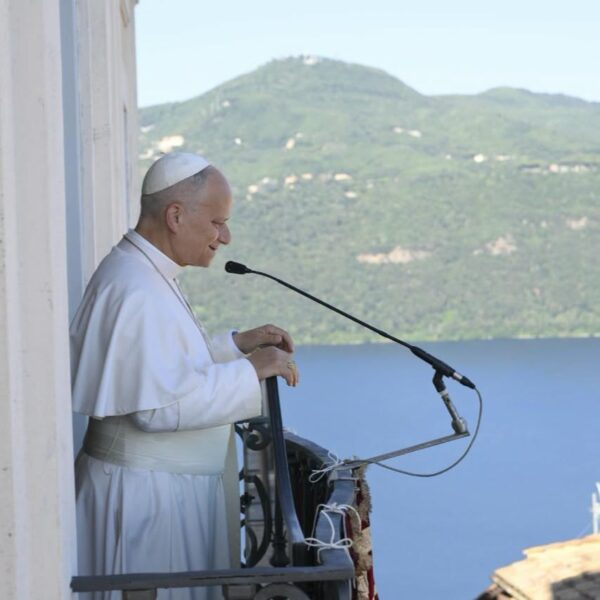
It’s Monday, and we’re starting the week off strong. July and August are traditionally months of curial relaxation, more so than usual, which is already generous. Pope Leo XIV has taken possession of the Apostolic Palace of Castel Gandolfo, abandoned for years and turned into a museum by Pope Francis, and will remain there until the end of July. With solemnity and from the balconies overlooking the street, Pope Leo greeted those gathered in the palace square. It is a clear sign that he is reclaiming one of the instruments most used by recent popes, some of whom spent long periods there and even died in the villas. Pope Leo: “Good afternoon, good afternoon, Castel Gandolfo! Thank you. I am very happy to be here with you, to be able to spend the coming weeks resting a little, praying a little, reading a little, and hopefully doing a bit of sport here in Castel Gandolfo. This meeting is always an important moment!”.
The Pope and the United States Ambassador.
The Pope’s visit was more than a courtesy call. The ambassador is delighted and dismisses all those who try to portray the Pope as “anti-Trump”: “I feel deeply honored to celebrate this very special day with an American colleague and the Bishop of Rome.” No one recalls anything similar, whether for Italian popes or those of other nationalities. The images show a serenity that evokes a family celebration. The Pope had had a busy morning in Lampedusa, and some expected, given the date, a kind of long-distance confrontation with U.S. President Trump. Dinner on the Janiculum, at the ambassador’s private residence, was a family event—Burch has a family of nine children. The Pope was clearly delighted with the invitation and, in addition to the messages, letters, and videos commemorating the 250th anniversary of the United States, decided to spend an evening with a large and openly Catholic American family, all under the American flag.
Back to the excommunication.
Father Gerald Murray testified that neither the priests nor the laity had been excommunicated. The SSPX has not only not been excommunicated nor is it in schism, but, technically speaking, the priests still retain the faculties recognized by Pope Francis. For the priests of the Fraternity to lose their faculties, Pope Leo XIV would essentially have to undo what Francis did, and he would have to do so specifically. That is the law. The Pope can change the law, and he is not personally bound by it and must govern according to it as long as it remains in force. This poses a major problem for Pope Leo, apparently caused by Fernández. The devotees of the New Spring have created a total disaster and have humiliated all those commentators who for years claimed that the Fraternity was in schism. The mere fact that friend Tucho wrote in his Note that the Society should be considered schismatic “from now on” is an admission that, before “from now on,” it had not been in schism.
Cardinal Koch believes reconciliation between the SSPX and Rome is still possible.
The Swiss cardinal stated that the purpose of an excommunication is to encourage repentance and promote a return to full ecclesial communion. He expressed hope that talks could resume in the future “so that they may once again find the path back to the Catholic Church.” Koch framed the current situation of the SSPX within a recurring phenomenon in the history of the Church. He recalled that after various ecumenical councils, groups emerged accusing the Church of having betrayed Tradition and introduced innovations incompatible with the received faith. The real question lies in discerning how to remain faithful to Tradition while responding to the new challenges of each era. The cardinal believes this balance is precisely at the heart of the conflict with the Society of Saint Pius X. He acknowledged that the Second Vatican Council is still a relatively recent event in the history of the Church and expressed confidence that the passage of time favors new paths of understanding.
Koch compared this attitude to that of certain progressive sectors that also claim to act outside the decisions of ecclesiastical authority. “Once again it is clear that traditionalists and progressives can suffer from the same illness, even if they are hospitalized in very different wards of the same hospital.” “When the Fraternity seems to condemn to hell all those who do not belong to the Catholic Church, I wonder how one can uphold the fundamental conviction of Sacred Scripture that God desires to save all men,” he warned, pointing to the risk of placing human theological judgment above God’s definitive judgment.
Letter to the Catholic Bishops.
Open letter from Father Francesco D’Erasmo to the Catholic bishops, at a difficult time for the Church. “The grave danger of confusing the defense of Catholic tradition with the denial of fundamental truths of the Catholic faith, which places souls in grave danger, is now evident.” “Sometimes the faithful are no longer able to understand what belongs to the Church and what is against it; everything seems confused.” “It would suffice to allow the celebration of the Holy Mass according to the ‘ancient’ rite in a more widespread manner, perhaps in every diocese, so that the faithful who wish to attend may do so without having to take refuge in self-governing sectarian groups, but within the normalcy of their Catholic life in the diocesan territory. The strength of these groups (and there are many) lies precisely in their identification with the enemy, so that the more they feel ‘persecuted,’ the less they perceive the internal problems.” “There are institutions in full communion with Rome, with sound doctrine and excellent human and spiritual formation. There are also many diocesan priests, like myself, who would be delighted to serve the Holy Church and the salvation of souls in this way. All that is needed is for the bishops to desire it.”
There are welcoming bishops.
Frank Joseph Caggiano, Bishop of Bridgeport, in the United States, as well as Bishop Fredrik Hansen of Oslo, invites “ those who previously participated in celebrations with the Priestly Fraternity of Saint Pius X to come home. The ” reverent devotion that attracted those faithful remains very much alive in our parishes ”, where there is “ not only the beauty they so appreciate, but also the fullness of communion with the universal Church and with our Holy Father ”. He announces that “ our Diocese is ready to welcome with open arms and great tenderness ” any priest or faithful of the Priestly Fraternity of Saint Pius X who wishes to return to full communion. For the bishop: “This excommunication does not fall upon those who simply participated in these liturgies out of a sincere desire for worship and who never intended to reject the authority of the Holy Father or the teaching of the Church.” He offers them the Traditional Mass (the Vetus Ordo) which continues to be celebrated in our Diocese at St. Mary Parish in Norwalk, the Oratory of Saints Cyril and Methodius in Bridgeport, and the Oratory of the Sacred Heart of Jesus in Georgetown, in addition to the celebration of Holy Mass in its ordinary form throughout our Diocese.”
Trusting in Divine Providence.
A fundamental aspect of the schism of the Priestly Fraternity of Saint Pius X is the blatant lack of trust in Divine Providence on the part of Archbishop Lefebvre and his followers. Whom did Christ place at the head of the Church? Peter and his successors, or someone else? This schismatic act of disobedience, committed in open rebellion against the public admonition of Pope Leo XIV, has resulted in the automatic excommunication of the six bishops . The newly excommunicated bishops have openly set aside what the Catholic Church has always taught its children: that the hierarchical nature of Catholicism includes the doctrine that the Pope is the supreme authority to whom all Catholics owe obedience. Father Pagliarani responded:“Paradoxically, in the current context, it seems to us our duty to do everything possible to mend the tunic of Christ, torn by forces and pressures incompatible with an authentically Catholic spirit.”
After the schismatic episcopal ordinations by Archbishop Lefebvre in 1988, the Holy See arranged for the ordination of priests for the Priestly Fraternity of Saint Peter, the Institute of Christ the King, and the Institute of the Good Shepherd, all groups that celebrate the Traditional Latin Mass. Where will all this lead us? The longer the SSPX continues to defy the Holy See, the more entrenched the separatist spirit will become among its members and the religious and laity who attend its Masses. This will generate greater antagonism toward Catholics who fulfill their duty to submit to papal authority. In 1988 the Holy See offered to ordain a bishop from the SSPX if Archbishop Lefebvre agreed to reconcile with the Holy See. This was an unusual concession, given that a society of priests like the SSPX does not require a member bishop to perform ordinations. Archbishop Lefebvre signed an agreement, but the next day he retracted. He later stated that he was troubled by the Holy See’s request to submit additional names of candidates for episcopal ordination, after he had already informed the Holy See of who, in his opinion, should be ordained bishop.
For China yes, for others no.
After the recent and inevitable excommunication of the Society of Saint Pius X, many Catholics are asking why what is permitted to the People’s Republic of China is not permitted to others. Cardinal Rosalio José Castillo Lara, president of the Pontifical Commission for the Authentic Interpretation of Canon Law, clarified that: “The mere act of consecrating a bishop is not in itself a schismatic act” and that the issue concerns open and conscious disobedience to the Pope’s authority, an act less grave than schism, but still punished with excommunication. This is where the theological and pastoral reflection begins, from Cardinal Gerhard Müller, certainly not a staunch modernist: “They are worse than Protestants.” It has been decades since we heard Protestants described in negative terms; for years no one dared to admit that they were schismatics, heretics, and excommunicated, also because in the meantime we have witnessed countless acts of mutual blessing. And since Protestants are characterized by openness, understanding,
closeness, listening, respect, and probably even absolution, one wonders whether all this should not be reserved even more for those who are “worse than them.” More generally, one may ask why the Church, mater et magistra, since the Council, has reserved openness, understanding, listening, and “non-discrimination” for everyone (“everyone, everyone, everyone…”) except traditionalists, except that world, with all its charisms, which is met with the greatest severity.
We must be honest and remember that actions that entail excommunication by the mere fact of having been performed are not limited to ordinations without mandate. It may be worth recalling, for example, that all who participate in an abortion are excommunicated, that anyone who publicly denies a dogma—for example, the real presence of
Christ in the Eucharist—is excommunicated, and that anyone who openly and consciously adheres to modernism is certainly liable to canonical prosecution for heresy. Beyond the “unfulfilled results,” which depend on Providence and not on men, it cannot be denied that the Council raised a series of questions,
tensions, and fractures that all post-conciliar Popes have had to address. Nor can it be denied that a very specific part of the Church, since the Council, has had a clearly political agenda, disguised as “pastoral.”
The solution to the post-conciliar problem is found in the address given by Cardinal Joseph Ratzinger to the Roman Curia on December 22, 2005, when he clearly distinguished the “hermeneutic of discontinuity and rupture,” so beloved by the media and certain politicians, from the “hermeneutic of reform in continuity.” It is entirely plausible that Pope Leo XIV shares Benedict XVI’s analysis of the need for a “hermeneutic of continuity,” having stated on January 28 of this year, referring precisely to the Council, that: “Scripture and Tradition form, in a certain way, a whole and tend toward the same end […] and all of us, in our various ecclesial ministries, must continue to guard it in its integrity.” There are things that change and things that do not: to affirm that a Council can change whatever it wants is a heresy already condemned. Only the abandonment of this idea will resolve, God willing, all the problems related to this endless post-conciliar period.
The devil in us.
Each month, L’Osservatore Romano, now reduced to a daily newspaper, finances the monthly magazine Donne Chiesa Mondo. In issue 157, published on July 1 under the title “The Devil in Us,” there is very little that is Catholic in its pages. The text that best summarizes the approach is by Marinella Perroni in the column S-PuntiTeologici : “The Serpent, the Woman, and the Fruit. And Satan?” The subtitle is already a statement of intent: “In Genesis there is no Satan, at the origin of a misunderstanding.” Perroni never categorically states that the devil does not exist. That would be too obvious a thesis, too compromising for a monthly magazine published under the seal of the Holy See’s newspaper. The “theologian,” a “biblical scholar” and founder of the Coordination of Italian Theologians, therefore chooses a different path: more elegant, more prudent, and precisely for that reason, more insidious. She does not deny. She speaks. She claims that in the myth of the Fall in Genesis “there is no devil,” that the serpent is simply the most insidious animal in the eyes of the desert nomads.
The problem does not lie in what Perroni writes, which, from a strictly exegetical point of view, is largely correct. The text of Genesis 3 does not identify the serpent with Satan: this identification is later, developed in Second Temple Judaism and made explicit in the New Testament (Revelation 12:9: “the ancient serpent, who is called the devil and Satan”). No one disputes this. The problem lies in what the article systematically omits: the Church’s faith in the existence of the devil is not based on a naïve reading of Genesis 3, as the article suggests by attributing it to “a childish catechism and insistent preaching.”
The Fourth Lateran Council (1215) defines that “the devil and other demons were created by God good by nature, but became evil” (DS 800). It is based on the Catechism of the Catholic Church, which in numbers 391–395 sees in this figure a “fallen angel” and speaks of a real “power,” not a social metaphor. It is based on the baptismal liturgy, which still today asks each catechumen to renounce Satan, not an archetype or a narrative device. The technique is diabolical: never deny, always contextualize historically; never affirm, always suggest. The reader is left with the task of drawing conclusions that the author, prudently, has not endorsed.
Job offer at the Vatican.
It is very strange that an institution like the Church, with thousands of dioceses and institutions of all kinds around the world, should have to resort to a public job offer, or something of the sort. The Secretariat for the Economy of the Holy See has published new calls for the recruitment of personnel for its financial intelligence offices. The required profiles mainly include experienced analysts and supervisors, tasked with evaluating reports of suspicious activities and conducting financial and regulatory investigations. The new staff will be responsible for identifying possible transactions related to money laundering, the financing of terrorism, and the proliferation of weapons of mass destruction. The entry-level positions require a bachelor’s degree and prior experience in banking, finance, or consulting. The calls are available on the official website of the Secretariat for the Economy.
The Eucharistic pilgrims.
This Sunday, July 5, Pope Leo XIV praised the Eucharistic pilgrims of the United States for traveling thousands of kilometers with Christ as part of a “great legacy of faith” within the framework of the celebrations of the country’s 250th anniversary. The pilgrimage, under the motto “One Nation Under God,” began in St. Augustine (Florida) in May and reached Portland (Maine) in the north, before heading south and concluding in Philadelphia. The pilgrimage, which followed a route through the original 13 colonies that rebelled against England in 1776, proved “particularly appropriate” for commemorating the 250th anniversary of the country’s founding. The United States “has been imbued with a sense of faith that recognizes the sovereignty of God even before its formal constitution.” The Holy Father mentioned a Thanksgiving Mass celebrated in 1583 in St. Augustine (Florida) by Spanish explorers. “This historical event, along with many others, bears witness to the solid—though largely unknown—Eucharistic heritage of the United States of America.” “The intense apostolic activity of these holy men and women, and others like them, would not have been possible without the strength they drew daily from moments of silent prayer before the tabernacle.” The Eucharist is “an inestimable gift,” he noted, from which the Church in the United States will draw “the strength needed to continue its charitable work for society as a whole.”
They read us inside the Vatican!
And so ends another intense day. Obviously, it is no surprise; it is logical and natural that the information published by Infovaticana is of the greatest interest within the sacred palaces. They have all the information in “Are we read inside the Vatican? This is what the data say” According to Google Analytics, the audience measurement tool used by this media outlet, between January 1 and July 2, 2026, 334 unique users accessed InfoVaticana from the official network of the Vatican City State. More striking than the number of readers is the way they read: the average interaction time per user during the period is 20 minutes and 41 seconds. The total activity recorded from that network—what Analytics calls “events”: page views, text scrolling, clicks—amounts to 19,004 interactions in the semester, an average of more than fifty per reader. In other words, those who read us do so many times and devote a great deal of time to it. The data only captures a portion of the readers who are physically in the Vatican. The 334 users counted are only those who access through the official corporate network of the Holy See, typically from their workstations. The figure is, therefore, a floor, not a ceiling. In any media outlet, it is appreciated to have readers; that is its reason for being, so we are very grateful to all, all, all, including our colleagues within the walls and even the excommunicated, for they too are readers.
“Take heart, daughter, your faith has saved you.”
Happy reading.