


Sundays were traditionally filler days, timeless articles to pad the paper and little more. The new media make everything much faster and do not let us rest even on Sunday. We begin the day immersed in the Roman heat that does not cease.
The perpetual adorers.
Pope Leo XIV has received the Perpetual Adorers of the Blessed Sacrament, the Federation of the Holy Spirit, on pilgrimage to Italy following in the footsteps of Blessed Maria Magdalena of the Incarnation, on the occasion of the fiftieth anniversary of the Federation. “They are called to be weavers of communion with the threads of prayer and work, of eucharistic adoration and fraternity in the monastery.” “Their presence is a luminous testimony of God’s generosity, who sows in the human heart the longing to seek and contemplate his face.” Citing his encyclical “Magnifica Humanitas,” Leo XIV recalled that, “as Saint Augustine explains to the new Christians of his Church, the bread and wine on the altar are the sacrament of the unity of the faithful in Christ.” Hence the need for “a eucharistic spirituality, that is, a spirituality of ecclesial unity in love.” The Pope finally recalled that “fidelity to the ancient and ever-new wisdom of the Gospel is the best path” for those who consecrate themselves to loving God and neighbor.
Desired and forced audiences.
Among those desired by Pope Leo, this Saturday he received German Archbishop Georg Gänswein, former secretary of Pope Benedict XVI and Apostolic Nuncio to Lithuania, Latvia and Estonia. The Vatican Press Office reported on today’s audience, without giving further details. The last time they met was on December 12, 2025, a few days after the archbishop, who was prefect of the Pontifical Household for 11 years, expressed his hope that the beatification process of Benedict XVI, of whom he was secretary for 17 years, would soon be opened. In January of this year 2026, Msgr. Gänswein gave an interview to EWTN News in Vilnius (Lithuania), in which he stated that the change of Pope has brought a “completely new positive dimension” to the Vatican.
On the other hand, there is no end to talk in the sacred palaces about the tense conversation between Leo XIV and Sánchez Sorondo in St. Peter’s Square. It seems that the Argentine bishop had been seeking a private meeting with the Pope for some time. Failing to obtain one, he approached the Wednesday audience to meet him, in front of the other bishops at the end. We know nothing of the content, but the tension is palpable without difficulty and the Pope did not much like the forced encounter that he clearly wanted to avoid.
Disappointment of abuse victims.
One more. Requests from victims of sexual abuse have arrived more frequently than expected before Pope Leo XIV’s trip to France, from September 25 to 28. The scheduled meeting in Lourdes will be limited to only seven people and will not include associations or groups. This decision has already provoked a strong reaction from the Betharram collective, which brings together more than two hundred former students and has expressed its “consternation” at the Pope’s refusal to grant them an audience. Leo XIV’s visit to Lourdes revived their hopes, partly due to its geographical proximity to Betharram, a place that has become a symbol of the scandal of sexual abuse of minors in France. “We wanted a few minutes to pray, receive a blessing and present the Pope with five concrete proposals for protection, reparation and prevention.” According to the association, this refusal is a demonstration of the “institutional contempt to which victims are still subjected all too often.”
The bishop clarified that Leo XIV had made himself available to the victims individually, but not to associations or groups. “No group, neither from Betharram nor from anywhere else.” This clarification seems to further limit the scope of the meeting and makes it difficult to imagine the organized presence of the women who denounced Rupnik. The issue of abuse risks becoming one of the most delicate moments of the trip to France. And Lourdes adds a particularly sensitive element to the story: the Rupnik case. This situation makes Pope Leo XIV’s visit to Lourdes even more delicate: the Pope will meet with some victims, but others will remain outside.
The next Secretary of State.
The Roman Curia remains an apparatus almost entirely appointed by Pope Francis. The College of Cardinals, also shaped 85% by Pope Francis, awaits the first Consistory of this pope, who is no longer so “new.” Leo XIV has quickly and with some ease addressed changes in the Holy See’s diplomatic representations around the world. Already in the first weeks of his pontificate he began to move and appoint his first “ambassadors.” During Pope Francis’s pontificate, the Secretariat of State and the Holy See’s diplomatic machinery drastically reduced their power. He had the habit—in this as in all other areas—of acting personally, or through a handful of loyalists, even in matters of foreign policy and in relations between the Vatican and the various States. He did not like “collaborators, but simple executors.”
Of these diplomatic appointments, three in particular are attracting some attention and the envy of many veterans. The three enjoy great esteem from Leo XIII, but also share another distinctive characteristic: they are Italian. Monsignor Piero Pioppo, Apostolic Nuncio in Indonesia, transferred from Indonesia to Spain after a long diplomatic battle with the Sánchez government; Monsignor Gabriele Giordano Caccia, Nuncio in Washington; and Paolo Rudelli, the new Substitute for General Affairs of the Secretariat of State, are the three pillars of Leo XIII’s diplomacy.
While there is no established Vatican practice requiring an Italian Secretary of State when the pope is foreign, this has been the case for the last fifty years. It is plausible to suppose that when Leo XIV decides to replace Cardinal Parolin, he will choose a diplomat of Italian origin. Piero Pioppo stands out above all others; his career links him to a certain traditional world, in particular to the figure of the influential Cardinal Angelo Sodano, of whom he was personal secretary for a long time and who steered him toward a diplomatic career. Under Tarcisio Bertone, declared enemy of his predecessor as Secretary of State, Pioppo was transferred from Vatican City to the nunciature in Cameroon and Equatorial Guinea. Things worsened with Pope Francis and his Parolin, and he was relocated even farther, to Indonesia. In his last months Pope Francis changed his mind and after his exhausting trip to Asia and Oceania in autumn 2024, instructed Parolin to find a closer and more suitable residence for this man, so marginalized during the last two decades. In the sacred palaces there are many willing to bet that he will be Leo XIV’s future Secretary of State.
Pompeii already has its patron saint.
The city owes its existence to him and Saint Bartolo Longo will be the patron saint of Pompeii. The Holy See has accepted the proposal of the Territorial Prelature and on October 5, the day of the death of the Apostle of the Rosary, will be celebrated annually as the feast of the patron saint of the Marian city. This announcement comes on the eve of the centenary of Longo’s death. The proposal was also supported by the municipal administration, headed by Mayor Tortora, as a sign of “the deep gratitude of the entire citizenry to Saint Bartholomew.” Longo, together with his wife, Countess Marianna Farnararo de Fusco, founded the Shrine of Pompeii, the associated works of charity, the Congregation of the Dominican Sisters, Daughters of the Holy Rosary of Pompeii, and the New City. Longo died before Pompeii was established as an independent municipality.
The tainted world of Vatican folklore.
For years, a kind of underworld has been growing around the Vatican and the Catholic Church in general. It is populated by young and old who have quickly realized how beneficial it can be to associate with cardinals, bishops, monsignors, Curia officials and journalists specializing in religious affairs: connections, visibility, access to ecclesiastical circles and, in some cases, even economic benefits. They introduce themselves, obtain accreditations, take photos, organize events, publish books, hand out awards.
Grana is the typical young man sponsored by Cardinal Michele Giordano, who introduced him to various priestly circles. Giordano wrote the prefaces to his books and, in 2009, the Archdiocese of Naples gave him a volume of his on Benedict XVI, accompanied by a text from the then emeritus archbishop. After the cardinal’s death in 2010, the prize bearing his name was created: Grana has been its secretary for years and is part of the committee that decides the awards. The literary prize dedicated to Giordano dates from 2012. It is one of those institutions created specifically to give visibility to certain figures and managed through friends and family.
It is repeated with alarming frequency that those who manage to access ecclesiastical circles transform their proximity to the authorities into a form of power. Even access to the Holy See Press Office becomes a reason for ostentation. Those who usually pay the consequences are priests, bishops and cardinals, who end up being targeted by these individuals for being unaware of the existence of this network. With Francis, the phenomenon even reached the Pope himself. For some of them, Santa Marta had also become a place from which to extract something to recount in Roman salons and in private conversations: a confidence, a meeting, a photograph secretly taken of the Pontiff on his return to his room. Material enough, then, to appear in other places and say: “Look, I was with the Pope.” Thus, a simple physical proximity, obtained thanks to the unsuspecting cardinal, is transformed into credit, influence and a supposed familiarity with power.
Certain individuals manage to survive any situation because they always find someone willing to receive them: a bishop willing to be photographed with them, an ecclesiastical institution willing to provide them protection, a journalist who introduces them and another who rewards them.
The bishop of Barbastro.
The Torreciudad case has become the case of the bishop of Barbastro; that is what happens when you mitre clearly recognizable deficiencies—they are capable of stirring up trouble where there is none. Today’s news sets aside the possible problem, more created by the bishop—who answers to the name of Ángel Pérez Pueyo—and focuses on the mitred one’s actions. Serrano Oceja in ABC dedicates his weekly article with the suggestive title “Saving the bishop of Barbastro-Monzón.” “It is difficult to explain how around a world-renowned Shrine and an image venerated by thousands of people around the world, such a mess is stirred up.” “The bishop publicly uses private conversations and documents of Pope Francis—something unprecedented not only in the Church; he undervalues the work aimed at resolving the conflict of the Pontifical Commissioner, Msgr. Alejandro Arellano, appointed by Pope Francis; he denies that he has documents he should have, which the Opus Dei has made public with great fanfare; and he conditions his future as bishop of that diocese, with emotive and populist arguments, threatening to present his resignation if what he wants is not done. Is this an example of how a bishop of the Catholic Church should act?” “Would the bishop have acted the same way, in all this story, if we were talking about a religious Congregation or another ecclesial reality? After more than three years, what is needed is for someone to do something to save the bishop, also from himself.”
The fact is that two private letters from Pope Francis about Torreciudad reached the press while Leo XIV must decide on the conflict between the diocese of Barbastro-Monzón and the Opus Dei. For a long time, the dispute was limited to canonical questions: who should appoint the rector, what was the legal status of the shrine and which agreements from the 1960s remained in force. Now the center of the conflict is, above all, a Romanesque carving of the Virgin and, since Thursday, September 3, also two private letters from Pope Francis. One is dated July 13, 2023. Francis simply writes to him: “Do not yield!” The other is from October 13, 2024 and is much more explicit. The Pope tells him that he had made his “direct intervention” in Torreciudad visible by appointing the dean of the Roman Rota, Alejandro Arellano Cedillo, and adds that the transfer he had proposed should serve to free him from the “Mafia intrigues” which, in his view, were underway.
Interview with Vitaliy Kryvytskyi.
He is the Latin-rite Catholic bishop of Kiev-Zhytomyr since 2017, born in 1972; Ukraine finds itself “without adequate air defenses, exposed to the ferocity of the enemy: the West must help us protect our skies, because we cannot do it alone.” “I understand Archbishop Paul Gallagher’s arguments and thank him for his constant commitment to peace.” “We need defense systems to survive, and the Holy See has never denied legitimate defense.” “We know that negotiations must involve both parties in conflict. At the same time, we are aware that we and the Russians must speak the same language of peace. Unfortunately, Moscow persists in using the language of weapons, imperialism and occupation. For this reason, and for our own survival, we must isolate it.”
The starting point and the end point of the Council.
The Council closed on December 8, 1965; sixty years later the results can already be analyzed. Around 1965, almost 99% of Italians declared themselves Catholic. More than 98% of marriages were celebrated in church. In 1965, 1,017,944 children were born; the average number of children per woman was 2.66, well above the level necessary to ensure generational continuity. Approximately 517,000 deaths were recorded; births exceeded this figure by half a million. Foreign residents were statistically almost nonexistent: 62,780 in the 1961 census and 121,116 in the 1971 census. At the midpoint of both censuses, in the year the Second Vatican Council ended, the figure was therefore approximately one person per five hundred.
Sixty years later, in 2025, only 355,000 children were born and 652,000 people died. Fertility plummeted to 1.14 children per woman. In the same year, net migration with foreign countries was positive by 296,000 people. A decrease of 296,000 due to migration to the hereafter and an increase of 296,000 due to immigration.
During that same period, religious continuity collapsed. Today, not even one in three Italians identifies as Catholic? A 2023 survey still places self-declared church membership at around 61 percent. But only 17.9 percent of the population attends a place of worship weekly. In 1995, 70.3% of children between six and thirteen years old attended religious services weekly. In 2023, the figure dropped to only 32.4%. Among young adults, the figure is less than one in ten. In 2024, only 38.7 percent of weddings were religious. In 1965, the figure exceeded 98 percent. Between 2000 and 2024, baptisms decreased by 64.6%, while births fell by 31.9%. The number of children is decreasing, but the transmission of the faith is decreasing at twice the speed. In 1970 there were 6,337 seminarians. In 2019, 2,103 remained. Priestly ordinations went from 527 in 2000 to 279 in 2024. Affiliation, religious practice, religious marriages, baptisms, vocations and ordinations have declined simultaneously.
When a major pastoral reform is followed by a constant deterioration in all the indicators that should have measured its success, it is illogical to claim that there can be no connection. Chronological sequence is not enough to prove causality; however, it does raise the question. The Council is presented as the Church’s response to modernity. Perhaps Italian society would have become de-Christianized anyway. Perhaps the birth rate would have plummeted just as quickly. Perhaps the family would have dissolved just as quickly, and the lost population would have been replaced by the same immigration. What is the probability that all this is mere coincidence? After sixty years, it is not enough to repeat that the Council still needs to be understood, implemented or completed. Sixty years are more than two generations. The time for experimentation is over. The time has come to render accounts: “By their fruits you will know them.”
The Masonic Rotarians.
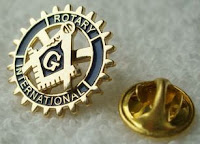
Rotary was founded on February 23, 1905 in Chicago, Illinois, USA. Its four founders were: Gustave Loehr (1864-1918), mining engineer; Silvester Schiele (1870-1945), coal merchant; Hiram Shorey (1862-1944), tailor; and Paul Percival Harrys (1868-1947), lawyer and Mason. Harrys proposed the name Rotary because the four founders met “in turns” in their professional offices and workshops. During the Duluth Convention in 1912, the Rotarians decided to adopt as their symbol a “blue wheel” with “twenty-four teeth” and “six spokes.” It symbolizes the wagon wheel of the pioneers of the American adventure, which began in the seventeenth century with the “Pilgrim Fathers,” who went to North America from England and Holland to live their Puritan and Calvinist Protestantism with greater freedom.
The vocation of Rotary implies universality and planetary globalism. Rotary aspires to “encompass within its circumference the universality of nations, races and cultures.” The “blue color” represents cosmic tension, like the water of the sea, the vault of the sky and of the Masonic Lodge, and signifies the will to reunify all nations in a broader New World Order (see the flag of the United Nations) through a feeling of philanthropic friendship. Rotary appears as a public Freemasonry and as the anteroom of the esoteric and secret one, where Freemasons can easily find people who have entered out of naivety to turn them into “Brothers of Three Points.” In a sense, it is even worse than Anglo-American Freemasonry, which “postulates as a primordial requirement belief in the Great Architect of the Universe […], while Rotary is above any religious conception.”
In 1928, the Catholic Church attacked Rotary (with the article by Father Pietro Pirri s.j. in L’Osservatore Romano of February 15, 1928) accusing it of para-Masonry, since “its morality is nothing more than a disguise of the Masonic one.” On February 4, 1929, the Holy Office published a Decree prohibiting priests in Italy from joining the Rotary Association, while in Spain the primate Cardinal Pedro Segura y Sáenz (1880-1957), Archbishop of Toledo, on January 23, 1929 extended the prohibition also to simple baptized laypeople, since the Association was based on an autonomous and secular morality, a globalist conception, a conception of philanthropic fraternity in opposition to the theological virtue of charity, a subjectivist and relativist philosophy. Even La Civiltà Cattolica addressed the Masonic-Rotarian question in three articles (June 16, 1928, July 21, 1928 and February 16, 1929), in which the Rotary association was defined as “a Masonic emanation, a new type of Masonry that operates in broad daylight.”
Cardinal Angelo Roncalli, during his patriarchate in Venice (1953-1958), had numerous contacts with Rotarians, and once he became John XXIII (1881-1963) on April 20, 1959, he received the Rotarians of Italy for the first time, followed by a second on March 20, 1963. On November 13, 1957, Giovanni Battista Montini, archbishop of Milan, had already attended the meeting of the Milan Rotary club and had declared that in the past he had had many reservations about Rotary, “the fruit of ignorance and error.” On September 28, 1963, Paul VI (1897-1978) received an entire Rotary representation. Then on March 20, 1965, then on November 14, 1970 and on February 16, 1974. And finally, John Paul II (1920-2005) addressed a message of sincere sympathy to the Rotarians of the LXX Convention on June 14, 1979, then on February 13, 1984 and then on February 25, 1989.
“…there I am in their midst.”
Good reading.