


We see the week ending and we do so with another intense day.
Bishops of the Latin rite from the Arab regions.
The Pope received the bishops of the Latin Episcopal Conference of the Arab Regions (CELRA). His speech did not focus on conflicts or governments; he spoke of martyrs, of communities in decline, of foreign workers in the Persian Gulf, and of what it means to shepherd a small Church in countries where Christians make up a tiny percentage of the population. The Catholic Church in the Middle East is a mosaic of traditions. Most Catholics in the region belong to the Eastern Catholic Churches: Maronites in Lebanon, Melkites in Syria and Palestine, Chaldeans in Iraq, Coptic Catholics in Egypt, and Syriac and Armenian Catholics throughout the world. Each has its own patriarch, its own synod, its own liturgy in Arabic, Syriac, Coptic, or Armenian, and a history that dates back centuries before the arrival of European missionaries. The Latin rite is also present—that is, the same liturgical tradition as Rome—and CELRA is the body that coordinates its bishops.
It was established in 1967 by the Congregation for the Evangelization of Peoples, the Vatican department that administers mission territories, and its statutes were ratified in 1989. It functions as an episcopal conference, presided over by the Latin Patriarch of Jerusalem, currently Cardinal Pierbattista Pizzaballa, a Franciscan friar. In the Holy Land, Jordan, Iraq, and Syria, Latin Catholics are native communities, often small. In the Persian Gulf, the faithful are Filipino, Indian, Sri Lankan, African, and Lebanese workers who arrived on temporary contracts with no possibility of obtaining citizenship. According to estimates from the vicariates themselves, they number more than two million people, spread across a few dozen parishes that celebrate Mass continuously on feast days in a dozen languages. In Saudi Arabia, public non-Christian worship is prohibited and the Church has no buildings; in Yemen, the war has reduced the Catholic presence to a few nuns and a handful of faithful. The apostolic vicar of Southern Arabia, Capuchin Bishop Paolo Martinelli, has repeatedly described his as “a Church of migrants, always on the move.” The Latin Patriarchate of Jerusalem, re-established by Pius IX in 1847, is the Holy See’s interlocutor with Israel and the Palestinian Authority regarding the Holy Places.
“Your Churches have known the witness of martyrdom.” “The many priests, religious, and faithful who gave their lives in Iraq, Syria, and other lands ravaged by violence.” These are the only three nations the Pope mentioned by name. “Their names may not be known to the world, but they are well known to God,” the Holy Father continued. “Their fidelity to the Gospel remains a light for your communities and an invitation not to give in to fear or resignation.” “Do not fear your smallness. The fruitfulness of the Church is not measured in numbers, structures, or resources, but in fidelity to the Gospel.” “Your mission is not simply to maintain a Christian presence, but to make Christ present.” “You are not called to solve all the problems of your lands, but to be faithful to the Gospel and to the people entrusted to you. Do not seek success or recognition first: seek fidelity.”
Pope Leo and the President of Colombia.
Pope Leo XIV held a telephone conversation on Wednesday, September 2, 2026, with Colombian President Abelardo de la Espriella regarding the recent earthquake that affected the country. The Pope referred to “the difficulties arising from the recent earthquake that has affected Colombia” and focused his words on “the families of the deceased, the victims, the rescue teams, and humanitarian personnel.” The official communiqué also noted that “the situation in the country and the regions affected by the earthquake was briefly addressed.” The presidential communications office confirmed in a statement that Pope Leo XIV expressed his support for Colombia during the crisis in a 20-minute telephone call with President De la Espriella. The Pope conveyed his “support and closeness to the Colombian people” in light of “the complex situation the country is facing.” The head of state responded with a message of gratitude and “sincerely thanked the words of the Supreme Pontiff and his valuable spiritual accompaniment at this time of national mourning.” Things can be done in many ways; a 20-minute call is important and undoubtedly supports the public and proud confession of Catholicism by Colombia’s president. Long live Christ the King!
Seminaries are necessary.
Leo XIV received in the Apostolic Palace the seminarians of the Pontifical Regional Seminary of Apulia “Pius XI” in Molfetta and those of the Episcopal Seminary of Aversa, along with their bishops, formators, and families. It is noticeable in the audiences that the tailors have more work, and all the ordained clerics appeared in cassocks—even the seminary rector dusted off his own. Jesus “went up the mountain and called to him those whom he desired, and they came to him. He appointed twelve to be with him and to be sent out to preach.” “These few words already contain everything,” and the seminary coincides with the central moment: “learning to be with the Master.”
The evangelist writes that Jesus called “those whom he desired,” and the Pope emphasized that verb: “There is no competition, no hierarchy, nor is it written that he chose the best: he chose those he desired.” The goal is clear: “in a world so eager to celebrate self-fulfillment, none of you, nor any of us, is here because we deserve it.” The Pope addressed the common objection that years of formation are “a luxury or an outdated institution” in a society “that is in a hurry and looks with suspicion on any prolonged pause.” “Precisely because our time is fast and noisy, a place and a time of life are needed in which one learns to be, to discern, to allow oneself to be formed without shortcuts.” “The seminary is not a postponement of the mission, but its condition. Let us not underestimate it.” The formators received an equally clear reminder: “As a formator, one cannot improvise: yours is a very delicate ministry for which you must prepare yourselves with knowledge, patience, and love.”
What the new bishops study.
Abuse, synodality, liturgy, crisis management, clergy formation, and relations with the Holy See. 147 newly appointed bishops have arrived at the Vatican for the formation course; in 2025 there were 192, and in 2024, 267. In two editions, the number has almost halved. The Dicastery for Bishops, primarily intended for prelates of Latin Church jurisdictions under its jurisdiction, has gone from 153 enrolled in 2024 to 114 in 2025 and 98 this year. The Dicastery for Evangelization, which brings together bishops from territories entrusted to the Section for First Evangelization and New Particular Churches, successor to Propaganda Fide, has gone from 114 to 78 and then to 49: less than half compared to two years ago.
The first significant data point is that an increasing number of new bishops “come from” the Roman Curia. The 267 participants in 2024 all belonged to the final phase of Pope Francis’s pontificate; the 2025 group, by contrast, was in the transition from Francis to Leo XIV. This year’s group is the first composed mostly of bishops chosen and ordained during the new pontificate.
The ecological sin is ending.
The International Theological Commission has published a 148-paragraph text that reinterprets the environmental crisis starting from the Trinity, assigns humanity the role of steward and servant of the planet, and proposes a new formula for sin against the environment. The term “ecological sin” has circulated in Catholic Church texts without a common definition being established. The 2019 Amazon Synod outlined one in its final document, but the formula, as the Commission itself admits, has never fully taken hold in the Catholic Church. Now, the International Theological Commission, the advisory body that supports the Dicastery for the Doctrine of the Faith on the most delicate doctrinal questions, suggests abandoning it and replacing it with a more extensive formula: “sin against creation and the Creator.” The proposal appears in Caring for Our Common Home: A Responsible and Fraternal Response to the Triune God. The Commission’s documents are not acts of the magisterium. They are opinions of specialists, published with the prefect’s authorization after examination by the Pope, and binding only to the extent that subsequent magisterium adopts them.
The Commission has two reasons for abandoning the formula “ecological sin.” The first is terminological: theology should “privilege terms that denote concepts proper to the faith” rather than borrowing them from the sciences, and for this reason “ecocide” is also discarded. The second is substantive: the adjective “ecological” highlights harm to nature but eclipses what, from a theological perspective, is primary—namely, “the ignorance or even rejection of the Creator’s plan,” who entrusted our common home to human beings. “Sin against creation and the Creator” would express both factors. The conclusion speaks of an “ecological change” that stands alongside the phenomenological, anthropological, and linguistic changes that have marked 20th-century thought, and emphasizes hope as a virtue that “does not exempt us from personal responsibility, but calls it forth and strengthens it.”
Schneider “comments” on Leo XIV.
Bishop Athanasius Schneider, in an interview, focused primarily on the Society of St. Pius X (SSPX). He was asked about the comments made by Pope Leo during a general audience on August 26, in which the pontiff suggested that those who attended the Traditional Latin Mass (TLM) before the post-conciliar reforms participated as “strangers and silent spectators,” implying this was because the liturgy was in Latin and marked by silent parts. For Schneider, the pontiff’s statements did not reflect the “true reality” of how the vast majority of Novus Ordo Masses are celebrated today. The Council Fathers never intended for Mass to be celebrated entirely in the vernacular, as occurs in most Masses celebrated according to the Novus Ordo Missae today. Nor would they have foreseen the loss of sacred silence during Mass, which makes it difficult for the faithful to enter into deep interior prayer and contemplation. “Today, more than 90 percent of Novus Ordo Masses are celebrated in the vernacular. There are even dioceses where, when priests want to celebrate the Novus Ordo in Latin, they are punished and forbidden from doing so. This is absurd.” “There are people who really want to keep silence during Mass, to contemplate interiorly. Contemplation is also possible during Mass, of course; it is not about the entire community remaining mute and not speaking. That is not the ideal. The ideal is that they respond to the priest. But we must also be open to the possibility that there are people who prefer to contemplate. There can also be active participation, which is useless because there is no interior participation at all.”
Referring to the 1965 Missal, Schneider explained that the Council Fathers were generally satisfied with this “careful and organic reform” that largely preserved the traditional Mass, removing only Psalm 42 and the Last Gospel, while allowing broader use of the vernacular. “Thus, the first part of the Mass, up to the Preface, was celebrated in the vernacular. And after the Canon, also in the vernacular. Therefore, from the Preface to the end of the Canon, everything was in Latin. It was obligatory that these parts be celebrated in Latin.”
The Opus Dei gets angry with the Bishop of Barbastro.
It is unusual for Opus Dei’s own publications to use a less restrained tone; it is clear that Pope Francis is no longer there. In response to the latest installment of the “serial” on Torreciudad, with the communiqué issued by the bishop of the diocese of Barbastro-Monzón, Ángel Pérez Pueyo, on August 31, the Opus Dei has made its position public in this conflict. In the communiqué on the occasion of the 47th Pilgrimage of the Virgins of Ribagorza and Sobrarbe at the Torreciudad shrine, Bishop Ángel Pérez Pueyo described as illegitimate a “supposed” retention of the original image of Our Lady of the Angels of Torreciudad by the Opus Dei; he questioned the work of the pontifical commissioner and threatened to resign if the statue did not return to the original shrine (located a few meters from the new church).
The Prelature’s communiqué notes that “it has never been in dispute that ownership of the image belongs to the diocese. The controversy concerns the scope and validity of the rights of use, custody, and location established by agreements between the parties.” “The image was not moved to another town or removed from Torreciudad: it was placed, with documented authorization from the diocese, in the new church built a few meters from the hermitage and within the same devotional complex. Always with the bishop’s authorization, it was restored in 1964 and again around 1970, and since 1975 it has presided over the altarpiece of this new church, publicly exposed for the veneration of all the faithful.” The Opus Dei states that “it is legitimate that there are currently differing interpretations regarding the legal effects of the agreements. It is up to the competent authority to resolve them. But a legal difference cannot become an offensive accusation without foundation.”
The Prelature recalls the restoration, adaptation, and maintenance work on the complex, which also includes the original shrine (owned by the Diocese but ceded in perpetuity). They recall the state of abandonment in which the original hermitage was found: “historical photographs show the material condition of the hermitage and its dependencies before the works. Current images allow us to verify the result of the restoration, conservation, and hospitality efforts carried out by many people, including the faithful of the diocese.”
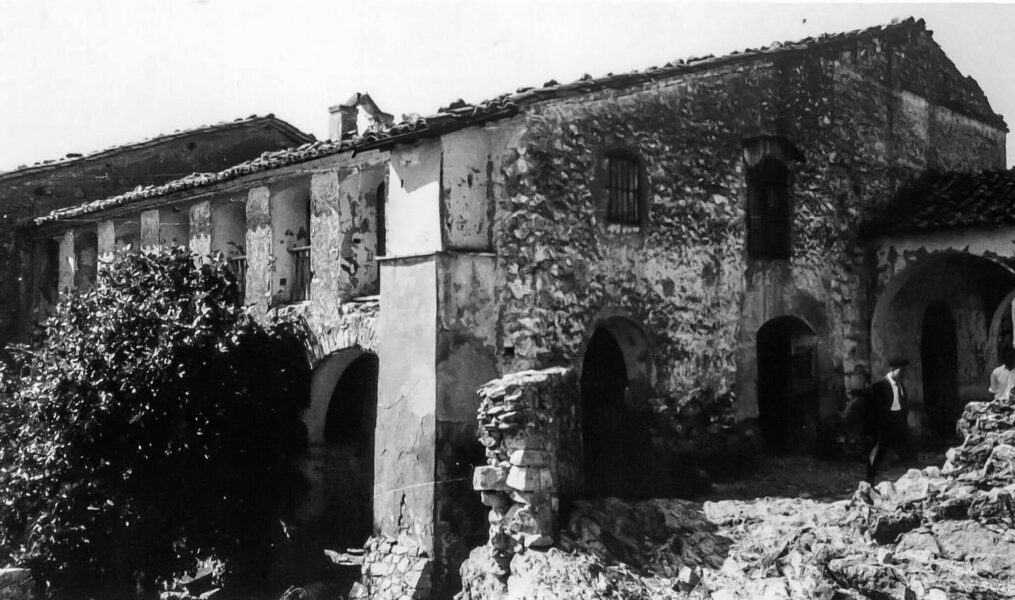
Torreciudad faces a week full of events: on September 5 the pilgrimage will take place, while on the 12th the Holy See’s commissioner will preside over the Marian Family Day, which for 33 years has been attended by thousands of people from all over Spain. Our image today is the hermitage of controversies in 1950, shortly before the Opus Dei took charge of it. It is evident that without the presence of the Opus Dei, with the construction of the surrounding reservoir, it would have been expropriated and the image, which today is greatly venerated, would be forgotten in a museum.
Pope Francis and Torreciudad.
It is more than evident that Pope Francis was a man of sympathies and antipathies in the purest Peronist style. Two unpublished handwritten letters demonstrate the support Pope Francis gave to the bishop of Barbastro-Monzón, Ángel Pérez Pueyo, during his conflict with the Opus Dei over the Torreciudad shrine. In one of them, dated July 13, 2023, he wrote: “Do not give in,” while in another, dated October 13, 2024, he warned him about the “Mafia intrigues underway.” The content of the letters also provides new details about Francis’s position regarding the differences between the two parties and about his relationship with Pérez Pueyo during the most delicate moments of the conflict. Pope Francis died in April 2025, and the Torreciudad conflict continues without a definitive resolution during the pontificate of Leo XIV. On September 18, 2024, Pérez Pueyo greeted Pope Francis in St. Peter’s Square, and according to the bishop himself, the Pope again asked about the status of the image of the Virgin of Torreciudad. The Pope’s position acquired an institutional dimension in October 2024, when Francis appointed Archbishop Alejandro Arellano as extraordinary commissioner for Torreciudad. The publication of the letters now places the conflict in a new documentary phase: in addition to the positions publicly maintained by the parties, there are private writings in which Francis left a record of his support for the bishop.
The Orlandi kidnapping.
Is it true that everyone in the Vatican thought it was a kidnapping? The writer Giuseppina Coali, author of the investigative essay “Giallo Vaticano”, sheds a different light on those hours. Raised in Rome as the daughter of a Gendarmerie inspector, Coali witnessed those dramatic days firsthand. According to her reconstruction, in the first hours after the girl’s disappearance, no one in the Vatican feared it was a kidnapping. This revelation belies the image of the Holy See as immediately alarmed by any hostile action. The announcement, riddled with inaccuracies about Emanuela’s clothing and the place of her disappearance, did not come from the investigating authorities or the Vatican secretariats. The one who had the note published was Mario Meneguzzi, the fifteen-year-old’s uncle, a figure who from the beginning played a central role in managing contacts. Until that moment, the investigation had focused on a sexual predator, an approach limited to the young woman’s relationships with people known to the flutist. The idea of kidnapping then became the dogma around which the Rome Prosecutor’s Office, the media, and the Orlandi family themselves began to revolve any testimony or allegation of guilt. Was Uncle Mario Meneguzzi’s action a simple mistake born of desperation, or the beginning of a deliberate maneuver to turn a disappearance into a kidnapping?
What to do with the desecration of a sacred place.
There are bishops who know what to do and do it. Antonio Suetta, bishop of Ventimiglia-San Remo: “The competent diocesan authority has formally confirmed the desecration of the sacred place.” For the “improper use of the church for commercial purposes: worship is suspended in Grimaldi. There will be a penitential rite with the bishop on Friday, September 4” to restore the Church of the Holy Guardian Angels, in the Grimaldi neighborhood of Ventimiglia, to its full dignity as a place of worship.
The fact was: “Following an incident related to the improper, illegitimate, and unauthorized use of the church by third parties for commercial purposes, for the filming of an advertisement that was later shared on social media, the competent diocesan authority has formally determined the grounds for the desecration of the sacred place.” Therefore, Masses cannot be celebrated in the church until the penitential rite has been performed. After the ceremony, the place of worship can resume its usual liturgical activity. In this case, unlike others, the diocese denies all responsibility to the parish priest, who, according to the bishop, was not informed that the church would be used for filming the advertisement. Access was obtained during the building’s regular opening hours. The bishop wants to get to the bottom of it, and the case will also have judicial follow-up: the Diocese has announced that it will file a complaint with the competent authorities, who will now be responsible for verifying the methods and responsibilities related to the unauthorized use of the church.
“New wine must be poured into new wineskins.”
Good reading.