


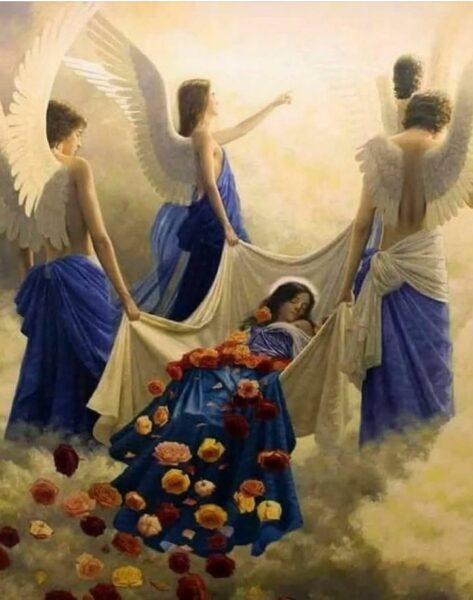
Mid-August has arrived, the Solemnity of the Assumption of Our Lady, patronal feast of thousands of churches throughout the world and a holiday in thousands of parishes. It is incredible that even on a day like today we have abundant and interesting information; let us proceed…
Another Freemason who slips into the Vatican?
We do not wish to be suspicious, but given the repetition of cases it rather seems that consultants who are Freemasons are being sought; the interested parties do not conceal it and the Vatican appears to like them. We now have another Freemason in the house, and this one very well documented; at least before, they kept up appearances a little—Masons have always existed, but not so brazenly. It seems the Vatican superiors have lost respect for the People of God and think anything is possible; here we will remind them. It would be good if Pope Leo woke up, or he will find himself surrounded by very unsavory brethren.
Pope Leo XIII has appointed a historian who appears repeatedly in Masonic records to serve on a Vatican historical committee. He is Umberto Longo, director of the Italian Historical Institute for the Middle Ages and professor of medieval history at Sapienza University of Rome, now a member of the Pontifical Committee of Historical Sciences. The appointment comes despite documentary evidence linking him to Freemasonry, including records of the Ancient and Accepted Scottish Rite and Longo’s subsequent appearances at events organized within the main Italian Masonic lodge, the Grand Orient of Italy.
On 9 February 2019, for example, Longo took part in the conference “God and the People: The Roman Republic—170 Years of Love,” organized in Rome by the Grand Orient and the District College of Venerable Masters of Lazio. The preserved video provides visual evidence of Longo’s intervention at the event, opened by Giuseppe Bramucci, a Masonic master. Specifically, Longo delivered a lecture entitled “The Legacy of the Roman Republic.” The 2014 issue of Logos, the journal of the Ancient and Accepted Scottish Rite in Italy, contains an article written by “Father Orator Umberto Longo, 9°,” a member of the Lodge of Perfection of Secret Masters “Giano” in Rome. The article deals with the history, ritual, and initiatory development of the Scottish Rite. The title “Fr.” is used in the publication as the abbreviation for “Fratello” (“Brother”), while the number indicates the Masonic degree. Specifically, the number “9°” means he attained the Ninth Degree of the Ancient and Accepted Scottish Rite, that of Elect of the Nine. In December 2022, Longo participated in a conference on Hugo Pratt, the renowned Italian comic-book artist who was a Freemason. The conference was organized by the Fondazione Scozzese Triveneta, a cultural institution linked to the Ancient and Accepted Scottish Rite. During his lecture, Longo describes with remarkable precision the stages of the Masonic initiation ritual: the chamber of reflection, the divestiture of metals, and the inner journey. He presents them not merely as objects of historical study but as a “complete representation” that he interprets with the language of someone versed in the Order’s symbolism. At the end of his lecture, Longo places himself, Hugo Pratt, Corto Maltese, and the audience in the same category: “Corto and Ugo know well that an initiate can only be a traveler… Pratt and Corto embody all this, with a kindly smile, without dogmas, without pretensions of superiority; they are gentlemen of means. And, after all, so are we.”
The disobedient Marx, rewarded.
Cardinal Reinhard Marx has been re-elected by Leo XIV as coordinator of the Council for the Economy, a post he has held since 2015. This comes after Marx himself maintained an open disagreement with Rome regarding blessings for same-sex couples. The Archdiocese of Munich implemented the guideline “A Blessing Strengthens Love,” which includes ritualized blessings for same-sex couples and divorced-and-remarried couples, despite the fact that the Vatican had already rejected the German project and that rejection was reaffirmed by Pope Leo XIV. Marx did not lose his post, was not removed, exiled, or sanctioned, and moreover was re-elected once again to head one of the Holy See’s most important economic bodies. As is well known: “Justice and mercy for friends, law for enemies.”
Roche and Leo XIV.
When Cardinal Arthur Roche declared that Leo XIV would not modify Traditionis custodes nor return to the discipline introduced by Benedict XVI with Summorum Pontificum, his words inevitably raised a question: was the prefect of the Dicastery for Divine Worship expressing his own assessment or was he actually conveying the Pontiff’s orientation? In the interview granted to The Tablet, Roche had left little room for interpretation: “Pope Leo is not going to change Traditionis custodes nor return to Summorum Pontificum.” A document predating that interview, published today at the will of Pope Leo himself, now allows those statements to be placed in a more precise framework.
On 29 June 2026, a month before Roche’s words, Leo XIV had addressed a letter precisely to the English cardinal on liturgical formation, intended for the meeting held at the Benedictine Abbey of Mount Angel in Oregon. The text deals mainly with the formation of the People of God and the ars celebrandi, but contains a passage that acquires particular weight in light of what Roche would say a few weeks later. The Pope invites, in effect, to “underline the need for fidelity to the approved texts and instructions” and recalls the respect that all those called to prepare the celebration of the divine mysteries, “and priests in particular,” must show “toward the rites promulgated by Pope Saint Paul VI and Pope Saint John Paul II.” Leo XIV does not mention Traditionis custodes, does not allude directly to the 1962 Roman Missal, nor does he establish new norms on its celebration. In the motu proprio of 16 July 2021, Francis established that “the liturgical books promulgated by the holy Pontiffs Paul VI and John Paul II, in conformity with the decrees of the Second Vatican Council, are the only expression of the lex orandi of the Roman Rite.” Leo XIV’s decision to refer expressly to those same two Pontiffs when he calls for fidelity to the approved rites cannot, therefore, be interpreted as a mere detail.
In the letter to Roche, the Pope clarifies that respect for liturgical provisions must spring from an interior attitude of openness and trust in God, “manifesting humility before His greatness and sincere fidelity to ecclesial communion.” It is a concept Leo XIV had already developed publicly in the catechesis of 27 May dedicated to Sacrosanctum Concilium: on that occasion he recalled that no one may add, remove, or modify on his own initiative what has been established in liturgical matters and had expressly linked respect for the texts and ordinances of the liturgy with the communion of the Church.
Also in this area the parallel with Traditionis custodes is evident. Francis had presented the restrictions on the use of the 1962 Missal precisely within the framework of a search for ecclesial unity. In the letter to the bishops that accompanied the motu proprio, he had explained, moreover, that he wished to restore the unity of the Roman Rite around the books promulgated by Paul VI and John Paul II, indicating as a perspective that, over time, the faithful rooted in the earlier form would return to celebration according to the books of the conciliar reform. In the official Spanish version, Francis speaks expressly of those who “need time to return to the Roman Rite promulgated by the holy Pontiffs Paul VI and John Paul II.” Roche’s words are nothing other than the orientation Leo XIV had personally entrusted to him. Even before the prefect publicly stated that the Pope would not modify Traditionis custodes, Leo XIV had already written to him reaffirming the principle of fidelity to the rites promulgated by Paul VI and John Paul II and linking it directly to ecclesial communion.
The 1962 Missal.
What really happened to the Roman Missal before the liturgical reform? Has that Missal been abrogated? Has it simply been replaced? And what relationship exists today between that liturgical form and the Tradition of the Church? On this topic it is easy to fall into the trap of pitting “progressives” against “traditionalists”; an article today proposes starting from the documents. The first thing to remember is that the Second Vatican Council did not promulgate a new missal. The Constitution Sacrosanctum Concilium, approved on 4 December 1963, established the principles of liturgical reform. In number 23 we read: “To preserve a sound tradition and at the same time to open the way to legitimate progress, the revision of individual parts of the liturgy must always be preceded by careful theological, historical, and pastoral investigation.” “Innovations should not be introduced unless a true and proven good of the Church requires it, and with care that the new forms arise organically, in some way, from those already existing.”
The Council does not set Tradition and Progress in opposition. It speaks of a “sound tradition” and a “legitimate progress.” And it asks that new liturgical forms arise “organically” from those already existing. This does not mean that the liturgy cannot change. On the contrary, Sacrosanctum Concilium itself recognizes, in no. 21, that in the liturgy there is an immutable part and another part susceptible to change. ( Sacrosanctum Concilium, no. 21). The question is whether a reform can be authentic without becoming a rupture with Tradition.
On 3 April 1969, Paul VI promulgated the Apostolic Constitution Missale Romanum, which promulgated the renewed Roman Missal as requested by the Second Vatican Council. Before presenting the new Missal, Paul VI recalls the role played for four centuries by the Missal promulgated by Saint Pius V in 1570 and acknowledges that it had nourished the spiritual life of countless Christians and saints. The reform is not presented as the replacement of a liturgy now devoid of value by a liturgy that is finally authentic. Paul VI speaks of a revision and renewal of the Roman Missal, situating it in the prior history of liturgical reform, which had already begun under the pontificate of Pius XII. This fact is important: the new Missal does not arise from nothing and the previous Missal is not described as an error of the Church.
Did the promulgation of the new Missal automatically imply the juridical abrogation of the previous Missal? Benedict XVI in 2007, with the Motu Proprio Summorum Pontificum, established that the Roman Missal promulgated by John XXIII in 1962 could be used and expressly described it as “never abrogated.” “Therefore it is permitted to celebrate the Sacrifice of the Mass according to the typical edition of the Roman Missal promulgated by Blessed John XXIII in 1962 and which has never been abrogated.” Benedict XVI defined the Missal promulgated by Paul VI as the ordinary form of the one Roman Rite and that of 1962 as the extraordinary form of the same Roman Rite.
Benedict XVI’s position is made even clearer in the letter to the bishops that accompanied Summorum Pontificum. The Pope explained that his intention was not to create a contrast between two Churches or two rites, but to recognize two forms of use of the Roman rite and, above all, he believed that both forms could “enrich each other.” It was not a matter of denying the Second Vatican Council, but of preventing the liturgical reform from being interpreted as the annulment of everything that had preceded it. This is a position consistent with the more general thought of Joseph Ratzinger.
In his address to the Roman Curia on 22 December 2005, Benedict XVI contrasted the “hermeneutic of discontinuity and rupture” with the “hermeneutic of reform,” arguing that the Council must be interpreted in continuity with the one subject: the Church. For Ratzinger, therefore, the liturgical question formed part of a broader ecclesiological question: the Church can be reformed without ceasing to be herself.
Pope Francis, through the Motu Proprio Traditionis custodes of 16 July 2021, expressly abrogated the previous norms, instructions, concessions, and customs relating to the use of the Roman liturgy before the 1970 reform. “The liturgical books promulgated by the holy Pontiffs Paul VI and John Paul II, in conformity with the decrees of the Second Vatican Council, are the only expression of the lex orandi of the Roman Rite.” The difference with Summorum Pontificum is evident. In 2007, Benedict XVI recognized two forms of use of the Roman rite. In 2021, Francis established that the liturgical books promulgated by Paul VI and John Paul II constitute the only expression of the lex orandi of the Roman Rite. But to say that Traditionis custodes has profoundly modified the discipline of 2007 does not mean that the 1962 Missal is simply declared non-existent. Article 2 establishes that it belongs to the diocesan bishop to authorize its use in his own diocese. Article 3 also specifically regulates celebrations according to the 1962 Missal, indicating the conditions, places, and pastoral responsibilities.
The 1962 Missal is no longer, according to the discipline of Traditionis custodes, a second expression of the lex orandi of the Roman Rite. But its use remains the object of a specific ecclesiastical discipline. Today the 1962 Missal is no longer recognized by current discipline as a second expression of the lex orandi of the Roman Rite. That does not mean that the 1962 Missal no longer existed juridically at the moment of the promulgation of the new Missal; then the question is much more complex. Because in 2007 Benedict XVI expressly affirmed that that Missal “had never been abrogated” and we cannot simply erase this declaration from the history of the Church.
The Second Vatican Council did not pose the question in terms of a choice between preserving the past and opening to the future. A Catholic can love the 1962 Missal without denying the Council, the liturgical reform, or the authority of the Pope. But when that liturgical form is used as a tool to question the entire conciliar reform, the problem ceases to be merely liturgical. The Church was not born in 1970 and the Christianity was not born with the Second Vatican Council. A liturgy that has shaped generations of Christians for centuries cannot be reduced simply to a historical error that the Church has finally corrected. How can the Church reform its liturgy without ceasing to be faithful to its Tradition? How can a liturgical tradition be safeguarded without turning it into a rejection of the Church’s legitimate authority?
If we take Summorum Pontificum seriously, we must recognize that Benedict XVI attributed to the 1962 Missal a juridical permanence that cannot simply be denied retroactively. If we take Traditionis custodes seriously, we must recognize that Francis has profoundly modified that discipline and has established that the liturgical books promulgated by Paul VI and John Paul II constitute the only expression of the lex orandi of the Roman Rite. All these data form part of the history of the Church. The liturgy belongs to the Church and it is precisely for that reason that it is too important to turn it into a war between factions. We need to understand how the Church can reform itself without losing its memory, and how it can preserve its memory without turning it into a rejection of reform.
But what is synodality and what is the synod for?
Bishop Mutsaerts, auxiliary bishop of the Dutch diocese of ’s-Hertogenbosch, has published an open letter addressed to Pope Leo XIV in which he questions the usefulness of the Synod on Synodality. Mutsaerts urges evaluating the Synod in light of concrete indicators, rather than on the basis of the number of meetings organized or reports drafted: Sunday Mass attendance, priestly vocations, the practice of confession, and the transmission of the faith to new generations. In these areas, he writes, the performance of the dioceses of Western Europe remains disappointing, and the energy devoted to questions of governance seems disproportionate to the gravity of the current pastoral crisis.
The bishop insists on the distinction between a faith received by apostolic transmission and a faith reconstructed through consultation, arguing that Catholic truth cannot depend on the consensus of the faithful consulted. Hence his most incisive objection: in the synodal texts there is a risk of inverting the order of listening, placing the expectations of the contemporary world before Scripture and the Magisterium, whereas tradition demands the opposite path: that of conversion.
Ample space is devoted to the liturgical dimension, defined as a touchstone of ecclesial health, and to a historical parallel with the evolution of Protestant communities, where Mutsaerts questions whether the greater emphasis placed on administrative participation has really produced a spiritual revival elsewhere. He contrasts these structures with the example of the saints, from Francis of Assisi to Catherine of Siena and John Paul II, whose capacity for reform arose, he argues, from radically consecrated lives rather than from programmatic documents.
The nuncio to Morocco in Gibraltar.
What a desire to stir up unnecessary trouble. “Gibraltar Cultural Services (GCS), on behalf of the Ministries of Culture and Tourism, are pleased to confirm that Monsignor Alfred Xuereb, closely linked to the figures of Pope Joseph Ratzinger and Pope Francis, will participate in the 2026 edition of the Gibunco Gibraltar Literary Festival.” He was private secretary to Pope Benedict XVI from 2007 to 2013, and to Pope Francis from 2013 to 2014, and currently serves as Apostolic Nuncio to Morocco. Within the framework of the Festival, Monsignor Xuereb will present his book My Days with Benedict XVI, which offers an intimate look at the Pontiff’s daily life and his witness of faith. The Minister of Culture and Tourism, Christian Santos, stated: “I am delighted that Monsignor Xuereb is part of our Festival. His book is fascinating, and I am convinced that the theme will arouse great interest among our public. Our aim is to offer a varied selection of literary genres and themes. The Monsignor’s experiences and his memories of the time shared with two Popes are stories not to be missed.”
Very un-Catholic Catholic bishops.
Every day we have cases that indicate the narrowness of the miters of so many of our bishops—very synodal, no doubt, but very un-Catholic. On the same day, the archbishop of Montes Claros, José Carlos Campos, consecrated his archdiocese to Saint Michael; another bishop, Vicente Ferreira, has criticized the consecration to Saint Michael the Archangel, suggesting that the devil is “rather imaginary.” “Are there theological justifications for consecration to Saint Michael? Consecration is to God the Father, Son, and Holy Spirit,” wrote Bishop Vicente Ferreira last week. “Is not the devil against whom we fight rather imaginary?” “The greatest exorcism should be: of homophobia, of femicide, of racism, of crimes against indigenous peoples. Of that legion of evils.” “What is your religion? You should convert to Catholicism,” wrote an X user. “At your age, worrying about these progressive nonsense will not get you to heaven. You should worry about saving your soul.” Another social-media user commented: “For this bishop, the Church is not in communion with the saints; the Apostolic Nuncio should be aware of this bishop’s publications. There are already 34 dioceses dedicated to Saint Michael the Archangel in Brazil.” Bishop Ferreira is known for his sublime reasonings and has also publicly stated that there exists a “biblical communism.” Dom Vicente Ferreira is bishop of the Diocese of Livramento de Nossa Senhora in the state of Bahia, Brazil.
The former bishop of Broome, Christopher Saunders, has been sentenced to 76 years in prison for 13 sexual offenses. The crimes date back to 2008 and are believed to have been committed against two young Aboriginal men. The case came to light in 2020, when the first complaints caused a scandal in the Australian diocese, but the initial investigations did not lead to charges. Only in subsequent years did new testimonies and a file of more than 200 pages reopen the case, leading to his arrest in 2024. The Australian police had already carried out two investigations into Saunders’ case, between 2018 and 2020, but without bringing charges. The prosecution considered that there was insufficient evidence to proceed. The situation changed after the appearance of new reports derived from an investigation initiated by the Vatican after Saunders’ resignation in 2021. This new information prompted the Australian police to reopen the investigation, leading to the arrest of the bishop in February 2024. After his release on bail, judicial proceedings were initiated, which concluded yesterday with his conviction.
At the time of his arrest in 2024, Saunders had been charged with 19 offenses, including non-consensual penetration, sexual assault, and indecent conduct against two young indigenous men aged 16 to 18. Yesterday’s ruling found the former bishop guilty of 13 of the 19 charges. Tim Norton, current bishop of the Diocese of Broome, expressed his gratitude to the investigators and judicial authorities, as well as his solidarity with the victims. “We deeply regret the pain they have suffered. We feel the shame they have had to bear. We regret that it took so long for their voices to be heard and their pain acknowledged.” It would be interesting to analyze who was responsible for the appointment of this bishop; there are too many cases that indicate the system for selecting bishops fails too often and no one takes responsibility.
Homosexuality in the Church of Latin America.
This is the subject of a long article in the Jesuit magazine América. “From these echoes and in light of the recent visit of Pope Leo XIV to Spain, I find myself reflecting on the Latin-American Church and, in particular, on the Dominican Church. I think of a Church that its own reality has constantly called to go out to meet the marginalized and the wounded. I also think of the occasions when it has not heeded that call. Few realities evidence this absence more clearly than the relationship, or its absence, of our ecclesiastical hierarchy with LGBTIQ+ persons. In other words, the law does not encompass the reality of human experience; love does.”
“Although this reflection focuses on the LGBTIQ+ collective, it would be unfair not to recognize that similar dynamics affect other human groups: the migrant community, particularly the Haitian community; Dominicans of Haitian descent, also deprived of such fundamental rights as a name or nationality; and women, especially the poor and racialized.” “More than 35 years ago I contemplated people dying: some convinced of their own unworthiness, full of self-hatred; many others also full of hatred toward the God with whom, I believe, they were about to meet. All deprived of the attention, the consolation, or even the simple presence of a Church called to be a reflection of Christ on earth. Yet it was precisely there that I also understood that faith only finds its full meaning when it leads us to encounter God from human dignity.”
Father Kolbe.
Maximilian Maria Kolbe, the priest who in 1941 offered himself in place of a father in the Auschwitz bunker, remains in collective memory primarily for that extreme act. Less well known is his career as an editor, who anticipated by decades ideas we now take for granted about the scale, technology, and cultural transmission of the message of faith. Born Rajmund Kolbe in Zduńska Wola in 1894, he entered the Conventual Franciscan Order and studied philosophy and theology in Rome. While still a student, in 1917 he founded the Militia of the Immaculata, a lay association intended to counter the anticlerical propaganda of the time through spiritual and cultural means. From this was born Rycerz Niepokalanej, the Knight of the Immaculata, five years later. Conceived from its first issue as a tool of religious propaganda directed at a broad public, with the declared ambition of transcending the limits of the devout community. Its growth was vertiginous: the editorial office moved from Kraków to Grodno and, finally, from 1927 onward, to the convent of Niepokalanów, founded specifically for this purpose near Warsaw.
Meanwhile, Niepokalanów became more than a convent: an autonomous citadel inhabited by nearly a thousand friars, novices, and seminarians, with its own industrial printing press, bakery, fire station, and power plant. Eight hundred clerics worked tirelessly on the editing, printing, and distribution of books, pamphlets, and periodicals. Kolbe also installed a radio station there, Radio Niepokalanów, capable of reaching a large part of Poland, and planned a film studio, an experimental television service, and an airport to speed up the distribution of the press—plans that the outbreak of war in 1939 would leave unrealized. This technical curiosity was not the result of a momentary impulse: still a teenager, in 1915, Kolbe had presented a sketch of an airplane powered by rockets of his own invention to the patent office; a minor biographical detail, but revealing of a mind accustomed to treating technology as a territory to inhabit, not to escape.
The most ambitious initiative came in 1935 with the founding of the Mały Dziennik, the Little Daily: a popular newspaper, available at newsstands every day, with approximately 130,000 copies on weekdays and more than 200,000 on Sundays—one of the most widely circulated in interwar Poland, far beyond the limits of the confessional press. Kolbe conceived it as a tool to shape public opinion on current events, capable of transmitting Catholic sensibilities through the presentation of news and commentary, in an operation that today would be called editorial framing.
To broaden its readership, the newspaper adopted a deliberately sensationalist style, openly claiming to be based on “healthy sentiment.” Kolbe was its creator and spiritual director; editorial direction fell to Father Marian Wójcik. After arriving in Nagasaki in 1930 without knowing a word of Japanese, within a month of his arrival he published the first issue of Rycerz in a local edition. Five years later, that Japanese newspaper had reached a circulation of 65,000 copies. The convent he founded there, Mugenzai no Sono, stands on a hillside that locals consider unfavorable according to traditional criteria of building orientation—a choice that would prove providential fifteen years later, when that sheltered location saved the building from the atomic bomb dropped on Nagasaki. Today that area of the city concentrates the largest Catholic population in Japan.
“…my spirit rejoices in God my Savior.”
Happy reading.