


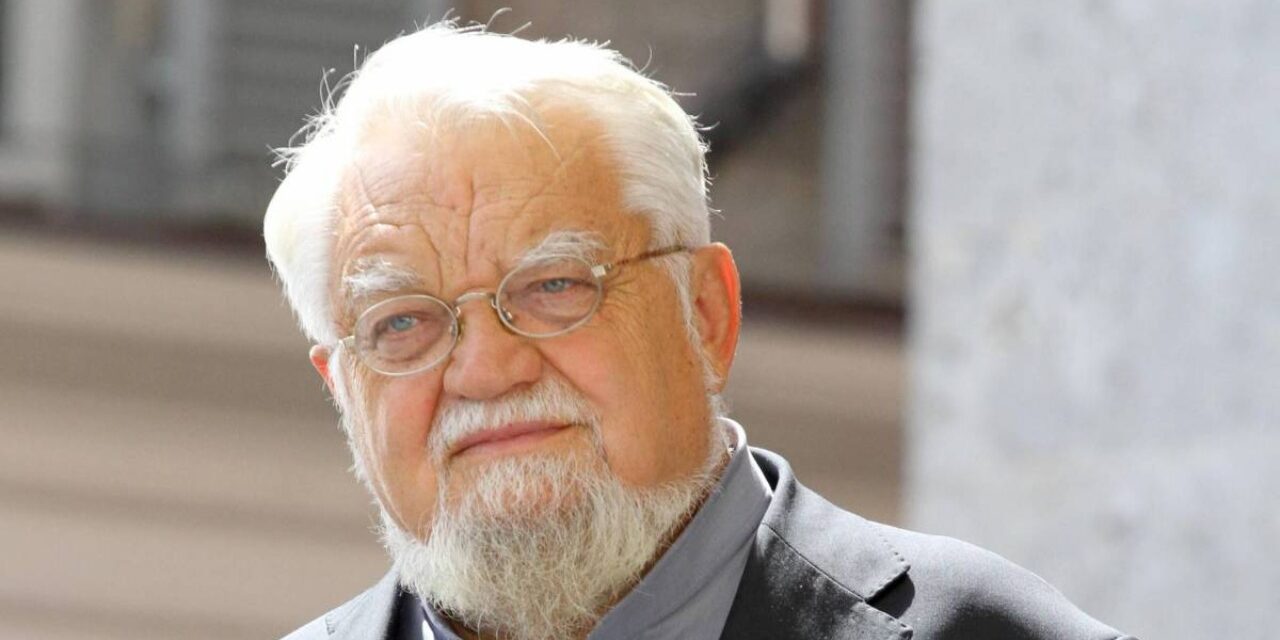
Enzo Bianchi has died.
His body has been lying in state since Wednesday morning at the Casa della Madia in Albiano d’Ivrea. Enzo Bianchi will return to Castel Boglione, the town in the province of Asti where he was born on 3 March 1943. The funeral will be held tomorrow in the parish church. After the funeral, the founder of Bose will be buried in the municipal cemetery. The announcement is signed by the brothers and sisters of Madia: Goffredo Boselli, Giovanni Gatti, Maurizio Milesi, Claudio Bellandi, Antonella Casiraghi and Laura Marino, together with their relatives Maddalena and Ines Moccafighe, Loredana Nicala, Francesca Bianchi and Sandra Cordara. The simple text begins with the traditional formula: “Having completed his earthly pilgrimage, he has entered into the rest of the Lord.” Those who sign it express their gratitude to the Lord for the gift of his life.
The Fraternity has added a prayer to the message, summarizing how his brothers wish to remember him. They thank him for a life “filled with passion” for the Word, his “frank and prophetic words” and his “unconditional hospitality, capable of turning every encounter into a space of fraternity and sincere ecumenism.” They ask God to purify “all his weaknesses” and to grant him the opportunity to contemplate “that Face which he sought with love in the Scriptures, in the liturgy and in the gaze of every brother and sister.”
In his final years, Bianchi acknowledged that his faith was “more filled with questions and doubts than before,” but also how he remained steadfast in what had not faded: “his love for the Lord remained.”
Enzo Bianchi dies in exile.
Enzo Bianchi, 83, one of the main founders of the monastic community of Bose, established in 1965 in the province of Biella. In 2020, he was removed from Bose by order of Pope Francis and founded Casa della Madia, a monastic “confraternity” located in Albiano d’Ivrea. Since then, he had gradually withdrawn, partly due to health problems, and in his final days his condition worsened because of renal failure, which led to his death in metabolic coma.
Bianchi made his last public appearance last May in Turin, where he presented a book by Spadaro SJ. In recent years he had addressed, among other topics, the Mass in the ancient rite, debating with other theologians and Church historians, always maintaining a stance in defense of the Council and its reforms. In 2017, Enzo Bianchi suffered a harsh conflict with Pope Francis, who wanted a change in the leadership of the Community to avoid an excessive concentration of power. After a long tug-of-war that included the intervention of a psychoanalyst sent directly by the Vatican, Bianchi said: “I am in the exile that was imposed on me.”
Aldo Maria Valli and Enzo Bianchi.
“I remember him as a welcoming and curious person, always ready to answer questions. Talking with him was pleasant and certainly never boring. His reflections were never banal. Despite a non-classical education (he had a degree in accounting and had not completed his university studies in economics), he was able to address philosophical and theological questions with a certain mastery. He had a talent for writing, both in short journalistic articles and in essays. I admit that he fascinated me, until I realized the distance between our positions when I began to recognize myself as an involuntary modernist and, consequently, rediscovered Tradition.”
“In 2022, together with Don Nicola Bux, I dedicated the book “The Changing of the Guard” to Enzo Bianchi, in which I summarized the internal conflict in the monastery of Bose, the Vatican’s intervention and the vicissitudes Bianchi faced in the final stage of his life. I believe that Enzo Bianchi’s story is paradigmatic of the post–Second Vatican Council Church, with all its deviations, ambiguities and contradictions, in the context of the almost unanimous applause of secularist culture.” He published a book, “What Is Beyond?”, in which he took up this question. He explained: “We know the here and now and we see that it has an ineluctable limit. We hope there is a life after death, but I believe we must make it present in the here and now. Elements of eternity already exist here and now. What is not yet, is already here.” “Lately, his thoughts often turned to death. Once, when I met him, he asked me: “Do you think that if I had been tall and handsome I would have become a monk?” “You know, Aldo, I still haven’t fully accepted this business of death. I’m afraid of it.”
The monk who was popular outside the monasteries
Reducing Bianchi’s figure to the disastrous conclusion of the Bose experience would be a mistake. He played a fundamental role in opening Italian Catholicism to ecumenical dialogue and in restoring the centrality of the Scriptures. He addressed an audience that often would not have listened to a bishop or entered a parish. Theologians, philosophers and intellectuals of the most diverse kinds passed through Bose. He maintained relations with the Orthodox world, with Protestants and even with Buddhist communities. He possessed an extraordinary ability to relate to others and even an extraordinary capacity to be at the center of those relationships.
Bianchi lived the constant tension between the monk and the public figure, between the community and the founder, between the preacher of secrecy and a public figure who had very little in common with the secret world. Even some who had long shared or frequented the Bose experience ended up criticizing him precisely for this: his departure from the original spirit, his growing self-promotion, even his taste for titles and praise which, in their view, were incompatible with the radicalism of his beginnings. The young man who had come to Bose in 1965 to seek God in silence had become a public moral authority.