


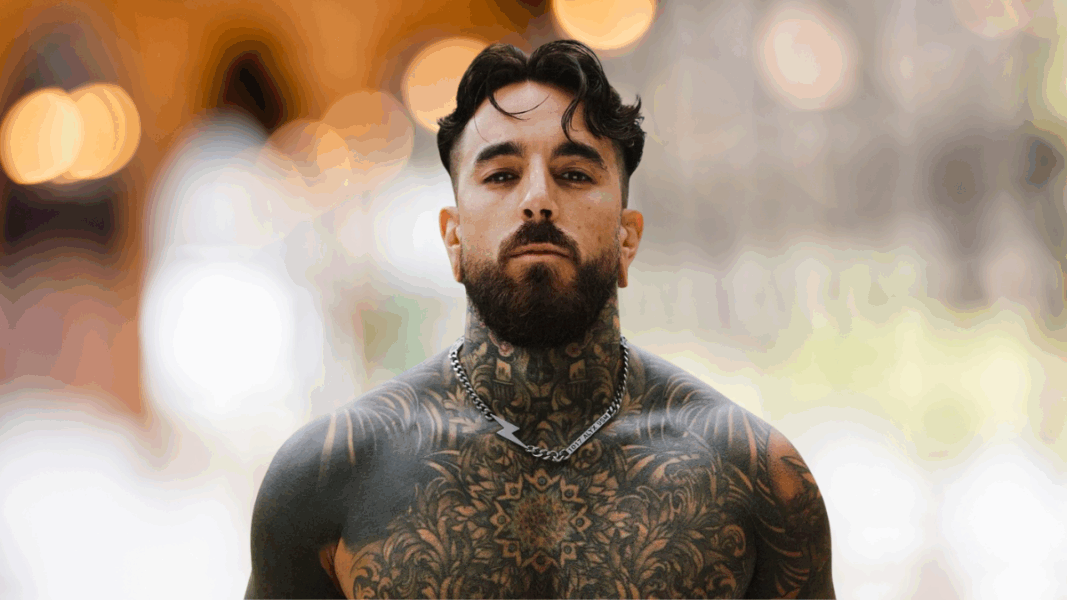
René Ponte, known online as René ZZ, sat across the table from his own podcast so that Celia, the woman he is about to marry, could interview him. In more than two hours he revisited a childhood marked by the fear of abandonment, an adolescence in search of identity, and the 2021 dream in which he felt that God loved him, along with everything that followed: the reunion with his father after eighteen years, his first confession since First Communion, the chastity he has practiced in their relationship, which he describes as “a gift from God” and admits “has not been an easy path,” and a wedding in which he hopes his vocation will take on a “completely overwhelming” meaning. There are many proofs that God exists, he told her, but “the most convincing proof is you.”
Episode 100 of ZZEN Talks opened with a prayer. Before the first question, Celia told the audience about a habit of her fiancé: while she blesses the table with the two-second formula she learned from her grandmother, he prefers to improvise long prayers, giving thanks for very specific things from the day and making requests for people by name. She asked him to open the interview that way. René made the sign of the cross, gave thanks for the hundredth conversation of a project he called “so beautiful,” and above all for “life, your love, your guidance, and everything you give us every day, every hour, even when we don’t see it,” and ended with a request that set the tone for the more than two hours that followed: “May you be the one who speaks for us and may your will be done.”
The format was an exception. René had hosted and directed the previous 99 episodes of the podcast, launched two years ago by ZZEN Labs, the supplement brand he founded with several partners, and Celia had never conducted an interview before. She introduced him as someone the audience already knew: some, since he opened a YouTube channel more than seven years ago to talk about tattoos, a passion his body is “a great showcase” of; others, from the video in which, in the summer of 2025, he recounted his conversion and the dream he had in Finland. “I also have the incredible luck of promising eternal love to this man in less than a month,” she added. She warned him that she would try not to call him “my love” during the recording, “so no one throws up,” and that she would not follow a rigid order. She kept her word: half an hour in, she admitted she was no longer paying attention to anything she had written down.
The first question asked him to describe the René before everything: before meeting her, before encountering God, even before getting tattooed. He first warned that he does not entirely trust his memories, because life is lived through emotions, and then portrayed himself as “a kid with a strong desire to create.” He had been drawing since he was very young, and at eleven he asked his mother to buy him a diary to write about his day-to-day life, on his own initiative. While his cousins asked for trucks at Christmas, he asked for monsters, and he was interested in anime and things no one around him knew about. He was also, he said, “a calm and fearful child,” raised with a great fear of life, but with “an inner flame” that pushed him forward and told him that, despite the fear, he could do something important. “I don’t know how or when or why, but I sensed it.”
To break the ice, Celia asked about his favorite Disney movie. Dumbo, he replied, the little orphan elephant who gets lost and cannot find his mother, and Casper, which is not Disney, the ghost of a child who lived with uncles who did not pay attention to him. She followed the thread and asked what his relationship with death had been as a child. He did not recall any close one, but he did remember something that, over the years, he has come to understand resembles him greatly: the fear of being left alone. At seven or eight he woke up early to watch cartoons just as his mother and stepfather had gone out on a quick errand, convinced he would sleep in, and he still remembers “as if it were today” the anguish of finding himself alone in the house. “I have always been afraid of not being enough and of people abandoning me at some point,” he explained, and he extended it to everyone: we want to be loved, and the fear of loneliness is “a fear of death in life,” the certainty that no one loves you, “which is almost worse than death because you are still alive.”
That thread led to the first of the stories René had never told on camera. This summer, in La Coruña, where he grew up, he reconnected with his father after eighteen years without seeing him, beyond crossing paths a couple of times. He had spent years talking online about his absence, a kind of shared therapy with his audience that has helped many people and for which people still stop him on the street. But he reached a point where that complaint seemed unworthy of the man he wants to be: “Sitting in public places and saying ‘my father wasn’t there’ no longer works.” A conversation with Pablo Andrés, with whom he had spoken a year earlier about healing his relationship with his mother, left him with the feeling that he had to try. Summer was approaching, he was afraid, and he kept telling himself he had no time, until something happened that he described as “very much of God, very providential.” Just as he was about to leave, his mother made a comment about something someone had heard his father say, and he thought: “I have to call him now.” Fifteen minutes later he was calling him, with the number his mother still had and by phone, as she advised, instead of sending a WhatsApp. His father answered “very kindly” and they arranged to have a coffee that lasted forty-five minutes.
He did not go to demand explanations. He almost felt, he said, that he was the one who should ask for forgiveness, for having been “a bit of a coward,” for having talked too much and done very little while the possibility of speaking with his father still existed. What he found was “a man who reminded me a lot of myself,” who laughed at the same jokes and did things René had never seen in anyone else: “Of course, he’s my father.” He asked a lot about Celia, of whom he was aware, and about his mother and sister. It was, he summarized, a “super cordial father-and-son conversation,” with laughter, in which neither reproached the other for anything. They agreed to meet again before René left, but it did not happen, because he was overcome by doubt about how to fit it all in. A couple of months have passed and, the day before the recording, his father wrote to him on WhatsApp; he replied. He confessed that he still does not know how to process it, that he tends to expect the worst and had prepared himself for the opposite, for meeting someone with whom he could not communicate, which would have broken his heart. “Thanks to God it was the other way around.” It left him, he said, “very confused in the most positive sense of the word.” And he explained why it weighed so heavily on him. He had a stepfather and a grandfather, but he does not know what it is like to tell a father something and have him help, or teach him to fix what is broken: “When I see my friends with their fathers, I don’t know what that is.” He said it without victimhood, because “there are people who have neither father nor mother.”
Celia asked why now and whether it had to do with his faith. René wanted to clarify something first: Jesus’ love is working so much inside him that these conversations no longer seek to vent or blame his parents for his behavior. He loves his mother very much and, in a different way, loves his father very much, and Jesus is teaching him “that we are all very imperfect people with a lot of fear.” The trigger was her: having met her, having asked her to marry him, and the many conversations about forming a family and being a father. “What kind of father would I be if my father is alive and I have not been able to face his absence and turn it into a presence?” he asked. To his children he could only tell lies about their grandfather. He had always been accompanied by the fear that his father would die without him having tried, and this time he heard another voice. “It was really God speaking to me,” he said. “Talk to your father. You will not be able to be a good father if you are not brave and try to build a relationship with yours.”
From there came the question about love. René defined it as “a gift from God,” the capacity to understand the value of life and of everything we have before us every day. It is easy to talk about love when one is in love, or to love one’s parents out of inertia; truly loving is not. What becomes more evident to him every day is that the people around him “are also children of God,” that his parents were also children and that his grandparents also made mistakes and had their own stories. “When I met with my father I saw a child of God who has suffered a lot, who thanks to him I am here, and who clearly did not know how to do what was best.” He understands because he recognizes himself in him: the fear that prevented his father from reaching the potential God expected of him is the same fear that has tormented René all his life, and if he has managed to keep it at bay it has been because he has a different psyche, education, and context. With Jesus at the center, he concluded, he can allow himself to be imperfect without feeling judged, and aspire to “love you as God wants me to love you.” The same, he said, with his mother and with his father.
Adolescence was the darkest stretch of the conversation. At twelve or thirteen, he recounted, he suddenly became aware and entered a “very hard” existential crisis. Each of those years, he describes in his book Encontrar un hogar, felt like three or four, and he remembers being in September wondering when that school year would end. He had a lot of fear and a lot of uncertainty, and it anguished him to imagine himself a failure or forgotten. He said he had “a great desire to die” and immediately asked for respect for those who truly suffer from those ideas, “which are terrible,” of which he assured that “it is never, never worth it” and which he will never tire of talking about. Part of the energy he has poured into all his projects since then comes, he believes, from that anguish: “This life is an uncertain burden, I don’t understand anything, but at least I am going to do what I can to at least leave a mark.” Even then he sensed an antidote. Maybe, if he grew up, there would be a girl to marry and start a family with.
What came next he told with tenderness and quite a bit of humor. At thirteen he discovered the internet and thought “okay, I can be here,” because there he found people who listened to his music while at school everyone talked about football or Harry Potter. At twelve he had written in his diary “when I grow up I want to be a metal star.” He was emo and listened to metal, “premium emo,” in a La Coruña where, according to Celia, he was one of the first and where being emo meant receiving insults on the street; his response was to straighten his hair even more and use more hairspray. From parkour he learned what the sports his mother signed him up for did not give him: there was no competition, “it was you against yourself, you just have to be a little better every day.” On the bus that took them to rehearsals he met Andrés Caramés, the bassist a friend had found for them, who was wearing a Sepultura T-shirt and has been his best friend ever since. With him he formed a deathcore band with which they wanted to be the best in Spain. They invested money, health, and time in a record they did not quite like and disbanded after their first and only concert. “Sometimes things don’t work out and thank God they don’t.”
He spoke of friendship as “a deep admirer of all my friends.” Without them, he said, he would not be here. Andrés and another friend from that time, Carlos, were fundamental in what he called a process of hope, of falling in love with life, and seeing them fight to make something meaningful of their lives gave him reasons to get up every morning. To anyone who complains about not having friends he asked them to look inside themselves: “You also have to be a person who inspires, a person who listens, a person who cares.” And he attributed to Celia that she is helping him “to love my friends better, to love my family better, and to love myself better.”
The tattoos, which cover almost his entire body except his face and ears, began shortly before he turned eighteen, with a microphone and a heart. After studying graphic design in La Coruña he moved to Barcelona to do a master’s in art direction, the first time he had lived alone, in a city he said “either you leave or it traps you.” He found himself lost, the band having just broken up, a breakup he describes in the book as “an absolute loss of identity.” He decided to tattoo his body because he was fascinated by it as a form of expression and because that was how the deathcore singers he admired did it, and at the same time he dreamed of being a brilliant graphic designer or great art director. “I was there trying to find my identity, and I didn’t find it.”
Celia then entered, “in passing” and less than a month before the wedding, into his previous relationships. René explained that at that time he was looking for an idealization, someone who would tell him that everything was fine, that his world was fascinating and that the future was going to be hopeful, and then try to make that movie come true. A relationship in Barcelona went badly. The next one, with whom he ended up living in Finland, he tried to sustain for years against all evidence. To those who, in a relationship, overlook what is fundamental—respect or boundaries—in the hope that the other person will change, he said: “The reality is that they don’t.” His conclusion is that you cannot project an ideal onto a person you do not know, because you are doing them “a disservice”: you are telling them that you are not interested in knowing them, but in fitting them into the delusion you have created. With Celia, he said, it has been the opposite: “I have come to know you for who you are and I have fallen in love with your soul, and you have fallen in love with mine.” That, he added, in a state of absence of God, confusion, and little inner work, seems “unfeasible” to him. “You’ve jumped ahead to the next part,” she cut in, laughing.
Celia went back to ask why, in nearly five years of relationship and when he had wanted a family since childhood, he had never asked his ex-girlfriend to marry him. Because every time he thought about it he was overcome by a dread that was not nerves, but “an imminent certainty of catastrophe”: he saw himself living the life he had never wanted, that of divorce and not seeing his children, like several foreigners he knew there. At that time he imagined marriage as “a guarantee of perpetuity”; what he has learned from the sacrament, he said, has nothing to do with that. “I had to listen to my heart.” Leaving took him months, and he compared it to the sunk-cost syndrome, that of someone who has spent years investing in something life tells them is not right. He returned to Spain without time to say goodbye to almost anyone, except Billy and Esteban, a Swiss man and a Venezuelan who, he said, “gave him life” there. Finland, with its cold and its loneliness, served him to get to know himself. He began to read seriously, discovered Jordan Peterson, and opened a YouTube channel to talk about the only thing he then knew quite a bit about—tattoos—with the hope that someday ten people would comment. Today, according to his calculations, together with ZZEN he has nearly two million followers.
The dream, “the dream in capital letters,” he has told many times, but Celia asked him to say what he remembers of it today. René placed it on March 24, 2021, in Finland, and warned that he has always had a lot of dream activity, that he has written down his dreams thousands of times and has worked on them in psychoanalysis. That one was unlike any other. He did not hear God tell him that He loved him. He felt an extremely strong emotion, a love that filled him and came out “through every pore,” without even remembering having a body, rising, and the extraordinary thing was that he returned it with the same intensity, the same love that went and came back “in every second, in every moment, repeating itself throughout eternity.” There was no place or voices. He has often compared it to dreaming of a color that does not exist on Earth: “I saw it. What is it like? I don’t know. Then I knew it was God.” The curious thing, he said, is that dreams are forgotten within minutes and this one does the opposite. It seems to him “like a spoiler of what I could come to live here on Earth if I followed the thread of what God was telling me at that moment,” and he believes that that love has a translation in the existence we know: “The more I know you, the more real and vivid I remember that love of God.” It also happens to him with the friends from Hakuna who recently threw them a surprise farewell party, twenty people who dropped what they were doing to celebrate his imminent wedding. “Echoes of that dream come to me all the time.” And he finally answered the question. He does not forget the dream: “Every time it is less a dream and more reality.”
After the dream, the logical thing for him was to conclude that Jesus Christ is God. He was baptized, from a Catholic family that did not practice much, but that changed everything. “As José Carlos says, knowing that God exists, that God is love and loves me, something will be expected of me.” He realized he had spent his whole life looking for that love in tattoos, in the attention of others, and in the delusion of a perfect future, that of someone who says that not now, but that as soon as he achieves this he will start to be happy, and which he called one of “the cancers of the mind.” He sensed that God had not given him that dream so that he would continue “fooling around” at his own pace, but for the opposite: “I have given you a lot and I am going to ask you for a lot.” Thoughts began to come to him that did not feel like his own, of the type “René, you have to start doing this or stop doing that,” and faced with them he saw two options: ask them to leave him in peace or listen to them. “I am going to listen to this intuition, which in my case I already took for granted was God, and I am going to see where it leads me. It’s a good thing I did, because look where we are.”
The path was slow. It took him about two years to set foot in a Mass and another eight months to go to confession for the first time since First Communion. Back in Madrid, single and sharing an apartment with Carlos, he tried to reconcile the two lives: he recorded videos, met other creators, did a lot of therapy, and had a Bible on the table at the same time as he bought a watermelon vape on a trip with friends to Albufeira, a habit he later dropped. He was “very hurt, very confused.” He recalled an idea from Peterson, that someone who discovers they have been wrong about their own life feels they are not as smart as they thought. He translated it as not being “as valid” and that sooner or later they would abandon him.
Confession came one summer in La Coruña, where he had gone to think and to be calm. He described the reluctance of someone who already prays in the mornings and at night, goes to Mass from time to time, and reads the Bible, and suddenly wonders if he really has to kneel before a priest and tell him everything he has been doing wrong for years. What worried him most was the protocol: what to say, whether he had to make an appointment, whether it was done before or after Mass. One day he arrived a little early for Mass, saw a priest, and asked if he could go to confession. “Yes, of course,” the priest replied. René warned him that he had not done so since First Communion, and the priest told him not to worry. He did not bring any parchment with the list of his sins, he joked. He told him he had been completely away, that he had sinned in more ways than he was probably aware of, and added: “My gravest sin is having ignored God’s love for so many years.” He received absolution, stayed for Mass, and thought: “I like this.” The first day, he admitted, there was some vanity, that of having gotten it off his chest. The power of confession he discovered by making it a habit. “The fact of kneeling before God and being brave enough to say all that I have done wrong and then knowing that I am forgiven helps me heal with myself.” It has taught him something he had never known how to fit in: that one makes mistakes and is not for that reason less valid as a person, and a certainty: “Jesus is willing to forgive you. You just have to take the initiative to go to His arms and He does everything else.”
Celia asked if he regrets his past. He would not change anything, he replied, because thanks to God they have met and now everything makes sense, and he explained it with The Butterfly Effect, the movie in which a man who goes back to correct an error returns to a worse present. But he does feel sorry for how he has lived. “I feel sorry for how bad I have felt throughout the first third of my life.” He did not know how to see where love was or decide freely, and was “a slave to many things,” to what he called idolatry, that of success, money, or an ideal future. He believes he has been his own worst enemy: he has not been cruel to anyone, he likes to think, except to himself, and that “a lot.” He is trying to make peace with that with the same mercy he feels toward his father, who did what he could. “God makes all things new,” he said, and hopes to be able to look back someday and say to himself: “It’s a good thing I prioritized God at all times and thanks to that I am here.”
It seemed to her that God’s forgiveness is, in quotes, easier to receive than one’s own. “I think it is my greatest struggle and I think it is the struggle of many people,” René replied, and there, he said, his “evangelizing vein” comes out. Neither sports, nor success, nor the psychologist, nor tattoos reach the root, although everything contributes something and he continues going to therapy. He identified the root with original sin, carried from the origin of humanity: not feeling worthy, not feeling enough, not knowing how to prioritize what is truly important. One does not begin to heal, he maintained, “until you let God into your heart and let Him dig there and let the Holy Spirit enlighten you with His light so you can see yourself through Him and not through yourself.” Celia linked it to The Art of Loving, by Erich Fromm, which she was reading, and to the commandment to love one’s neighbor as oneself, without which, she said, one is not capable of loving.
The conversation thus arrived at Hakuna. Upon returning from that summer retreat in La Coruña, Pablo Garna, the influencer who was then entering the seminary, invited him to a concert by the movement. René said no once and on the second time accepted. He recalled that that night he was asked for two photos and Pablo twenty-seven. They took him backstage and he, accustomed to that of deathcore bands, found himself with nuns and priests, and they led him to a small improvised room where there was adoration of the Blessed Sacrament. “And what is that?” he asked. He had never been to one. He knelt out of respect, someone started playing the guitar, and he burst into tears without understanding what was happening to him, although, he admitted with humor, maybe the three gin and tonics he had had did not help. That night they introduced him to José Pedro Manglano, the founder of Hakuna, whom they want at their wedding: “Don Josepe, from here, please answer our WhatsApp.” Later he learned that on Mondays there was holy hour at the church of the Sacramento, deduced that it would be something similar to what had happened in that room, and began to go. There he met Celia.
It was in the midst of the whirlwind of ZZEN’s first event, an “ultra-ambitious” project in which René, who had never given a conference, presented guests like José Carlos González-Hurtado or Andrés Caramés and gave his first talk, in the same months in which the video of his testimony surpassed, according to what he said, a million views. They coincided at the holy hours, which were crowded and full of interruptions, until one day he walked her home and discovered that he liked her, “excessively well.” He told her so a lot at the beginning, she recalled, comparing it to what one says to the friend who is courting you. What amazed him was “the purity you transmitted to me, how listened to I felt, and how much I liked listening to you.” On their first official date they talked about serious things from the start, and she asked him how he handled frustration. “After all, you were famous,” Celia justified herself, and with the ego in those worlds you never know. He, who admitted that the question left him thinking, said that from the first moment he noticed that she asked from the heart. “Every day with you I fall more in love,” he told her, also when they do not agree and when they have complicated conversations.
They had been talking on WhatsApp for a while. He was the one who asked for her phone number, although she maintains that at first she was the more proactive one. The first kiss came on the ninth date, in a very cold winter, last year’s, and they are getting married, they recalled laughing, without having been together a year: “Catholic aura, guys.” To recount how he asked her to be his girlfriend, René reconstructed a Saturday. Mass at the Valley of the Fallen with the Hakuna guys, where he had never been and which he found “fascinating,” something to drink, and to top it off, a Taburete concert with her and her friends, a plan “very much for eighteen-year-olds” that he enjoyed without the aura of darkness that, he said, those nights usually have for him. The next day they went to Mass, and about where there was no way to agree. He placed it at Buen Suceso; she, who arrived late, at San Francisco el Grande, and she argued it with the clothes each was wearing, a brown trench coat in one church and a black leather jacket with a red scarf in the other. The discussion was not entirely settled. What René does remember is being with her hand in hand, contemplating the cross, with the absolute certainty that he wanted to ask her, even though they had talked about not rushing things: “I can’t wait, I don’t want to wait, and God doesn’t want me to wait.” They had been seeing each other for a month, she pointed out. He asked her later, extremely nervous, in a cocktail bar with a strange name, and she said yes. That day, according to him, the relationship changed drastically for the better, as it changed again when he proposed to her at the beginning of this summer. And he left advice for those who have been dating for years without defining the relationship: it is important to “take the right steps and in an orderly manner.”
What has he learned about himself in this relationship? “That I am loved,” he replied, and that he can be himself, get things right and make mistakes, without for that reason being “less valid or less of a person or less loved.” He is living the moment of greatest pressure, most responsibilities, and most open fronts of his life, something that to the anxious person he is would have “literally blown his brain” just a year ago, and instead he feels grateful and valid, because he has beside him someone who trusts him and who is willing to swear eternal love to him. Going from being “a fearful child who did things for external validation” to what he is becoming, he said, “is a miracle.” He identified the greatest challenge of the relationship with suspicion. Both came wounded from other relationships, and one part of them wanted to surrender without limits while another repeated “careful, careful.” Each saw in the other that suspicion as a defense mechanism and, through it, the love the other wanted to give, “until love overcame suspicion and now we are literally getting married.” Sharing the faith has healed them, praying about all of it and putting God first “before getting into ridiculous arguments, which we have also had our share of.” What comes next will not be a “they lived happily ever after.” “God will provide.”
Celia opened the central block with chastity, which neither of them had lived in previous relationships. René got nervous when defining it, and defined it this way: “A gift from God that allows you to order your relationship with your body and sexuality.” He believes it has returned to the general conversation because society has become so hypersexualized that it has reached the limits of hedonism, and there are people who are beginning to see that there is nothing there. He cited Father Ignacio, who recently told him that the Church, contrary to what is said, promotes sexuality, but an ordered sexuality, one that bears the fruits God intended. He was honest about how they live it: “with a lot of effort,” as a daily or at least weekly conversation of the couple and as “a daily intention to order the mind, the spirit, and the body to learn to love the other person as they deserve to be loved.” It requires, he said, “a renewal, in my opinion, constant,” and “wherever you fail you have to return to Jesus.” He did not want to embellish it: “For me chastity is being a spectacular learning experience, but it has not been an easy path.” And at another moment: “Chastity is a beauty. I am a lover of order, but once again it is difficult to do it well.” Celia thanked him for his honesty and recalled the idea, which she attributed to Saint John Paul II, that saints are sinners who keep trying.
His advice to anyone who feels that contradiction and at the same time the desire to wait was to delve into the theology of the body and understand that spirit and flesh do not cancel each other out: “Nothing has to be repressed. Nothing has to be denigrated, nothing has to be degraded. Flesh and spirit go hand in hand. That is why God became incarnate.” Ordering sexuality is, in his judgment, one of the best things one can do to learn to love, and he warned: “It is going to cost you. Of course it is going to cost you. And whoever says it is easy is lying.” Conversion, he added, involves unlearning things and making space for mystery, for a grace that keeps blossoming along the way. In the face of falling, never self-punishment, self-contempt, or loss of hope: “The solution is always Jesus. Return to Him. No matter how bad you feel, with whatever the issue, return to Him.” The humility and joy of the Christian, he summarized, lie in being able to say: “Hey, I am not as I should be, but I want to be.” He finished with a joke about original sin, in which “we already proved that we were not especially agile at making decisions.”
Celia then brought up Massimo Recalcati, the Italian psychoanalyst of The Telemachus Complex and The Hands of the Mother, and his concept of deadly enjoyment. René connected it with that death drive of his adolescence and with society. We seek to validate ourselves with objects and obsessions of the world, like the donkey chasing a carrot hanging from a stick, and upon reaching the goal, whether it is being a millionaire or tattooing the entire body, the sensation is the same: “This was not it.” “We live in a society where the absence of God makes most people look for it where it is not,” he said, and that desolation confirms a suspicion he attributed to the devil, that life has no meaning and one must enjoy what one can as one can. The antidote is to discover that one is a child of God and has been created out of love, by a God who, because He is God, can love each one, and also the person one hates most on the planet, and before whom anyone, in the midst of their most mistaken decisions, can turn, look Him in the eyes, and ask Him: “What do you want from me?” His invitation was simple: “Among all those things you have been trying, try God too.”
And life-giving enjoyment? “To know yourself through God’s eyes,” he replied. One’s own eyes can return an image of oneself that is insufficient, incapable, fearful, and what many people do then is try to get others to see them well, with cosmetic surgery, tattoos, hours at the gym, brand-name clothes, or reputation, in order to see themselves reflected in them and believe that lie. He has learned to look at himself differently by opening the Bible, going to Mass, and going to confession, although confession was, he admitted, the last thing he did from that entire list. There came the phrase that the episode itself advances in its first seconds. He told Celia what he had recently said to Father Ignacio: that, beyond theological debates and arguments about the existence of God, “for me, the proof that God exists, there are many, but the most convincing proof is you.” She is, he said, the living, flesh-and-blood, soul memory of a God who has not only taught him to see himself through His eyes and recover the self-esteem he never had, but has placed before him a woman in whose gaze he sees himself as he has never seen himself before. “I had a kind of myopia when it came to perceiving myself.”
This year he has returned to therapy, although he finds himself “more capable than ever.” He explained it as prevention, like going to the doctor without waiting for a scare; out of humility, the humility of recognizing that he cannot do it alone; and because he continues to be his worst enemy: “I do not entirely trust myself.” He chose psychoanalysis, an interest he recovered thanks to Celia and which materialized when his mother-in-law put him in contact with a professional. He imitated his psychotherapist, Argentine, who told him that he was like Virgil, who accompanies and guides him in a descent through the circles of hell of his own existence, but that the one who has to go down is René. Celia recalled the phrase that, according to her, opens The Art of the Good Fight, by Fabio Rosini, and he pronounced it: “If you want to know God, know yourself first.” It is from Evagrius Ponticus.
Is he free? “Freer than ever before,” and he explained where: “I think precisely in that surrender to God lies true freedom.” We have been told that freedom consists in having everything available, and that produces what he called an “agonizing delirium,” that of someone who can do everything and is not capable of doing anything. His lies in being a good son of God, letting Him enlarge his heart and being able to say no, to withdraw when necessary, and to move forward when God asks him to. Fear of the wedding? None. The only one, losing her. The old death drives, the “if I die it doesn’t matter either,” have disappeared, and now his terror is that one day she will not be there. Faith has changed his relationship with death, because everything makes sense, and it seems impossible to him that all the beauty of the world, the love he feels for her, the sacraments, friendship, or art are coincidences that end when one ends. “Our marriage, the covenant we make with God, is so that I may take you to heaven and so that you may take me to heaven.” And he summarized it this way: “If I die, I died and I will wait for you there.” “In your dream I didn’t appear,” she reproached him, laughing.
What excites him most about the wedding is the sacrament. That day, he said, his life and his vocation will take on a “completely overwhelming” meaning, because his eternal love will be made official “before the eyes of God in a covenant with Him here on Earth,” with his friends and the most important people in his life around. It moves him to imagine her walking toward the altar knowing what that implies: “When you understand the depth and forcefulness of the sacrament of marriage, you can either run away or say: this is what I have always wanted.” And he advanced what he is going to promise: “With all my heart, with every atom of my body, and with all the life I have lived until now, I am going to promise you that I am going to take care of you and that I am going to love you until I die.” His only problem, he confessed, is that he does not know how he is going to manage not to cry the whole time.
Before closing, Celia wanted to honor the company that gives the podcast its name, and René recounted for the first time on camera how it began. Already in Madrid, he saw on TikTok a fragment of José Carlos González-Hurtado talking about the scientific evidence for the existence of God, searched for the podcast it came from and watched it in full, something unusual for him, bought González-Hurtado’s book, read it, and wrote to the author and to Luis, the host. Luis had already invited him to his program before, and René had wondered what a guy who talked about tattoos was doing among philosophers and “colossi” like González-Hurtado. “Shut your mouth,” Luis replied. They met, they hit it off, and months later Luis proposed starting “something cool,” a supplement brand and a podcast. René took on the art direction and asked for a minimalist format, of deep conversations about faith, death, love, and uncertainty. He thanked Luis, Chema, Fer, Ignacio, and the more than twenty people who work with them, some agnostic, and said that they will all go to the wedding, not because they are coworkers, but because he loves them very much and admires them deeply.
The interview ended with rapid-fire questions, the only moment in which Celia consulted her cheat sheet. Intuition before reason. Fame before anonymity, for the ability to reach many people and inspire. Jordan Peterson before Jung and before González-Hurtado, “sorry, José Carlos,” and 12 Rules for Life as the book that changed him. The person he admires, after an attempt to go back to Peterson: Jesus. The motto for his tombstone: “Thanks be to God and thanks to all for everything.” What he would like God to explain to him: nothing, because he believes that whatever he needs to understand he will discover if he works hard enough in that direction. Between death metal and praise music, praise. Between traditional Mass and modern Mass with praise music, without hesitation: “Traditional Mass.” The saint he would go out for drinks with, Saint Thomas Aquinas. And between praying together or training together, praying together.
Celia closed by thanking him for his humility, his openness, and his authenticity. He returned the compliment: he was “almost dissociated” from how well someone who had never hosted anything had done, on the 100th episode of a podcast that so many guests have passed through. She replied that his believing in her had made her believe in herself, and that all of that was, in the end, about giving glory to God and about someone, upon hearing the story, thinking: “If this boy has become this man, then I can too.” Below the video, René wrote that this episode was very important to him, not only because a woman like Celia found him and they are about to declare eternal love before God, but because of her courage in accepting the challenge. And he ended with a request: “If I can ask you for one more thing, I would ask you to pray for our marriage.”
Read also