


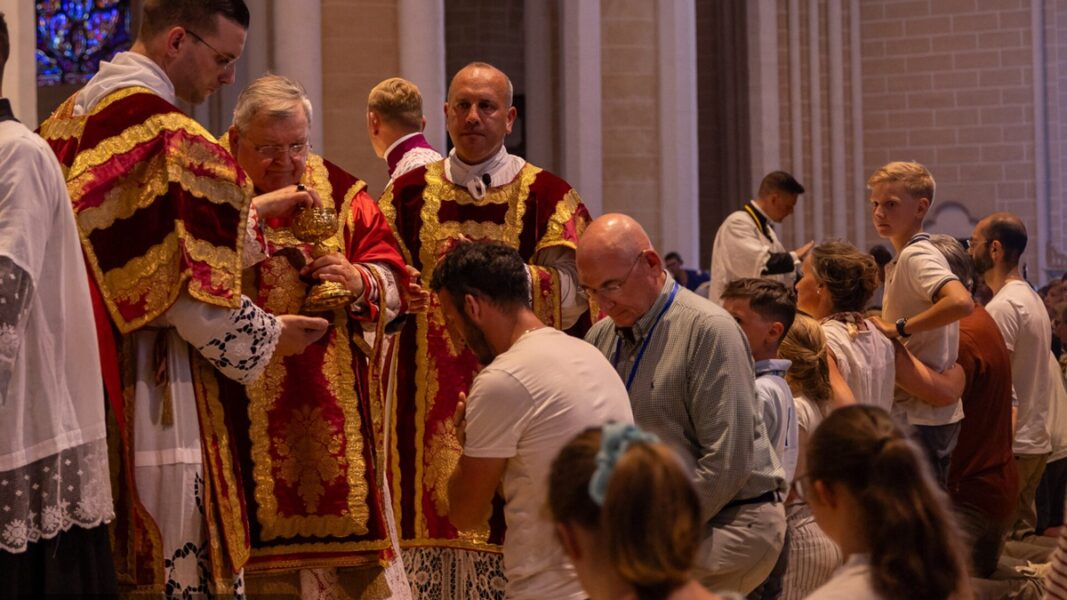
Infovaticana echoes an interview published by the Catholic Herald, in which journalist Jan C. Bentz speaks with British sociologist Stephen Bullivant about Trads: Latin Mass Catholics in the United States (Oxford University Press, 2026). The book, written with demographer Stephen Cranney, uses surveys, interviews, and fieldwork to analyze who the faithful who attend the traditional Mass in the United States really are. Bullivant, who recently discussed the research with Pope Leo XIV, argues that the restrictions imposed by Traditionis Custodes (2021) may be fostering the separatism they were meant to combat. We reproduce the interview translated into English.
What if the Catholics most frequently accused of dividing the Church were, in reality, some of those most eager to belong to it? What if Rome’s attempts to contain the traditional Latin Mass had unintentionally fostered precisely the separatism they sought to avoid?
Traditionalist Catholics occupy a singular position in the Church. They attract young families, form committed communities, and preserve a liturgical heritage that was once universal, yet at the same time they are the object of suspicion and restrictions. It is striking how little empirical research has been done on who these Catholics really are.
In Trads: Latin Mass Catholics in the United States, sociologists Stephen Cranney and Stephen Bullivant seek to fill that gap. Drawing on surveys, interviews, and fieldwork, they describe a world far more complex than either their admirers or their detractors assume.
Bullivant, who recently discussed the research with Pope Leo XIV, spoke with the Catholic Herald about traditionalist Catholics, the contradictions of Traditionis Custodes, and the possibility of recovering the liturgical peace of Benedict XVI.
Jan C. Bentz: Your new book, Trads, has just been published. How did the project come about?
Stephen Bullivant: I have known Stephen Cranney, a Mormon sociologist and demographer, for some time. We had already collaborated on studies about Theodore McCarrick’s social networks and other related topics.
A few years ago, Stephen told me about research he was conducting with a Catholic nonprofit research organization. They had surveyed Catholics who attend the traditional Latin Mass and others who do not, and they were also conducting interviews. The idea arose that this material could serve as the basis for a book.
I had written extensively about the Second Vatican Council and its consequences, especially in Britain and the United States, and had studied Catholics who attend the traditional Mass in Britain. It was a world I knew quite well.
It was clear that there was material for a book. The topic sparked enormous debate, but surprisingly little of what was being said corresponded to the congregations I had known.
The sociological question was fascinating. It concerned a group that, even in the eyes of its critics, seemed to go against the general pastoral trends. Traditional Mass communities attract young Catholics and families and show a high degree of religious commitment. Under normal circumstances, those would be precisely the characteristics the Church would want to foster. That has not always been the response.
Closer to the parish than people think
Bentz: One of the most striking findings is that those who attend the traditional Mass often attend the Novus Ordo as well. Yet I have encountered bishops who insist that traditionalists must become familiar with the new liturgy. Why not apply the same principle in reverse? If mutual familiarity is desirable, shouldn’t Catholics of the Novus Ordo also be encouraged to get to know the traditional Mass?
Bullivant: That is an important question. People often imagine someone who attends only the traditional Mass and for whom that preference is an essential part of their identity. The reality is far more varied.
Many attend both liturgies regularly. Others go to the traditional Mass once a month, when traveling or after driving several hours to a church. Some attend it during the week and the Novus Ordo on Sundays. The number of Catholics who appreciate the traditional liturgy is much greater than Sunday attendance alone suggests.
The same is true of the clergy. Most traditional Masses in the United States are still celebrated by diocesan priests, many of whom celebrate the Novus Ordo far more frequently.
Consider Chicago, where the traditional Mass is permitted on the second, third, and fourth Sundays of each month, but not the first, and where its celebration is restricted at Christmas and Easter. What seems to be assumed is that these Catholics must be forced to attend the Novus Ordo. Our research, however, hardly supports the idea that the majority would attend only the ancient liturgy.
Portraying traditionalists as a population completely distinct from ordinary Catholics is misleading. The Church routinely celebrates its liturgical diversity, but the traditional Mass is usually treated as an exception.
Bentz: I have observed a curious difference between the Society of St. Pius X and the former Ecclesia Dei institutes. In the SSPX, the liturgy seems less central to the community’s own identity. Its schools, catechesis, youth activities, and cultural life form an integral Catholic environment in which the liturgy occupies its natural place.
In some Ecclesia Dei communities, by contrast, the preservation of the liturgy can almost become the defining feature of Catholic identity. Could the constant struggle to defend it put at risk the Christian life as a whole, which the liturgy is meant to nourish?
Bullivant: That is a fascinating observation, and I had not thought of it exactly in those terms. From a sociological point of view, it makes sense.
For an Ecclesia Dei community, the liturgy is precisely what distinguishes it from the rest of the Catholic world. For the SSPX, that distinction is not enough. There may be an FSSP parish nearby celebrating exactly the same liturgy, so the Fraternity needs other reasons to consider itself distinct.
Historically, the SSPX was never concerned solely with the liturgy. For a considerable time it used the 1965 Missal, if I am not mistaken, and in Archbishop Lefebvre’s early writings the liturgical reform appears as one issue among much broader concerns about what was happening in the Church.
Bentz: Does your research confirm the concern that traditional Mass faithful reject the Second Vatican Council? Is that a general trait of these communities?
Bullivant: The data point to a much more complex picture. The first difficulty is methodological. Traditional Mass attendees are a relatively small population, so obtaining a nationally representative sample is extraordinarily difficult.
A Pew Research Center study of U.S. Catholics included thousands of respondents, but only 27 attended the traditional Mass. Drawing conclusions about an entire population from such a small subgroup is problematic.
That is why we surveyed Catholics in places where the traditional Mass was celebrated, including parishes that offered both forms. This allowed us to compare traditional Mass faithful with Novus Ordo Catholics from those same parishes.
It is not a perfect comparison. It is possible that those parishes are already more conservative than U.S. Catholicism in general. But that is precisely what helps separate attitudes specifically linked to the traditional liturgy from those that characterize conservative Catholics more broadly.
What we found is that traditional Mass faithful are not overwhelmingly opposed to Vatican II.
When we asked whether they agreed with the Council’s teachings (a rather peculiar question, since what does it mean to agree with an entire council?), far more said they agreed than disagreed.
At the same time, opposition was more frequent among traditional Mass attendees than in our comparison group.
Both things are true. Within traditionalist communities, those who accept Vatican II far outnumber those who reject it. And at the same time, rejection is overrepresented in those communities.
The distinction between relative and absolute proportions is fundamental. If you are looking for Catholics who reject Vatican II, you are more likely to find them at the traditional Mass. But if you are looking for the typical traditional Mass attendee, rejection of the Council is certainly not their defining trait.
Bentz: Allow me an uncomfortable question. Are people drawn to the traditional liturgy because they are politically conservative, or does participation in these communities gradually make them more conservative?
Bullivant: They clearly lean toward political conservatism, particularly toward the Republican Party. That does not mean there are no Democrats. We interviewed some, especially in university towns.
For many, abortion is a particularly important issue, even among Democrats. U.S. Catholics who attend Mass generally tend toward the Republican Party, but that tendency is considerably more pronounced in traditional Mass communities.
There is an overlap between what draws people to this liturgy and a broader conservative worldview: family life, traditional dress, and adherence to Catholic teaching on marriage and sexuality. Political, theological, and liturgical orientations are often correlated, though never perfectly.
When people are asked how they discovered the traditional Mass, the stories are surprisingly varied. We devoted an entire chapter to explaining why people came and why they stayed.
It is common for a friend to have invited them or for them to have entered a church by chance and been struck by its beauty. We met a young man whose interest came from his admiration for Supreme Court Justice Antonin Scalia, a conservative Catholic who had written about the traditional Mass. But that was an exceptional case.
In general, people did not describe a grand ideological project to restore Western civilization. Their motives were far more immediate and personal.
We are social beings, of course. Spending time among conservatives can influence one’s own way of seeing things. It is possible to hear homilies on abortion or other moral issues that one would hardly hear elsewhere.
The influence, therefore, can go in both directions, but the reasons people discover this liturgy are usually quite different from the political explanations imagined by those who view it from outside.
An audience with Leo XIV
Bentz: You and Stephen Cranney recently met with Pope Leo XIV. What impression did he make on you? Did you find him receptive? Did he give any indication of his attitude toward traditionalist Catholics?
Bullivant: He was extremely kind and welcoming. We were surprised that he granted us an audience, and that already seemed to us a sign of openness.
He is an extraordinarily busy man. That morning he had a meeting with the president of the World Bank and with political leaders, and yet he found thirty minutes to speak with two researchers about a book that had not yet been published.
He does not reveal much, however. He is not especially talkative about his own opinions. He listens attentively, and I suspect that is a very valuable quality in a Pope: to listen to different perspectives without immediately revealing what he thinks.
As an American, he was familiar with some of the places and contexts we discussed. He seemed to have complete mastery of the subject. Certainly, we did not have to explain to him who these Catholics were.
Bentz: I will put it provocatively. Are traditional Mass communities places where Catholics find a positive sense of belonging, or do they attract people whose identity is based on opposition, who simply like to go against the grain?
Bullivant: My experience, both from the interviews and from the years I have attended traditional Masses irregularly, is overwhelmingly of warm and welcoming communities.
Much of the fieldwork is quite ordinary. One goes to Mass, counts the attendees, observes their age and background, and then talks with people, often over coffee and donuts.
What one finds are people who love their faith and feel a special affection for a particular liturgy. They do not seem radically different from Catholics who attend Mass at an oratory, whether in the ancient or modern form.
There are visible differences. Traditional U.S. congregations tend to dress more formally and one sees more mantillas, although this is increasingly common among young Novus Ordo Catholics as well.
But one does not have the sense of having entered a completely different religious world.
One of the most recurring themes was the sense of community. Young families spoke of how important it was to find others who took their faith seriously, something that can be increasingly difficult in contemporary America. These congregations bring together people of different ages, backgrounds, and ethnicities, and people repeatedly told us: “Here we feel at home.”
There was also a deep resentment at how traditionalists are portrayed, even from Rome. Again and again we heard variations of the same idea: “If only they really knew us…”
People acknowledged that there are unpleasant characters associated with traditionalism on the internet. They themselves encountered them on social media. But they felt they were being confused with everyday parish life.
Some converts even found more hostility from nominally Catholic relatives than from practicing Protestants. A Baptist relative could respect their faith even if Catholicism seemed foreign to them. By contrast, a relative raised Catholic might ask: “What the hell is this?”
That sense of being misunderstood, especially by other Catholics, came up again and again.
Advice for bishops and a gesture for the Pope
Bentz: In light of these findings, what would you advise a bishop who has communities celebrating the traditional Mass in his diocese?
Bullivant: First, get to know those communities. A bishop may have hundreds of parishes, and only a few celebrate the traditional Mass. He may know relatively little about them, beyond the stereotypes.
Some communities may have specific problems, of course, and those must be addressed. But they cannot simply be attributed to the fact that everyone attends the traditional Mass.
We spoke with bishops who understood that Traditionis Custodes was a universal measure, applicable to situations that could be very different in France, Brazil, or anywhere else. They knew their communities well, or at least their priests, and had no particular concerns. Some even spoke very highly of those priests.
Traditionis Custodes forced bishops who had had no problem to deal with one that, according to them, did not exist. They had to face considerable bureaucratic hurdles just to keep the situation as it was.
There are bishops who believe they have a serious problem, and perhaps some do. But for the vast majority, the traditional Mass is by no means their greatest concern.
Very few bishops lie awake at night thinking: “We have too many young families and young adults who take their faith seriously. How can we get rid of some of them?”
I encourage bishops to trust their own experience with the communities under their care, rather than assuming that the problems reported elsewhere necessarily exist in their dioceses.
Bentz: Historians and sociologists do not like to predict the future, but as a philosopher I wonder anyway: will the liturgical peace many experienced under Benedict XVI ever return, or at least the path toward it?
Bullivant: That is a very good question. Remember that Summorum Pontificum was in force from 2007 to 2021. We usually associate it with Benedict XVI’s time, but most of those years actually corresponded to Francis’s pontificate.
The underlying idea was that persistent divisions would be better healed by normalizing the traditional Mass within ordinary parish life. Ideally, it would simply be one of the celebrations available, with its faithful fully integrated into the parish.
It would be nothing transgressive or controversial. One could go to the traditional Mass on Tuesday simply because that is what one’s parish celebrates that day. It is part of our heritage, with a special emphasis on silence and contemplation. There is no need to insist that one form is better than the other. It is good to have both.
Consider now the problem Traditionis Custodes sought to solve: that traditionalists were supposedly creating a parallel Church, attending only the ancient liturgy and developing separatist attitudes.
Even if that diagnosis were correct (and I am not convinced it is), the logical response would be to encourage ordinary parishes to celebrate the traditional Mass, with priests who celebrate the Novus Ordo nine times out of ten.
And it is precisely those traditional Masses that are most difficult to maintain.
One of the simplest ways for a bishop to preserve the offering is to create a shrine or oratory entrusted to the FSSP or the Institute of Christ the King, where people can attend exclusively and receive all the sacraments according to the ancient rites.
Personally, I do not think that is a problem. But if the problem were separatism, it would be a terrible solution. From a pastoral strategy standpoint, it makes no sense.
As for liturgical peace, Pope Leo may already be helping simply by letting time pass, listening to all sides, and avoiding a new confrontation.
Remember the pain. There were families who had been attending the traditional Mass for years, encouraged by a Pope who said that its greater availability was a good thing. They had forged friendships and communities. Suddenly they are told that it is bad for them and for everyone else, and that they may have to drive an hour more so their children can see their friends.
The closure of any parish causes pain. Over time, some of that pain subsides, especially if no new restrictions arrive.
At the end of the book we propose constructive measures that Pope Leo, or a future Pope, could adopt.
I do not think the simple repeal of Traditionis Custodes is necessarily the solution. It could reignite controversy, like a new slight to a predecessor. Since Paul VI, with the exception of the brief pontificate of John Paul I, every pope has introduced major changes regarding the traditional liturgy. That constant instability does not benefit the Church. Catholics should not simply wait for the next Pope to reverse everything again.
There are, however, many ways to ease the situation.
One would be to return competencies to diocesan bishops. Today certain permissions must be requested from Rome. It is inconceivable that someone in Rome should make detailed decisions about dioceses they have not even heard of. Let the local bishops decide.
Rome could also once again allow personal parishes, reduce bureaucracy, and make clear that the traditional liturgy remains a valuable part of Catholic life.
There is also ordinary pastoral work. Bishops used to visit traditional Mass communities and administer confirmation there. They may need someone to guide them through the ceremony, but that is by no means an insurmountable obstacle.
A bishop visiting a Ukrainian Greek-Catholic liturgy may also be unfamiliar with some of its aspects, yet he attends because these are Catholics under his care.
I suspect that after the publication of Traditionis Custodes, some bishops were reluctant to be photographed in mitre and vestments at traditional ceremonies, and preferred to delegate confirmations or insist on the new rites. It is a pity.
A very simple gesture would be for Pope Leo XIV, as bishop of Rome, to visit a community in his own diocese that celebrates the traditional Mass, perhaps to administer confirmation. There are several such communities in Rome, and there the traditional liturgy remained relatively accessible even during Francis’s pontificate.
That would convey to the entire Church that this is simply a normal part of Catholic life.
There are ways to calm much of the controversy without the need for another drastic legislative intervention. And I suspect that those everyday pastoral gestures could contribute enormously to restoring the peace that everyone claims to desire.
Stephen Cranney and Stephen Bullivant, Trads: Latin Mass Catholics in the United States (Oxford: Oxford University Press, 2026), ISBN 9780197843901.
Source: Catholic Herald