


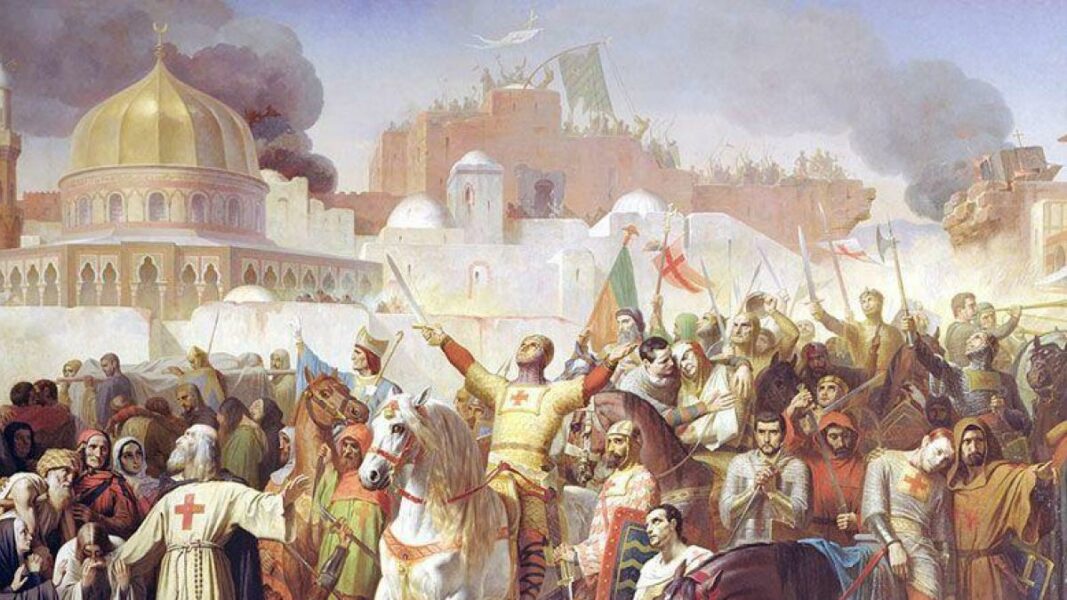
In the three preceding episodes, devoted to Portuguese expansion in the Indian Ocean from the first third of the fifteenth century until the conquest of Goa in 1510, we have consistently referred to those expeditions and exploits as crusade. Now, in the four episodes that follow, we will examine what the crusades historically were and the emergence of mendicant missions to pagans and infidels (Muslims and Mongols) in order to determine whether Portuguese expansion in the Indian Ocean can properly be called a Crusade in its true sense. This will also lead us to discuss the appearance, nature, and expansion of Islam, for it was its continuous threats and aggressions against Christendom that prompted its response at two historical moments: in the Crusades between the eleventh and thirteenth centuries and in overseas expansion from the fifteenth century onward.
What were the crusades, historically?
To place ourselves in the context of the emergence of the crusading phenomenon, we must turn to the expansion of Islam since its appearance in the seventh century. For a long time, relations between Byzantium and Islam had been relatively cordial, to the point that emperors could participate in the reconstruction of the Holy Sepulchre, which was in Muslim hands. But around the year 1000 the situation changed radically, with the appearance of the Seljuk Turks (or Seljuks), who resumed the holy war that had been their way of expanding since their origins: they conquered Baghdad and advanced toward Constantinople. In 1064 Christian Armenia collapsed, and in 1071 the Turks besieged Manzikert. The Eastern Empire was no longer able to defend Christendom. Only the young Western Christendom could relieve it. As Daniel-Rops writes: “the crusade was the response to the abdication of Byzantine forces.” The emperor sought help from Pope Gregory VII, but the Christian princes did not respond. In 1076 the Turks entered Jerusalem, news that shocked the entire Christian world. In 1081 Nicaea fell. The situation was dire.
The adjective applied to Western Christendom is apt: it was young. During the eighth to tenth centuries, the conversion of the pagan peoples of central and eastern Europe to Christianity had taken place. The Western Roman Empire was restored under the Frank Charlemagne, crowned emperor on Christmas Day in the year 800, while throughout the Mediterranean Saracen piracy broke out with violence, even reaching the sack of Rome itself in 846. The great Eastern Schism of 1054 tore millions of souls from the bosom of the Church. In 870 the Bulgarians converted to Christianity, and in the north of the Iberian Peninsula the first Christian kingdoms were created that began to reconquer lands from Islam: Asturias (719), León (910), Pamplona (824), Navarre (824), Aragon (1035), and Castile (1065). Christendom was beginning to give birth to the order of medieval chivalry through the fusion of Christianity and the warrior cultures of the barbarian peoples.
As we said, in 1071 the Byzantines suffered a catastrophic defeat at the Battle of Manzikert at the hands of the Seljuk Turks, leaving all of Anatolia (present-day Turkey) in Muslim hands and the weapons of Islam once again at the gates of Constantinople—that is, of Europe. The Church, especially during the tenth century, was affected by a period of moral decline among the clergy, but in 1073 Pope Gregory VII was elected, who renewed the faith of the Church by cleansing it from its foundations, contributing with his reforms to bringing Europe out of the dark age and into the glorious era of Christendom.
In Byzantium these centuries would see entire cities of the Empire razed by Mohammedan fanaticism, thousands of men, women, and children murdered or enslaved. Cities reduced to ashes, thousands of churches destroyed or converted into mosques. Churches were set on fire and the women and children who had taken refuge in them were locked inside to die burned. Up to a thousand nuns, not counting those who were murdered, were enslaved and handed over to the soldiers. Half the population was murdered and the other half was sold in the prolific slave markets of Asia. In the streets “bodies piled up in heaps,” writes the chronicler Michael the Syrian. Thousands were tortured to make them apostatize from the Catholic faith. Weakened and corrupted, Byzantium was ultimately defeated crushingly in 1071 at the Battle of Manzikert. Those who only a few decades earlier had separated from the papacy and torn Catholic unity asunder were forced to turn to the West to implore the mercy of the Sovereign Pontiff and seek aid from the Catholic nations.
Hilaire Belloc states that “in the eleventh century there occurred the awakening of Europe, due to three great forces: the personality of Gregory VII, the Normans, and the crusades. In this context of the decline of the Eastern Empire, the Byzantine emperor Alexios Komnenos wrote urgent letters to Pope Urban II requesting military aid to stop the Turks.
Then Urban II convened the Council at Clermont in 1095 and called for the formation of an expeditionary force against Islam.
We find ourselves here before the fundamental keys of analysis for understanding the crusading phenomenon: first, it was a defensive phenomenon of Christendom in the face of the conquering and destructive violence of Islam, to halt Islam in eastern Europe and Asia Minor and to recover the Holy Sepulchre from infidel hands. That is why the prestigious historian Daniel-Rops affirms “the crusade was the response to the abdication of Byzantine forces.” Second, the crusades were not spontaneous armed pilgrimages, but military expeditions promoted and directed by the Church. We will address this aspect a little later.
Regarding the crusades as a defensive phenomenon of Christendom, the extreme violence of the Seljuk Turks had begun decades earlier, as we have seen. In fact, when Urban II called for the Crusade at Clermont in 1095, it was not a new idea.
The historical events defined as crusades took place in the period that Daniel-Rops calls “the springtime of Christendom,” between 1050 and 1350. Favorable conditions existed in young Western Christendom: demographic growth, political and social stability, and missionary and evangelizing expansion. Thus, at the Pope’s call, Christendom set out to reconquer the Holy Land. Given the conditions offered by the Roman Pontiff, we can affirm without fear of error that the crusades were an armed pilgrimage.
In her work The Crusades, published in 1964, the French historian Régine Pernoud clearly states that 1) the motive (of the crusades) is religious, 2) the defense of Christians against an attack on persons, their homes, and churches, and 3) that it is a movement of Christian reconquest of those territories seized by the Saracens that previously belonged to Christians.
We have said that the first crusade was preached by Pope Urban II in 1095. It began in 1096 and ended in 1099. Urban had addressed himself above all to the Franks, but people, nobles and commoners, from all of Western Europe, from all of Christendom, participated.
The first response to the pope was a popular crusade led by Peter the Hermit, which ended in disaster. It was followed by that of the Christian princes and knights accompanied by their peoples. All members of a crusade wore sackcloth and a red cloth cross sewn either on the right shoulder or on the back. From this came the designation of the “cruce signati,” “crusaders,” or “marked with the cross”. The battle hymn of the crusaders would be a liturgical hymn referring to the cross, the Vexilla Regis prodeunt, which is intoned at the vespers of the Passion and on the feasts of the Cross.
The spirit of the Crusade was that of feudal Christendom, to the point of transferring its structure, even its castles, which ultimately made possible Christian rule for nearly a century in eastern lands. The feudal order would last throughout the Middle Ages and gave birth, among many other things, to the medieval knight. These were men who consecrated their lives, under a code of honor, to defending the holy Catholic faith and protecting the most defenseless. Together with the priest, the knight constituted the archetype of the Christian man during the following centuries, playing a fundamental role in the battle for the Holy Land. Threatened by the Saracens in the west and south and by the Vikings in the north, Europeans lived in constant danger and took refuge by placing themselves under the protection of feudal lords and kings, to whom they promised vassalage through a sacred oath. The duty of these feudal lords was the defense of their subjects against external attacks.
The first crusade, then, like those that followed, was a struggle for Christ. Urban II had exhorted the Christian princes and knights: “march to the defense of Christ, wage war on the infidels. Become soldiers. Fight for a just cause. Work for an eternal reward”.
At the Church’s call to take up arms in defense of the faith, countless numbers marched thousands of kilometers into the unknown at the risk of losing their own lives to liberate the Holy Sepulchre; men of every condition and people, united by the same faith, did not hesitate to leave everything behind and in the name of Christ, under the banner of the cross, march to war against the infidel.
We have arrived at the second fundamental key of analysis of which we spoke above: the institutional aspect of the crusades, which were military expeditions promoted and directed by the Church, as Dr. Roberto di Mattei indicates in his work “Islam and Christianity: Just War. Holy War.”
The Church considers the baptized “soldiers of Christ.” Here on earth, it is the Church militant, of militia, army. These are concepts that, for the moment, have fallen into disuse in the Church itself, but which are fundamental for understanding its history and its actions. And while the proximate active subject of the crusades was these laypeople (kings, princes, feudal lords, and simple faithful), the remote and principal active subject – affirms Professor di Mattei – was none other than the pope himself, from whom the crusading army depended directly, forming the army of the Church. The pope personally promulgates the crusade with a specially made bull that promises indulgences and privileges; the Church intervenes in the recruitment of the armed force through preaching; the pope establishes the time of the crusaders’ departure; and the Church actively participates in the direction of military operations, with the pope represented by delegates who, without directing military operations, play an important role as advisors.
The crusaders, with the cry of “God wills it!” (Dieu le vult!), advanced toward eastern Europe. All the combatants having confessed, they received Communion. “All had a common purpose: either to take the city of the enemies of God and liberate the holy places from the profanation of the infidels, or to render their souls to Him who created them. There was no one who wished to turn back in this enterprise,” in the words of the chronicle of the Archbishop of Tyre.
The first crusade departed while in the Iberian Peninsula and its various kingdoms the Reconquista was being carried out. This had begun before the first crusade, but it was considered the western flank of the struggle against the Mohammedans, who attacked Christendom from the east and from the south. Reconquista is, again, an unpopular word today, especially in academic circles and in school textbooks, from which it has been eradicated. It is preferred to speak of “conquest,” forgetting the obvious: that the Iberian territories were Christian kingdoms before the Moors (the term used in historical documents, and so we use it) invaded them by force.
The army of crusaders was a mixture of nobles and commoners. They were mainly Franks, but also English, Irish, Scots, knights from the kingdoms of Spain (engaged in the reconquest), from Italy, Germans, and Greeks, some motivated by deep piety and others by less noble reasons, but what is undeniable is that without the faith that permeated the Europe of Christendom it would have been impossible for these thousands of men to leave and risk everything to liberate the land of Christ and the Holy Sepulchre. The crusade was an armed pilgrimage, a battle fought in the name of Christ, in defense of the holy Catholic faith and under the cross, the banner of Christendom; battles fought to establish and defend the Christian order.
According to estimates by historian Rodney Stark, the army of the first crusade was initially composed of about sixty-three thousand combatants, of whom around thirteen thousand were nobles and knights and about fifty thousand were infantry soldiers accompanying their lords. In 1097, having passed through Constantinople, where Emperor Alexios I treated them with distrust and provided little help for the crusade he himself had requested, the army finally entered lands dominated by the Turks, in Asia Minor. They reconquered the important city of Nicaea and continued the march. They conquered Antioch and arrived greatly reduced in number at Jerusalem. Even today, experts in military history cannot explain how a few thousand hungry and exhausted men could defeat such a superior force. The chronicles speak of visions of Saint George fighting alongside the Christian knights.
Of the estimated total of thirteen thousand knights who had departed on the first crusade, only about one thousand three hundred remained, along with another twelve thousand foot soldiers in good physical condition. The Christians besieged Jerusalem. It was the year 1098. At the end of June news arrived of the great Fatimid army coming from Egypt. The situation of the Christians was desperate. It was then that a priest named Peter Desiderius had a divine vision in which the late papal legate, Adhemar of Puy, communicated to him that they should fast for three days and then march barefoot in procession around the walls of the city. After this, the city would fall within nine days, following the biblical example of Joshua in the conquest of Jericho. Although they were already hungry, they fasted and marched in procession, sounding trumpets and singing psalms while the Mohammedans from the walls laughed and mocked them and the cross. As Régine Pernoud explains: “who were these men capable of fasting on the eve of battle, knowing that humanly more food is needed, placing penitential duties before earthly calculations, and then poetically singing the exploits with the same lyricism with which they had been executed? They were men, but men such as only the Catholic faith can form”. Finally, Jerusalem was conquered.
Academic historiography, deeply ideologized, Islamophilic, and anti-Christian, has enormously exaggerated the massacre that followed the taking of Jerusalem, endlessly repeating tales of rivers of blood flooding the streets of Jerusalem. Contemporary Arabic sources of the event do not even mention a massacre.
When the combat ended, the crusaders, dressed in white and barefoot, raised crosses and proceeded in procession, raising songs to God, to the Church of the Holy Sepulchre for the ceremony of thanksgiving.
With the subsequent Battle of Ascalon against the Fatimids, the first crusade ended, the only successful one, which became a source of inspiration for millions of Christians in the following centuries who took up the sword in defense of the faith.
The crusades would last almost until the end of the thirteenth century, and throughout their entire course they would be in the background of all the events of the era. Eight crusades are usually spoken of, but in fact there was no year in which contingents more or less numerous of “crusaders” did not depart from Europe, sometimes unarmed, led either by lords of the nobility or by monks. That is why the opinion of Daniel-Rops seems correct that it is not appropriate to speak of the crusades, but rather of “the Crusade,” a unique and persistent impulse of fervor, uninterrupted for two centuries, which cast the best of the West on its knees before the Holy Sepulchre.
If we consider the crusades as a whole, heroic gestures are evident. But there were also excesses on the part of some primary or secondary protagonists, for it is known that in every war the noblest and the basest of man comes to the surface. Did the crusades constitute a failure? Militarily speaking, if one wishes, the balance was negative (the Holy Land did not remain in the hands of the reconquerors for an entire century). But morally it was a complete success in unifying Christendom toward a common end, reminding of the need to fight the good fight for the faith.
In the historical framework of the crusades were born the military religious orders such as the Templars and the Hospitallers. Monks – soldiers who, through solemn vow, defended pilgrims to the Holy Land. The name adopted by those known as “Templars” was “Poor Knights of Christ.” They received from King Baldwin II the temple esplanade and for this reason received over time the name “Templars,” adopting their own cross. They provided great help to Christendom, by guaranteeing pilgrimages without mishap. The Templars also became a guarantee of the Church’s independence from the power of the kingdoms. As monks, the Templars made a vow of poverty, but the order began to accumulate goods, fruits of donations and estates received as commendations; these material goods allowed the Templars to live with total independence. By bull of 1139 they were granted independence and exemption from tithes for the dioceses in which they were located. For this reason, the suspicion of bishops and kings toward them grew.
The initial purpose of the order, the defense of pilgrims, began to be overwhelmed from the moment Muslim troops continued to harass the territories reconquered for Christendom; thus these monk-warriors began to be true elite troops, indispensable.
The trial against the Templars at the beginning of the fifteenth century was a farce, according to Fr. Javier Olivera Ravasi, doctor in history: their independence and donations received did not sit well with temporal power. Régine Pernoud recounts how “paradoxically,” the terminal phase of the history of the Order of the Temple has been much more studied than its 200 years of existence. The ineptitude of the Catholic princes, who did not know how to remain united in a pro-Holy Land policy, caused Muslim victories to begin to undermine the Christian presence in the Middle East. Meanwhile, the king of France, Philip the Fair, and his chancellor, William of Nogaret, looked with greed upon the goods of the Temple and devised a treacherous move. France confiscated the goods of the Temple, but in Spain, England, and Portugal they were hardly touched. Pope Clement V took the process into his hands and in 1411 suppressed the order.
Crusade and mission
From the first crusade, priests and even bishops were found among the pilgrims. They served the pilgrims by celebrating Mass and administering the other sacraments, and were delegates of the pope, acting as advisors directing the crusading army. From the emergence of the mendicant orders – Franciscans and Dominicans – in the thirteenth century, the new friars also joined the crusades as missionaries. While the objective of the crusade was armed combat against Islam to liberate Christians and, above all, the Holy Sepulchre, the mendicant missionaries adopted another perspective: evangelization not only of pagans, but also of Mohammedans.
Daniel-Rops, in his work “L´Église de la cathédrale et de la croisade,” recounts how the Franciscans embarked on the expeditions of the various kingdoms of Christendom and how, in the thirteenth century, with the appearance of the mendicant orders, the various popes began to send missions toward Asia and Africa. Because, at the same time that we find Saint Francis of Assisi himself participating in the Crusade and going to the Sultan of Egypt to announce to him the Truth of the Catholic faith and exhort him to conversion, the pope begins to send unarmed missionaries as ambassadors to different fronts. Therefore, it is important to emphasize that the missions were an exclusively religious phenomenon, of conversion without arms.
That is to say, Crusade and mission are different concepts, but historically interrelated: the first missionaries launched themselves to evangelize among the crusaders. Furthermore, among the crew of many of the overseas expeditionary voyages financed by the Iberian crowns from the fifteenth century with crusading spirit were friars. Not in all, for there were many voyages of reconnaissance and in all or most a secular priest usually traveled. But from the second voyage of Christopher Columbus toward the West, for example, some religious already went, the superior of them with faculties of apostolic delegate.
In particular, the Franciscans stood out from the first moment by their eagerness to convert Mohammedans: thus they arrived in the Crown of Aragon to head toward North Africa; and thus the order counted numerous martyrs from the beginning. The ideal was Christ’s command to baptize all, but Islam represented a totalitarian and warlike politico-religious culture with the same pretensions of converting other peoples; in its case, by the sword and violent conquest, as we will see later.
Furthermore, the various Catholic pontiffs sent, as we have mentioned, missionary embassies to distant kingdoms. The case of the Franciscan missions to the Far East by order of the Pope is very interesting: in the thirteenth century, a mission was sent to the Mongol emperor in China to establish with them an alliance against the Muslims and their pretensions of conquering Europe from the east and the Holy Land. It turned out that the appearance of the Mongol Empire in the Asian steppe and its rapid expansion seemed a good opportunity to negotiate with the various emperors an alliance against Islam, knowing that there were Nestorians in their court. Although heretics, the pope thought, they were Christians, and this represented a great opportunity to reach an understanding. These missions were, therefore, at the same time, diplomatic embassies, both for establishing contacts and for attempting to establish alliances against Islam, an objective always present. These missions also show how the world of Christendom was not isolated.
The pope’s intuition that the alliance with the Mongols was a path to explore was confirmed by the chronicle of Marco Polo, the Venetian merchant and explorer (1254 – 1324) who, together with his father, had traveled to Jerusalem and subsequently reached the Great Khan, the Mongol emperor, in whose empire they engaged in the cloth trade. The Polos visited the pope and recounted their travels to him. In this regard, Daniel-Rops devotes most interesting pages to the Franciscan missions from the mid-thirteenth century to the Great Khan, precisely based on the accounts of the Polo merchants, and how, from then on, the idea of vast Asia as a place for evangelization, and also for commerce, was in the European mind.
The irruption of the Ming dynasty in 1368 and its nationalist policy in China meant the end of the Franciscan missions, but the evangelizing and economic potential of immense Asia had already been discovered.
The fact that the crusades were launched as a defense of eastern Europe and the Holy Sepulchre and that the mendicant friars sought to convert Mohammedans makes necessary, it seems to us, a chapter devoted to Islam, its origins, its nature, and the characteristics of its expansion, for they explain the Christian defensive and reconquering uprising.
All this also leads us in upcoming episodes to reflect on the concepts of holy war, just war, and the legitimacy of armed struggle for Christ.
Bibliographic references
Daniel-Rops, L´Église de la cathédrale et de la croisade. Paris: Librairie Arthème Fayard, 1952.
De Mattei, R., Christianity and Islam. Madrid: Homo Legens, 2026.
De Souza, P. J., “Whether it pleases the locals or not”: Empire and Consent in Portuguese Asia during the 16th century”, in Ler Historia, no. 84, 2024, pp. 55 – 77.
Marini, T., Vincit: the great battles of Christendom. Buenos Aires: Ediciones Parresía, 2026.
Olivera Ravasi, J., Que no te la cuenten. The Falsification of History. Vols I and II. Poland: Amazon Press, 2019.
Pernoud, R., The Crusades. Buenos Aires: Los libros del mirasol, 1964.
Scott, E., The Impact of Islam. London: New English Review Press, 2014
Sáenz, A., Christendom. A Historical Reality. Pamplona: Fundación Gratis Date, 2005.
Siddiqui, K., “Crusade and commerce: Portuguese mercantilism in the Indian Ocean, 1500 – 1600”, in The World Financial Review, 11 February 2026.
Villads Jensen, K., Crusading at the edges of Europe: Denmark and Portugal, c. 1000 – 1250. London: Routledge, 2019.