


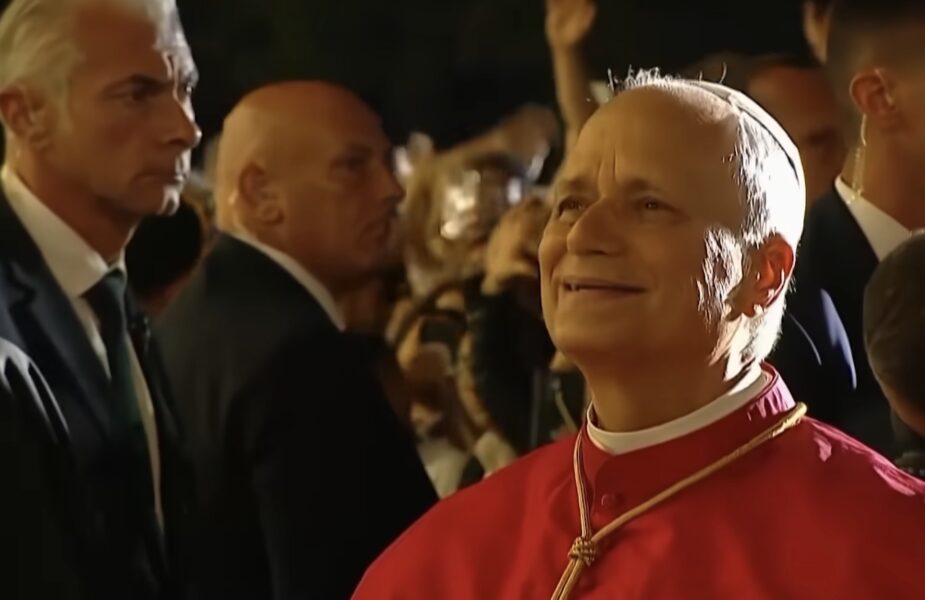
It rang in Uruguay, it rang again in Argentina, and it has been heard once more in Peru. In three countries, with different organizers and audiences, the same song has accompanied the Pope in his moments of greatest closeness with young people. Such insistence can hardly be attributed to the whim of a local choir. Someone has wanted “Alma misionera” to be the soundtrack of this journey, and everything suggests that this someone, close by, could even be Leo XIV himself, who knows it by heart and is moved every time he hears it.
The pontificates build their image through gestures, and music is one of the most eloquent because it works beneath arguments. When a Pope chooses the song that represents him, he reveals where he comes from, what Church formed him, and which one feels familiar to him. That gesture also allows for a reading of governance and of Church.
The popes, mirror of a generation
The Church functions, in a way, as an organic democracy. From among the clergy, at least in theory, the best are chosen for the episcopate; from among the bishops, the most outstanding for the cardinalate; and from among the cardinals, the one judged most suitable for the See of Peter. That long process of selection ends up distilling an entire generation. The chosen one arrives in Rome with his personality, always singular, and with the shared charism of the clergy who formed and worked alongside him for decades.
Francis was the Pope of the clergy of the sixties and seventies: the one of the post-conciliar “spring,” the preferential option for the poor, the theology of the people, distrust toward the institutional, and an austere, at times disheveled, aesthetic. Leo XIV represents with equal clarity the following generation, the one that marked pastoral ministry in the nineties and the early two-thousands. Each has its own aesthetic, its language, and its music. The second one fits entirely into “Alma misionera.”
The charism of the guitar
Anyone who attended a religious private school in those years recognizes the repertoire at the first chord: “Alma misionera,” “Pescador de hombres,” “Un pueblo que camina”… It was the soundtrack of an optimistic, warm, and emotional Catholicism, sung with guitar and clapping at school Masses, retreats, and summer camps, and which above all aspired to make faith feel welcoming.
That charism had undeniable virtues. Its priests, religious, and teachers were dedicated, joyful people, sincerely wishing that the children would keep a good memory of God. Their songs were catchy, beautiful, and somewhat corny, with that slightly naïve tenderness that does not prevent one from growing fond of them. Their theology was simple: God is love, Jesus is your friend, the Church is a great family on the way. All of that true, and all of it incomplete. In that songbook, sin, grace, the cross as sacrifice, or the real presence of Christ in the Eucharist barely appeared. It was taken for granted that shared emotion would suffice to sustain an adult Christian life.
A song without a clear owner
The history of the song itself portrays that world. Its authorship is disputed. For years it was attributed to the Mexican Enrique García Vélez, while the Argentine Mónica de la Canal maintains that she composed it in Chascomús in 1981, at the age of eighteen, inspired by the Claretian missionaries of her parish. She claims to keep the original manuscript and has taken her claim to the courts, with no definitive ruling yet recorded.
Those songs traveled from parish to parish in photocopied songbooks, handwritten guitar chords, without signature or date. They crossed borders in the backpacks of catechists and youth groups, and in a few years became common heritage across half a continent. No one asked who had written them because they seemed to belong to everyone. That almost anonymous condition explains their extraordinary diffusion in Latin America, and also explains why today, when a Pope turns it into an emblem, someone claims that their name be recognized.
The fruits we know
My generation, the one that filled the classrooms of those schools in the 90s, knows how the story ended. At any wedding or alumni dinner, with a few extra drinks, someone intones the first verses and the choir forms by itself. Everyone knows the lyrics in full. But almost all those singers abandoned Sunday Mass long ago; confession is for them a distant memory and faith an increasingly blurred label. From that education, mainly sentimental memory survived and sacramental life was shipwrecked.
Newman warned that the heart is reached through the imagination before through reason, and that pedagogy applied the lesson perhaps with too much enthusiasm. It forgot, instead, that a moved imagination later needs firm ground: a doctrine that gives reasons, sacraments that sustain when emotion fades, a liturgy that educates in the sense of the sacred. Aristotle recalled that virtue is born of repeated acts, and feeling, however intense, rarely becomes habit by itself.
A message of governance
That “Alma misionera” is the anthem of the journey, and perhaps of the pontificate, says something about the Church that Leo XIV imagines. Recognizing oneself in that song means recognizing oneself in a heritage with evident lights: dedication, missionary availability, closeness, joy. In Robert Prevost that heritage also has the endorsement of a life, for he left Chicago to spend long years of mission in northern Peru and ended up being bishop of Chiclayo. When he sings that he offers his life to be sent, he describes something he did.
It is advisable, however, to look toward where the green shoots are pointing today. Adult baptisms are breaking records in France, Eucharistic adorations are filling with young people, lines for confession are growing at major gatherings, and the number of Catholics concerned with the dignity of the Mass is increasing. Even the music that today gathers young people, equally emotional, usually leads before the Blessed Sacrament. Where faith is resurging, it does so in a Church more sacramental than that of our schools and parishes thirty years ago.