


By Zachary Naccash
Among the seven capital sins, sloth (acedia in the Greek tradition) is often confused with mere laziness. The image that comes to mind is that of an indolent teenager: not only someone who resists work, but who also despises it. Yet for the ancient and medieval Christian tradition, mere laziness and acedia are very different things.
Thomas Aquinas, following John Damascene, defines acedia as a kind of “sadness” in the face of spiritual good, and explicitly distinguishes it from mere laziness. Acedia is a reluctance one feels when the good one ought to pursue, instead of inspiring one to seek it, makes one feel one’s own weariness at that prospect all the more keenly. Far from being a simple unwillingness to work, acedia is a sadness or weariness before spiritual good itself.
In the modern world we have largely forgotten acedia, which is not only regrettable but dangerous. A misdiagnosis of any illness leads to ineffective remedies. As Boethius observes: “If you want the physician to help you, you must make your illness known to him.”
Today’s world is chronically connected. We have traded social life for “social” networks, replacing the spiritual goods of friendship, contemplation, and interiority with flickering images on a screen that offer the refuge of anonymity, yet stoke envy by fixing attention on material things, and spare us the discomfort of being alone with ourselves.
Modern man has built himself a technological Platonic cave, and our eyes have grown accustomed to the darkness.
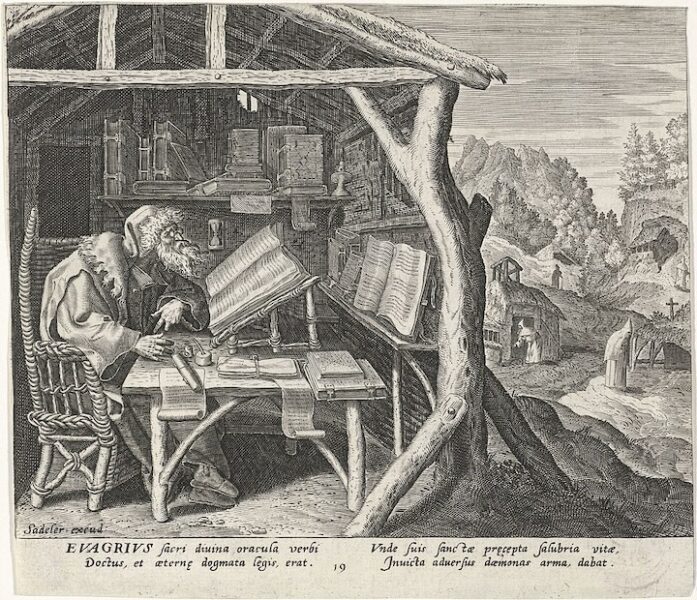
While today’s world may be especially conducive to inducing acedia, this vice is by no means exclusive to our age. Among the first spiritual writers to treat acedia was Evagrius Ponticus, a disciple of St. Gregory Nazianzen and an influential fourth-century monk.
In his Praktikos, a work composed to help monks pursue a life of holiness, Evagrius offers some advice to the monk struggling against the “noonday demon” (that is, acedia), “the most burdensome of all.”
First, Evagrius tells us to live as if we were to die tomorrow, but to treat our body as if we were to live a long time. Meditating on death is a common theme of Christian spirituality, and caring for the body is, in general, good advice. But both are especially pertinent to overcoming the noonday demon.
On the one hand, meditating on death—and realizing that it could be tomorrow—impels us to overcome the sadness of the moment and to pursue spiritual goods, rather than shrink from the effort of attaining them.
On the other hand, acedia is a kind of sadness and therefore a passion. Like all passions, it is closely tied to the body. Evagrius’s counsel to care for the body is therefore a practical remedy: one must care for the body because doing so will help maintain good spirits. Poor diet, lack of sleep, and lack of physical activity will contribute to a feeling of reluctance and sadness without the noonday demon having to lift a finger. Evagrius’s advice, then, is to care well for the body in such a way that the demon must work hard to tempt us to sadness.
Evagrius’s second piece of advice is to remain in one’s place. For the monks to whom Evagrius was writing, there was a strong temptation to leave their cells, to wander in search of another monk who might distract them, and to look at the sun to count how many hours of the day remained.
Although we are tempted in a similar way, today the temptation often manifests itself in constantly taking out one’s phone or glancing at a smartwatch: “What time is it and how long have I been working?” “Do I have any notifications?” “Just a couple of reels and then I’ll get to work.”
The pull of the phone can be intense and distract not only from work but even from real social activities. Today it is common to see a group of young people together, yet ignoring one another while staring at their phones. Evagrius’s advice here is basically: perseverance. The way to overcome the noonday demon is simply to resist the search for distractions: stay in one’s place, keep the phone in one’s pocket, and the temptation will pass.
Finally, Evagrius says that when the noonday demon strikes, “then is the time to divide the soul in two with tears: one part to encourage; the other to be encouraged.” The vice of acedia is, again, a kind of sadness, and the demon that strives to drag one into this sin does so by discouraging: exaggerating the difficulty of spiritual goods and suggesting that they are not worth the effort. Thus, Evagrius’s final remedy is to practice the virtue of hope.
He proposes praying with David: “Why are you sad, O my soul? Why are you troubled? Trust in God, for I will praise Him. He is my Savior, the light of my eyes and my God.” (Psalm 45:5-7)
The remedy is not to trust in ourselves—this is what the noonday demon wants, because that path leads to failure and a further descent into acedia—but, like David, to cast ourselves with confidence on the mercy of God and hope in Him.
The noonday demon is a fearsome enemy, but overcoming it is all the greater for that. As Aquinas notes, unlike the temptations of lust, from which we must simply flee, acedia can only be overcome by resisting. It is no easy task, but Evagrius encourages his reader, writing: “No other demon follows close on the heels of this one (when it is defeated), but from this struggle there arises only a state of deep peace and an inexpressible joy.”
About the author
Zachary Naccash is a doctoral candidate and instructor of theology at Ave Maria University. His research interests include the Trinitarian theology of Thomas Aquinas and the Greek Church Fathers, the doctrine of divine simplicity, and the doctrine of original sin. He lives in southwest Florida with his wife and four children.